

The evidence on follistatin-344 splits sharply in two: AAV1-FS344 gene therapy has repeatable animal data and early human investigational signals behind it, while injectable recombinant FS-344 has no validated human pharmacokinetic or efficacy data at all. Documented safety flags, including an ocular case series, argue for cautious study design. Any lab sourcing FS-344 peptide should treat vendor vials as biochemically variable until confirmed by mass spectrometry and a real Certificate of Analysis.
TL;DR:
- Recombinant FS-344 peptide lacks validated human pharmacokinetics and efficacy data, making dosing and safety assessments highly uncertain.
- The peptide’s precursor form is often mislabeled and varies in processing, aggregate state, and modifications, requiring mass spectrometry confirmation before use.
- Animal studies show AAV1-FS344 gene therapy can increase muscle mass two to three times with effects lasting over 15 months, unlike rapid-clearance recombinant injections.
- Human trials have only tested gene therapy and engineered constructs, with no controlled pharmacokinetic studies available for unmodified FS-344 peptides.
- Significant safety concerns include ocular risks from unauthorized injections and reproductive hormone suppression, alongside risks of connective tissue damage from rapid hypertrophy.
Table of Contents
- Follistatin 344 Research Depends on Which Isoform You’re Actually Studying
- How Does Follistatin Block Myostatin Signaling in Muscle Cells?
- What Do Animal Studies Show About Follistatin 344 and Muscle Mass?
- What Has Been Tested in Human Follistatin Trials?
- What Are the Known Safety Risks of Follistatin 344?
- How Should Labs Vet Follistatin 344 for Research-Grade Use?
- Designing a Follistatin 344 Study: Practical Guidance
- What Should Researchers Check on a Follistatin 344 COA?
- What Research Priorities Actually Move This Field Forward
- Where Researchers Source Verified Follistatin 344 for Lab Work
- Sources
- FAQ
Follistatin 344 Research Depends on Which Isoform You’re Actually Studying
The number “344” refers to the residue count of a specific splice variant of the follistatin precursor, not a single stable molecule circulating in blood. Getting this right matters more than almost anything else in follistatin 344 research, because the precursor itself is not the bioactive end product researchers usually care about.
The FST gene undergoes alternative splicing that produces multiple follistatin isoforms. The 344-residue form is the longer precursor construct, engineered specifically for use in AAV vectors because it favors proteolytic processing into FS-315, the isoform that predominates in circulation. A second major species, FS-288, retains a heparin-binding domain that keeps it tethered to cell-surface proteoglycans rather than circulating freely.
That distinction changes everything about tissue exposure. FS-315 travels systemically and can reach activin and myostatin at distant sites. FS-288 stays local, concentrated near the cells that produced it, which limits its endocrine reach but may concentrate its local growth-factor blocking activity. The choice of FS-344 as a gene therapy construct wasn’t arbitrary. Researchers selected it deliberately because it skews production toward FS-315 and reduces the off-target heparan-sulfate interactions that FS-288 dominance could cause, a design logic laid out clearly in the translational rationale reviewed by Rodino-Klapac and colleagues.
This creates a real problem for anyone buying a vial labeled “Follistatin-344” from a research supplier. A precursor-length recombinant protein injected directly into an organism does not behave like AAV-expressed FS-344, which gets processed intracellularly and secreted primarily as FS-315. What’s actually in that vial, and what it becomes once inside a biological system, are two separate questions.
Before drawing any mechanistic conclusion from a purchased peptide, verify:
- Sequence identity against the published FS-344 precursor sequence, not just a product label
- Processing state, since unprocessed precursor and cleaved FS-315/FS-288 fragments behave differently in binding assays
- Aggregation state, because recombinant follistatin is prone to forming multimers that skew ELISA readouts
- Post-translational modifications, particularly glycosylation patterns that differ between expression systems
Mass spectrometry confirmation, not vendor documentation alone, is the only way to know which isoform mixture a given lot actually contains. This single verification step resolves more downstream confusion in follistatin research studies than any amount of dosing optimization.
How Does Follistatin Block Myostatin Signaling in Muscle Cells?
Follistatin works by physically binding and sequestering myostatin and activin A before either ligand can engage its receptor, activin receptor type IIB (ActRIIB). No receptor engagement means no downstream signal, which is the entire basis for follistatin’s effect on muscle mass.
Myostatin and activin A normally bind ActRIIB, triggering a cascade that phosphorylates SMAD2 and SMAD3. Phosphorylated SMAD2/3 accumulates in the nucleus and suppresses genes required for muscle protein synthesis while simultaneously activating atrophy-related ubiquitin ligases. It’s a growth-limiting brake, and it’s a strong one; animals and humans with myostatin loss-of-function mutations develop markedly hypermuscular phenotypes.
Follistatin acts as a ligand trap upstream of that entire cascade. By binding myostatin and activin A directly, it prevents ActRIIB activation, which removes SMAD2/3-mediated suppression and disinhibits the mTOR pathway. Disinhibited mTOR signaling drives ribosomal biogenesis and protein synthesis, the machinery behind hypertrophy. Separately, reduced local myostatin signaling appears to support satellite cell activation and proliferation, expanding the pool of myogenic progenitor cells available for muscle repair and growth.
Statistic in context: the mechanistic strength of this pathway is precisely why nonhuman primates receiving AAV1-FS344 showed muscle mass increases in the range of 2 to 3 times baseline, with effects persisting more than 15 months post-injection. That’s not a modest signaling nudge. It’s one of the largest sustained mass-gain effects reported for any single-gene intervention in primate muscle biology.
Two things complicate interpretation for researchers designing follow-on work:
- Hypertrophy is not the same as functional improvement. Larger fibers do not automatically translate into proportionally greater force output, and several studies report a disconnect between mass gain and strength or endurance gains.
- Off-target pathway effects matter. Follistatin also modulates bone morphogenetic protein (BMP) signaling and suppresses activin-driven follicle-stimulating hormone (FSH) release from the pituitary, since activin is a physiological FSH secretagogue. Any study measuring systemic follistatin exposure needs to track reproductive hormone panels alongside muscle endpoints, not as an afterthought but as a primary safety readout.
Understanding follistatin’s role in muscle growth means understanding it is not muscle-selective. It intersects with reproductive endocrinology and skeletal signaling by the same mechanism that drives hypertrophy, which is exactly why isolated muscle biopsy data without endocrine monitoring tells an incomplete story.
What Do Animal Studies Show About Follistatin 344 and Muscle Mass?
Mouse and nonhuman primate data on AAV1-FS344 are the strongest evidence in the entire follistatin literature, and they consistently show large, durable effects rather than a fleeting bump in muscle size.
Early mouse work using single-gene AAV delivery of myostatin inhibitors, including FS-344 constructs, documented persistent increases in muscle mass and strength lasting many months, with some long-term studies tracking durability out to nearly two years without observed organ toxicity. That’s close to two years of sustained expression from a single administration, a durability profile that recombinant protein injections simply cannot replicate because unmodified protein clears from circulation within hours to days.
The primate data carries more translational weight because primate muscle physiology tracks closer to human physiology than rodent models do. The landmark Kota et al. 2009 study delivered AAV1-FS344 to nonhuman primates and reported:
- Muscle mass increases in the range of 2 to 3 times baseline in treated animals
- Effects persisting beyond 15 months post-injection, the longest follow-up window reported for the intervention
- No abnormal organ morphology detected across the observation period
That combination of magnitude and durability is what generated sustained interest in follistatin as a gene therapy candidate for muscular dystrophies rather than a cosmetic muscle-building agent. The distinction between local, sustained AAV expression and a systemic bolus injection explains most of the gap between what animal data supports and what an injected recombinant peptide can plausibly deliver. AAV-transduced muscle fibers become miniature FS-344 production factories, generating a steady local concentration gradient over months. A subcutaneous injection produces a spike that clears rapidly, with no mechanism to sustain expression at the tissue level.
This is the single most important thing for anyone extrapolating from primate gene therapy data to a peptide vial: the exposure profile is not remotely comparable. One produces chronic, compartmentalized protein expression. The other produces a transient systemic peak. Assuming equivalent efficacy between the two is a category error that shows up constantly in secondary literature and marketing material, but it does not hold up against the actual pharmacology.
What Has Been Tested in Human Follistatin Trials?
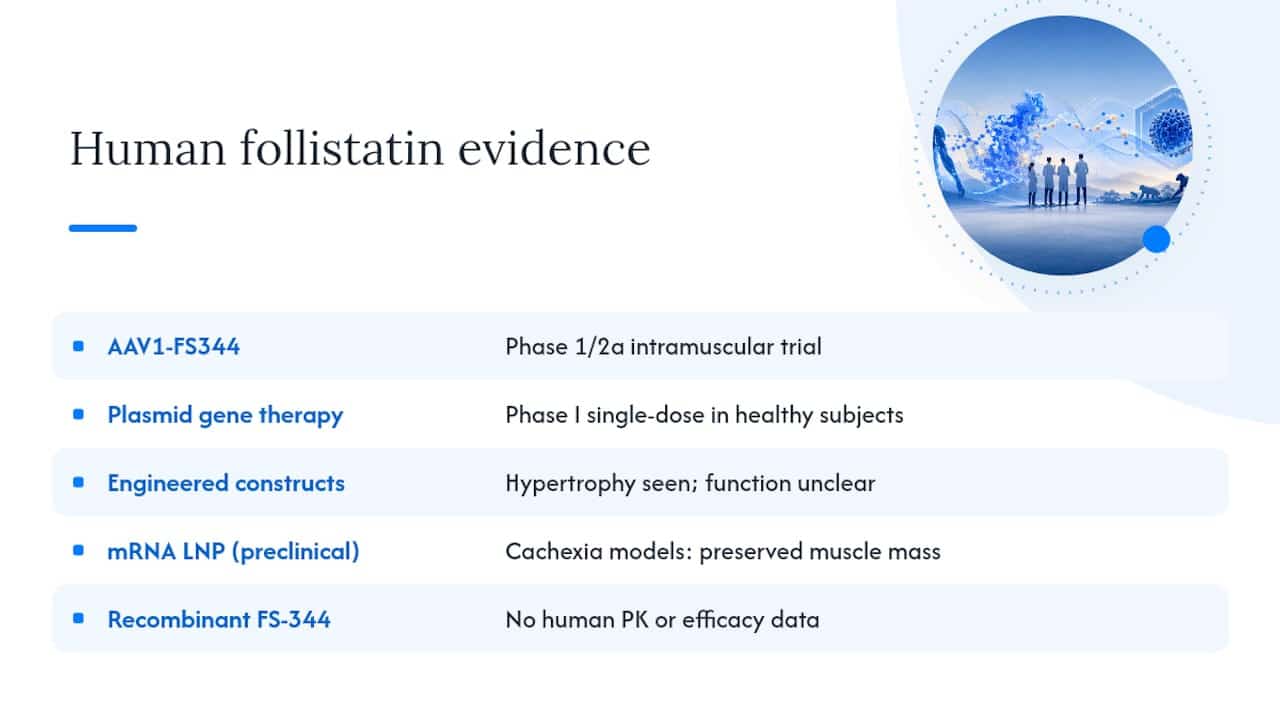
Human data on follistatin-based interventions exists, but it comes almost entirely from gene therapy and engineered constructs, not from injectable unmodified FS-344 protein. That gap is the most consequential fact in this entire field for anyone trying to translate primate results into clinical or personal-use claims.
The most cited human program is Jerry Mendell’s AAV1-FS344 Phase 1/2a trial, conducted in patients with Becker muscular dystrophy and inclusion body myositis. The trial demonstrated feasibility of intramuscular AAV1-FS344 delivery with an acceptable short-term safety profile, but functional outcomes were mixed and the trial population was small, which limits how confidently anyone can generalize efficacy claims. It remains, notably, an investigational gene therapy program under a research protocol, not an approved treatment or a validated peptide dosing regimen.
More recently, a different delivery approach entered testing. Clinicaltrials describes a Phase I, open-label, single-dose study of an injectable follistatin plasmid gene therapy in healthy subjects, evaluating safety alongside changes in circulating follistatin and body composition. The trial started in August 2022 with a primary completion date in August 2023. This is a plasmid construct designed for transient in vivo expression, not a recombinant protein injection, and it is a materially different intervention from a peptide vial despite sharing the word “follistatin” in its name.
Beyond gene therapy vectors, researchers have also pursued engineered follistatin therapeutics such as Fc-fusion constructs and related ligand traps like ACE-083, designed to extend half-life and improve target engagement compared to unmodified protein. The translational lesson from this class of molecules is consistent: engineered constructs frequently produce measurable hypertrophy in human trials without a correspondingly clear improvement in strength or function, echoing the mass-versus-function disconnect seen in animal models. Separately, preclinical work using mRNA lipid nanoparticle delivery of follistatin in cancer cachexia models reduced circulating activin A and preserved muscle mass, showing that delivery platform innovation extends well beyond AAV and plasmid approaches.
What does not exist anywhere in the published human literature is a controlled pharmacokinetic study of unmodified recombinant FS-344 protein given by injection. No dosing curve, no half-life data, no validated efficacy endpoint. Every legitimate human data point on follistatin traces back to a gene therapy vector, a plasmid, or an engineered fusion protein, never to a peptide vial.
What Are the Known Safety Risks of Follistatin 344?
The most concrete adverse-event signal for follistatin-344 in humans is ocular, and it comes from exactly the population using unregulated injectable protein rather than a controlled trial. A retrospective case series by Dağ and colleagues reported central serous chorioretinopathy (CSCR) in multiple male bodybuilders following unauthorized subcutaneous follistatin-344 use. CSCR involves fluid accumulation beneath the retina and can cause vision distortion or vision loss if untreated.
Causality between follistatin exposure and CSCR has not been proven in a controlled setting, since case series can’t establish mechanism the way a prospective trial can. But the signal is specific enough, and the case count large enough for a rare condition, that it warrants direct attention in any study protocol involving systemic follistatin exposure. Ocular screening should not be an optional add-on in these designs.
Beyond the eye, the endocrine risk deserves equal weight, not an afterthought status. Because follistatin sequesters activin A, and activin A is a physiological driver of FSH secretion, sustained systemic follistatin exposure has plausible mechanistic grounds to suppress reproductive hormone signaling. Animal studies examining long-duration myostatin inhibitor exposure have not reported major organ toxicity, but reproductive-axis endpoints are not the same as organ morphology, and they require dedicated hormone panels to detect.
A third concern is structural rather than endocrine: connective tissue mismatch. Rapid muscle hypertrophy driven by myostatin pathway inhibition can outpace the adaptive capacity of tendons and ligaments, which remodel on a slower timescale than muscle fibers. This creates a plausible injury risk profile distinct from anything captured by a strength or mass measurement alone.
Key risk categories to build into any study design:
- Ocular: baseline and periodic dilated fundus exam or optical coherence tomography, especially in any protocol involving sustained or high-dose systemic exposure
- Reproductive/endocrine: FSH, LH, and gonadal hormone panels at baseline and at defined intervals
- Musculoskeletal: tendon and connective tissue surveillance, ideally with imaging, given the mismatch risk between fast muscle growth and slower tendon remodeling
- Immunogenic: antibody response monitoring, which differs meaningfully between AAV vectors (which can trigger vector-neutralizing antibodies limiting redosing) and recombinant protein (which risks anti-drug antibody formation with repeated dosing)
Pro Tip: Don’t treat the CSCR case series as background reading. Build a baseline ophthalmologic exam into the protocol before the first dose, not after a symptom report. Retrospective signals like this one are exactly the kind that get missed when monitoring starts reactively instead of proactively.
How Should Labs Vet Follistatin 344 for Research-Grade Use?
Pharmacokinetics is the biggest unresolved variable in follistatin 344 research, and it’s the one most likely to invalidate a study if ignored. Unmodified recombinant follistatin protein has a genuinely short circulating half-life, which is precisely why researchers keep engineering alternatives, Fc-fusions, plasmids, mRNA constructs, specifically to extend exposure time. A bolus injection of unmodified protein produces a sharp peak and rapid clearance, nothing resembling the sustained tissue exposure that AAV-based studies achieve.
That short half-life has a direct practical consequence: sampling timing in any PK study needs to be front-loaded, with multiple early time points, rather than spread evenly across a day or week the way a longer-acting compound might be sampled.
Vendor variability compounds the PK problem. Anti-doping detection research and related assay literature has documented substantial lot-to-lot heterogeneity in grey-market vials labeled “Follistatin-344,” meaning the labeled concentration and the actual bioactive content can diverge meaningfully between batches from the same supplier.
Before running any experiment on a purchased lot, take these steps:
- Request the Certificate of Analysis and confirm it reports purity percentage, an impurity profile, and sequence confirmation, not just a molecular weight band on a gel.
- Cross-check with an orthogonal assay. Mass spectrometry confirms identity and sequence integrity; ELISA alone can be fooled by aggregates or fragments that bind antibody but lack full biological activity.
- Select analytes that reflect mechanism, not just presence. Circulating follistatin concentration matters less than downstream markers like activin A levels and SMAD2/3 phosphorylation state, which tell you whether the protein is actually doing anything biologically.
- Time your sampling to the expected short half-life of unmodified protein rather than assuming pharmacokinetics comparable to an engineered or AAV-expressed construct.
Pro Tip: *If a supplier can’t produce a batch-specific Certificate of Analysis with a sequence confirmation, treat every result generated from that lot as provisional until you’ve run your own mass spec confirmation.
Designing a Follistatin 344 Study: Practical Guidance
Model and control selection determines whether a study can actually distinguish hypertrophy from functional improvement, which the preclinical literature shows are not the same outcome. A design that measures only muscle cross-sectional area or wet weight will miss the strength and endurance divergence that primate and engineered-construct data both suggest is common.
- Pair mass measurements with functional assays. Grip strength, treadmill endurance, or force-frequency testing in animal models, and objective strength testing rather than self-report in any human protocol, should run alongside imaging or biopsy-based mass measurement.
- Build a PK/PD sampling schedule around the delivery method. AAV and plasmid constructs need sampling timed to detect sustained local expression over weeks to months; recombinant protein injection needs dense early sampling to catch a short, sharp exposure peak.
- Separate local from systemic expression. For any localized delivery approach, sample both target tissue and peripheral blood to determine whether the intervention is staying local or leaking systemically. This distinction drives the entire safety monitoring plan.
- Apply the safety monitoring checklist from the start. Baseline ocular exam, reproductive hormone panel, and tendon imaging belong at study initiation, not as a response to an adverse event report partway through.
A study that skips functional endpoints in favor of mass alone will produce data that looks impressive and tells you almost nothing about whether the intervention has translational value.
What Should Researchers Check on a Follistatin 344 COA?
A Certificate of Analysis is only useful if it documents the right things. For follistatin-344 specifically, that means purity percentage determined by high-performance liquid chromatography, an impurity profile that flags related fragments or aggregates, and sequence confirmation, ideally by mass spectrometry, that verifies the product actually matches the labeled construct rather than a similarly-sized contaminant.
That policy distinction matters: research-use-only labeling means the material is intended for laboratory and preclinical investigation, not human or animal administration outside a controlled research setting, and nothing in this article should be read as clinical guidance or dosing advice for any use case outside that scope.
For labs auditing suppliers, the checklist is the same regardless of vendor: purity data, impurity characterization, sequence verification, and batch-specific documentation rather than a generic product sheet reused across lots.
- Purity percentage with a stated testing method (HPLC, mass spectrometry)
- Batch-specific rather than generic documentation
- Sequence confirmation tied to the specific isoform claimed on the label
- Clear research-use-only labeling with no implied clinical claim
What Research Priorities Actually Move This Field Forward
The field doesn’t need another mass-and-strength study in mice. It needs pharmacokinetic and pharmacodynamic data on injected recombinant FS-344 before anyone runs a larger efficacy trial, because right now that foundational PK layer simply doesn’t exist in the published literature.
Any systemic exposure study should build in ocular and reproductive safety endpoints from day one, given the CSCR case series and the mechanistic plausibility of FSH suppression. Treating those as optional secondary measures, rather than primary safety readouts, is how signals get missed for another decade.
Engineered delivery, AAV, mRNA, Fc-fusion constructs, remains the most promising direction, but “promising” only holds if functional endpoints get equal billing with mass measurements. A hypertrophy result without a strength or endurance correlate is a half-finished experiment, and the field has already produced too many of those. Longer preclinical observation windows, as longevity researchers studying sustained biological interventions have argued in related contexts, tend to reveal problems that short studies miss entirely.
— Data Peptides
Where Researchers Source Verified Follistatin 344 for Lab Work
Sourcing errors, not experimental design flaws, are what sink a surprising number of follistatin studies before they even start. A vial with unconfirmed sequence identity or undocumented purity introduces variance no statistical model can correct for after the fact.
Some suppliers provide lab-grade research peptides with third-party testing and batch-specific Certificates of Analysis, aiming to help researchers trust what’s actually in a vial before using it in assays. Guaranteed purity at 99% or higher, combined with documented testing rather than a generic label, reduces the batch-to-batch variance that has plagued grey-market follistatin-344 supply for years. That consistency is what makes PK/PD replication across labs actually possible, rather than a hopeful assumption.
Review the full peptide catalog and Certificates of Analysis directly on the Data Peptides site, or go straight to the shop page to check current lot documentation before placing a research order. All products are sold strictly for laboratory research use.
This article is general information, not a substitute for advice from a qualified doctor. Consult a qualified healthcare professional about your own circumstances before acting on anything here.
Sources
- Inhibition of myostatin with emphasis on follistatin as a therapy for muscle disease (Rodino-Klapac et al., Muscle Nerve 2009)
- A Phase I, Open Label, Single Dose Study to Evaluate the Safety and Efficacy of an Injectable Follistatin Plasmid Gene Therapy in Healthy Subjects (NCT06411366)
- Nanoparticle‐based follistatin mRNA therapy for reprogramming metastatic ovarian cancer and ameliorating cancer‐associated cachexia (preclinical, 2022)
- Central serous chorioretinopathy associated with high-dose follistatin-344: a retrospective case series (Dağ et al., Int Ophthalmol 2020)
FAQ
How effective is follistatin 344 in research settings?
AAV1-FS344 gene therapy shows strong, reproducible efficacy in animal models, including 2 to 3 times increases in muscle mass in nonhuman primates lasting beyond 15 months. Injectable recombinant FS-344 protein has no comparable validated efficacy data in humans.
What are the downsides of follistatin 344?
Documented risks include a case series of central serous chorioretinopathy in bodybuilders using unauthorized injections, plus mechanistic concerns about reproductive hormone suppression through activin A blockade and tendon-muscle growth mismatch. Vendor lot variability adds a separate, purely practical risk for research use.
Do bodybuilders use follistatin 344?
Unauthorized use among bodybuilders has been reported in the clinical literature, most notably in a retrospective case series linking subcutaneous use to ocular complications. Some suppliers emphasize that their peptides are intended strictly for laboratory research use and not for human or animal administration.
How much follistatin 344 is used per day in studies?
There is no validated human dosing regimen for injectable recombinant follistatin-344, since no controlled Phase 1 pharmacokinetic study of the unmodified protein has been published. Human data instead comes from gene therapy and plasmid delivery programs, such as the Phase I plasmid trial, which use fundamentally different dosing units than a peptide injection.