

Randomized controlled trials and a 2026 meta-analysis confirm that tesamorelin produces clinically meaningful reductions in visceral adipose tissue, with modest but measurable improvements in hepatic fat, and does so without the sustained glycemic deterioration many researchers expect from a growth hormone secretagogue. IGF-1 rises reliably and predictably across trials, functioning as the field’s most consistent pharmacodynamic marker. The strongest evidence comes from Phase III trials, their extension studies, and pooled analyses published through 2026.
TL;DR:
- The drug produces modest but measurable reductions in hepatic fat, averaging around 2.9 percentage points in liver fat proportion, typically manifesting after VAT changes.
- Long-term safety data shows no sustained worsening of glucose metabolism, with transient early increases in fasting glucose normalizing within a few weeks.
- Metabolic improvements include increased lean mass and improved lipid profiles, without significant adverse safety signals related to immunogenicity or malignancy.
- The best research models use 2 mg daily subcutaneous injections, with imaging and biomarkers monitored at established intervals following trial protocols.
Table of Contents
- What Does Tesamorelin Research Show About Efficacy and Safety?
- What Do the Key Randomized Controlled Trials Show?
- What Does the 2026 Meta-Analysis Add to the Evidence Base?
- How Does Tesamorelin Work at the Mechanistic Level?
- What Adverse Events and Safety Signals Appear in the Literature?
- What Are Tesamorelin’s Approved Indication and Standard Dosing?
- What Research Gaps Remain in Tesamorelin’s Evidence Base?
- Where Should Researchers Source Tesamorelin for Study Use?
- A Publisher’s Note on Responsible Tesamorelin Research
- Get Research-Grade Tesamorelin With Verified COAs
- Sources
- FAQ
What Does Tesamorelin Research Show About Efficacy and Safety?
Tesamorelin’s evidence base is unusually mature for a peptide therapeutic. Two pivotal randomized trials, several extension studies, and now a comprehensive meta-analysis give investigators a rare thing in this space: convergent, reproducible numbers across independent research teams.
The headline finding hasn’t changed much since the drug’s original approval, but it has become more precise. Visceral adipose tissue (VAT) drops consistently, hepatic fat improves in a smaller but still measurable way, and the metabolic tradeoffs researchers worried about in early GH-axis research haven’t materialized at the doses tested.
Key efficacy findings across the literature:
- VAT reduction of roughly 15% relative to baseline in the original NEJM Phase III trial, versus a 5% increase in the placebo arm at 26 weeks.
- A separate JAMA randomized trial measured an absolute VAT change of −34 cm² with tesamorelin against +8 cm² with placebo, alongside a median hepatic fat reduction of −2.0% versus +0.9% for placebo.
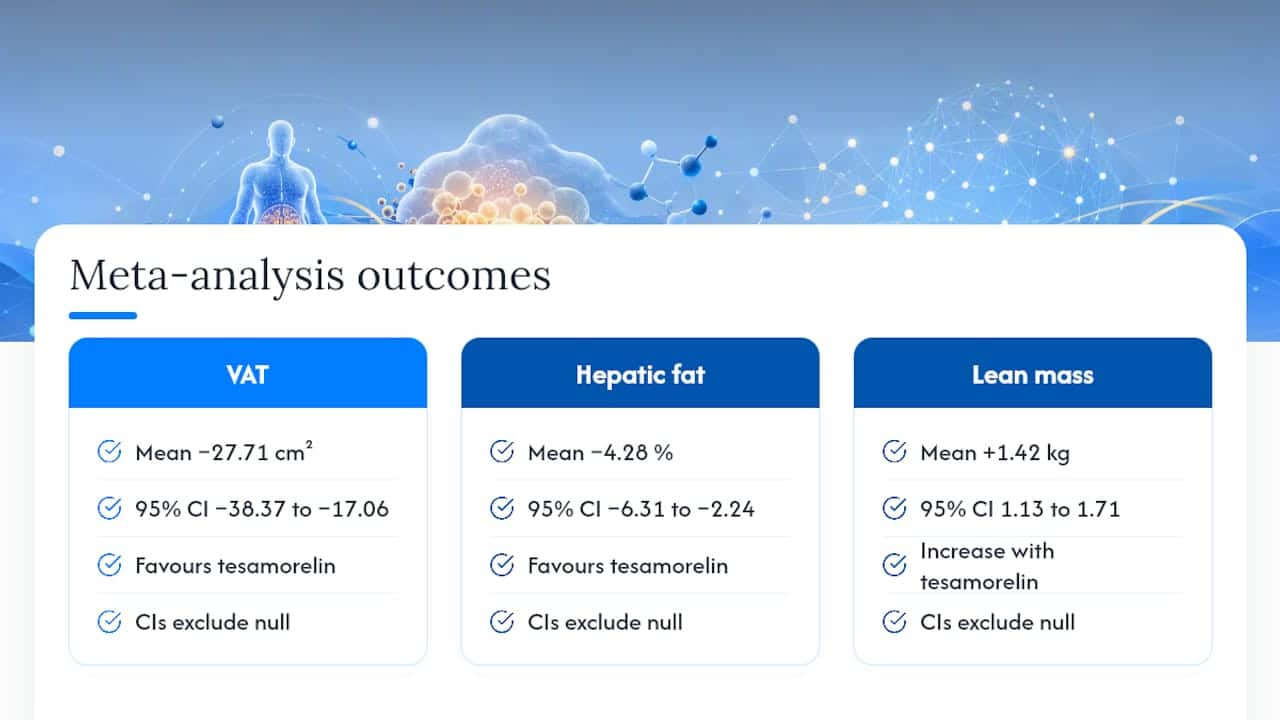
- The 2026 meta-analysis pooling multiple RCTs found a mean difference in VAT of −27.71 cm² (95% CI −38.37 to −17.06) and a hepatic fat percentage mean difference of −4.28% (95% CI −6.31 to −2.24).
Statistic Callout: The FDA’s clinically significant threshold for VAT response is an 8% or greater reduction from baseline. Subgroup data on modern INSTI-based antiretroviral regimens found that a majority of tesamorelin-treated participants met that threshold, compared to a small minority on placebo.
Hepatic fat outcomes deserve their own paragraph because the imaging methodology varies across trials, and that matters when you’re comparing effect sizes. Trials measuring liver fat have used proton magnetic resonance spectroscopy (1H-MRS) as the primary noninvasive tool, with liver biopsy reserved for mechanistic substudies rather than primary endpoint determination. The JAMA trial’s 1H-MRS data showed a net lipid-to-water percentage difference of roughly 2.9 percentage points favoring tesamorelin over placebo at six months. That’s a real signal in a population where hepatic steatosis often tracks lockstep with visceral fat accumulation, but it is smaller in absolute terms than the VAT effect, and researchers should not extrapolate VAT magnitude onto liver outcomes.
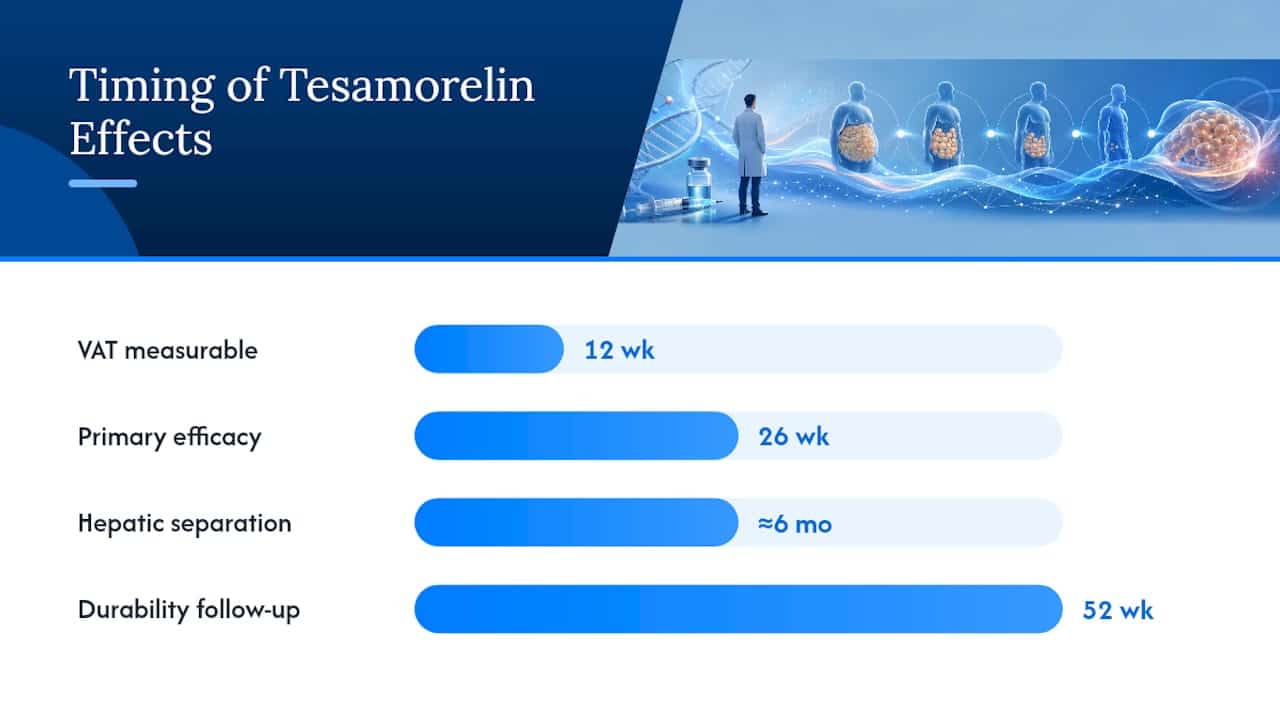
Timing to effect is fairly consistent. Measurable VAT reductions typically emerge by week 12, with the primary efficacy readout in most trials falling at 26 weeks. Hepatic fat changes tend to lag slightly, often not reaching statistical separation from placebo until closer to the 6-month mark, which is one reason shorter trials sometimes underpower liver-fat secondary endpoints even when VAT results are unambiguous. Trial durations informing durability data extend out to 52 weeks in the extension studies, and those longer windows are where the safety picture (rather than the efficacy picture) becomes most informative.
One thing that doesn’t get enough attention in secondary literature: dropout and antibody formation rates in the pivotal trials were low enough that immunogenicity has not been a major confound in interpreting the efficacy signal. That’s notable for a peptide therapeutic, where anti-drug antibodies frequently complicate long-term dosing conclusions.
What Do the Key Randomized Controlled Trials Show?
The evidentiary core of tesamorelin research rests on a small number of well-designed trials, each answering a slightly different question.
The NEJM multicenter trial remains the reference study. It randomized HIV-positive participants with excess abdominal fat to tesamorelin 2 mg SC daily or placebo, with VAT change at 26 weeks as the primary endpoint. Results:
- VAT decreased 15.2% with tesamorelin versus a 5.0% increase with placebo.
- IGF-1 increased approximately 81% from baseline, the largest relative biomarker shift reported in any tesamorelin trial.
- Triglycerides and total cholesterol to HDL ratio both improved, a lipid signal that has held up in subsequent trials.
- No sustained worsening of glucose metabolism was observed despite the substantial GH axis activation.
That combination, meaningful fat reduction plus favorable lipid movement without a glycemic penalty, is what separates tesamorelin from earlier GH-based interventions researchers had tried in this population.
The JAMA trial extended the question to liver fat specifically, using imaging in a population selected for abdominal fat accumulation. Its VAT and hepatic fat findings are covered above, but the trial’s safety data adds an important nuance: fasting glucose rose transiently at the 2 week mark, then normalized, with no sustained worsening through 6 months. That transient bump is worth flagging for anyone designing a shorter trial with an early glucose checkpoint, since it could be misread as a safety signal if the study stops before the rebound.
Long-term extension data, running to 52 weeks, generally reinforce the shorter-trial findings rather than revealing new risks. VAT reductions persist with continued dosing, and triglyceride improvements are maintained rather than attenuating over time. The main methodological caveat across these extensions is that they typically enroll only patients who tolerated the initial treatment phase, which introduces a completer-population bias that inflates apparent tolerability relative to an intention-to-treat population.
Mechanistic substudies, including the hepatic transcriptomic work published in JCI Insight, add a biological plausibility layer that pure imaging endpoints can’t provide. That data gets its own treatment in the mechanism section below, but it’s worth noting here that it came from biopsy specimens nested within a 12 month RCT, not a standalone observational cohort, which strengthens the causal inference considerably.
What Does the 2026 Meta-Analysis Add to the Evidence Base?
Pooled analysis is where individual trial noise gets averaged out, and the 2026 meta-analysis of tesamorelin RCTs gives researchers the clearest quantitative summary available to date.
Statistic Callout: Pooling the available randomized trials, the mean difference in VAT favored tesamorelin at −27.71 cm² (95% CI −38.37 to −17.06), and hepatic fat percentage improved by a mean difference of −4.28% (95% CI −6.31 to −2.24). Lean body mass also increased, with a mean difference of +1.42 kg (95% CI 1.13 to 1.71).
Both confidence intervals sit comfortably away from the null, which is a stronger statement than any single trial could make on its own given typical sample sizes in this population. The lean mass finding is arguably underappreciated in secondary coverage of tesamorelin, since most discussion focuses narrowly on fat reduction. A gain in lean mass alongside visceral fat loss suggests the drug’s action on body composition is broader than a simple lipolytic effect, consistent with growth hormone’s known anabolic signaling.
Heterogeneity across the pooled trials was present but not prohibitive, reflecting differences in trial duration, imaging modality (CT versus MRI for VAT, 1H-MRS versus biopsy for hepatic fat), and the specific antiretroviral regimens participants were on. Adverse events pooled across the included RCTs mirrored the individual-trial safety profile: arthralgia, myalgia, and injection-site reactions were the most frequently reported, with no new safety signal emerging from aggregation.
The authors’ certainty framing lands closer to moderate than high, largely because of the modest number of trials feeding the pool and the relatively narrow demographic (predominantly HIV-positive cohorts with central adiposity) that most trials have studied. For investigators, that translates into a practical takeaway: the point estimates are solid enough to plan a trial around, but generalizability outside HIV-associated lipodystrophy remains an open empirical question rather than a settled one.
How Does Tesamorelin Work at the Mechanistic Level?
Tesamorelin is a synthetic analogue of growth hormone releasing hormone, specifically GHRH(1-44), engineered with a modified N-terminus to resist enzymatic degradation while preserving the native pulsatile signaling pattern. That distinction, pulsatile versus sustained GH release, is the mechanistic hinge the entire safety and efficacy story turns on.
Core pharmacodynamic points:
- Tesamorelin binds GHRH receptors on pituitary somatotrophs, triggering episodic GH secretion that mimics the body’s natural circadian pulses rather than flooding the system continuously.
- Pulsatile GH elevation drives a corresponding IGF-1 rise, which functions as the standard biomarker endpoint across trials, since IGF-1 is far easier to measure reliably than pulsatile GH itself.
- Because the GH signal arrives in pulses rather than a steady elevation, tesamorelin appears to spare glycemic control more effectively than continuous GH exposure, one plausible explanation for why trials haven’t shown the insulin resistance researchers might otherwise expect from GH axis activation.
Pro Tip: When designing a comparator arm or discussing GHRH pharmacology in a protocol, don’t treat all GHRH analogues as interchangeable. Long-acting analogues like CJC-1295 use structural modifications, including DAC-mediated albumin binding, to sustain GH elevation between doses. That’s a fundamentally different pharmacodynamic profile than tesamorelin’s pulsatile pattern, and it changes what endpoints and monitoring intervals actually make sense.
The transcriptomic data adds a tissue-level mechanism to the imaging-based endpoints. Biopsy analysis from a 12 month RCT found that tesamorelin increased hepatic expression of oxidative phosphorylation gene sets while decreasing inflammation and tissue repair gene signatures, correlating with improved fibrosis-related gene scores. That gives the hepatic fat imaging findings a biological explanation rather than leaving them as an unexplained correlation.
What Adverse Events and Safety Signals Appear in the Literature?
Tesamorelin’s adverse event profile is well characterized across trials totaling hundreds of participant-years, and the pattern is remarkably consistent from study to study.
Commonly reported adverse events:
- Arthralgia and myalgia, generally mild to moderate and often attributed to the musculoskeletal effects of GH axis stimulation.
- Injection-site reactions, including erythema, the most frequently reported local adverse event.
- Paresthesia, reported less often but present across multiple trial safety tables.
Statistic Callout: Across trial safety data, fasting glucose showed transient increases at early timepoints (around 2 weeks) but no clinically meaningful worsening of glucose or HbA1c sustained through 6 to 12 months at the standard 2 mg daily dose.
IGF-1 monitoring is the backbone of the trial-based safety approach, both as an efficacy marker and a dose-adjustment trigger. Protocols generally define an upper IGF-1 threshold, informed by age and sex-adjusted normal ranges, above which investigators consider dose reduction or discontinuation. That’s a meaningfully different monitoring philosophy than fixed-dose trials in other drug classes, where dose adjustment is driven by adverse events rather than a biomarker ceiling.
One caveat that deserves more attention than it typically gets: a clinical review from NCBI raises the theoretical consideration that sustained IGF-1 elevation could carry cancer-related risk in susceptible populations, given IGF-1’s known role in cell proliferation signaling. No trial to date has shown a signal of increased malignancy incidence with tesamorelin, but the review recommends surveillance and caution in populations with active or recent malignancy history, which is a sensible default for any trial screening criteria.
Extra caution is also warranted in participants with baseline glucose intolerance, since the transient early glucose elevation, while not sustained in trial populations overall, hasn’t been separately characterized in prediabetic subgroups with the same statistical power as the general trial population.
What Are Tesamorelin’s Approved Indication and Standard Dosing?
Tesamorelin holds FDA approval under the brand name Egrifta for the reduction of excess abdominal fat in HIV-infected patients with lipodystrophy, a labeling context that matters because it defines the population most of the pivotal trial data actually represents.
Practical dosing and trial-design conventions:
- Standard trial and labeled dose: 2 mg subcutaneous injection once daily, a dose used with near-uniformity across the Phase III program and subsequent RCTs.
- Formulation in trials has relied on reconstituted lyophilized powder, with injection-site rotation as a standard protocol element to manage local reaction rates.
- Common inclusion criteria across trials center on HIV-positive status with confirmed central adiposity, typically verified by baseline CT or MRI VAT measurement rather than waist circumference alone.
- Exclusion criteria commonly rule out active malignancy, uncontrolled diabetes, and pituitary or hypothalamic disease that could confound the GH axis response.
Monitoring schedules in the published RCTs typically check IGF-1 at baseline and at intervals through the treatment period, alongside fasting glucose and lipid panels at similar checkpoints, with imaging (CT, MRI, or 1H-MRS depending on the endpoint) performed at baseline and at the primary efficacy timepoint, usually 26 weeks.
What Research Gaps Remain in Tesamorelin’s Evidence Base?
Despite a mature RCT record, several questions remain genuinely open, and they represent the highest-value targets for the next wave of tesamorelin research.
- Long-term cardiovascular outcomes. Existing trials measure surrogate markers, VAT and lipids, but no trial has been powered or designed to capture hard cardiovascular endpoints, particularly in populations now managed on modern INSTI-based antiretroviral regimens where the metabolic baseline differs from the older trial cohorts.
- Expansion beyond HIV-associated lipodystrophy. Tesamorelin’s hepatic fat and VAT effects raise an obvious question for non-HIV NAFLD, NASH, and general obesity cohorts. Any such trial would need careful ethical and design consideration, since the risk-benefit calculation in a metabolically healthier population may differ substantially from the HIV lipodystrophy population where the drug has been validated.
- Mechanistic and transcriptomic follow-through. The hepatic gene-signature findings from JCI Insight are compelling but come from a single biopsy substudy. Replicating that transcriptomic work in a larger cohort, and linking specific gene-expression changes to hard clinical endpoints like fibrosis progression, would substantially strengthen the mechanistic case behind the imaging data.
Where Should Researchers Source Tesamorelin for Study Use?
Getting the pharmacology right in a protocol means nothing if the material behind it isn’t verified. Data Peptides supplies research-grade tesamorelin that is third-party tested for purity, with batch-specific Certificates of Analysis available for institutional review, strictly for laboratory research use.
Practical procurement notes for research teams:
- Institutional procurement and IRB-governed studies should request batch-specific COAs before finalizing any purchase order, not after material arrives.
- Chain-of-custody documentation matters more for peptide reagents than many research teams initially budget for, since degradation and mislabeling are common failure points in this supply category.
- Lab-level handling should follow cold-chain storage guidance, typically lyophilized peptide stored frozen and reconstituted solution refrigerated, with assay timing scheduled relative to dosing intervals to avoid measuring a GH or IGF-1 pulse at the wrong point in its cycle.
- Imaging and biomarker endpoints modeled on the published RCTs, VAT by CT or MRI, hepatic fat by 1H-MRS, and IGF-1 at defined intervals, give a new protocol a validated comparison point against the existing literature.
A Publisher’s Note on Responsible Tesamorelin Research
We built Data Peptides on the premise that research integrity starts with the material itself. A protocol is only as good as the reagent behind it, and peptide research has too long a history of unverified sourcing undermining otherwise solid experimental design. That’s why every batch we ship carries a Certificate of Analysis, and why we treat COA transparency as non-negotiable rather than a marketing checkbox.
We also recognize that institutional researchers often need more than a product page. Procurement teams working under IRB oversight or institutional purchasing requirements can request technical documentation and batch-specific testing data to support internal review, provided the request comes with the proper institutional approvals in place.
Ethics-first research use means keeping the line between laboratory investigation and clinical application clear at every step. Tesamorelin’s evidence base is compelling precisely because it was built on rigorous trial design, and that same rigor should extend to how the compound is sourced for the next study.
— Data Peptides
Get Research-Grade Tesamorelin With Verified COAs
Data Peptides is the sourcing partner for investigators who need tesamorelin backed by actual documentation rather than a vague purity claim. Every batch of Egrifta-equivalent research tesamorelin ships with a third-party Certificate of Analysis, guaranteed purity, and a support team available around the clock for procurement or technical questions.
Three things set this apart from ordering peptides blind: independent third-party testing on every batch, guaranteed purity levels backed by that testing rather than a marketing claim, and dedicated research support for teams navigating institutional procurement. Researchers comparing sourcing models internationally can also review how partner labs like Au Peptide Labs structure their own testing disclosures, though procurement processes and regulatory frameworks differ by market.
All products are sold strictly for laboratory research use only, not for human or animal consumption. Start by checking current batch COAs and placing your order through Data Peptides today.
This article is general information, not a substitute for advice from a qualified doctor. Consult a qualified healthcare professional about your own circumstances before acting on anything here.
Sources
- Metabolic Effects of a Growth Hormone–Releasing Factor in Patients with HIV | New England Journal of Medicine
- Effect of Tesamorelin on Visceral Fat and Liver Fat in HIV-Infected Patients With Abdominal Fat Accumulation: A Randomized Clinical Trial | JAMA
- Body composition, hepatic fat, metabolic, and safety outcomes of Tesamorelin, a GHRH analogue, in HIV-associated lipodystrophy: A meta-analysis of randomized controlled trials
- Metabolic effects of growth hormone–releasing factor in patients with HIV (safety data summary) | PMC
- Effects of tesamorelin on hepatic transcriptomic signatures in HIV-associated NAFLD | JCI Insight
FAQ
Why was tesamorelin banned or restricted in some contexts?
Tesamorelin itself is FDA-approved as Egrifta for HIV-associated lipodystrophy. What gets restricted is compounded, non-regulatory versions sold outside that approved supply chain, since those lack the standardized Phase III safety and efficacy data behind the approved product.
Is tesamorelin actually effective based on the clinical research?
Yes. Multiple RCTs and a 2026 meta-analysis show consistent, statistically significant reductions in visceral adipose tissue, with a pooled mean difference of −27.71 cm² versus placebo.
How fast do measurable fat reductions appear with tesamorelin?
Measurable VAT reductions typically emerge by around week 12, with the primary efficacy readout in pivotal trials set at 26 weeks; hepatic fat improvements tend to register slightly later, closer to the 6 month mark.
Which is better for research purposes, sermorelin or tesamorelin?
The two compounds answer different research questions. Tesamorelin has the deeper RCT record specifically for visceral and hepatic fat endpoints, while sermorelin’s evidence base centers more on general GH stimulation, making the right choice dependent on the study’s specific endpoint.
What is tesamorelin’s approved dosing in clinical trials?
The standard dose used across Phase III trials and current labeling is 2 mg subcutaneous injection once daily.