

High-purity tirzepatide for laboratory research is available, but only when you insist on paperwork that actually proves it. Before any vial goes near an assay, demand a batch-specific Certificate of Analysis showing an HPLC chromatogram and mass spectrometry identity confirmation, and independently verify the lab that ran the tests. Data Peptides (Trusted American Peptides) publishes exactly this kind of documentation for its tirzepatide, which is why COA literacy, not brand loyalty, should drive your sourcing decisions.
TL;DR:
- Suppliers should provide a batch-specific Certificate of Analysis that includes a matching lot number, chromatogram image, and independent verification details.
- Verifying mass spectrometry data and calculating peptide content accurately are critical to ensure molecule identity and proper dosing in research applications.
- Regular third-party testing on initial and periodic batches helps detect quality slips or contaminated lots, maintaining assay reliability.
- Proper storage, reconstitution procedures, and documentation of handling improve peptide stability and traceability within research workflows.
- Only purchase tirzepatide labeled explicitly as research-use-only from reputable sources with transparent COAs, avoiding unverified or poorly documented imports.
Table of Contents
- What Does Tirzepatide Research Actually Require From a Supplier?
- How Do You Read a Tirzepatide COA Field by Field?
- When Should You Escalate to Third-Party Testing?
- What Are the Storage and In-Lab QC Rules for Tirzepatide?
- How Should You Document Purchases for Traceability?
- What Is Tirzepatide’s Mechanism of Action?
- What Do Key Clinical Trials Show About Tirzepatide?
- What Research Applications Commonly Use Tirzepatide?
- What Are Typical Preparation Protocols in Research Settings?
- What Safety Considerations Apply to Handling Tirzepatide in a Lab?
- What Is the Regulatory Status of Tirzepatide as a Research Compound?
- What Do Buyers Get Wrong About Peptide Quality Assurance?
- How Do You Review a Tirzepatide COA Before You Order?
- Sources
- FAQ
What Does Tirzepatide Research Actually Require From a Supplier?
Tirzepatide peptide research lives or dies on documentation quality, not marketing copy. A supplier can print “99% pure” on a label with zero accountability behind it. What actually protects your assay data is a paper trail that lets you verify, independently, that the molecule in the vial matches the molecule on the report.
That means a few non-negotiables before a vial ever touches a bench:
- A batch-matching COA with a lot number that exactly matches the vial label, not a generic template.
- HPLC purity percentage plus the actual chromatogram image and method details, including column type, mobile phase, and detection wavelength.
- Mass spectrometry identity confirmation, showing theoretical versus observed mass and a stated tolerance.
- A mass balance or peptide content statement, plus a residual solvent panel when the application calls for it.
- The testing lab’s name and contact information, with evidence of ISO 17025 accreditation or an equivalent recognized standard.
- Endotoxin data for any cell-culture-sensitive workflow, since standard HPLC purity says nothing about pyrogenicity.
- A documented retention sample policy, so you can send material for independent testing later if a result looks off.
Pro Tip: Keep a spreadsheet mapping every vial’s lot number to its COA file. When a chromatogram looks slightly different from the last batch, that log is what lets you catch drift before it wrecks a week of assay work.
How Do You Read a Tirzepatide COA Field by Field?
A COA is only as useful as the fields it forces the supplier to show its work on. Purity percentage alone tells you almost nothing about identity, and a document missing method metadata should be treated as unverified, not just incomplete.
Work through it in this order:
- Check the HPLC method details. A number like “98.5% pure” means little without the column, mobile phase, gradient, and detection wavelength listed. For lipidated peptides like tirzepatide, detection method matters: fatty-acid modifications can underreport on standard UV detection, so a COA using CAD or ELSD detection generally gives a more honest read on impurity peaks that UV might miss.
- Verify the mass spectrometry data. The COA should show theoretical mass against observed mass, with a defined tolerance. Modern LC-MS instruments routinely hit low-parts-per-million accuracy, and wide tolerance windows on a COA can quietly mask sequence errors on a molecule this size.
- Separate HPLC purity from peptide content. These are not the same number. HPLC purity measures how clean the peak is relative to other peaks in the sample; it says nothing about counter-ions, residual water, or salts. Peptide content, or mass balance, commonly runs 75 to 90 percent of total vial mass depending on lyophilization and counter-ion chemistry, which directly affects how you calculate stock concentrations for reconstitution.
- Scan for red flags. Missing batch numbers, no chromatogram image, absent MS data, or an unverifiable testing lab are the most common signs of a fabricated or recycled document.
Statistic Callout: Practitioner guidance sets 95% HPLC purity as the research-grade floor, with 98% or higher preferred for sensitive assay work where background noise can skew dose-response curves.
When a field is missing, ask the supplier directly for the raw chromatogram and MS spectrum, not just a restated summary number. If they can’t produce it, that’s your answer.

When Should You Escalate to Third-Party Testing?
Supplier COAs are a starting point, not a final word. Third-party verification is what turns “trust me” into “verify it yourself,” and it’s worth building into your procurement routine rather than treating it as an emergency measure.
Start by confirming the testing lab is real. Contact accreditation bodies directly using independently sourced contact details, not a phone number printed on the COA itself, and check the lab’s accreditation scope actually covers peptide identity and purity testing, not just generic chemical analysis. An in-house COA from the manufacturer is useful for routine confirmation, but it carries less weight than a report from a lab with no financial stake in the result.
A workable cadence looks like this:
- Send the first batch from any new supplier to an accredited third-party lab before scaling up orders.
- Run periodic spot checks, roughly one batch out of every ten to twenty, once a supplier has an established track record.
- Keep a retention sample from every batch, refrigerated or frozen as appropriate, so you can test retroactively if an assay produces unexpected results.
- Log every supplier response and QC exception in a shared document your whole team can reference.
Independent confirmatory testing on an initial order, with periodic spot checks after that, catches the two failure modes that cause the most damage: a one-time bad batch and a supplier whose quality slips gradually over time. Reliable vendors welcome this scrutiny. Ones who resist it are telling you something.
What Are the Storage and In-Lab QC Rules for Tirzepatide?
Lyophilized tirzepatide holds up well when stored correctly, but the margin for error shrinks fast once it’s reconstituted. Bench practices here matter as much as the paperwork that got the vial to your lab.
- Store lyophilized vials at the temperature specified on the COA, typically frozen or refrigerated and shielded from light, until you’re ready to prepare a working solution.
- Document reconstitution procedures precisely: diluent used, volume, and date, so any future assay discrepancy can be traced back to a specific preparation step rather than guessed at.
- Keep a small retention aliquot from each reconstituted batch, and run it against an in-house HPLC or MS check if a downstream assay result looks inconsistent with prior runs.
- Compare each new chromatogram’s peak shape and baseline against the supplier’s reference image. A shifted retention time or a new shoulder peak is often the first visible sign of degradation or a formulation change.
Pro Tip: A quick visual comparison of chromatograms, side by side on a monitor, catches more early degradation than most people expect. Baseline drift and peak broadening show up before purity percentages move enough to flag anything.
How Should You Document Purchases for Traceability?
Every tirzepatide order needs a documentation trail tight enough to survive an audit or a failed assay investigation months later. Build this into your purchase order template rather than improvising it after the fact.
- Require batch-level detail on every PO and invoice: lot number, COA provision as a condition of sale, and stated shipping/storage conditions in transit.
- File COAs and any independent test reports using a consistent naming convention tied to the lot number, and retain them for the life of the related research project plus a buffer period.
- Log chain-of-custody events: who received the vial, when it was reconstituted, and how aliquots were used, all referenced back to the batch number.
- Record QC outcomes, including any discrepancies between supplier and independent test results, in a format your team can search later.
A supplier such as Data Peptides that issues batch-specific COAs as standard practice makes this entire step faster, since the traceable document already exists at the point of sale.
What Is Tirzepatide’s Mechanism of Action?
Tirzepatide is a dual GIP/GLP-1 receptor agonist, meaning it activates two distinct incretin receptor pathways rather than one. That dual-agonist design is what distinguishes tirzepatide’s mechanism of action from single-pathway GLP-1 peptides, and it’s the reason it draws sustained interest in receptor pharmacology and comparative incretin research.
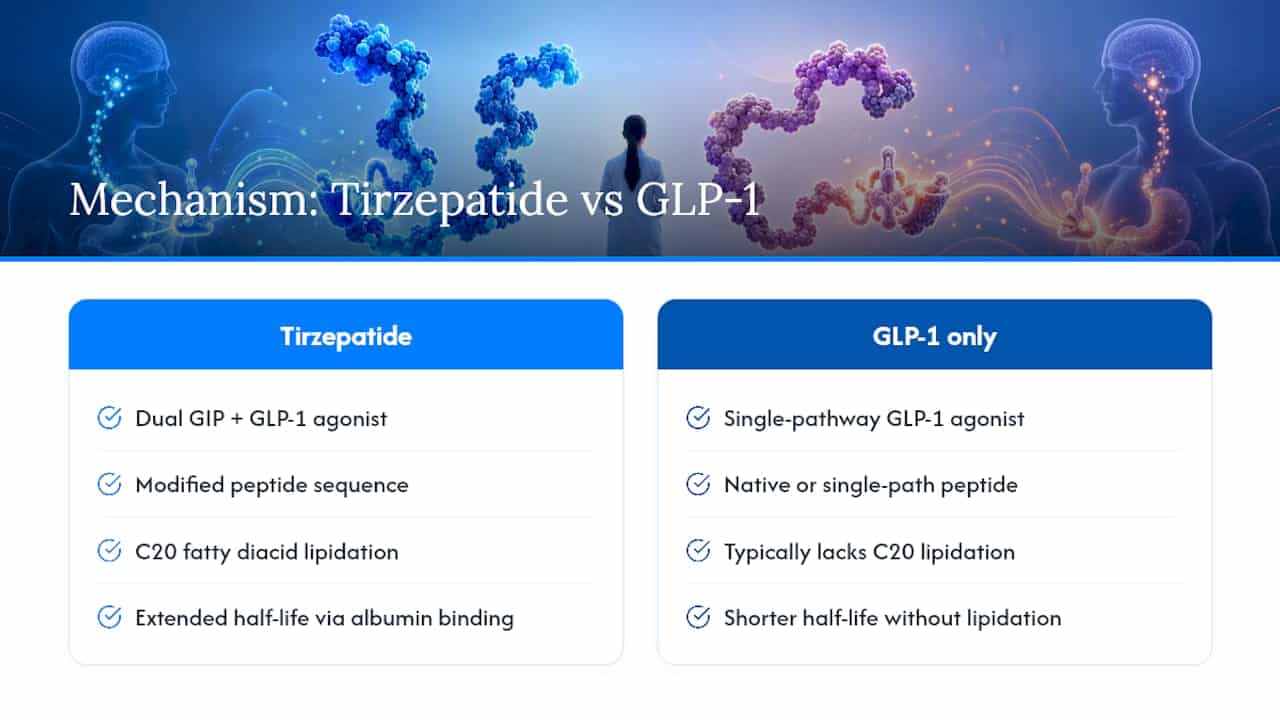
Structurally, tirzepatide is a synthetic peptide built on a modified sequence with a C20 fatty diacid moiety attached through a linker, the same lipidation strategy that extends the half-life of several GLP-1-class peptides by promoting albumin binding. That fatty-acid modification is also exactly why detection method matters on a COA. Standard UV-based HPLC can underrepresent impurities in lipidated peptides, and CAD or ELSD detection tends to give a more complete picture of the purity profile.
In receptor-binding studies, tirzepatide engages both the GIP receptor and the GLP-1 receptor, with binding characteristics that differ from native GIP and GLP-1 in ways researchers are still characterizing across different cell and tissue models. For laboratory purposes, understanding this dual-receptor profile matters less for any single result and more for experimental design: assay conditions, receptor expression systems, and control peptides all need to account for the fact that tirzepatide is not simply “a stronger GLP-1 agonist” but a structurally distinct molecule with its own binding kinetics.
What Do Key Clinical Trials Show About Tirzepatide?
Clinical trial data on tirzepatide is not the focus of laboratory procurement decisions, but researchers working in receptor pharmacology and metabolic research often reference trial-derived pharmacokinetic and pharmacodynamic parameters when designing in vitro or ex vivo experiments that model the compound’s behavior.
Published pharmacokinetic profiles describe tirzepatide’s extended half-life, largely attributable to the fatty-acid modification discussed above, along with dose-proportional exposure across the ranges studied. These parameters inform how researchers select concentration ranges for cell-based assays intended to reflect physiologically relevant exposure, and they shape the kinetic windows used in receptor internalization or downstream signaling studies.
For lab teams building dose-response curves or timecourse experiments, published half-life and exposure data serve as a starting reference point rather than a direct translation. In vitro systems don’t replicate systemic pharmacokinetics, so researchers typically calibrate their own concentration ranges empirically, using purity-verified reference standards. This is precisely where a COA’s mass balance and MS identity data become operationally important. If your stock concentration calculation is based on an inaccurate peptide content figure, every downstream dose-response point inherits that error.
What Research Applications Commonly Use Tirzepatide?
Tirzepatide shows up across a range of experimental models built around incretin receptor biology, metabolic signaling, and comparative peptide pharmacology. Common applications include receptor-binding assays comparing tirzepatide’s affinity for GIP and GLP-1 receptors against native ligands and other synthetic agonists.
Cell-based signaling studies frequently use tirzepatide to investigate downstream cAMP production, receptor internalization kinetics, and beta-arrestin recruitment in cell lines expressing GIP and GLP-1 receptors. These studies help characterize how a dual agonist behaves differently from single-pathway comparators at the molecular level, independent of any physiological outcome.
Ex vivo tissue models, including isolated pancreatic islet preparations, are used in some labs to study insulin secretion dynamics in response to dual-receptor activation. Comparative pharmacology studies also position tirzepatide alongside other incretin-based peptides to map structure-activity relationships across the fatty-acid-modified peptide class.
Because tirzepatide’s lipidation is central to several of these research questions, purity and identity verification take on outsized importance. A batch with even minor sequence or lipidation defects can produce binding or signaling data that looks plausible but doesn’t reflect the intended molecule, which is exactly the failure mode that a verified COA with genuine MS confirmation is built to prevent. Anyone building comparative peptide panels benefits from checking Data Peptides’ broader peptide catalog for consistently documented reference standards across related compounds.
What Are Typical Preparation Protocols in Research Settings?
Preparation protocols for tirzepatide in a research setting center on accurate reconstitution and concentration verification, not on any therapeutic dosing schedule. Labs generally reconstitute lyophilized peptide using an appropriate sterile diluent, calculated against the peptide content figure from the COA rather than the raw vial weight.
That distinction matters because HPLC purity and peptide content are different numbers, as covered earlier. A stock solution calculated purely off label weight, without adjusting for the mass balance figure, can be meaningfully off from the intended concentration, which then propagates through every dilution series built from it.
Once reconstituted, standard lab practice includes aliquoting into single-use volumes to avoid repeated freeze-thaw cycles, which degrade peptide integrity over time and introduce variability between experimental replicates. Each aliquot should be logged against its source batch number, tying preparation records directly to the traceability system described earlier in procurement documentation.
Concentration ranges used in specific assays, receptor binding, signaling, or islet studies, vary considerably by experimental design and published methodology, and researchers typically validate their own working range against reference literature and internal controls rather than following a single universal protocol. The consistent thread across labs is documentation discipline: reconstitution date, diluent, calculated concentration, and storage condition recorded at the moment of preparation, not reconstructed afterward from memory.
What Safety Considerations Apply to Handling Tirzepatide in a Lab?
Tirzepatide is a research-use-only compound, and laboratory handling protocols should follow the same rigor applied to any bioactive peptide, regardless of its therapeutic reputation outside research settings.
Standard peptide handling precautions apply: work in a controlled environment appropriate to the risk profile of a bioactive compound, use personal protective equipment consistent with your institution’s chemical hygiene plan, and avoid aerosolizing lyophilized powder during weighing or transfer. Because tirzepatide is not approved or intended for human or animal administration outside registered clinical contexts, no research lab should treat it as a substance for personal use under any circumstance.
Cross-contamination is a practical concern given tirzepatide’s structural similarity to other GLP-1-class research peptides. Dedicated pipette tips, clearly labeled stock solutions, and separate storage from unrelated peptide compounds reduce the risk of mixing up samples in labs running comparative panels.
For any workflow feeding into cell culture, request endotoxin data on the COA. Residual endotoxin levels, reported in EU per milligram, matter directly for cell-culture-sensitive applications since even trace pyrogen contamination can confound signaling assays that are sensitive to inflammatory pathway activation. A COA lacking this field, when your application requires it, is a reasonable basis to request supplemental testing before use.
Waste disposal should follow your institution’s biohazard and chemical waste protocols for peptide-based research materials, since local requirements vary by jurisdiction and institutional policy.
What Is the Regulatory Status of Tirzepatide as a Research Compound?
Tirzepatide sold for laboratory research carries research-use-only status, meaning it is intended exclusively for non-clinical laboratory applications and explicitly not for human or animal consumption, diagnostic use, or any in vivo administration outside a registered research protocol.
This status shapes how legitimate suppliers market and label the compound. A COA-backed research peptide should arrive with clear labeling stating research-use-only status, without dosing instructions or health claims that would suggest suitability for direct administration. Suppliers who blur that line, through vague labeling or promotional language implying personal use, are a signal to walk away regardless of how strong their purity claims look on paper.
Institutional oversight for tirzepatide research typically falls under the same frameworks governing other bioactive peptide research: institutional biosafety committees, chemical hygiene plans, and standard laboratory safety protocols specific to your organization. There is no universal single regulatory body governing research-use-only peptide sales in the way pharmaceutical products are regulated, which is precisely why documentation rigor at the supplier level, COAs, accredited testing, traceable batch records, carries so much weight. In the absence of blanket regulatory oversight of the research peptide market itself, the paper trail is what stands between your lab and an unverified compound.
What Do Buyers Get Wrong About Peptide Quality Assurance?
The biggest mistake we see in tirzepatide peptide research procurement isn’t buying from an unverified source outright. It’s assuming a professional-looking COA is the same thing as a verified one. We’ve reviewed documents with clean formatting, a purity number, and nothing else, no chromatogram, no MS data, no lab name a researcher could actually call. That gap is what quietly corrupts assay data months later, when nobody can figure out why results stopped replicating.
Every batch of tirzepatide we release carries a batch-specific COA with HPLC chromatogram images, MS identity confirmation, and documented ISO 17025-aligned third-party testing. We built that practice around the mass balance and detection-method issues described above, not around a marketing claim. Fast, discreet shipping and 24/7 support matter, but they don’t substitute for a document a researcher can actually verify. This compound is sold strictly for laboratory research use, never for human or animal administration.
— Data Peptides
How Do You Review a Tirzepatide COA Before You Order?
Data Peptides publishes batch-specific Certificates of Analysis for its tirzepatide, covering HPLC chromatogram data, mass spectrometry identity confirmation, and third-party testing results, so you can verify what you’re buying before the order ships. That’s the same standard laid out throughout this guide: a lot number that matches the vial, a chromatogram you can actually inspect, and a testing lab you can independently confirm.
If you’re evaluating tirzepatide for bench work, start by reviewing the tirzepatide product page for current specifications and available COA documentation. Requesting a retention sample or asking about independent testing options for a specific batch is a normal part of the order process, not an unusual demand, and any supplier serious about research-grade quality should accommodate it without pushback. For labs comparing multiple peptides across a research program, the laboratory applications guide breaks down the same documentation standards across Data Peptides’ broader catalog, so you can apply one consistent verification process across every compound you order.
Sources
- How to Read a Peptide COA: Complete Certificate of Analysis Guide
- Reading a Research Peptide CoA: Field-by-Field Guide | YPB
- How to Read a Peptide COA & HPLC report — 9-point checklist · PeptideDefinition
FAQ
What Purity Level Should Research-Grade Tirzepatide Have?
Practitioner guidance sets 95% HPLC purity as the research-grade floor, with 98% or higher preferred for sensitive assay applications where background noise affects results.
Why Isn’t HPLC Purity the Same as Peptide Content?
HPLC purity measures peak cleanliness relative to other detected peaks, while peptide content accounts for residual water, salts, and counter-ions and commonly runs 75 to 90 percent of total vial mass.
What Are the Biggest Red Flags on a Tirzepatide COA?
Missing batch numbers, no chromatogram image, absent mass spectrometry data, and unverifiable testing lab accreditation are the clearest signs of a weak or fabricated document.
How Often Should You Send Batches for Independent Testing?
Send the first batch from any new supplier to an accredited third-party lab, then run periodic spot checks on subsequent orders once a track record is established.
Does Data Peptides Provide Batch-Specific COAs for Tirzepatide?
Yes. Data Peptides issues batch-specific Certificates of Analysis for its tirzepatide, including HPLC chromatogram data and mass spectrometry identity confirmation, viewable through its tirzepatide product page.