

ACE-031 is an ActRIIB-Fc ligand trap that increases lean mass in both humans and animals, but clinical development was halted because of vascular safety signals. It remains a research-only reagent, prohibited for competitive sport use, with 2026 primate data reconfirming its anabolic effects without changing that safety picture.
TL;DR:
- A single 3 mg/kg dose increased lean body mass 3.3% and thigh muscle volume 5.1% by day 29 in healthy postmenopausal women.
- The Duchenne trial stopped after its second dosing regimen when nosebleeds and telangiectasias emerged; early termination left favorable efficacy trends statistically unconfirmed.
- In marmosets, 14 weeks of dosing increased lean mass, muscle fiber size, and specific force, but the study did not reassess vascular safety over longer periods.
- The reagent remains for research only and is prohibited in competitive sports; verify each lot’s identity, purity, endotoxin results, and batch traceability before laboratory use.
Table of Contents
- Mechanism of Action: ActRIIB-Fc Ligand Trap Pharmacology
- Human Clinical Trials: Phase 1 and the DMD Phase 2 Program
- 2026 Marmoset Study: What the New Preclinical Data Adds
- Safety Signals and Mechanism: BMP9/BMP10 Off-Target Inhibition
- Research Use, Availability, and Product-Quality Risks
- Detailed Dosing Protocols Used in Research
- Common Administration Methods and Handling for ACE-031 in Labs
- Potential Molecular and Cellular Pathways Affected Beyond Muscle Growth
- Comparative Analysis With Similar Peptides or Agents Targeting Myostatin
- Recommended Storage Conditions and Stability Data for ACE-031
- Overview of Typical Research Applications and Experimental Models Using ACE-031
- Author Perspective: What Researchers Should Take Away
- Data Peptides: Research-Grade Sourcing and Verification Steps
- FAQ
- Sources
Mechanism of Action: ActRIIB-Fc Ligand Trap Pharmacology
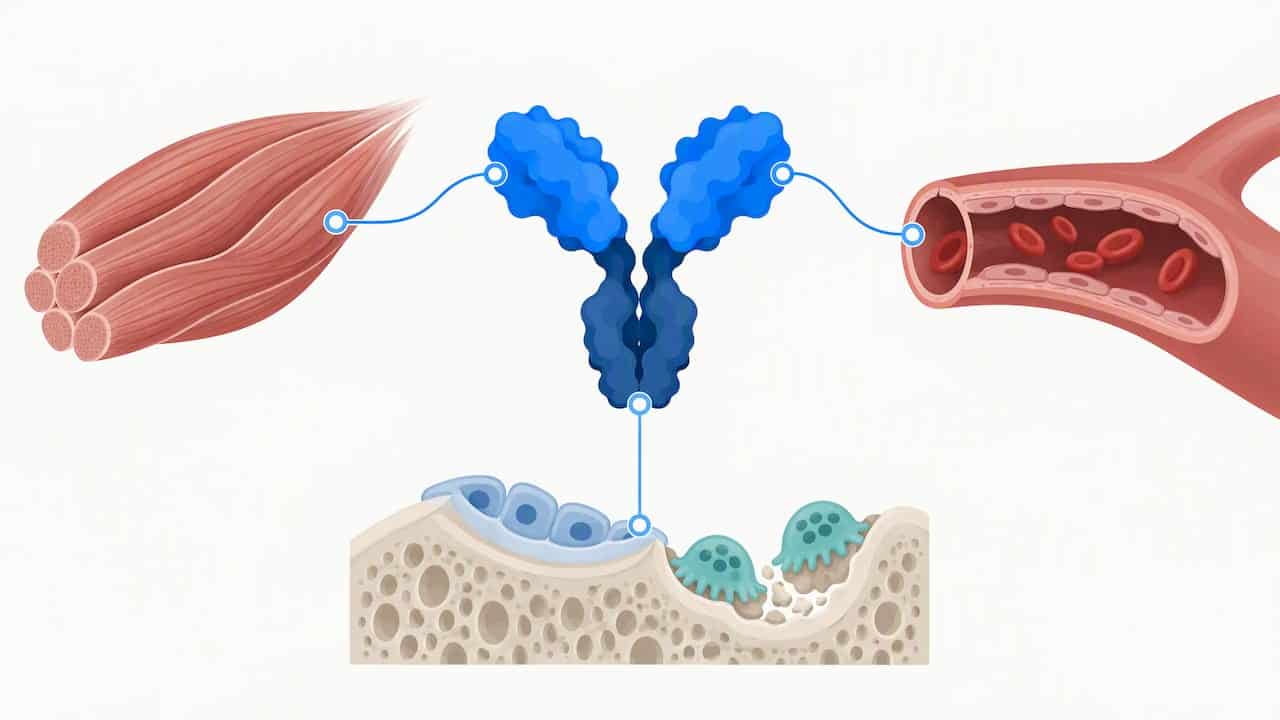
ACE-031 is a fusion protein built from the extracellular domain of the activin receptor type IIB (ActRIIB) joined to the Fc portion of human IgG1. This architecture lets the molecule act as a soluble decoy receptor: it circulates in the bloodstream and intercepts ligands before they ever reach a cell’s native receptor. The Fc domain extends the protein’s half-life and gives it the stability of an antibody while the ActRIIB domain does the actual ligand-catching.
The appeal for muscle research is that ActRIIB does not bind a single target. It grabs several members of the TGF-beta superfamily at once:
- Myostatin (GDF-8), the primary brake on skeletal muscle growth.
- Activins, which also suppress muscle protein synthesis.
- GDF-11, a growth factor with roles in tissue aging and regeneration.
- BMP9 and BMP10, bone morphogenetic proteins involved in vascular maintenance.
By soaking up myostatin and activins, ACE-031 interrupts SMAD2/3 signaling, the intracellular pathway these ligands normally use to suppress muscle fiber growth. Less SMAD2/3 activity means less restraint on protein synthesis and fiber hypertrophy. That broad-spectrum binding is exactly what makes the molecule such a potent anabolic agent and, as later sections cover, exactly what makes it risky: a receptor trap that cannot distinguish myostatin from BMP9 will interfere with tissues that depend on BMP9 signaling, not just muscle.
Human Clinical Trials: Phase 1 and the DMD Phase 2 Program
The human data on ACE-031 comes from two formal trials, each with objective, instrument-based endpoints rather than subjective reporting.
The Phase 1 single ascending-dose study enrolled healthy postmenopausal women and tested a range of single doses, measuring outcomes by DXA and MRI at day 29. Key findings:
- The highest single dose (3 mg/kg) produced a 3.3% increase in lean body mass and a 5.1% increase in thigh muscle volume.
- The drug’s half-life ran approximately 10 to 15 days, supporting infrequent dosing schedules.
- Single doses were generally well tolerated in this short observation window.
Those numbers established proof of concept: a single injection of a ligand trap could meaningfully shift body composition in healthy adults within a month.
The Phase 2 trial in ambulatory boys with Duchenne muscular dystrophy moved to a patient population where muscle-wasting disease made the therapeutic case stronger, using randomized, placebo-controlled, ascending-dose schedules. The trial tracked lean mass, bone mineral density, and the six-minute walk test (6MWT), a standard functional measure in neuromuscular disease research. Results showed trends toward increased lean mass, preserved 6MWT performance, and higher bone mineral density relative to placebo. But the trial was halted after the second dosing regimen when vascular adverse events, epistaxis (nosebleeds) and skin telangiectasias (visible small blood vessel lesions), appeared in treated participants.
Because the program stopped early, the abbreviated cohort meant most of these favorable trends did not reach statistical significance. The anabolic signal was real and measurable; the statistical power to confirm it definitively never was.
2026 Marmoset Study: What the New Preclinical Data Adds
A 2026 study in the common marmoset, published in PLOS One, gave ACE-031 research a primate data point it had lacked for over a decade. Over 14 weeks of dosing, researchers measured significant increases in lean body mass alongside direct muscle tissue analysis.
The biceps showed fiber cross-sectional area increases across both Type I (slow-twitch) and Type II (fast-twitch) fibers, paired with improved specific force, a measure of contractile strength relative to muscle size. That combination matters: mass gains that come without matching force gains are a weaker translational signal than mass and strength moving together.
Marmosets share more physiological and genetic similarity to humans than rodent models, so this result strengthens confidence that the anabolic mechanism observed in the 2013 human trial generalizes across species. It does not, however, resolve the vascular safety question. The study’s design centered on muscle outcomes over a 14-week window and does not stand in for the longer-duration, larger-cohort vascular monitoring that would be needed to reassess ACE-031’s human safety profile.
Safety Signals and Mechanism: BMP9/BMP10 Off-Target Inhibition
The vascular adverse events seen in the DMD trial were not random noise. Later mechanistic analysis traced them to ACE-031’s broad ligand affinity, specifically its interception of BMP9 and BMP10.
- Epistaxis appeared as the most immediately visible event, prompting early scrutiny of the dosing schedule.
- Gingival bleeding followed a similar pattern, consistent with fragile small-vessel integrity rather than a clotting disorder.
- Telangiectasias, visible dilated capillaries near the skin surface, confirmed a structural vascular effect rather than a transient one.
BMP9 and BMP10 are not incidental targets. They play a central role in endothelial homeostasis, the process by which blood vessel linings maintain structural integrity and regulate new vessel formation. A ligand trap potent enough to block myostatin at the doses needed for muscle effect is, by the nature of ActRIIB’s binding profile, also potent enough to blunt BMP9/10 signaling. The muscle benefit and the vascular liability come from the same molecular promiscuity.
That lesson reshaped the field. Later myostatin-pathway programs moved toward antibodies and engineered ligand traps designed to spare BMP9/10 while still binding myostatin, and added vascular monitoring endpoints as a standard part of trial design rather than an afterthought.
Pro Tip: When reviewing any myostatin-pathway study, check whether the trial protocol includes vascular or bleeding-time endpoints. Its absence is a red flag for incomplete safety monitoring, not a sign of a cleaner safety profile.
Research Use, Availability, and Product-Quality Risks
ACE-031 was never approved for any clinical indication, and its developer discontinued the program following the safety findings above. Today the molecule exists only as a research reagent, sold by specialty suppliers and, less reliably, by unregulated vendors.
That second category carries a documented problem. WADA’s reporting on black-market ACE-031 and ramatercept products found that many samples sold under this name do not contain the authentic ACVR2B-Fc fusion protein at all. Misidentified samples undermine both reproducibility and basic lab safety.
Before using any ACE-031 reagent in a research setting:
- Request the full Certificate of Analysis for the specific lot, not a generic product sheet.
- Confirm molecular identity through mass spectrometry or SDS-PAGE against the expected fusion protein weight.
- Ask for endotoxin testing results alongside purity data.
- Verify lot traceability back to a named manufacturing batch.
Detailed Dosing Protocols Used in Research
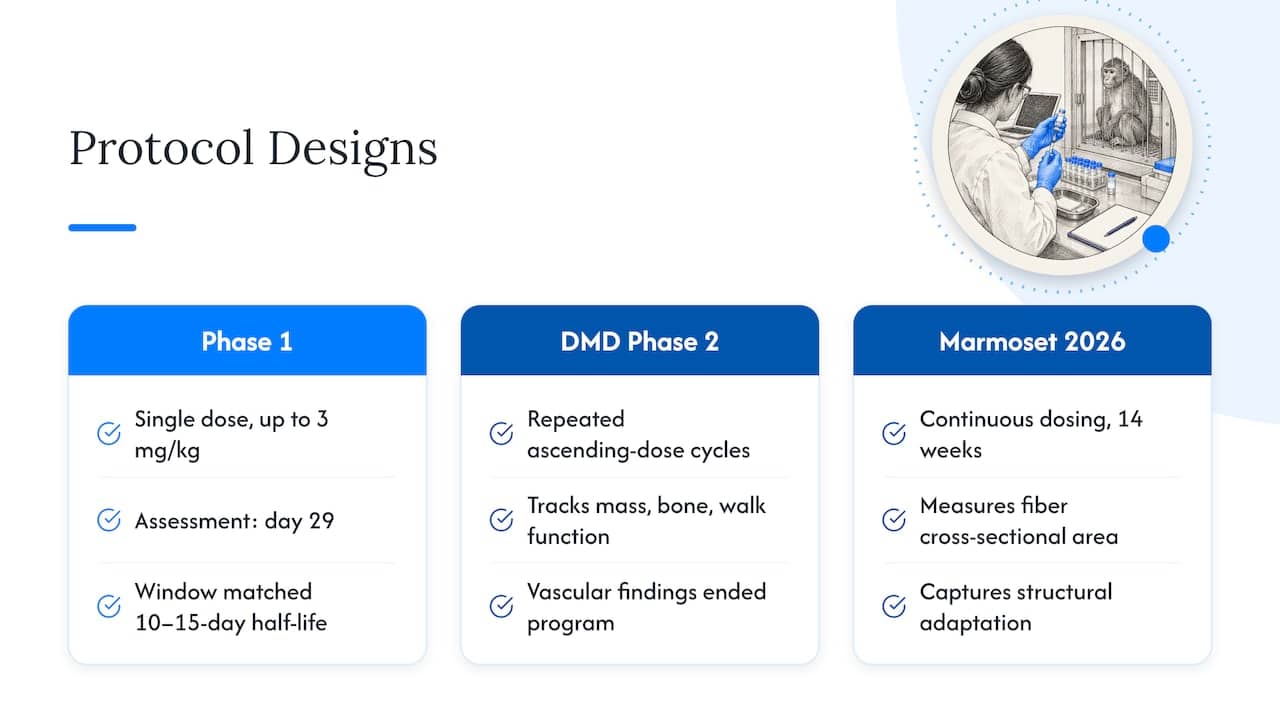
Published ACE-031 protocols cluster around two designs, each matched to a different research question. The Phase 1 single ascending-dose design tested a range of one-time doses up to 3 mg/kg in healthy adult subjects, with outcome measures captured at day 29, a window chosen to match the drug’s 10 to 15 day half-life and allow a full pharmacodynamic cycle to play out from a single injection.
The DMD Phase 2 protocol used repeated ascending-dose regimens instead, starting at a lower dose and stepping upward across sequential treatment cycles rather than a single injection. This design let researchers track cumulative effects on lean mass, bone density, and functional walk testing over a longer observation period, but it also meant that any dose-dependent adverse effect would compound across cycles, which is precisely what happened with the vascular findings that ended the program.
The 2026 marmoset study used a third approach: continuous dosing across a full 14-week period in a non-human primate model, long enough to capture structural muscle fiber adaptation rather than just early biochemical markers. This duration lines up with how long fiber hypertrophy actually takes to manifest at the tissue level, which is why the fiber cross-sectional area data from that study carries more weight than a short-duration readout would.
Across all three designs, dosing protocols were matched to body weight rather than fixed amounts, reflecting standard practice for a biologic with a defined receptor-binding mechanism. Any research protocol modeled on these studies should specify the dosing basis (single versus repeated), the half-life-informed observation window, and the specific functional and structural endpoints being measured, since effect size and safety signal both depend heavily on which of these three templates a study follows.
Common Administration Methods and Handling for ACE-031 in Labs
In the clinical trials that generated the existing ACE-031 data set, the protein was administered by injection, consistent with how most Fc-fusion biologics are delivered since oral administration would degrade the protein before it reached circulation. Handling in a laboratory setting follows standard practice for recombinant fusion proteins of this type.
Reconstitution typically requires sterile technique and the diluent specified on the Certificate of Analysis for the specific lot, since Fc-fusion proteins are sensitive to mechanical stress from vigorous mixing and to temperature fluctuation during preparation. Aliquoting reconstituted material into single-use volumes reduces the number of freeze-thaw cycles any one aliquot experiences, which matters because repeated freeze-thaw is one of the more common causes of activity loss in fusion protein reagents.
Researchers working with ACE-031 or comparable ActRIIB constructs should also plan for appropriate control reagents when designing binding or functional assays. A recombinant activin A preparation, such as the rat recombinant activin A available through Mayflower Bioscience, gives researchers a defined ligand to test against a ligand-trap construct in binding or competition assays, which is useful context when characterizing a new lot of ACE-031 material against its known targets.
Personal protective equipment and biosafety practices for ACE-031 handling mirror those for any recombinant biologic: gloves, eye protection, and standard sharps disposal for injection equipment, with no special containment beyond what applies to other research-grade Fc-fusion proteins.
Potential Molecular and Cellular Pathways Affected Beyond Muscle Growth
Because ACE-031 binds several TGF-beta superfamily ligands rather than myostatin alone, its downstream effects extend past skeletal muscle hypertrophy. GDF-11, one of the ligands this construct sequesters, has been studied for roles in tissue aging and progenitor cell regulation, so a ligand trap broad enough to catch GDF-11 may influence pathways beyond the muscle compartment, even though the clinical trials were not designed to measure those effects directly.
The clearest documented pathway beyond muscle is vascular. BMP9 and BMP10 signal through endothelial cells to maintain the structural integrity of small blood vessels, and inhibition of that signaling is the leading explanation for the epistaxis and telangiectasias seen in the DMD trial. That finding means any systemic ligand trap with this binding profile needs to be evaluated for endothelial effects, not just muscle outcomes, when researchers design a study around it.
Bone density also showed a trend toward improvement in the DMD trial population, which is consistent with activin and myostatin signaling having some role in bone remodeling alongside muscle. Because this was a secondary trend in an abbreviated trial rather than a powered primary endpoint, it should be treated as a hypothesis for further study rather than an established effect. Researchers modeling ACE-031’s full biological footprint should treat muscle, vascular, and bone signaling as three separate but mechanistically linked outcomes worth tracking in parallel.
Comparative Analysis With Similar Peptides or Agents Targeting Myostatin
ACE-031 sits at the broad end of a spectrum of myostatin-pathway research agents, and that breadth is both its strength and its liability. Its defining feature is non-selectivity: it binds myostatin, activins, GDF-11, and BMP9/10 all at once, which produced the strongest single-agent anabolic signal of this class in human trials but also caused the vascular events that ended its clinical program.
Follistatin-based constructs take a related but distinct approach, binding myostatin and activin through a different structural mechanism rather than acting as a receptor decoy. Because the binding architecture differs from ActRIIB-Fc, follistatin-based research reagents are studied with a separate safety and mechanistic profile, and should not be assumed to carry the same BMP9/10 interaction risk simply because both pathways converge on myostatin suppression.
In response to the ACE-031 vascular findings, later development programs moved toward engineered variants and monoclonal antibodies designed to hit myostatin selectively while sparing BMP9/10, such as newer ActRIIB constructs with reduced BMP9 potency. These more selective agents represent the field’s attempt to keep the anabolic benefit ACE-031 demonstrated while removing the off-target vascular liability tied to its broader ligand profile. For researchers comparing agents, the key variable to track is not just potency on myostatin but the breadth of the ligand panel each construct binds, since that breadth predicts both efficacy ceiling and off-target risk.
Recommended Storage Conditions and Stability Data for ACE-031
Lyophilized (freeze-dried) material is generally more stable than reconstituted solution and is the form most research suppliers ship in.
Standard practice for fusion proteins of this class is storage at minus 20 degrees Celsius or lower for long-term stability prior to reconstitution, with short-term storage at refrigerated temperatures acceptable only for brief periods immediately before use. Once reconstituted, the protein should be kept refrigerated and used within the window specified on the COA, since Fc-fusion proteins lose activity more quickly in solution than in lyophilized form.
Repeated freeze-thaw cycling is one of the most common causes of unexplained activity loss in biologic reagents generally, which is why aliquoting into single-use volumes immediately after reconstitution is standard good practice rather than an optional precaution. Avoiding vigorous vortexing during reconstitution, using gentle swirling instead, also protects the protein’s tertiary structure from mechanical denaturation.
Because ACE-031 is not a standardized commercial pharmaceutical with a single manufacturer-published stability dataset, researchers should treat the specific lot’s documentation as the authoritative source for storage guidance and flag any supplier that cannot provide storage and stability data alongside identity and purity results.
Overview of Typical Research Applications and Experimental Models Using ACE-031
ACE-031 research has concentrated in a small number of experimental contexts, each chosen because the myostatin pathway is directly relevant to the outcome being studied. Muscle-wasting disease models represent the largest body of work, exemplified by the Duchenne muscular dystrophy trial, where researchers used the drug to probe whether relieving the myostatin brake could offset the muscle loss characteristic of the disease.
Healthy-volunteer pharmacology, represented by the Phase 1 single ascending-dose study, established basic dose-response and pharmacokinetic parameters that later informed the DMD trial design. The 2026 marmoset study extended this work into primate muscle physiology, using fiber-level histology and force measurement to confirm the mechanism translates beyond rodent and human trial data into a broader mammalian model.
Beyond these direct studies, ACE-031 and the ActRIIB-Fc construct more broadly serve as a reference point in comparative pharmacology research examining how ligand-trap breadth relates to both efficacy and off-target risk across the myostatin-inhibitor class. Researchers studying muscle-related endpoints alongside ACE-031 sometimes use IGF-1 LR3 as a comparator reagent in growth-pathway research, given its distinct but overlapping role in muscle anabolism through the IGF-1 signaling axis rather than the myostatin pathway.
Author Perspective: What Researchers Should Take Away
ACE-031 is a genuine proof of concept: broad ligand traps can produce real anabolic effects. But the same promiscuity that drives muscle growth hit BMP9/10 and caused vascular harm, a trade-off no amount of new primate data resolves. Future ligand-trap research should prioritize selectivity and rigorous reagent verification over raw potency.
— Data Peptides
Data Peptides: Research-Grade Sourcing and Verification Steps
Given the documented misidentification problem in black-market ACE-031 samples, lot-level verification matters more than brand loyalty when sourcing any myostatin-pathway reagent. We provide research peptides with documentation intended to help researchers confirm identity and purity before a reagent ever touches an experiment.
- We publish batch-specific COAs with purity and endotoxin data, reviewable before purchase through our COA page.
- We stock muscle-research reagents, including IGF-1 LR3, with documentation available alongside each listing.
- Our shop carries research-use-only peptides across muscle growth, recovery, and related categories, each shipped with verifiable lot traceability.
Browse our shop to review available research reagents and their documentation directly.
This article is general information, not a substitute for advice from a qualified doctor. Consult a qualified healthcare professional about your own circumstances before acting on anything here.
FAQ
What are the side effects of ACE-031?
In the Phase 2 Duchenne muscular dystrophy trial, ACE-031 caused vascular adverse events including epistaxis (nosebleeds), gingival bleeding, and telangiectasias (visible small blood vessel lesions). These effects are linked to off-target inhibition of BMP9 and BMP10, ligands that maintain vascular integrity, and led directly to the trial’s early termination.
What is ACE-031 peptide used for?
ACE-031 is used exclusively as a research reagent to study myostatin-pathway biology, muscle hypertrophy mechanisms, and translational models of muscle-wasting conditions like Duchenne muscular dystrophy. It is not approved for human or animal treatment and is prohibited by WADA for use in competitive sport.
What is the price of ACE-031 peptide?
Pricing for ACE-031 and related research peptides varies by supplier and lot, so check current listings directly on our shop for available research reagents and documentation. We do not sell ACE-031 itself as a standalone listing at this time.
Which peptides block myostatin?
ACE-031 blocks myostatin as a broad ActRIIB-Fc ligand trap, while follistatin-based constructs use a different structural mechanism to achieve a related effect. Newer engineered ActRIIB variants and selective antibodies have also been developed to inhibit myostatin while reducing the BMP9/10 interaction tied to ACE-031’s vascular safety signals.
Is ACE-031 legal to use in research?
ACE-031 is not FDA-approved for any clinical indication and is sold strictly as a research-use-only reagent in the United States. It is separately listed by WADA as a prohibited substance for athletes subject to anti-doping rules, a restriction distinct from its laboratory research status.
Sources
- A single ascending-dose study of muscle regulator ACE-031 in healthy volunteers (Muscle & Nerve, 2013)
- Myostatin inhibitor ACE-031 treatment of ambulatory boys with Duchenne muscular dystrophy (Muscle & Nerve, 2017)
- ACE-031, a soluble activin type IIB receptor, increases muscle mass and strength in the common marmoset (PLOS One, 2026)
- WADA report: administration study & black-market ACE-031 / ramatercept