
Before any peptide lot goes into an assay, we confirm three things: a lot-specific Certificate of Analysis with matching third-party test data, a purity grade appropriate for the assay, and a storage and handling plan that follows the supplier’s Safety Data Sheet. Skipping any of these introduces identity, concentration, or contamination errors that are difficult to trace once an experiment is underway.
TL;DR:
- Match the vial lot number to its COA; require mass spectrometry identity, an HPLC chromatogram, net peptide content, and endotoxin results for cell work.
- HPLC purity does not measure actual peptide mass: counterions, salts, and bound water can lower net content, so calculate concentrations from a separate content result.
- Crude peptide suits relative or qualitative comparisons only; quantitative mass spectrometry requires a purified, characterized standard, ideally isotope labeled and validated against the target sequence.
- Store sealed, dry lyophilized peptide at temperatures from 20°C below zero to 80°C below zero; aliquot it before freezing and never refreeze thawed solutions.
- Check each product’s Safety Data Sheet before opening: it sets PPE, ventilation, spill response, and disposal requirements based on solvents and formulation.
Table of Contents
- Quality and Certificate Checks Every Researcher Should Run
- Storage, Reconstitution, and Adsorption Control
- Lab Safety, PPE, and Institutional Protocols
- Matching Peptide Grade to Your Assay Type
- Disposing of Peptide Materials Safely
- Our Procurement View on Minimum Acceptance Criteria for Research Lots
- Review Documentation Before You Order Research-Grade Peptides
- FAQ
- Sources
Quality and Certificate Checks Every Researcher Should Run
A Certificate of Analysis is only useful if it matches the vial in front of you. Start by confirming the lot number on the COA matches the lot number on the label, since a mismatched document tells you nothing about the material you actually received. Our peptide certificate of analysis guide walks through this verification step in more detail.
A complete COA should include:
- Mass spectrometry confirmation of identity, not just a retention time match.
- An HPLC chromatogram showing peak purity and resolution from related impurities.
- Net peptide content or amino acid analysis, separate from HPLC purity percentage.
- Residual solvent and moisture data where synthesis byproducts are a concern.
- Lot-specific endotoxin results when the peptide will touch cell culture or in vivo systems.
HPLC purity and net peptide content measure different things. HPLC percentage describes how clean the peptide peak is relative to other peaks in that run, but it says nothing about counterions, bound water, or salts that add non-peptide mass to the vial. A peptide listed at 99% HPLC purity can still deliver meaningfully less actual peptide by weight once that non-peptide mass is accounted for, which is why HPLC purity and net peptide content need to be checked separately before you calculate a working concentration.
When a supplier’s documentation looks thin, ask for the raw MS spectra or chromatogram files rather than a one-page summary. Crude, unpurified peptide is acceptable for relative or qualitative comparisons, but quantitative work requires a purified standard with a documented net content, ideally an isotope-labeled version characterized against the sequence you are studying, consistent with recommendations for peptide-based MS assays.
Pro Tip: Keep a folder of COAs organized by lot number, not by product name, since you may reorder the same peptide months later under a different batch.
Storage, Reconstitution, and Adsorption Control
Peptide integrity starts degrading the moment moisture or repeated temperature swings reach the material. Lyophilized peptide should stay sealed, desiccated, and cold, typically between -20°C and -80°C for long-term storage, because freeze-thaw cycling and humidity are the two most common causes of unexplained potency loss, per recommendations on peptide storage and handling.
- Aliquot lyophilized peptide into single-use portions before the first freeze, so no vial is opened and resealed repeatedly.
- Reconstitute with the solvent the supplier specifies, minimizing exposure to light and air during the process.
- Use working solutions promptly, and avoid refreezing a reconstituted aliquot once it has thawed.
- Pre-rinse pipette tips and sample tubes with the peptide solution itself to reduce surface adsorption losses.
- Switch to low-binding tubes and vials for sequences known to adsorb strongly to plastic or glass.
Carrier molecules or inert gas blanketing can help with particularly sticky or oxidation-prone sequences, especially when working at low nanomolar concentrations where adsorption losses are proportionally larger. Our guide on keeping lyophilized peptides cold and dry covers aliquoting workflows in more depth, and the partner protocol at Peptide Reconstitution: A Bench-Ready Protocol offers additional bench-level detail on solvent selection.
Pro Tip: Label each aliquot with reconstitution date and solvent, since concentration drift over days in solution is a common, overlooked source of assay variability.
Lab Safety, PPE, and Institutional Protocols
Peptides themselves are generally low-hazard, but the solvents, counterions, and synthesis residues that accompany them are not automatically benign, and every lot ships with chemistry that deserves the same scrutiny as any other lab reagent. Always read the supplier’s Safety Data Sheet before opening a new vial, since it lists the specific hazards tied to that product’s formulation and residual solvents.
- Confirm PPE requirements on the SDS: gloves, eye protection, and lab coat are the baseline for most peptide work.
- Check whether the SDS calls for fume hood use or respiratory protection, which is more common when residual organic solvents like dichloromethane are present.
- Follow the SDS spill response and waste disposal instructions exactly, rather than defaulting to general lab practice.
- Loop in your institutional safety officer before working with a new peptide class or an unfamiliar synthesis residue.
A representative SDS for a common synthesis solvent lists specific ventilation, PPE, and spill containment steps, and reviewing an example SDS for a lab solvent shows how detailed these hazard controls can get even for a single reagent class. Treat the SDS as the authority, not a formality, since it reflects the actual chemistry in your specific lot rather than generic peptide handling advice.
Matching Peptide Grade to Your Assay Type
The right peptide grade depends entirely on what you are measuring. A quantitative mass spectrometry assay needs a highly purified, well-characterized standard, ideally a stable isotope-labeled version of your target peptide, because between-laboratory agreement depends on everyone calibrating against material with known, consistent purity, as outlined in recommendations for harmonizing peptide-based MS measurements.
- Reserve crude, unpurified peptide for relative or qualitative comparisons, never for absolute quantification.
- Validate any crude peptide by LC-MS or MALDI-TOF before trusting it in a published result.
- Prefer amino acid analysis for concentration determination; use UV absorbance only when you have a confirmed extinction coefficient for that sequence.
- Watch for sequence-specific degradation risks like oxidation at methionine or cysteine residues and deamidation at asparagine or glutamine.
Transparent sample preparation and documented SOPs for digestion and quantification steps matter as much as the peptide itself, since two labs running the same peptide through different prep protocols can land on different numbers even with identical material, a point emphasized in work on harmonizing targeted MS measurements.
Pro Tip: Store a small, dedicated aliquot of your internal standard separately from working stock so a handling error never contaminates your calibration reference.
Disposing of Peptide Materials Safely
Peptide waste disposal follows the same logic as any other chemical waste stream: match the disposal method to what is actually in the vial, not just the peptide name on the label. Empty peptide vials, used reconstitution solvents, and contaminated tips should go into your institution’s designated chemical or biohazard waste stream rather than general lab trash, since residual solvents and buffer components can carry their own disposal requirements under your SDS.
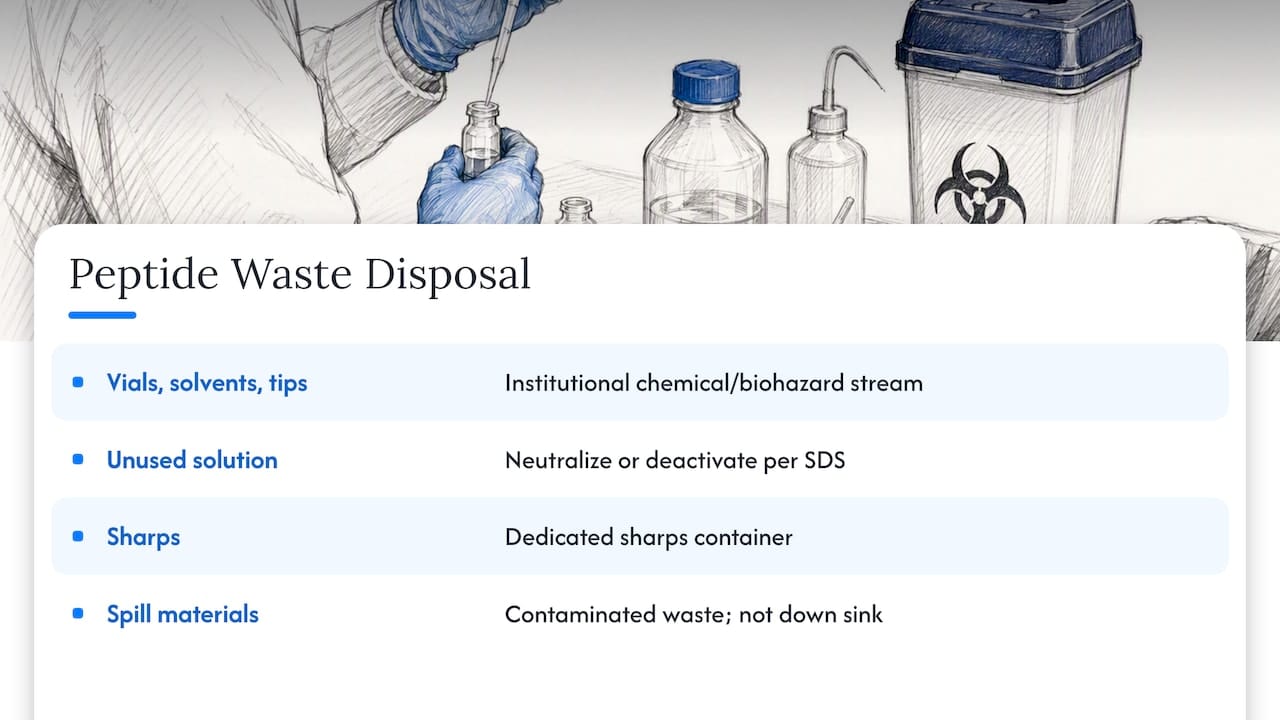
Unused reconstituted peptide solution should be neutralized or deactivated according to the disposal section of the product’s SDS before it leaves the bench, particularly when the solvent used for reconstitution is flammable or classified as hazardous waste on its own. Sharps used for reconstitution or aliquoting, including needles and glass pipettes, belong in a dedicated sharps container regardless of how small the peptide quantity involved.
Spill cleanup materials, including any decontamination reagent used on a bench surface, should be disposed of as contaminated waste rather than rinsed down a sink. Products like SBCleaner for peptide decontamination are built for this step and should be used according to their own labeling for spill response. Document disposal dates and volumes alongside your lot records, since a complete audit trail covers not just what you received, but what left the lab and how.
Our Procurement View on Minimum Acceptance Criteria for Research Lots
We treat every incoming lot the same way: request the Certificate of Analysis first, verify it against independent third-party test data and a matching lot number, and run an analytical check in-house when the application demands tighter confidence. Only then does a lot get accepted and logged.
Research peptides sold under documented third-party testing with lot-specific COAs give labs a defensible paper trail, which matters more than any single purity number. Traceability, meaning retained COAs tied to specific lot numbers, is what lets a lab explain an unexpected result months later or defend a published finding under audit. Our own procurement checklist for buying research peptides follows this same sequence.
— Data Peptides
Review Documentation Before You Order Research-Grade Peptides
Lot-specific COAs with third-party testing and endotoxin data provide identity and purity information before peptide materials reach your bench. Research-grade peptides for weight loss, muscle growth, recovery, anti-aging, and related categories are organized by lot on our shop page, and our support team answers technical documentation questions directly. Review a COA, confirm it matches your assay tier, and order with the paperwork already in hand.
FAQ
What should a peptide Certificate of Analysis include?
A complete COA includes mass spectrometry identity confirmation, an HPLC chromatogram, net peptide content separate from HPLC purity, residual solvent data, and lot-specific endotoxin results when relevant. The lot number on the document must match the lot number on the vial label, or the COA does not apply to that material.
Is HPLC purity the same as net peptide content?
No. HPLC purity describes how clean a peptide peak looks relative to other peaks in that chromatography run, while net peptide content accounts for non-peptide mass like counterions and residual moisture. A peptide can show high HPLC purity while containing meaningfully less actual peptide by weight, which matters for concentration calculations in quantitative assays.
How should lyophilized research peptides be stored?
Lyophilized peptide should stay sealed and stored cold, generally between -20°C and -80°C, with moisture kept out and the vial divided into single-use aliquots before the first freeze. Repeated freeze-thaw cycles and humidity exposure are common, avoidable causes of potency loss, as noted in recommendations on peptide handling.
What PPE is needed when handling research peptides?
Gloves, eye protection, and a lab coat are the baseline for most peptide handling, but the specific requirements depend on the Safety Data Sheet for that product’s formulation and residual solvents. Some lots call for fume hood use or respiratory protection, so the SDS should be checked for every new peptide before opening the vial.
When is crude peptide acceptable for research use?
Crude, unpurified peptide can work for relative or qualitative comparisons, provided it has been validated by LC-MS or MALDI-TOF before use. Quantitative work, especially mass spectrometry-based measurements meant to be compared across labs, requires a purified and well-characterized standard rather than crude material, per recommendations for harmonizing MS measurements.
Sources
- Recommendations for the generation, quantification, storage and handling of peptides used for mass spectrometry-based assays – PMC
- Safety Data Sheet – Methylene chloride (example SDS)