

A 99% purity label is generally acceptable for research-grade peptides, but only as a starting point, not proof of quality. That figure almost always describes HPLC area percent, a chromatographic measurement, not the actual peptide mass in the vial. Before you trust it, request a lot-specific Certificate of Analysis with the full HPLC chromatogram, mass spectrometry identity data, and a peptide content assay. Chromatographic purity and absolute peptide content are two different numbers, and the gap between them can be significant.
TL;DR:
- A 99% purity label mostly reflects chromatographic area percent, not the actual peptide mass in the vial, which can be significantly lower after accounting for counterions and moisture.
- Confirming peptide identity requires mass spectrometry and additional orthogonal methods, not just HPLC purity, with comprehensive certificates including chromatograms and purity data.
- Impurities above 0.5% can affect experimental outcomes by biasing results and introducing immunogenic risks, especially in quantitative studies demanding high precision.
- Always request lot-specific Certificates of Analysis that include raw chromatograms, MS spectra, water content, counterion data, and peptide content assays for reliable procurement.
- Vendors like Data Peptides provide detailed lot documentation and third-party testing, which are essential for ensuring quality and reproducibility in peptide-based research.
Table of Contents
- What “Peptide Purity 99%” Really Means
- Why 99% Purity Matters for Experimental Reliability
- How Do You Read and Verify a COA?
- Common Pitfalls: TFA, Moisture, and Labeling Ambiguity
- Building a Procurement Checklist for Institutional Orders
- How Data Peptides Approaches 99% Purity Verification
- Where to Find Data Peptides’ COAs and Lot Documentation
- Sources
- FAQ
What “Peptide Purity 99%” Really Means
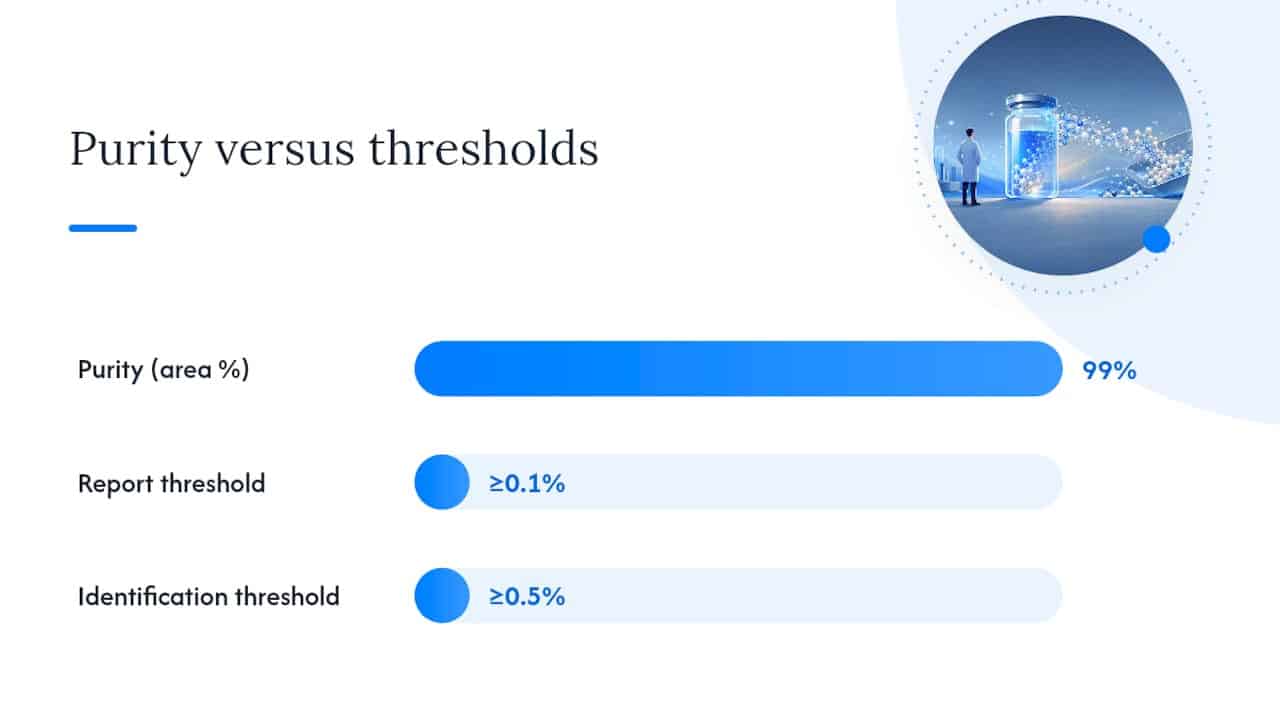
That number represents the proportion of total peak area under a chromatogram attributed to the main peptide peak, compared against everything else eluting in that run. It says nothing directly about how much actual peptide mass sits in the vial, which is a separate figure called peptide content, calculated through a mass-balance approach that factors in water content and counterion mass. The USP’s reference standard guidance describes exactly this method: combine chromatographic purity with weight-based impurity data to assign the real peptide mass per vial.
Confirming identity requires a different tool than confirming purity. RP-HPLC separates compounds by retention time; mass spectrometry confirms the molecule is the correct sequence and molecular weight. Reviewers increasingly call for orthogonal methods on top of both. Peptide mapping and quantitative NMR (qNMR) offer independent structural confirmation that a single HPLC run cannot provide.
A COA worth trusting includes:
- The HPLC method parameters (column type, mobile phase, gradient, detection wavelength)
- A raw, unedited chromatogram, not just a summary percentage
- MS spectra confirming molecular identity
- Water content and counterion identity data
- A peptide content or mass-balance calculation, not just area percent
Ph. Eur. standards expect labs to report impurities above 0.1% and identify them above 0.5%, a threshold regulatory reviews of peptide drug quality treat as a baseline for rigorous characterization.
Why 99% Purity Matters for Experimental Reliability
Impurities do not just sit inertly in a vial. They bias quantitative results in ways that compound over an experiment. If you are calculating an IC50 or EC50, an unaccounted 5% to 10% impurity load shifts your effective concentration, which shifts your curve, which shifts your conclusion about potency. Reproducibility problems that seem like protocol issues often trace back to inconsistent purity between lots.
Purity requirements are not uniform across every experiment. A qualitative binding screen, where you are asking a yes/no question about receptor interaction, tolerates lower purity than a quantitative structure-activity relationship study where precise dosing drives the entire analysis. Pharmacology work demanding exact concentration curves needs the highest confidence in both purity and content.
Impurities also carry an immunogenicity risk that is easy to overlook. Truncated sequences, deamidated residues, or aggregated species can behave differently in cell-based assays than the intended peptide, sometimes provoking responses that have nothing to do with your hypothesis. When impurity levels sit above the 0.5% identification threshold flagged in regulatory guidance, it is worth asking the vendor to identify exactly what those impurities are.
Pro Tip: If your assay depends on precise molarity, don’t just multiply vial weight by the stated purity percentage. Ask for the actual peptide content assay. The two numbers can diverge by a wide margin, and only one of them tells you how much active peptide you are actually dosing.
How Do You Read and Verify a COA?
It requires knowing what to request and how to read it once it arrives.
- Ask for a lot-specific COA, not a generic template. Purity varies between production batches, and a COA tied to a different lot number tells you nothing about the vial in your hands.
- Request the raw HPLC chromatogram, including run parameters: column, mobile phase gradient, total run time, and detection wavelength. A trained analyst can spot whether late-eluting impurities were excluded from the reported area percent, a detail purity method reviews flag as a common blind spot.
- Check the main peak’s retention time and integration window against the stated run length. A short run can hide impurities that would show up given more time.
- Request the MS spectrum with annotation confirming molecular weight matches the expected sequence.
- Ask for water content and counterion identity, plus a peptide content assay if your work depends on precise dosing.
If a vendor can’t produce a lot-specific chromatogram or hesitates on MS data, treat that as a reason to escalate the question, not to drop it.
Common Pitfalls: TFA, Moisture, and Labeling Ambiguity
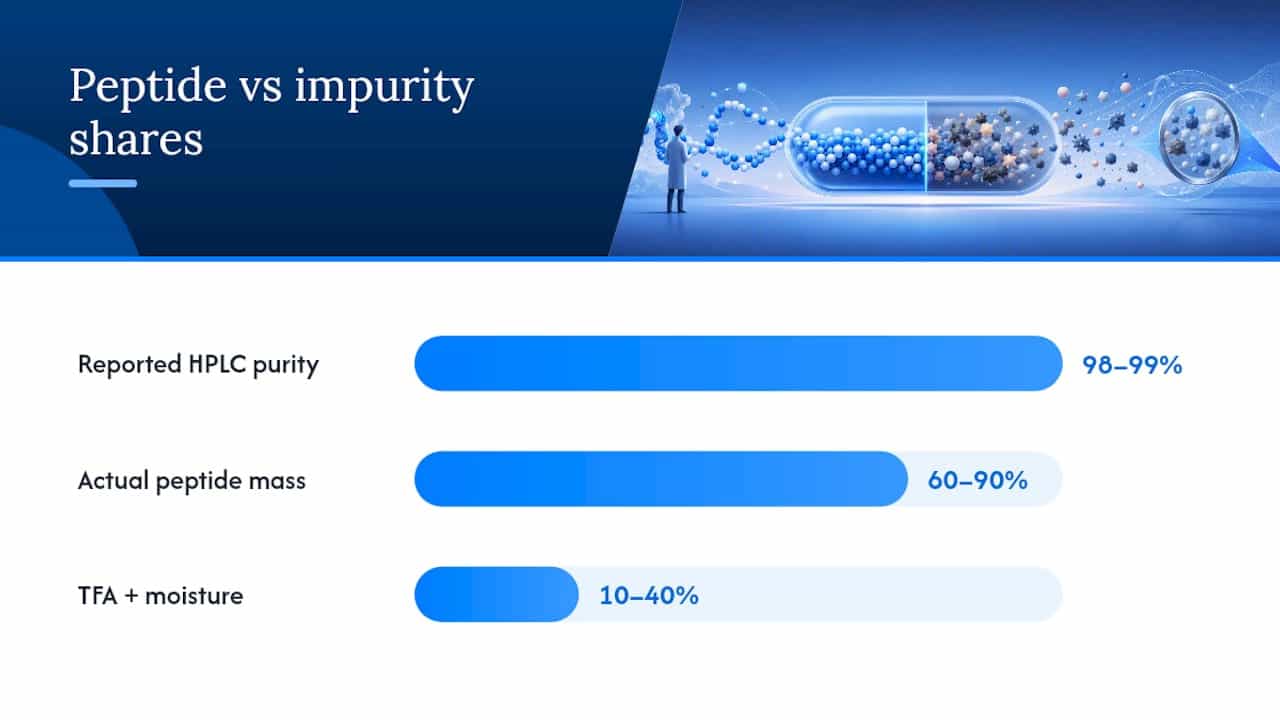
The most underappreciated gap in peptide procurement is the counterion effect. Most synthetic peptides are purified using trifluoroacetic acid (TFA), which remains bound to basic residues as a counterion. That residual TFA can represent 10% to 40% of total vial mass for peptides with multiple basic amino acids, meaning a vial reported at 99% HPLC purity might contain substantially less actual peptide mass once you account for counterion and residual moisture.
A few practical notes worth keeping in mind:
- A peptide at 98% to 99% HPLC purity can still have a peptide mass fraction as low as 60% to 90% once TFA and water are factored in, according to analytical reviews of purity standards.
- HPLC area percent alone cannot detect this. Only mass-balance calculations or peptide content assays reveal it.
- For assays requiring physiological compatibility or exact dosing, ask whether counterion exchange (to acetate or chloride) has been performed.
Building a Procurement Checklist for Institutional Orders
Institutional purchasing benefits from a standing rule set, not case-by-case judgment calls. At minimum, require the following before accepting a lot into inventory:
- A lot-specific COA including the full chromatogram and MS identity confirmation
- Water content and counterion data alongside the purity figure
- Documented storage and shipping conditions for that specific lot
- A traceable lot number that ties back to the vendor’s internal QC records
Vendor behavior tells you a lot before you even place an order. Prefer suppliers who run third-party testing rather than relying solely on in-house QC, who provide stability data supporting shelf life claims, and who give clear storage temperature guidance rather than a generic “keep cold” instruction. Domestic manufacturing with documented quality standards tends to correlate with faster, more complete documentation turnaround, since testing partners and vendors operate under the same regulatory expectations.
Once a lot clears your checklist, archive the COA and chromatogram alongside the lot number in your lab records. Reproducibility disputes months later are far easier to resolve when you can pull the exact documentation for the exact material you used, a practice that institutional procurement guidance increasingly recommends as standard lab hygiene.
How Data Peptides Approaches 99% Purity Verification
Some vendors treat a purity percentage as a claim to be backed, not a marketing line to repeat, shipping lots with third-party testing and documentation covering chromatogram data, identity confirmation, and lot traceability. That approach exists because researchers ordering material for quantitative work need more than a number on a label.
If your protocol or institutional audit requires additional documentation beyond what’s posted, check if the vendor’s support team can provide it. Use the checklist above every time you order, regardless of vendor. It’s the difference between assuming purity and confirming it.
— Data Peptides
Where to Find Data Peptides’ COAs and Lot Documentation
Every product listing in the Data Peptides shop links to lot-specific documentation, including the kind of chromatogram and identity data this guide walks through. Product pages like the hCG listing show how that documentation is presented at the item level, so you can see what to expect before you order. For a broader look at what “buy pure peptides” should actually mean for institutional purchasing, the complete guide to peptide quality and compliance breaks down the documentation standard Data Peptides holds itself to.
If a specific lot needs documentation beyond what’s posted, whether for an IRB submission, a grant audit, or an internal QC review, the support team can pull it directly. Start at Datapeptides to browse current lots, check available COAs, and request anything your protocol requires before you place an order.
Sources
For readers who want the underlying regulatory language, the EMA’s guideline on synthetic peptide development covers orthogonal analytics expectations across MS, NMR, and peptide mapping. The journal review on peptide drug quality assessment details Ph. Eur. impurity thresholds. For a technical look at how measurement approach affects purity claims across product categories, this comparison of whey protein purity testing illustrates similar method-comparison logic applied outside peptide chemistry.
- Regulatory and analytical considerations for the quality assessment of peptide drugs | Journal of Pharmaceutical Investigation
- Reference standards to support quality of synthetic peptide therapeutics | USP
FAQ
Who Sells the Purest Peptides?
Look for vendors who provide lot-specific COAs with full chromatograms, MS identity confirmation, and third-party testing rather than relying on advertised percentages alone. Data Peptides documents each lot this way.
Why Does HPLC Purity Sometimes Overstate Actual Peptide Content?
HPLC area percent measures chromatographic separation, not vial mass. Residual TFA counterion and moisture can account for 10% to 40% of total mass in some peptides, so the real peptide content can run lower than the printed percentage suggests.