

Sermorelin research confirms a specific, testable mechanism: this 29-amino-acid fragment of growth hormone-releasing hormone binds pituitary receptors and triggers pulsatile GH release, reliably lifting IGF-1 in subjects with intact pituitary reserve. Pediatric evidence is strong; adult trial data is real but comes from small studies. The clinical bottom line is straightforward: sermorelin works when the pituitary can still respond, and IGF-1 tracking is how you find out.
TL;DR:
- Sermorelin effectively increases IGF-1 in individuals with functioning pituitary glands, with dosing frequency and timing significantly influencing the response.
- Its strongest evidence comes from pediatric trials supporting safety and efficacy in GH deficiency, while adult data remains limited and small-scale.
- The peptide depends on intact somatotroph cells, offering pulsatile GH release that mirrors natural hormone secretion, unlike continuous exogenous GH.
- Safety profiles are mild, primarily injection site reactions, but antibody development may blunt effectiveness over time and metabolic effects require monitoring.
- Currently, sermorelin is only accessible through compounding pharmacies with a prescription, as the original marketed product was withdrawn for commercial reasons.
Table of Contents
- What Does the Clinical Evidence on Sermorelin Show?
- How Does Sermorelin Work in the Body?
- What Do the Key Sermorelin Clinical Trials Show?
- What Are the Safety Risks and Side Effects of Sermorelin?
- Is Sermorelin FDA Approved and Available Today?
- What Research Gaps Remain in Sermorelin Studies?
- How Does Data Peptides Support Reproducible Sermorelin Research?
- What Actually Matters When Evaluating Sermorelin Research
- Order Research-Grade Sermorelin for Your Study
- Primary Sources for Sermorelin Research
- Sources
- FAQ
What Does the Clinical Evidence on Sermorelin Show?
The literature splits cleanly into three confidence tiers, and conflating them is where a lot of secondary sources go wrong.
At the top sits pediatric registration data. Growth hormone-releasing hormone analog trials supporting the original Geref approval established growth velocity and safety benchmarks in children with GH deficiency, generating the most rigorous dataset sermorelin has ever produced.
Below that sits adult evidence, which is real but thinner. Small trials in older men demonstrate measurable increases in GH pulsatility and IGF-1 concentrations, with outcomes shifting based on dose and how often subjects were injected.
The weakest tier covers the claims that circulate most in consumer marketing: body composition, sleep quality, libido. These rest on small samples, open-label designs, or observational reports, not controlled comparisons.
- High confidence: pediatric diagnostic and therapeutic data tied to Geref’s original registration.
- Moderate confidence: adult GH/IGF-1 increases in controlled but small trials, dependent on dosing frequency.
- Low confidence: body composition, sleep, and libido effects based on limited or uncontrolled data.
Data point: dosing frequency and timing relative to sleep meaningfully shift outcomes. Twice-daily dosing, or well-timed nightly dosing, produced larger IGF-1 responses than single nightly injections in some adult trials, meaning study design choices explain a good chunk of the variation you see across the literature.
How Does Sermorelin Work in the Body?
Sermorelin is the acetate salt of a synthetic peptide matching the first 29 amino acids of endogenous human GHRH, commonly labeled GHRH(1-29). That N-terminal fragment retains full biological activity even though it’s a fraction of the native 44-amino-acid hormone.
The mechanism runs through the pituitary’s GHRH receptor. Sermorelin binds that receptor on somatotroph cells, activating a cAMP signaling cascade that triggers the release of stored growth hormone in pulses, not a steady drip.
That pulsatile pattern is the mechanistic detail that separates it from exogenous HGH. Sermorelin cannot bypass the pituitary; it depends on functioning somatotrophs to do the work, which is also why it fails in subjects with damaged or exhausted pituitary reserve.
- Structure: 29-amino-acid GHRH analog, acetate salt, amidated at the C-terminus.
- Receptor target: pituitary GHRH receptor on somatotroph cells.
- Signal: cAMP-mediated pulsatile GH secretion, distinct from continuous exogenous GH exposure.
- Route limitation: subcutaneous injection only. Oral and topical delivery fail against peptide degradation and skin barrier limits.
This feedback-regulated pathway is why sermorelin research consistently frames the peptide as working with the body’s own GH axis rather than overriding it, capping the risk of the supraphysiologic spikes associated with injected recombinant HGH.
What Do the Key Sermorelin Clinical Trials Show?
The trial record for sermorelin spans four decades, starting with pediatric registration work and continuing through a handful of adult studies that still anchor most citations today.
- Pediatric registration trials. The data supporting Geref’s original therapeutic approval measured growth velocity and safety in children with confirmed GH deficiency, establishing the strongest efficacy signal sermorelin has generated in any population.
- Corpas 1992. This early proof-of-concept study in older men demonstrated that exogenous sermorelin administration restored measurable GH pulsatility and raised IGF-1, providing the first solid evidence that GHRH stimulation could partially reverse age-related GH decline in a controlled setting.
- Vittone 1997. Building on that groundwork, this trial tested defined dosing regimens in elderly subjects, tracking IGF-1 trajectories alongside modest signals in body composition. Sample sizes stayed small, which limits how far the findings generalize.
- Khorram 1997 and related dosing studies. These trials varied administration frequency and timing, reinforcing that dosing schedule, not just total dose, shapes the IGF-1 response.
- Later synthesis and review-level commentary. Subsequent reviews, including Walker’s and comparable analyses, consolidate these findings and consistently flag the same limitation: promising physiological signal, insufficient sample size for firm clinical conclusions.
The recurring theme across Corpas, Vittone, and Khorram is not whether sermorelin raises GH and IGF-1 in older adults. It does, in subjects with adequate pituitary reserve. The open question is how durable and clinically meaningful that rise is when body composition and function are the real endpoints.
A separate line of evidence worth flagging: sermorelin’s long clinical track record and prior FDA registration give it a larger human safety dataset than most newer growth hormone secretagogues, even though the efficacy trials themselves remain modest in scale.
What Are the Safety Risks and Side Effects of Sermorelin?
Adverse events reported across sermorelin trials and clinical use skew mild. Injection-site reactions top the list, alongside flushing, headache, and occasional dizziness following administration.
Antibody formation is the underappreciated variable. Pediatric registration trials documented antibody development against sermorelin in a subset of subjects, and antibodies can blunt the GH response over time. Clinicians running longer protocols should suspect antibody interference when a subject’s IGF-1 response plateaus or reverses despite consistent dosing.
Metabolic effects deserve monitoring too. GH and IGF-1 elevation can shift glucose and insulin sensitivity, and sustained high IGF-1 raises theoretical, though not established, concerns about proliferative signaling in susceptible tissue.
- Injection-site irritation, flushing, headache: most commonly reported.
- Antibody formation: documented in pediatric trials, likely underreported in adult studies.
- Metabolic shifts: glucose and insulin sensitivity changes warrant periodic screening.
- Theoretical proliferative risk: relevant at sustained high IGF-1, not established as a direct harm signal.
Pro Tip: Draw baseline metabolic labs before starting any protocol, recheck IGF-1 at four to six weeks, and repeat metabolic panels quarterly. A flattening IGF-1 curve after an initial rise is your first clue to test for antibody interference rather than assuming dosing is the problem.
Is Sermorelin FDA Approved and Available Today?
Sermorelin has a documented regulatory history that gets misrepresented constantly. The compound earned diagnostic approval and later therapeutic approval under the brand Geref. The manufacturer withdrew Geref from the market in 2008, and the FDA’s Federal Register notice confirms explicitly that the withdrawal was for commercial reasons, not safety or effectiveness failures.
That distinction matters for anyone citing regulatory status. Sermorelin remains available today primarily through 503A and 503B compounding pharmacies, which requires a valid prescription and compliance with compounding regulations rather than a commercially marketed product.
- Diagnostic and therapeutic approval history: established under Geref before its 2008 withdrawal.
- Withdrawal reason: commercial, per FDA’s own Federal Register determination.
- Current access: compounding pharmacies only, prescription required.
- Route: subcutaneous injection exclusively; timing is typically tied to the pre-sleep GH pulse.
- Adult dosing: off-label ranges exist in practice, but no formal consensus dose has been established.
What Research Gaps Remain in Sermorelin Studies?
The adult evidence base has a structural problem: small samples, inconsistent dosing schedules, and short trial durations. A recent review of peptide therapy evidence calls directly for larger randomized trials with standardized endpoints, and that call has gone largely unanswered for years.
- Trial scale. Adult sermorelin studies rarely exceed a few dozen subjects; nothing in the current record approaches the size needed for confident clinical guidance.
- Comparative data. Head-to-head trials against recombinant HGH or other secretagogues are essentially absent, leaving relative effectiveness unresolved.
- Subject selection. Pituitary reserve is the key biological limiter, and obese subjects or those with pituitary damage respond poorly, meaning future trials need tighter inclusion criteria.
- Confounding co-interventions. Concurrent testosterone or other endocrine adjuncts can obscure whether sermorelin itself is driving a body-composition outcome.
Pro Tip: If you’re designing a trial, build in DXA scans at baseline and follow-up, standardize IGF-1 draws to the same time of day, and screen for antibody formation at the midpoint. Most published adult studies skip at least one of these.
How Does Data Peptides Support Reproducible Sermorelin Research?
Reproducibility in peptide research depends on knowing exactly what’s in the vial. Some suppliers address this with third-party lab testing and Certificates of Analysis for every batch, giving investigators lot-level verification of identity and purity before a compound ever reaches the bench.
That documentation matters more than most protocols acknowledge. A study built on unverified material produces unverifiable results, no matter how careful the dosing schedule or the endpoints are.
- Third-party testing on each production lot, with results tied to a published Certificate of Analysis.
- Lot-specific documentation that lets investigators trace purity and identity back to the exact batch used.
- Purity verification aimed at supporting consistent, comparable results across research groups.
What Actually Matters When Evaluating Sermorelin Research
The gap between the pediatric evidence and the adult evidence gets flattened constantly in marketing copy, and it shouldn’t be. Pediatric data is registration-grade; adult data is a collection of small, honest studies pointing in a consistent direction without the statistical power to close the argument.
Sermorelin makes sense as an investigational or adjunct option specifically in subjects with documented age-related GH decline and confirmed pituitary reserve, not as a blanket anti-aging intervention. Anyone sourcing material for a study or protocol carries the same obligation: verify identity and purity before dosing a single subject, and report outcomes, including null or ambiguous ones, transparently. The field needs more data-sharing and fewer trials that quietly disappear after weak results.
— Data Peptides
Order Research-Grade Sermorelin for Your Study
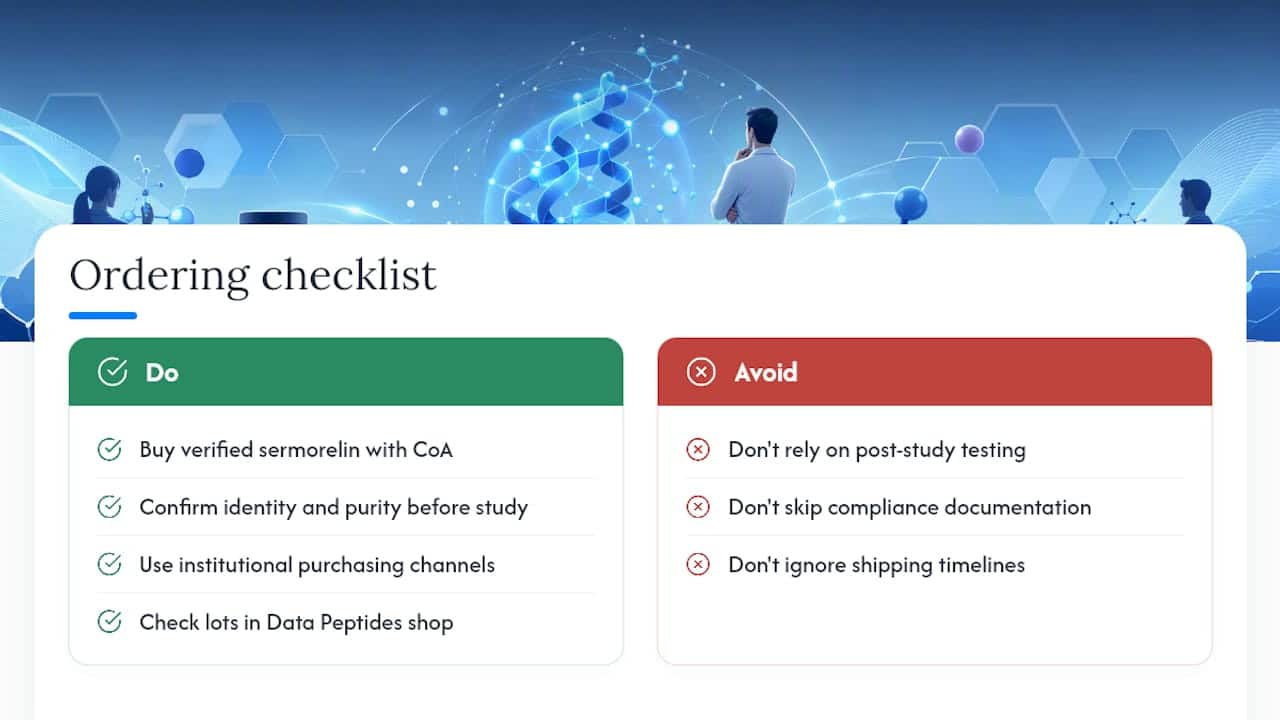
Sourcing verified sermorelin shouldn’t be the hardest part of running a trial. Verified sermorelin and related GH-axis peptides are available from some suppliers, often backed by batch-specific Certificates of Analysis, so investigators can confirm identity and purity before a study starts rather than after.
Ordering processes may include support for institutional buyers, documentation for compliance, and shipping designed to align with research timelines. If your protocol calls for GHRH-class peptides, related secretagogues, or endocrine adjuncts like testosterone-support peptides for combination-arm designs, the same testing standard applies across the catalog.
Browse current lots and Certificates of Analysis in the Data Peptides shop, or check the ordering guide for institutional purchasing and documentation details before you place your next order.
Primary Sources for Sermorelin Research
For protocol design or citation, start with the PMC review on adult-onset GH insufficiency, the FDA Federal Register notice, the PubChem compound record, and the Mayo Clinic reference.
This article is general information, not a substitute for advice from a qualified doctor. Consult a qualified healthcare professional about your own circumstances before acting on anything here.
Sources
- Sermorelin: a better approach to management of adult-onset growth hormone insufficiency? — PMC
- Federalregister
- Sermorelin (injection route) – Side effects & dosage — Mayo Clinic
FAQ
Does Sermorelin Affect Testosterone Levels?
Sermorelin acts on the GH axis through the pituitary GHRH receptor, not the hypothalamic-pituitary-gonadal axis, so it has no direct mechanism for altering testosterone. Any perceived shift is more plausibly tied to concurrent interventions or normal fluctuation.
What Does Sermorelin Do to Facial Appearance?
Elevated IGF-1 from sustained sermorelin use is associated with subtle changes in skin and soft tissue in some reports, but controlled trial data on facial-specific outcomes is essentially nonexistent. Treat before-and-after facial claims as anecdotal rather than evidence-based.
Does Sermorelin Increase Height or Body Size?
In pediatric registration trials with confirmed GH deficiency, sermorelin increased growth velocity, which is a height effect specific to that population and skeletal maturity stage. In adults with closed growth plates, it does not increase height, and body-composition changes are modest and require months of sustained IGF-1 elevation to appear.
Is Sermorelin a Legitimate, Evidence-Backed Compound?
Sermorelin is a real, well-characterized GHRH(1-29) analog with a documented FDA approval history under the brand Geref and a substantial peer-reviewed trial record. Its 2008 market withdrawal was confirmed by the FDA as a commercial decision, not a safety or effectiveness finding.
How Soon Do IGF-1 Levels Change After Starting Sermorelin?
Responders typically show measurable IGF-1 increases within four to six weeks, based on clinical monitoring patterns described for GHRH-class peptides. Body-composition changes take considerably longer, generally three to six months of sustained elevation.