
Store lyophilized peptides at −20°C, or −80°C when long-term stability matters most, and keep reconstituted peptides refrigerated at 2–8°C. Cold slows the chemical reactions that break peptide bonds, and the dry, powdered form resists degradation far better than any solution does. Exceptions exist: sequences rich in cysteine, methionine, or tryptophan, and certain reconstitution solvents, can shrink these windows considerably.
TL;DR:
- Keeping lyophilized peptides at −20°C ensures stability for one to several years, with −80°C offering extra security for sensitive or high-value stocks.
- Reconstituted peptides should be refrigerated at 2–8°C and used within 28 days if preserved with bacteriostatic water but no more than 24 hours in sterile water without preservatives.
- Handling mishaps like repeated freeze-thaw cycles, moisture, or light exposure significantly accelerate peptide degradation, emphasizing careful aliquoting, sealing, and storage practices.
- Peptides with cysteine, methionine, or tryptophan residues benefit from colder storage and antioxidant measures due to their higher sensitivity to oxidation and deamidation.
- Cold-chain failures during shipment can compromise peptide integrity, so using insulated packaging, temperature indicators, and immediate inspection upon arrival are crucial.
Table of Contents
- What Temperature Should You Use for Peptide Storage Temperature Decisions?
- How Do You Store Lyophilized Peptides vs. Reconstituted Solutions?
- How Long Do Peptides Last in Storage?
- How Do You Handle Peptides to Protect Long-Term Stability?
- What Causes Peptide Degradation Beyond Temperature Alone?
- What Should You Check When Peptides Arrive by Shipment?
- Where Do These Peptide Storage Guidelines Come From?
- Chemical Stability and Sterility Are Not the Same Problem
- Sources
- FAQ
What Temperature Should You Use for Peptide Storage Temperature Decisions?
Not every peptide needs a deep freezer, and not every freezer setting protects a peptide equally well. The right choice depends on how long the material will sit, in what form, and how sensitive its sequence is to moisture and oxygen.
- Room temperature (15 to 25°C): acceptable only for brief transit windows, typically hours to a few days, and never for stocks you plan to use again later.
- Refrigerated (2–8°C): the standard for reconstituted peptides in active use, and short-term holding for lyophilized vials between experiments.
- Freezer (−20°C): the baseline for long-term dry peptide storage, with stability commonly reported across one to several years.
- Ultra-low freezer (−80°C): reserved for peptides that must remain viable for multi-year archives or for sequences known to be unusually degradation-prone.
Peptide temperature stability isn’t uniform across every sequence. Methionine and tryptophan residues oxidize readily, cysteine forms unwanted disulfide bonds at warmer temperatures, and asparagine or glutamine residues are prone to deamidation over time. Peptides carrying any of these features benefit from colder, tighter-controlled storage than a “generic” sequence would need.
Statistic callout: Stability reviews indicate lyophilized peptides frozen at −20°C often remain stable for multiple years, with −80°C offering an added margin for the most sensitive or highest-value stocks.
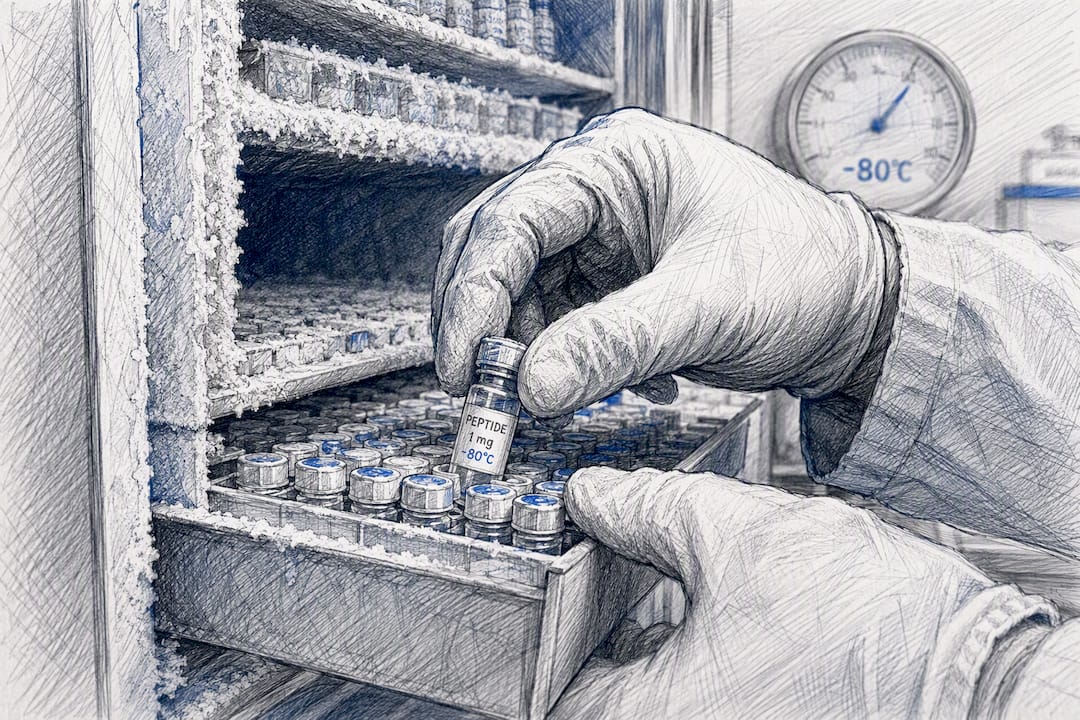
If your lab runs vaccine-grade material, multi-year archives, or anything you can’t easily reorder, defaulting to −80°C is the safer bet, even when −20°C would technically hold up. The cost of a chest freezer is nothing compared to re-synthesizing a lost batch.
How Do You Store Lyophilized Peptides vs. Reconstituted Solutions?
Dry powder and dissolved peptide behave like two different materials once storage conditions come into play, and treating them the same way is one of the most common mistakes in a working lab.
- Keep lyophilized vials sealed and desiccated. Store them at −20°C for routine long-term inventory, or −80°C for maximum longevity, and always shield them from light and ambient humidity.
- Refrigerate reconstituted peptides at 2–8°C. Bacteriostatic water typically extends the usable window to around 28 days post-puncture, while sterile water without a preservative limits usable time to a matter of hours or, at best, 24 hours.
- Never refreeze the original reconstituted vial. Repeated freeze-thaw cycles accelerate aggregation and chemical breakdown. If you need frozen solution stock, aliquot it into sterile single-use cryovials before freezing, not after.
Pro Tip: Label every reconstituted vial with the puncture date the moment you draw from it, not at the end of the day. A missed label is how a lab accidentally uses a 6-week-old vial believing it’s two weeks old.
How Long Do Peptides Last in Storage?
Shelf life expectations shift dramatically depending on form and temperature, and confusing “peptide shelf life” with “solvent sterility limit” is where most inventory mistakes start.
- Room temperature: hours to a couple of weeks at most, suitable only for shipping or brief handling windows.
- Refrigerated (2–8°C): weeks to a few months for reconstituted material, governed largely by the solvent’s preservative content rather than the peptide itself.
- −20°C freezer: commonly one to three years or more for lyophilized peptide, sequence permitting.
- −80°C freezer: multi-year stability reported in peer-reviewed stability literature, though the same research stresses that results are sequence-dependent and critical stocks deserve in-house validation.
Statistic callout: The often-quoted “28-day rule” for reconstituted peptides corresponds to the bacteriostatic water preservative’s sterility limit, not the chemical stability of the peptide itself. The peptide molecule may remain intact beyond that period; it is the preservative’s effectiveness in preventing microbial growth that lapses.
How Do You Handle Peptides to Protect Long-Term Stability?
Temperature control means little if handling habits introduce moisture, contamination, or unnecessary freeze-thaw stress. A few disciplined steps in your workflow prevent most avoidable losses.
- Aliquot frozen stock into single-use cryovials the first time you thaw a batch, so no vial gets refrozen and rethawed more than once.
- Let sealed vials equilibrate in a closed desiccator before opening them, rather than exposing a cold vial straight to room air.
- Record the reconstitution date, solvent, and puncture date directly on the vial label and in your freezer log.
- Discard reconstituted material on schedule, following the solvent’s known sterility window rather than guessing based on appearance.
Pro Tip: Condensation is the silent killer of peptide integrity. Opening a cold vial in humid room air lets moisture creep past the septum before you ever add solvent, and by the time you notice reduced potency, the damage is already done. Warming vials inside a sealed desiccator instead of on the bench eliminates this risk almost entirely.
What Causes Peptide Degradation Beyond Temperature Alone?
Temperature gets most of the attention, but moisture, light, and oxygen exposure degrade peptides just as reliably, sometimes faster than a few degrees of warmth ever could.
- Store vials with silica desiccant packs inside sealed secondary containers to block ambient humidity.
- Use amber glass vials or opaque outer boxes for any peptide sequence documented as light-sensitive.
- For sequences containing cysteine, methionine, or tryptophan, purge vial headspace with argon or nitrogen before sealing to limit oxidative damage.
- Consider antioxidant buffer additives when your downstream assay can tolerate them, particularly for oxidation-prone research peptides.
None of these steps replace correct temperature control. They work alongside it, closing the gaps that a freezer setting alone can’t cover.
What Should You Check When Peptides Arrive by Shipment?
Cold-chain failures during transit are a leading, underappreciated cause of compromised peptide stock, and most of them are preventable with the right acceptance criteria.
- Require insulated shipping packaging with gel packs for short refrigerated routes, or dry ice for anything that must stay frozen in transit.
- Ask suppliers for temperature indicators or data loggers included in the shipment, and define an acceptable temperature window before the order ships.
- On arrival, check the logger or indicator immediately, before the package even reaches the bench.
- If a shipment arrives warm or the indicator shows a breach, quarantine the vials, inspect the desiccant color and vial seal, and contact the supplier before using the material in any experiment. Potency or sterility testing may be warranted for anything questionable.
Where Do These Peptide Storage Guidelines Come From?
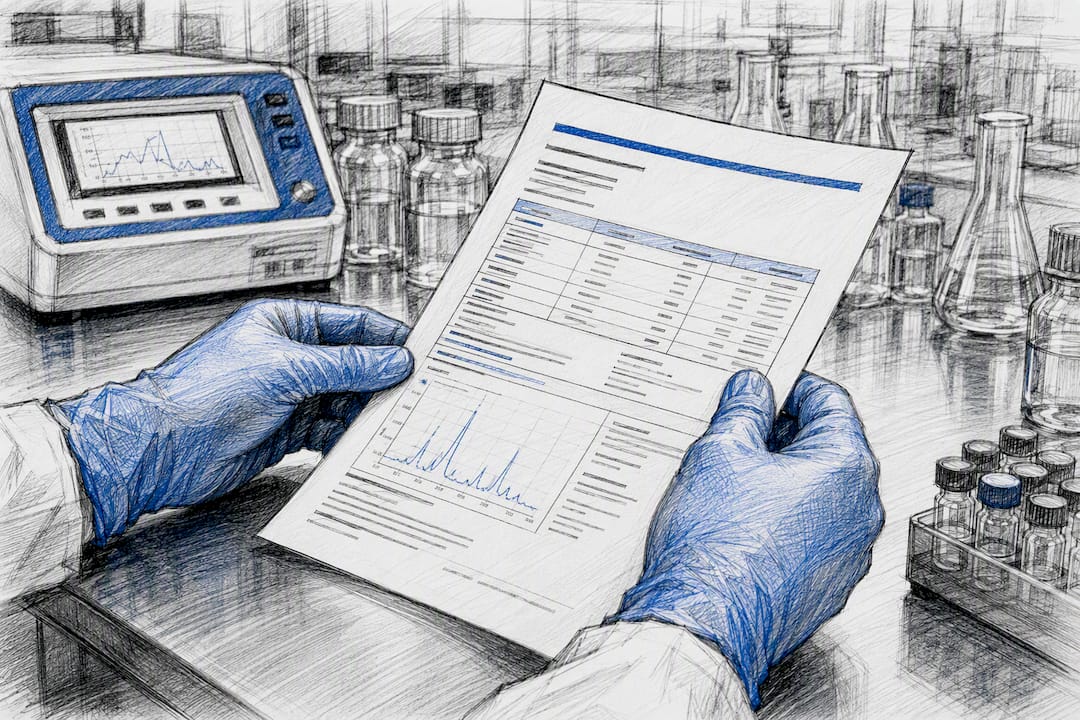
These recommendations reflect supplier-published handling data from organizations like NIBSC, GenScript, and Sigma-Aldrich, alongside peer-reviewed stability literature on frozen peptide preservation. Certificates of Analysis remain the fastest way to confirm a given lot meets its stated purity before storage even begins, and Data Peptides makes COA access part of every order rather than an afterthought.
For labs building or refining their own storage protocols, Data Peptides’ laboratory standards outline SOP-level detail on handling, aliquoting, and documentation that go beyond what a product label alone can offer. Reviewing an actual product quality overview also helps clarify what a COA should and shouldn’t be expected to certify.
Chemical Stability and Sterility Are Not the Same Problem
Most storage advice conflates two separate questions: how long the peptide molecule itself stays chemically intact, and how long a reconstituted solution stays sterile. They’re governed by different mechanisms, and treating them as one number is where a lot of research budgets get wasted.
The peptide bond itself, especially in dry, cold, dark storage, is remarkably durable. Multi-year stability at −20°C or −80°C for lyophilized stock isn’t a marketing claim; it shows up consistently in stability literature. The 28-day figure for bacteriostatic water has nothing to do with that chemistry. It’s a preservative performance limit, tied to benzyl alcohol’s ability to keep microbial growth in check, not to whether the peptide has degraded.
Conventional advice tends to blur this distinction, treating every storage rule as if it protects against the same failure mode. It doesn’t. A lab that separates these two concerns can make sharper calls: extending confidence in a properly frozen dry stock while staying strict about discarding reconstituted solutions on schedule regardless of how “fine” they look. Sequence-specific risk, particularly around cysteine, methionine, and tryptophan content, deserves more attention than most generic storage charts give it. Start there, and the rest of your storage protocol falls into place with far less guesswork.
— Data Peptides
This article is general information, not a substitute for advice from a qualified doctor. Consult a qualified healthcare professional about your own circumstances before acting on anything here.
Sources
- How to Store Peptides | Best Practices for Researchers
- Peptide Storage and Handling Guidelines
- Handling and storage technical article (Sigma-Aldrich)
- Peptide Handling, dissolution & Storage (NIBSC)
- PubMed: peptide stability/study (example stability literature)
FAQ
At What Temperature Do Peptides Go Bad?
Peptides degrade faster as temperature rises, but there’s no single “bad” threshold. Reconstituted solutions lose integrity noticeably above 8°C over days to weeks, while lyophilized powder can tolerate brief room-temperature exposure without lasting harm.
Do Peptides Really Go Bad After 30 Days?
The 30-day figure usually refers to bacteriostatic water’s sterility window, not the peptide molecule itself. A reconstituted peptide may still be chemically intact past that point, but the solvent may no longer be reliably sterile.
What Happens if I Forgot to Put My Peptides in the Fridge?
A reconstituted peptide left at room temperature for a few hours generally isn’t a total loss, but extended exposure risks both degradation and contamination. Lyophilized powder tolerates room temperature far longer, though it should still go back into the freezer or fridge as soon as possible.
How Long Can BPC-157 Stay Unrefrigerated?
Reconstituted peptides follow the general rule: a few hours at room temperature poses limited risk, but they should be refrigerated at 2–8°C promptly and not left out for extended periods. Lyophilized peptides tolerate brief unrefrigerated handling considerably better than any reconstituted solution does.