
“GLP-1 peptides” in a research catalog means lab-grade, research-use-only peptide reagents used to study GLP-1 receptor biology in vitro or in preclinical models, not the prescription drugs sold under clinical brand names. If you’re procuring material for an assay, the immediate move is simple: request a full Certificate of Analysis, an HPLC chromatogram, and mass spectrometry identity confirmation before you place the order. A supplier who can’t produce all three in writing isn’t ready for your protocol.
Before you fill out a purchase order, confirm the basics:
- The material is labeled research-use-only (RUO), with no clinical or veterinary use claims anywhere on the listing.
- The vendor, such as Data Peptides, provides a Certificate of Analysis with HPLC and LC/MS data, not just a purity percentage on a webpage.
- Testing traceability exists, ideally referencing standards consistent with ISO 17025 accreditation.
Key Takeaways
Reliable GLP-1 peptide research depends on verifying identity, purity, and lot traceability before an experiment begins, not after results fail to reproduce.
| Point | Details |
|---|---|
| Confirm scope first | “GLP-1 peptides” here means RUO lab reagents, not clinical drugs; scope confusion wastes procurement time. |
| Demand the full COA | Require HPLC chromatogram, LC-MS identity, and lot number together, not a purity number alone. |
| Run orthogonal QC on arrival | Combine HPLC, MS, and amino acid analysis when stoichiometry matters, especially at picomolar ranges. |
| Match format to assay | Use unlabeled peptide for binding and functional assays; reserve tagged variants for imaging work. |
| Track batch drift | Log lot numbers against assay performance to catch variability before it corrupts a dataset. |
| Choose a transparent supplier | Data Peptides provides third-party tested COAs with chromatograms across its research peptide catalog. |
Table of Contents
- What Counts as a Lab-Grade GLP-1 Peptide?
- Which GLP-1 Research Sequences and Modifications Show Up Most Often?
- How Do You Choose a Reliable GLP-1 Peptide Supplier?
- What QC Checks Should You Run the Moment Material Arrives?
- How Should You Store and Reconstitute GLP-1 Peptide Stocks?
- Which Assays Actually Suit GLP-1 Peptide Reagents?
- What Compliance Steps Precede a GLP-1 Peptide Order?
- Why Does Batch-to-Batch Variability Matter More Than Suppliers Admit?
- What Are the Most Common Mistakes Labs Make Handling GLP-1 Peptides?
- Why Supplier Transparency Shapes Reproducible GLP-1 Research
- Where to Source Lab-Grade GLP-1 Peptides for Your Next Study
- Sources
- FAQ
What Counts as a Lab-Grade GLP-1 Peptide?
A lab-grade GLP-1 peptide is a synthetic peptide reagent manufactured and sold specifically for laboratory research, not for administration to humans or animals outside a controlled study. It’s built to let researchers probe GLP-1 receptor pharmacology, downstream signaling, and structural questions in vitro or in preclinical models, and nothing else.
Expect a proper listing to specify the exact amino acid sequence, any modifications (C-terminal amidation is common, along with acetylation for some analogs), the salt or counter-ion form, and available pack sizes, usually in the low milligram range for research quantities. RUO labeling should appear on the vial, the packing slip, and the product page, not buried in fine print.
This guide draws a hard line around one exclusion: it does not cover prescription GLP-1 receptor agonist drugs, clinical formulations, or any material positioned for human or veterinary administration. Those products sit in an entirely different regulatory category with different manufacturing standards, and conflating the two is how labs end up with material that’s wrong for their protocol.
- Sequence and modification data should be explicit, not implied.
- Pack sizes and concentration should match your assay’s working range.
- RUO labeling must appear consistently across product page, COA, and shipping documents.
Which GLP-1 Research Sequences and Modifications Show Up Most Often?
Catalogs built for researchers typically organize GLP-1 peptides by sequence variant and functional truncation rather than by brand name. You’ll commonly see native GLP-1 fragments, exendin-based analogs used as long-acting receptor agonist tools, and various length variants used to probe activation kinetics. Recent literature on GLP-1 receptor biology traces how these engineered variants evolved specifically to extend half-life and refine receptor selectivity for research purposes.
These reagents show up across a fairly predictable set of experiments:
- Receptor binding assays, both radioligand and fluorescent-ligand formats.
- cAMP accumulation assays that measure downstream signaling after receptor activation.
- Optical and trafficking studies, including genetically encoded sensors that visualize receptor activation in real time.
- Pharmacology screens comparing analog potency and selectivity.
- Photo-uncaging experiments in cell systems, where a caged peptide is activated with precise spatial and temporal control.
Modifications change what a peptide is good for. Amidation and acetylation generally improve stability against enzymatic degradation, which matters for longer assay windows. PEGylation slows clearance in more complex model systems but can bulk up the molecule enough to interfere with binding pocket access. Fluorescent tags make imaging possible but often reduce binding affinity, so labeled variants belong in visualization work, not in functional potency assays where an unlabeled peptide gives you cleaner data.
How Do You Choose a Reliable GLP-1 Peptide Supplier?
Supplier selection comes down to paperwork and traceability, not marketing copy. The strongest signal a vendor takes research quality seriously is a Certificate of Analysis that actually shows its work: an HPLC chromatogram with visible peak shape and baseline, LC-MS identity confirmation, and a lot number that ties the vial in your hand to that specific analytical run.
A usable COA and supplier relationship should include:
- HPLC chromatogram showing area-percent purity, not just a stated number.
- LC-MS data confirming molecular identity and matching expected mass.
- Lot and batch traceability linking the physical vial to its analytical record.
- Clearly stated analytical methods and run parameters.
- A full list of available modifications and pack sizes.
- Endotoxin and sterility testing availability, at minimum as an add-on option.
- Documented shipping conditions, including cold-chain handling where the peptide requires it.
Before you order, put these questions to the supplier directly:
- Do you retain reference samples from each batch, and can you provide one on request?
- Is testing performed independently, or only in-house?
- Are you accredited to a recognized standard, and can you document it?
- What’s the turnaround time between order placement and COA delivery?
- Do you require a Material Transfer Agreement, and what RUO terms apply?
Weigh vendors on how transparent their methods are, not just their advertised purity figure. A peptide QC guide from ILS Laboratories recommends a standard panel covering HPLC purity, endotoxin (LAL), sterility, and heavy metals, with results typically delivered within three to five business days. Independent third-party verification of that panel matters more than an in-house-only claim, and so does practical logistics: lead time, minimum order quantities, and whether the vendor ships on dry ice when the material demands it.
What QC Checks Should You Run the Moment Material Arrives?
Don’t trust a purity percentage until you’ve looked at the chromatogram behind it. Peer-reviewed method guidance consistently points to the same practice: inspect peak shape and baseline yourself rather than taking the headline number at face value.
On receipt, run through this sequence:
- Confirm the COA matches the lot number on the vial.
- Examine the HPLC chromatogram for peak symmetry, resolution, and a clean baseline.
- Run or outsource LC-MS confirmation if the supplier’s mass data looks thin or inconsistent.
- Verify solubility and actual concentration, using amino acid analysis or quantitative MS when stoichiometry matters for your assay.
- For cell-based or in vivo work, screen for endotoxin using an LAL assay and confirm sterility separately.
Purity thresholds should scale with use case. In vitro binding work can often tolerate somewhat lower purity than in vivo studies, where impurities compound biological variability you can’t easily control for. A purity verification guide recommends a four-stage hierarchy, RP-HPLC, ESI-MS, amino acid analysis, and orthogonal structural checks, specifically for situations where dosing accuracy can’t tolerate guesswork.
Pro Tip: When you’re working in picomolar assay ranges, run HPLC, MS, and amino acid analysis together rather than trusting any single method. A concentration error that’s invisible at micromolar doses can throw off an entire binding curve at picomolar concentrations.
How Should You Store and Reconstitute GLP-1 Peptide Stocks?
Lyophilized peptide stays stable far longer than reconstituted solution, so store the dry material at negative 20 degrees Celsius or lower, sealed with desiccant, until you’re ready to use it. Once reconstituted, plan for single-use aliquots. Repeated freeze-thaw cycles degrade peptide integrity fast, and that degradation shows up as noisy, inconsistent assay data weeks later when you’ve forgotten which vial got thawed three times.
Reconstitution follows a fairly standard sequence:
- Check the peptide’s hydrophobicity profile before picking a solvent. Water or slightly acidified water works for most hydrophilic GLP-1 variants; more hydrophobic analogs may need a small volume of DMSO first.
- Add solvent slowly down the vial wall rather than directly onto the lyophilized pellet.
- Use gentle swirling or brief low-power sonication rather than vigorous vortexing, which can introduce shear stress and promote aggregation.
- Calculate final concentration against actual peptide content, not vial label weight, since salt content and residual moisture affect the real number.
- Aliquot immediately into single-use volumes and refreeze anything not used the same day.
Two degradation pathways matter most for GLP-1 peptides specifically: DPP-IV mediated cleavage at the N-terminus, and general proteolytic breakdown in aqueous solution at room temperature. Aggregation is the other risk, particularly at higher concentrations or after repeated freeze-thaw.
Which Assays Actually Suit GLP-1 Peptide Reagents?
Match the reagent to the assay format before you order, because the wrong pairing wastes both money and bench time. Receptor binding assays, whether radioligand or fluorescent-ligand based, work best with unlabeled peptide since any tag risks altering binding kinetics at the receptor pocket. cAMP accumulation assays and G-protein or arrestin recruitment assays are the standard workhorses for measuring functional receptor activation downstream of binding.

Live-cell imaging is where labeled and sensor-based tools earn their place. Genetically encoded sensors like GLPLight1 report GLP-1 receptor activation optically with high sensitivity and fast temporal resolution, useful for tracking activation dynamics in real time rather than at a single endpoint. Photo-uncaging experiments extend this further, giving researchers spatial and temporal control over when and where receptor activation happens within a cell population.
Concentration ranges deserve experimental confirmation rather than assumption. GLP-1 receptors bind ligand with high affinity, often in the low nanomolar to picomolar range, which means small errors in stock concentration produce outsized errors in your dose-response curve. Recalculate working concentrations against amino acid analysis results rather than the vial label whenever stoichiometry is critical to your conclusions. As a general rule, reserve labeled and tagged variants for imaging work with proper controls, and keep unlabeled peptide on hand for anything measuring functional potency.
What Compliance Steps Precede a GLP-1 Peptide Order?
Confirm RUO labeling appears consistently across the product listing, the COA, and the shipping documentation before you submit a purchase order. A supplier marketing the same molecule for human or veterinary use anywhere in its catalog is a red flag regardless of how clean its analytical data looks. Most institutions also require a Material Transfer Agreement or vendor terms agreement on file, so check with your procurement office before the order ships rather than after.
International and interstate shipping carries its own paperwork. Confirm the correct customs classification, whether any permits apply to your jurisdiction, and whether cold-chain shipping on dry ice is even permitted for import into your specific institution or country. U.S. labs should loop in their institutional biosafety committee and procurement office early, since requirements vary by institution even within the same state.
Keep a standing compliance file per vendor relationship:
- Documented COA for every lot received.
- Lot traceability records tied to each experiment that used that material.
- Signed MTA or vendor terms, where your institution requires one.
- A running log of batch-to-batch variability, so you can flag drift before it corrupts a dataset.
Why Does Batch-to-Batch Variability Matter More Than Suppliers Admit?
Even a supplier with tight manufacturing controls will show some lot-to-lot drift in purity, residual solvent, or trace impurity profile. That’s not necessarily a red flag. It’s a normal feature of peptide synthesis, and the question isn’t whether variability exists but whether you’re tracking it.
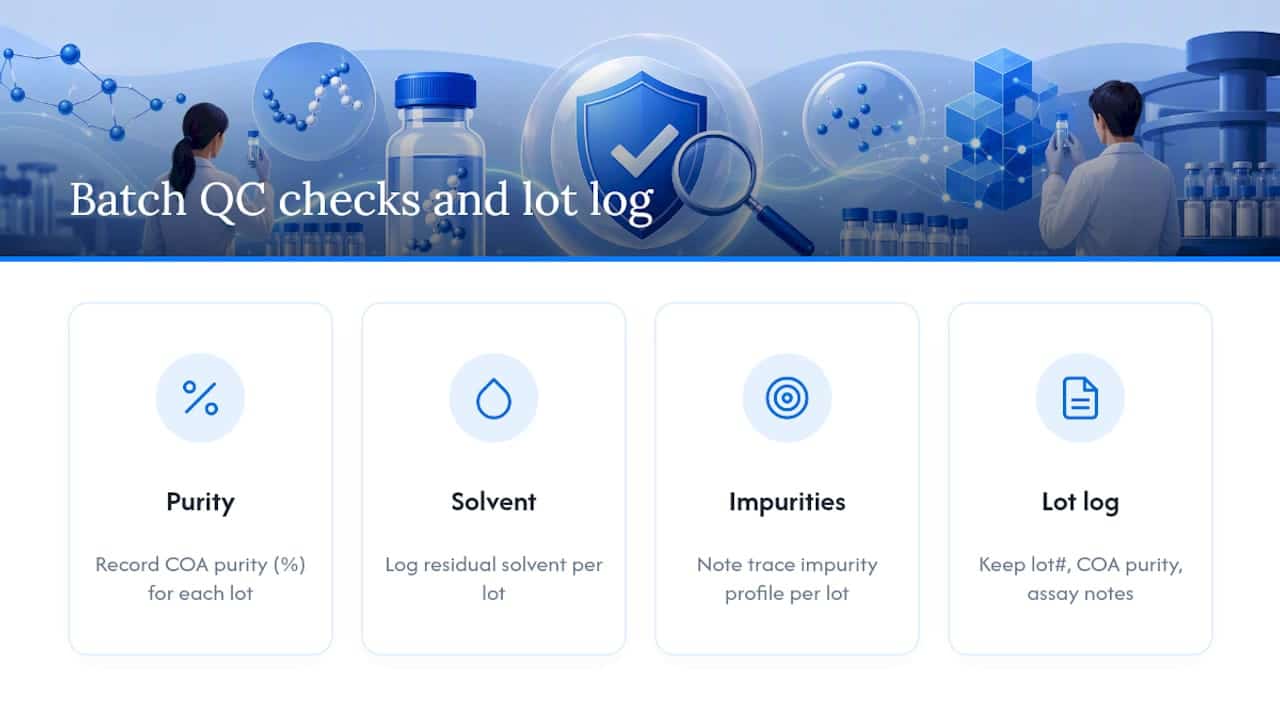
The practical fix is a simple internal log: record the lot number, COA purity figure, and any assay performance notes every time you open a new batch of the same peptide. If your EC50 in a cAMP assay drifts by more than what you’d expect from normal biological variability, check whether a new lot arrived around that time before you start troubleshooting your cell line or reagents.
Ask suppliers directly whether they maintain consistent synthesis routes and analytical methods across lots, or whether formulations change based on raw material sourcing. A vendor that can tell you exactly what changed between lot 4471 and lot 4502, even a minor solvent substitution, is giving you the kind of traceability that protects your data. One that shrugs and points to the purity percentage on the COA is not.
For long-running studies, consider ordering enough of a single lot to cover the full experimental timeline where possible. Splitting a critical dose-response series across two different lots introduces a variable you can’t fully control for later, and reviewers increasingly ask about lot consistency in methods sections. Document it now rather than reconstructing it retroactively when a reviewer asks.
What Are the Most Common Mistakes Labs Make Handling GLP-1 Peptides?
The single most common failure point isn’t the peptide itself, it’s the freeze-thaw cycle. Researchers reconstitute a full vial, use a fraction of it, and refreeze the rest repeatedly over weeks. Each cycle degrades a bit more peptide and introduces noise into downstream data that often gets misattributed to biological variability instead of reagent handling.
Solvent choice trips people up next. Using plain water for a more hydrophobic analog often leaves visible undissolved material at the bottom of the vial, and researchers sometimes proceed with the assay anyway, unaware their actual working concentration is well below the calculated value. Always visually inspect reconstituted peptide for clarity before use.
Tag interference is another recurring issue in binding and functional assays. A fluorescently labeled peptide that performs beautifully in an imaging assay can produce misleading potency data in a binding assay, because the tag itself can partially block the receptor interface. When results look unexpectedly weak, check whether the format of the peptide, not the biology, is the actual variable.
Finally, watch for stoichiometric assumptions built on label weight rather than actual peptide content. Lyophilized peptide vials often contain more salt, counter-ion, and residual moisture than researchers account for, which means a vial labeled 1 mg might deliver meaningfully less active peptide than expected. When an assay result won’t reproduce and everything else checks out, recalculate concentration from amino acid analysis data before assuming a biological explanation.
Why Supplier Transparency Shapes Reproducible GLP-1 Research
Reproducibility problems in peptide-based research rarely trace back to bad science. They trace back to reagents nobody fully characterized before the experiment started. Data Peptides treats third-party testing and COA transparency as the baseline, not an upsell, because a chromatogram you can actually inspect saves you from chasing phantom biological effects that are really just impurities in disguise.
Lot traceability matters just as much. When a result won’t reproduce, the first question should be “did the lot change,” and that’s only answerable if the paperwork exists. Transparent QC doesn’t just build trust. It shortens the distance between a strange result and its actual cause.
Where to Source Lab-Grade GLP-1 Peptides for Your Next Study
Every checklist in this guide, COA with chromatogram, LC-MS identity, lot traceability, RUO labeling, points toward the same standard: reagents you can verify before you ever open the vial. Data Peptides builds its catalog around that standard, with third-party testing behind every batch and Certificates of Analysis available for the pack sizes researchers actually order.
For labs comparing sequence variants and modification options, the product catalog lists available pack sizes and current lot documentation up front, so you’re not requesting paperwork after the fact. Shipping is handled with research timelines in mind, discreet packaging, US-based fulfillment, and cold-chain handling where the peptide calls for it, backed by support that answers procurement questions before an order goes out rather than after a shipment arrives.
If your next protocol calls for GLP-1 receptor reagents with documented purity and traceable lots, start by requesting a current COA for the specific product and pack size your study requires.
Sources
- Optical tools for visualizing and controlling human GLP-1 receptor activation with high spatiotemporal resolution | eLife
- How to Verify Peptide Purity, Independent Testing Guide, Best Peptides For You
FAQ
What does “GLP-1 peptides” mean in a research catalog?
It refers to synthetic peptide reagents sold strictly for laboratory research on GLP-1 receptor biology, not prescription drugs approved for human or veterinary treatment.
What documents should a supplier provide before you order?
A Certificate of Analysis showing HPLC chromatogram data, LC-MS identity confirmation, and a traceable lot number; Data Peptides includes these with its research peptide listings.
How should I store reconstituted GLP-1 peptide?
Aliquot into single-use volumes immediately after reconstitution and store at negative 20 degrees Celsius or lower, since repeated freeze-thaw cycles degrade peptide integrity.
Why does a labeled peptide sometimes underperform in a binding assay?
The fluorescent or chemical tag can partially block the receptor interface, so unlabeled peptide typically gives cleaner results in binding and functional potency assays.
How much lot-to-lot variability is normal?
Some drift in purity or trace impurities is expected across manufacturing batches; the key is logging each lot’s COA data against your assay results so you can spot meaningful deviations early.