

Some peptides show consistent evidence for faster tendon repair in animal models, but none have FDA approval for treating tendon injuries in humans. That gap matters. BPC-157, TB-500, and the PEDF-derived 29-mer have produced measurable improvements in collagen organization and tensile strength in rodent and rabbit studies, while GHK and collagen peptides work through slower, more general mechanisms. What’s missing across the board is large-scale human trial data confirming dosing, safety, or long-term outcomes.
Here’s the honest state of the science:
- Preclinical support is real for several candidates, particularly BPC-157 and the PEDF 29-mer, which have shown faster healing markers in controlled animal models.
- Human randomized trials are essentially nonexistent for tendon-specific applications, which means dosing and safety data come almost entirely from lab animals.
- Every peptide covered here sits outside FDA-approved treatment status. They’re sold and studied as research-use compounds, not medications.
- Delivery method changes the picture. Local injection or hydrogel-based application appears to outperform systemic dosing because tendons are notoriously hard to target with blood-borne compounds.
The consistent thread across peer-reviewed animal studies is biological plausibility, not clinical proof. Mechanisms look promising. Human confirmation does not yet exist.
If you’re a researcher or patient considering peptide therapy for tendon repair, the practical first step isn’t sourcing a compound but consulting the Mobility Restoration Checklist for Athletes to guide your rehabilitation and recovery planning. It’s talking to a clinician about your specific injury and, if research use is the goal, confirming that any supplier provides third-party testing and a Certificate of Analysis (COA) before you trust a product’s purity claims.
Key Takeaways
Preclinical animal studies consistently show peptides like BPC-157 and the PEDF-derived 29-mer accelerate tendon healing markers, but no human trials confirm efficacy or safe dosing.
| Point | Details |
|---|---|
| Evidence is animal-only | BPC-157, TB-500, and the 29-mer show strong preclinical results, but human randomized trials don’t exist yet. |
| Mechanisms differ by compound | Angiogenesis, TSPC activation, ECM remodeling, and actin regulation each drive different peptides’ proposed effects. |
| Delivery method affects outcomes | Local hydrogels sustained effects for weeks; systemic injection struggles with poor tendon blood flow. |
| No FDA approval exists | Every peptide covered, except oral collagen, remains research-use only under current U.S. regulatory status. |
| Sourcing quality matters | Data Peptides supplies third-party tested, COA-backed research peptides including BPC-157 and TB-500 for lab use. |
Table of Contents
- Which Peptides Have Evidence for Tendon Healing?
- How Do Peptides Help Tendons Heal?
- What Are the Best Delivery Methods for Tendon Peptides?
- Is Peptide Therapy for Tendons Legal and Safe?
- How We Evaluated the Tendon Repair Research
- What Should Researchers and Patients Realistically Expect?
- What Responsible Peptide Sourcing Looks Like
- Sources
- FAQ
Which Peptides Have Evidence for Tendon Healing?
Six categories of compounds dominate the tendon repair research conversation right now: BPC-157, TB-500 (thymosin beta-4), the PEDF-derived 29-mer, GHK, oral collagen peptides, and self-assembling peptide hydrogels like KI24RGDS. Each works through a different mechanism, and each sits at a different point on the evidence spectrum, from consolidated preclinical data to early-stage experimental scaffolding.
None of this is a straight line. A compound with strong rat data doesn’t automatically translate to human tendons, which are larger, slower to heal, and mechanically loaded in ways a lab model can’t fully replicate.
BPC-157: the most-cited research peptide, still animal-only
BPC-157 is a synthetic peptide derived from a protective protein found in gastric juice. It’s the most frequently discussed compound in tendon repair research, and for good reason: a substantial body of rodent studies reports accelerated tendon and tendon-to-bone healing compared with untreated controls. One consolidated review of this literature found BPC-157 accelerates tendon and tendon-to-bone healing across multiple rodent models, often with markedly faster functional recovery.
The catch is translation. A critical review of BPC-157’s evidence base points out that nearly all supportive data comes from rats and rabbits, with no large, controlled human trials validating efficacy, dosing, or long-term safety. That’s not a minor caveat. It means every dosing protocol circulating online is extrapolated from animal body weights, not calibrated for human physiology.
TB-500: systemic reach, different mechanism
TB-500 is a synthetic fragment of thymosin beta-4, a naturally occurring protein involved in cell migration and actin regulation (the cellular scaffolding that lets cells move and change shape). Where BPC-157 tends to concentrate its effect on local angiogenesis and fibroblast stimulation, TB-500 is more often studied for systemic cell migration, which is why researchers frequently discuss combining the two. Musculoskeletal Key’s breakdown of the BPC-157/TB-500 pairing explains the rationale: complementary pathways, one local and angiogenic, one systemic and structural, though the source is explicit that no human trials validate stacking protocols.
If you’re comparing the two compounds directly, a side-by-side look at BPC-157 and TB-500 research mechanisms covers how their proposed pathways diverge.
The PEDF-derived 29-mer: the most mechanistically detailed evidence
This one gets less mainstream attention than BPC-157, but it may have the cleanest study design of the group. Researchers isolated a 29-amino-acid fragment from pigment epithelium-derived factor (PEDF) and delivered it via a single hydrogel injection into damaged tendon tissue. The result: expansion of CD146-positive and nucleostemin-positive tendon stem/progenitor cells (TSPCs, the resident cells responsible for tendon regeneration) within 2 to 7 days, followed by improved collagen fiber organization and higher tensile strength by three weeks. That timeline and outcome data come from a study on PEDF-derived peptide’s mitogenic effect on tendon stem/progenitor cells.
What makes this compound notable isn’t just the outcome. It’s that researchers can point to a specific cellular mechanism (TSPC proliferation) rather than a vaguer “it helps healing” claim.
GHK: a copper peptide with broader tissue support, not a tendon specialist
GHK (glycyl-L-histidyl-L-lysine) is a naturally occurring copper-binding peptide studied mostly in skin regeneration and wound healing contexts. Its relevance to tendon repair is more indirect. It supports collagen synthesis and tissue remodeling broadly, but it doesn’t have the tendon-specific injury-model data that BPC-157 or the 29-mer have generated. Researchers looking at GHK for tendon applications are largely extrapolating from its general tissue-repair profile rather than citing tendon-specific outcome studies.
Collagen peptides: nutritional support, not a signaling therapy
Oral collagen peptides are a different category entirely. Where BPC-157, TB-500, and the 29-mer are bioactive signaling peptides that modulate cell behavior, collagen peptides function as a nutritional building block, supplying amino acids the body can use for collagen synthesis without directly triggering the cell-signaling cascades (like TGF-beta1 activation) that drive TSPC recruitment. That distinction matters for anyone comparing “peptides” as a single category. A daily collagen supplement and a localized 29-mer injection are not doing the same biological job, even though both fall under the peptide umbrella.
Self-assembling peptide hydrogels: the delivery innovation
KI24RGDS represents a different approach altogether: an injectable scaffold rather than a signaling molecule. In a rabbit patellar tendon defect model, this self-assembling hydrogel improved collagen fiber orientation and failure load at 8 weeks compared with untreated defects. It works less like a drug and more like scaffolding that gives the tendon’s own repair cells a structured environment to rebuild in.
Broader reviews of the field note that local and systemic peptide therapies for soft tissue regeneration face a shared translational hurdle: getting the compound to stay where it’s needed long enough to work.
Here’s how the six candidates stack up against each other:
| Peptide | Evidence Level | Typical Administration | Primary Mechanism | Safety/Regulatory Status | Best-Documented Use Case |
|---|---|---|---|---|---|
| BPC-157 | Animal (rodent, rabbit) | Local or systemic injection | Angiogenesis, fibroblast stimulation | Research-use only, no FDA approval | Acute tendon and tendon-to-bone injury (rodent models) |
| TB-500 | Animal, limited in vitro | Systemic injection | Actin regulation, cell migration | Research-use only, no FDA approval | Adjunct to BPC-157 in combined research protocols |
| PEDF 29-mer | Animal, mechanistic in vitro | Local hydrogel injection | TSPC proliferation via ERK/STAT3 | Experimental, research-use only | Acute injury, early-stage cellular recruitment |
| GHK | Animal and human (skin/wound contexts, not tendon-specific) | Topical or injection | Collagen synthesis, general tissue remodeling | Widely available as a cosmetic ingredient; not studied specifically for tendons | Broad tissue repair support, not tendon-specific |
| Collagen peptides | Human (nutritional studies) | Oral supplement | Amino acid supply for collagen synthesis | Legal dietary supplement | General connective tissue and joint support |
| Self-assembling hydrogels (KI24RGDS) | Animal (rabbit) | Local injectable scaffold | Structural scaffolding, collagen realignment | Experimental, research-use only | Chronic defect models, adjunct to surgical repair |
A few patterns jump out from that table. First, the compounds with the strongest mechanistic detail (the 29-mer, the hydrogels) tend to be the least publicly known, while the compounds with the most name recognition (BPC-157) have the broadest but shallowest evidence base, lots of studies, but all in animals. Second, collagen peptides are the only entry with actual human data, but that data speaks to general connective tissue support, not acute tendon injury recovery.
How Do Peptides Help Tendons Heal?
Four biological processes show up repeatedly across the tendon repair literature: angiogenesis, tendon stem/progenitor cell (TSPC) activation, extracellular matrix (ECM) remodeling, and actin-based cell migration. Understanding these helps explain why a peptide that works for one type of tendon injury might do nothing for another.
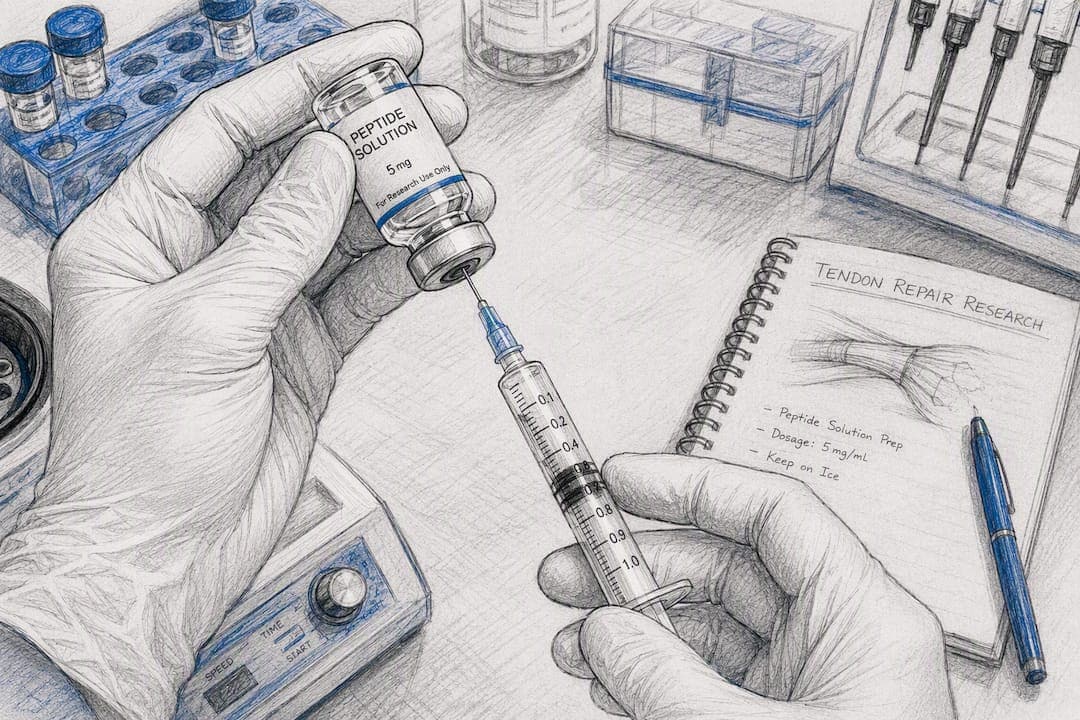
Angiogenesis is the formation of new blood vessels, driven partly by vascular endothelial growth factor (VEGF) and nitric oxide (NO) signaling. Tendons have notoriously poor blood supply, which is a major reason they heal slowly in the first place. BPC-157’s proposed local effect centers heavily on stimulating this process, restoring blood flow to a tissue that doesn’t get much of it naturally.
TSPC activation refers to waking up and multiplying the resident stem cells inside tendon tissue. This is where the PEDF 29-mer’s data gets specific. The study on the 29-mer’s mitogenic effect documented expansion of CD146+ and nucleostemin+ TSPCs within a week of a single injection. That expansion appears tied to activation of the ERK2 and STAT3 signaling pathways, according to mechanistic work on peptide-stimulated TSPC, two cell-signaling nodes that control proliferation in many tissue types, not just tendon.
ECM remodeling is the reorganization of collagen fibers into aligned, load-bearing structures. A torn or degenerated tendon often has disorganized, weaker collagen. Both the 29-mer and the KI24RGDS hydrogel showed measurable improvements in fiber alignment, which is the structural feature most directly tied to tensile strength.
Actin regulation governs how cells physically move and change shape, which matters for recruiting reparative fibroblasts to an injury site. TB-500’s proposed mechanism leans on this pathway more than BPC-157’s does, one reason researchers frame the two as complementary rather than redundant.
Why does any of this matter for choosing between options? An acute rupture and a chronic tendinopathy are different biological problems. Acute injuries may respond better to angiogenesis-focused compounds that jump-start blood flow and cell recruitment early. Chronic, degenerated tendons might benefit more from ECM remodeling and structural scaffolding, since the core problem is disorganized tissue rather than lack of initial healing signal.
The number worth remembering: TSPC expansion from the 29-mer was measurable within 2 to 7 days post-injection, with downstream collagen and strength improvements not showing up until the three-week mark. Mechanism and outcome don’t move on the same timeline, which is a detail easy to miss when skimming abstracts.
- Angiogenesis addresses poor tendon blood supply, a root cause of slow healing.
- TSPC activation recruits the tendon’s own stem cells rather than introducing foreign material.
- ECM remodeling fixes structural disorganization in already-healing tissue.
- Actin regulation supports cell migration and fibroblast recruitment to the injury site.
One caveat worth sitting with: mechanism data from rats and rabbits doesn’t automatically scale to human tendon biology. Tendon size, loading patterns, and healing timelines differ substantially between species, and a pathway that activates cleanly in a rodent Achilles tendon may behave differently in a human rotator cuff.
What Are the Best Delivery Methods for Tendon Peptides?
Getting a peptide to the tendon and keeping it there long enough to work is arguably a bigger scientific problem than finding an active compound in the first place. Tendons have limited blood flow, which is exactly why they heal slowly, but that same property makes them hard to reach with systemic (bloodstream-delivered) treatments.
Four delivery approaches dominate current research: local injection, hydrogel-based scaffolding, systemic injection, and oral supplementation. Each trades off differently between convenience, duration of effect, and how much of the compound actually reaches the target tissue.
Local injection puts the compound directly at the injury site, which sidesteps the blood-flow problem but usually means the effect is short-lived unless combined with a sustained-release carrier. Hydrogels solve that duration problem: the KI24RGDS study used an injectable scaffold that stayed in place and continued influencing tissue structure through the full 8-week observation window, and the PEDF 29-mer research used an alginate gel carrier specifically to control release timing rather than relying on a single bolus injection.
Systemic injection is simpler logistically but faces the homing problem head-on. A compound injected into the bloodstream has to find its way to a tissue with limited circulation, and much of the dose likely never reaches the tendon at meaningful concentration. This is precisely the gap that’s driving newer nanoparticle research.

Oral collagen peptides sit in their own lane. They don’t need to “target” tendon tissue in the same sense, since they’re providing systemic amino acid supply rather than a localized signaling effect, but that also means they’re working on a much slower, more general timescale than a local injection.
| Delivery Method | Pros | Cons | Typical Duration of Effect |
|---|---|---|---|
| Local injection | Direct tissue contact, bypasses poor blood supply | Effect often short-lived without a carrier | Days, unless combined with sustained release |
| Hydrogel scaffold | Sustained local release, structural support | Requires injection or minor procedure, still experimental | Weeks (8-week data documented for KI24RGDS) |
| Systemic injection | Simpler administration, no local procedure | Poor tendon homing, much of dose lost to circulation | Variable, generally lower local concentration |
| Oral collagen peptides | Non-invasive, widely available | Slow, general effect, not tendon-targeted | Ongoing with continued use |
| Nanoparticle-targeted delivery | Improved homing to tendon tissue | Early-stage, not yet broadly available | Under active investigation |
The nanoparticle approach deserves a closer look because it’s the newest attempt to solve the homing problem directly. Researchers have developed tendon-targeting nanoparticles functionalized with a TRAP binding peptide (TBP-NP), which improved delivery of a therapeutic inhibitor and enhanced functional and mechanical recovery in preclinical models. Instead of hoping a systemically injected compound finds the tendon on its own, this approach attaches a targeting molecule that actively steers the payload there. It’s a meaningfully different engineering strategy than local injection, and one that could eventually make systemic dosing viable for tendon-specific applications, though it remains firmly in the animal research stage.
Pro Tip: If you’re evaluating a supplier’s release-profile data for any hydrogel or scaffold product, ask specifically for the observation window (days vs. weeks), the animal model used, and whether the outcome measure was histological, biomechanical, or both. A supplier that can’t answer those three questions probably hasn’t reviewed the study they’re citing.
Is Peptide Therapy for Tendons Legal and Safe?
None of the peptides discussed here, BPC-157, TB-500, the PEDF 29-mer, GHK for tendon-specific use, or self-assembling hydrogels, carry FDA approval for treating tendon injuries. Collagen peptides are the exception, sold legally as dietary supplements, but they aren’t regulated as a therapeutic treatment for tendon damage either. Everything else in this category is sold and studied strictly as a research-use compound, not a medication a clinician can legally prescribe for tendon repair.
That distinction has real teeth. The FDA’s guidance on bulk drug substances used in compounding makes clear that compounding rules vary by substance and by application, and many research peptides fall outside any approved compounding pathway entirely. A compounding pharmacy offering to prepare BPC-157 for injection is operating in a legal gray zone that most consumers don’t recognize as one.
Safety concerns are harder to quantify than efficacy, mostly because so few human trials exist to document them. The concerns raised in preclinical and case literature include off-target angiogenesis (new blood vessel growth in tissues where it isn’t wanted), potential immune reactions to synthetic peptide fragments, and unknown long-term effects from repeated dosing, since even the animal studies rarely run longer than several weeks.
The absence of human safety data isn’t evidence of safety. It’s an absence of information, and that distinction gets lost in a lot of online discussion about these compounds.
Before considering any research use, ask these questions:
- Does the supplier provide a Certificate of Analysis (COA) confirming purity and identity for the specific batch you’re purchasing?
- Is the product independently third-party tested, not just tested in-house?
- What are the storage and stability requirements, and does the supplier disclose degradation data?
- Is there any dosing evidence behind the amounts being suggested, and does that evidence come from a species and injury model relevant to your research question?
- Has a clinician reviewed your specific situation if the goal involves any form of human application?
If you’re a researcher sourcing material for laboratory study rather than personal use, the BPC-157 and TB-500 research overview covers the kind of documentation that responsible sourcing should include. This article provides general information for research and educational purposes and is not a substitute for professional medical or legal advice.
How We Evaluated the Tendon Repair Research
Building an accurate picture of this field meant working through primary studies rather than relying on secondary summaries, since so much online content about BPC-157 and similar compounds repeats claims without checking the underlying data.
- Source search. Studies were pulled primarily from PubMed and PMC (PubMed Central), prioritizing peer-reviewed journal articles over blog posts or supplement marketing pages.
- Inclusion criteria. A study needed a clearly defined animal model (species and injury type specified), measurable outcomes (histology, biomechanical testing, or cellular markers), and peer review status to qualify as primary evidence.
- Model transparency check. Each study was flagged for exactly what it tested, rat Achilles tendon versus rabbit patellar tendon versus in vitro cell culture, since these are not interchangeable when assessing real-world relevance.
- Exclusion of unverifiable claims. Anecdotal reports, forum discussions, and studies without accessible methodology were excluded from the evidence base entirely.
The trust signals that mattered most in this review were explicit species and injury-model identification, availability of raw outcome measures rather than just summary conclusions, and peer-reviewed publication status. The clearest limitation across the entire field: there are essentially no randomized controlled human trials for tendon-specific peptide therapy, and the animal studies that do exist vary widely in dosing, injury model, and observation length, which makes cross-study comparison harder than it should be.
Data Peptides applies the same standard of scrutiny to its own product testing that this review applied to the research literature: third-party verification over self-reported claims, and full documentation over marketing language.
What Should Researchers and Patients Realistically Expect?
The honest takeaway here is that biological plausibility and clinical proof are not the same thing, and this field currently has a lot of the former and almost none of the latter. Three practical guidelines follow from that: prioritize compounds with mechanistic detail and multiple independent studies over ones riding on reputation alone, favor local delivery with a validated carrier (hydrogel or scaffold) over systemic dosing when researching acute injury models, and never source or administer unverified compounds outside a legitimate research or clinical framework. Peptides belong in the conversation as potential adjuncts to physical therapy, platelet-rich plasma (PRP), or surgical repair, not replacements for any of them.
What Responsible Peptide Sourcing Looks Like
Reproducible research depends on knowing exactly what’s in the vial. A supplier that can’t produce these on request isn’t one worth building a research protocol around.
Data Peptides provides lab-grade research peptides with third-party testing and Certificates of Analysis on every batch, covering compounds discussed throughout this article including BPC-157 and TB-500 formulations. That documentation exists specifically so researchers aren’t taking purity claims on faith. Combined with fast, discreet US shipping and support available around the clock, it’s built for labs and researchers who need consistent material without chasing down verification themselves.
If you’re evaluating options for a tendon-focused research protocol, the BPC-157 and TB-500 research applications guide covers dosing ranges used in laboratory settings and formulation notes worth reviewing before purchase. For general sourcing, the Data Peptides shop lists current research peptide inventory with COAs available for each product.
Sources
- Science
- Self-assembling peptide hydrogel scaffold accelerates healing of patellar tendon injury: A histological and biomechanical study
FAQ
Does BPC-157 work immediately for tendon injuries?
No. Animal studies show measurable healing markers appearing over days to weeks, not immediately, and there’s no human data confirming any timeline for tendon-specific effects.
Are collagen peptides good for tendon repair?
Collagen peptides support general connective tissue health by supplying amino acids for collagen synthesis, but they work through nutrition rather than the cell-signaling mechanisms that drive targeted tendon regeneration.
Which peptide has the strongest evidence for tendon healing?
The PEDF-derived 29-mer has the most mechanistically detailed evidence, showing specific TSPC expansion and measurable strength gains in controlled animal studies, though BPC-157 has the broadest body of preclinical research overall.
Is peptide therapy for tendons legal in the United States?
Collagen peptides are legal dietary supplements. Bioactive peptides like BPC-157 and TB-500 remain unapproved for medical use and are sold under research-use-only classification, not as prescription treatments.
How does Data Peptides ensure research peptide quality?
Data Peptides provides third-party testing and a Certificate of Analysis for each batch, giving researchers verified purity data rather than unverified seller claims.