

For laboratory research into brain-fog mechanisms, prioritize Semax, Selank, TAT-TrkB, and Cerebrolysin, with bSAPP and lactononadecapeptide (LNDP) as food-derived comparators. The single most important procurement step: never accept a shipment without a lot-specific Certificate of Analysis showing HPLC purity, mass spectrometry identity confirmation, and endotoxin (LAL) results.
- Semax, Selank, TAT-TrkB, Cerebrolysin, bSAPP, LNDP cover the main mechanistic angles: neurotrophic signaling, anxiolytic modulation, receptor cleavage prevention, and food-derived cognitive support.
- Demand chain-of-custody documentation alongside the CoA, especially for peptides headed into in vivo protocols.
- Confirm IACUC and institutional biosafety sign-off before any animal work begins, regardless of how routine the peptide seems.
Pro Tip: Request the raw HPLC and MS chromatogram files, not just a summary percentage. A supplier like Data Peptides that provides lot-specific chromatograms lets your team independently verify peaks instead of trusting a single number on a certificate.
Key Takeaways
Reproducible brain-fog peptide research depends on verified sequence identity, lot-specific CoAs, endotoxin testing, and confirmed intact-peptide brain exposure before any mechanistic claim is made.
| Point | Details |
|---|---|
| Shortlist core candidates | Prioritize Semax, Selank, TAT-TrkB, and Cerebrolysin, with bSAPP and LNDP as food-derived comparators. |
| Demand lot-specific documentation | Require HPLC/MS CoAs, endotoxin (LAL) results, and chain-of-custody paperwork before any order ships. |
| Verify on arrival | Run in-house LC-MS/MS identity checks and confirm cold-chain integrity before reconstitution. |
| Confirm brain exposure directly | Use LC-MS/MS on plasma and brain tissue rather than inferring exposure from behavioral results alone. |
| Choose a documented supplier | Data Peptides provides lot-specific CoAs, endotoxin testing, and institutional compliance support for these exact requirements. |
Table of Contents
- Which Peptides Are Used to Study Brain Fog Mechanisms?
- What Should You Require From a Peptide Supplier Before Ordering?
- How Do You Verify Peptide Quality in Your Own Lab?
- What Dosing and Model Examples Appear in the Literature?
- What Regulatory and Ethical Steps Apply to Peptide Research?
- How Should You Receive, Store, and Prepare Peptides?
- How Do You Confirm Brain Exposure and Mechanism?
- Where Can Research Organizations Source These Peptides?
- Sources
- FAQ
Which Peptides Are Used to Study Brain Fog Mechanisms?
Cognitive dysfunction research draws on a handful of peptides with distinct, well-characterized mechanisms rather than one catch-all molecule.
- Semax, an ACTH fragment, is tied to hippocampal BDNF upregulation and TrkB phosphorylation, with a short-lived pulse dynamic that shapes how often researchers dose it in preclinical models.
- Selank, a synthetic tuftsin analog, shows anxiolytic and GABAergic gene-expression effects, with a 14-day dosing course serving as the standard clinical anchor point.
- TAT-TrkB is a fused peptide that blocks TrkB-FL receptor cleavage, and it rescued synaptic plasticity deficits in a 5XFAD Alzheimer’s mouse model.
- Cerebrolysin, a porcine-brain peptide and amino acid mixture, is typically administered as a 10 to 20 day injection course in stroke and dementia research.
- Food-derived peptides like bSAPP and LNDP offer oral administration routes but carry real bioavailability and blood-brain barrier caveats.
TAT-TrkB improved Morris water maze performance in 5XFAD mice with no liver or kidney toxicity reported in that study, a notable finding for a peptide engineered to cross the blood-brain barrier via its TAT domain.
What Should You Require From a Peptide Supplier Before Ordering?
Treat procurement as a verification exercise, not a purchase transaction. A supplier’s marketing claims mean nothing without paperwork tied to the specific lot arriving at your bench.
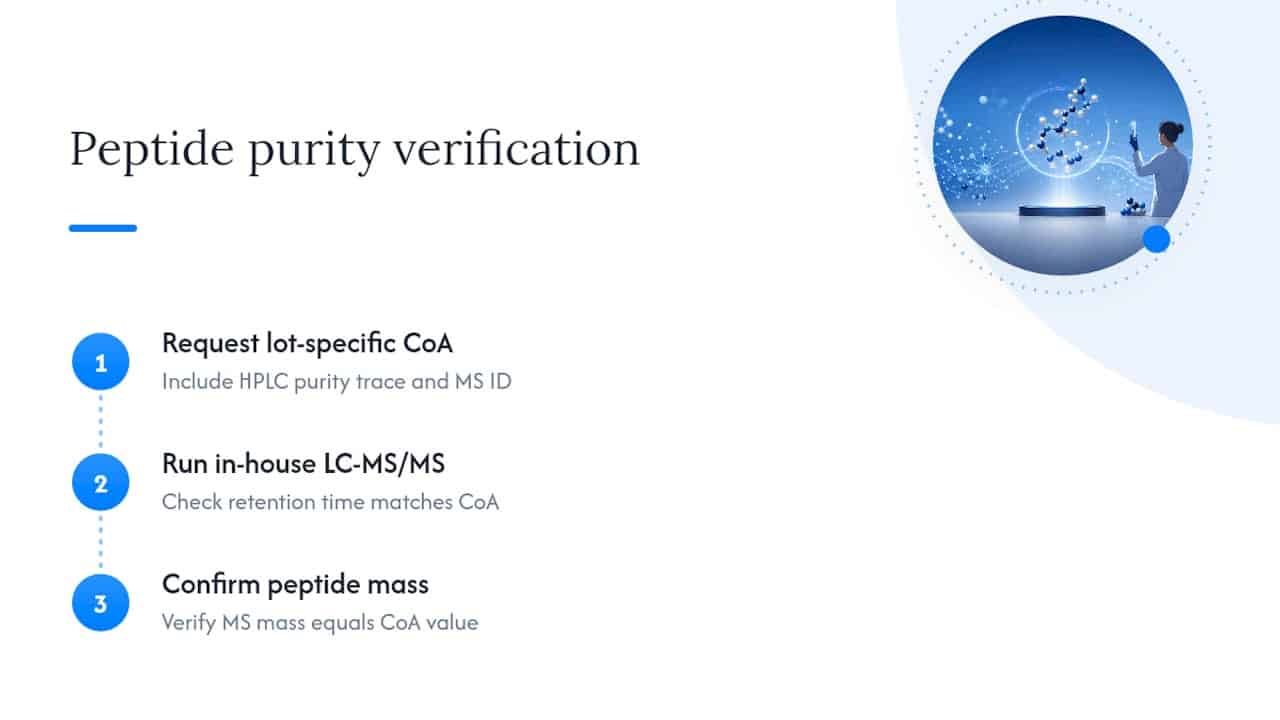
- Lot-specific Certificate of Analysis. It needs an HPLC purity trace, MS identity confirmation with exact mass or sequence data, and a declared assay percentage, not a generic product-line average.
- Endotoxin and sterility reports. Any peptide destined for in vivo or intracerebral work needs a documented LAL result, with tighter thresholds expected for parenteral and intracerebral routes than for standard in vitro use.
- Third-party testing availability. Ask whether independent retesting is contractually permitted, and get chain-of-custody documentation plus an MSDS or technical datasheet in writing.
- Supply-chain terms. Confirm lead time, cold-chain or desiccant-packed shipping conditions, and a written policy for failed-batch returns before you commit budget.
A few practical red flags to watch for:
- A CoA dated months before shipment, or one that references a different lot number than what’s on the vial.
- Reluctance to share raw chromatogram files when you ask directly.
- No stated endotoxin threshold, or a threshold that doesn’t match your intended administration route.
Data Peptides structures its documentation around exactly this checklist, and its buy peptides guide walks through the same compliance expectations in more depth.
How Do You Verify Peptide Quality in Your Own Lab?
Supplier documentation is a starting point, not a substitute for your own bench verification. Build a receiving protocol that treats every new lot as unverified until your instruments say otherwise.
- Run LC-MS/MS to confirm peptide mass and sequence, matching MS/MS fragmentation patterns against the expected structure.
- Compare HPLC retention time against the supplier’s CoA trace; a shift suggests degradation or a formulation change.
- For in vivo work, push your purity threshold above 99% and document any impurity peaks rather than ignoring them.
- Re-run LAL endotoxin and sterility tests in-house when the study design calls for parenteral or intracerebral administration.
- Verify storage integrity on arrival: check desiccant packs, vial seal condition, and cold-chain temperature logs before reconstitution.
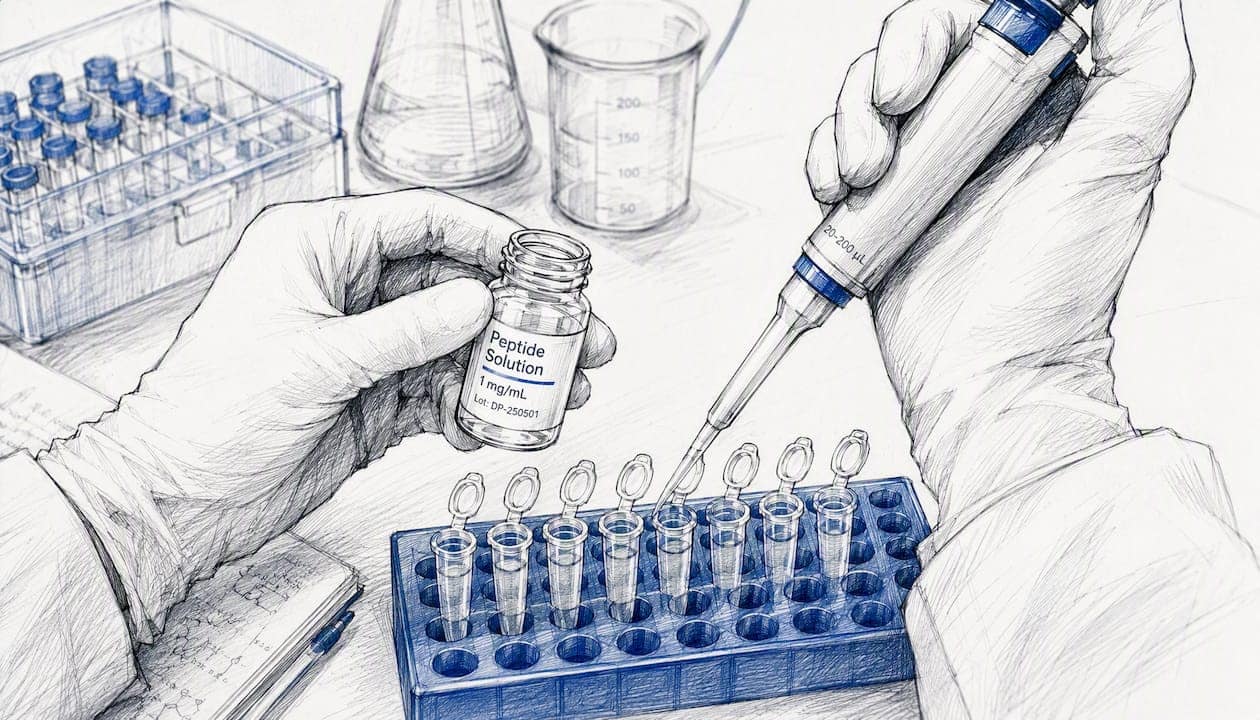
- Reconstitute using validated solvents and sterile technique, and record final concentration for every aliquot.
Pro Tip: Keep a QC log tied to lot number, and attach the scanned CoA plus your own retest results directly to the experiment file. When a reviewer asks how you know the peptide was what the label said, this is the answer.
What Dosing and Model Examples Appear in the Literature?
Route and timing choices should track the mechanism you’re testing, not a generic dosing convention borrowed from an unrelated peptide class.
- Semax intranasal dosing in rodents is usually daily or twice-daily, timed to match the short-lived hippocampal BDNF pulse rather than a steady-state exposure model.
- Selank preclinical work often mirrors the 14-day clinical course, with microgram-per-day intranasal ranges scaled to the same anxiolytic and GABAergic endpoints seen in human trials.
- TAT-TrkB proof-of-concept studies used intraperitoneal administration in transgenic mouse models over defined multi-week schedules, tracking receptor cleavage prevention alongside behavioral recovery.
- Cerebrolysin courses run 10 to 20 days, delivered intramuscularly or via slow IV infusion in stroke and dementia protocols, with safety monitoring built into each session.
- bSAPP produced cognitive benefits in high-fat-diet mice at an EC50 of 0.01 mg/kg body weight per day, acting through CCK1R and acetylcholine signaling with measurable hippocampal neurogenic markers.
- LNDP improved composite and verbal memory scores against placebo in a randomized, double-blind, cross-over human trial, a rare food-derived peptide with direct human cognitive data.
Track behavioral assays like the Morris water maze, long-term potentiation measures, and neurotrophic biomarkers as your primary readouts across these models, since dosing without a matched endpoint tells you little about mechanism.
What Regulatory and Ethical Steps Apply to Peptide Research?
Institutional approval isn’t a formality you clear once and forget. Every new protocol involving these peptides needs its own review pass.
- Secure IACUC approval for any vertebrate animal work, and route recombinant sequences or delivery vectors through your institutional biosafety committee.
- Confirm the product carries clear “research use only” labeling, and check for jurisdictional import or export restrictions before placing an international order.
- Document administration protocols and safety monitoring in writing, and never present these peptides as clinical treatments in any internal or external communication.
- Keep CoAs, MSDS sheets, and shipping manifests attached to the protocol file itself, ready for audit or inspection at any point.
How Should You Receive, Store, and Prepare Peptides?
Degradation often happens in the first hour after delivery, not in the freezer months later. Build your receiving workflow around that reality.
- Inspect packaging, temperature-monitoring inserts, and vial seals immediately, then match every lot number against its CoA before anything goes into storage.
- Store lyophilized powders at negative 20 degrees Celsius with desiccant, and keep liquid formulations refrigerated at 2 to 8 degrees Celsius or frozen as the datasheet specifies, avoiding repeated freeze-thaw cycles.
- Prepare working solutions in sterile, low-bind tubes with validated solvents, record final concentrations, and aliquot for single use wherever possible.
- Insist on overnight cold-chain shipping with a validated carrier and temperature-monitoring inserts for any parenteral-grade lot.
How Do You Confirm Brain Exposure and Mechanism?
A peptide that works in a dish doesn’t automatically cross into brain tissue, and that gap is where a lot of preclinical claims fall apart.
Build your pharmacokinetic plan around time-course sampling of plasma and brain tissue, using LC-MS/MS to confirm the intact peptide is actually present rather than a degraded fragment. Report recovery rates and limit of detection or quantification (LOD/LOQ) alongside your results, since a peptide detected at the noise floor isn’t the same as one showing meaningful exposure. Blood-brain barrier transport reviews consistently flag this as the field’s central uncertainty: many food-derived and small peptides show activity in animal models, but intact brain bioavailability is often low and requires direct mass-spec confirmation, not inference from behavioral outcomes alone.
- Use in vitro BBB models, in situ brain perfusion, or in vivo parenchyma detection to demonstrate actual transport.
- Include scrambled-peptide controls, a vehicle arm, and a positive comparator such as a BDNF mimetic or cholinesterase inhibitor where mechanistically relevant.
- Measure BDNF/TrkB signaling, long-term potentiation, Morris water maze performance, and inflammatory or amyloid markers depending on your model.
Pro Tip: Pre-register your analytic methods and LOD/LOQ thresholds before you run the study. It closes off the temptation to reinterpret a borderline signal as proof of brain exposure after the fact.
A Supplier’s Note on Reproducibility
Data Peptides, operating as Trusted American Peptides, supplies lab-grade peptides with lot-specific CoAs, MSDS documentation, and optional third-party testing built into every order. Institutional customers can request batch traceability records and expedited shipping, along with compliance paperwork to support IACUC and biosafety submissions. This is supplier-provided information meant to describe available documentation, not a clinical claim about any peptide’s effects.
Where Can Research Organizations Source These Peptides?
Sourcing reliable material is usually the bottleneck, not the science. Data Peptides supplies lab-grade peptides at greater than 99% purity, backed by lot-specific HPLC and MS Certificates of Analysis, endotoxin testing, and cold-chain shipping built for institutional timelines rather than one-off retail orders.
Researchers ordering in bulk can request documentation directly through the peptide shop for institutional quantities, stability data, and CoAs tied to the exact lot shipped. Trust signals worth checking before you commit a budget line:
- Lot-specific HPLC/MS CoAs available on request, not just a generic product page.
- Endotoxin (LAL) testing documented for parenteral-grade material.
- Chain-of-custody records and institutional biosafety support documentation available for IACUC submissions.
For labs building out a broader peptide research program, the best peptides for research guide breaks down selection criteria across cognitive, metabolic, and recovery-focused study designs. Start with a documentation request before your next order ships.
Sources
Key primary sources for this article include the TAT-TrkB Alzheimer’s model study, the Semax and related peptide literature on PubMed, the bSAPP oral cognition study, the LNDP human trial, and the blood-brain barrier transport review. For supplier-side documentation formats, see Data Peptides’ peptide product and quality standards page and its laboratory research applications guide.
- PubMed 16996037 (Semax / related peptide literature)
- PubMed 41405891 (bSAPP study)
- Impact of Peptide Transport and Memory Function in the Brain (review)
- A small TAT‑TrkB peptide prevents BDNF receptor cleavage and restores synaptic physiology in Alzheimer’s disease (2024)
- Effects of a single dose of tablets containing lactononadecapeptide on cognitive function in healthy adults (trial)
FAQ
What Are the Best Peptides for Studying Memory and Focus?
Semax, Selank, TAT-TrkB, and Cerebrolysin cover the main mechanistic categories: neurotrophic signaling, anxiolytic modulation, receptor cleavage prevention, and broad neurotrophic support, respectively.
How Do You Verify a Peptide’s Purity Before a Study?
Request a lot-specific Certificate of Analysis with an HPLC purity trace and MS identity confirmation, then confirm retention time and mass in-house with your own LC-MS/MS run.
What Endotoxin Threshold Should In Vivo Studies Use?
Parenteral and intracerebral routes require tighter LAL endotoxin thresholds than standard in vitro use, and the exact threshold should be documented in your protocol and matched against the supplier’s sterility report.
Why Does Blood-Brain Barrier Transport Matter for These Peptides?
Many peptides show activity in cell or animal models but have low intact brain bioavailability, so BBB transport studies recommend LC-MS/MS confirmation of intact peptide in brain tissue rather than relying on behavioral outcomes alone.
Where Can Research Organizations Buy Lab-Grade Peptides for This Work?
Data Peptides supplies these peptide categories with lot-specific HPLC/MS CoAs, endotoxin testing, and cold-chain shipping suited to institutional research timelines, available through its shop page.