

In this guide, “nootropic peptides” means lab-grade, research-use-only compounds like Semax and Selank, sold strictly for laboratory study of cognitive mechanisms, not for human or animal use. The one rule that matters more than any other: never accept a lot without a verifiable, lot-matched Certificate of Analysis (COA) from a named independent testing laboratory. Everything else in procurement is downstream of that decision.
- Scope: research-use-only (RUO) peptides intended for laboratory experiments only
- Non-negotiable: a COA must match the specific lot number on your vial, not just the product name
- Legal/safety note: these compounds are not approved or intended for human or animal administration
Key Takeaways
A lot-matched COA from a named independent lab, verified through HPLC purity and MS identity data, is the single documentary requirement that separates trustworthy research peptide lots from unverifiable ones.
| Point | Details |
|---|---|
| Require lot-matched COAs | Never accept a COA that doesn’t reference the exact batch number on your vial. |
| Distinguish purity from identity | HPLC shows chromatographic purity; only MS confirms molecular identity, especially against co-elution risk. |
| Verify independently | Contact the named lab directly and confirm the report number rather than trusting the supplier’s word. |
| Handle by sequence chemistry | Store lyophilized, limit freeze-thaw cycles, and protect oxidation-prone residues from moisture and air. |
| Choose documented suppliers | Data Peptides provides lot-matched COAs, named lab reports, and continuous support for verification questions. |
Table of Contents
- What Does “Nootropic Peptides” Mean in a Research Context?
- How Do You Verify a Peptide’s Certificate of Analysis?
- What Do HPLC and Mass Spectrometry Actually Prove?
- How Should You Store Peptides to Preserve Integrity?
- What Is the Right Procurement Workflow Before and After Purchase?
- Why Documentation, Not Marketing, Protects Your Research
- Where to Find Verified Lab-Grade Nootropic Peptides
- Sources
- FAQ
What Does “Nootropic Peptides” Mean in a Research Context?
Consumer marketing has muddied this term. Search results for “nootropic peptides” often surface supplement blogs pitching self-administration, but that is a different subject with a different audience. This article covers research-grade RUO peptides purchased by labs and advanced hobbyists to study cognitive mechanisms in controlled experimental settings.
Peptides like Semax, Selank, and similar sequences appear frequently in research catalogs as examples of compounds studied for effects on neurotrophic signaling and stress-related behavior in laboratory models. None of that implies a use case outside the lab.
The RUO classification changes what you should demand from a supplier:
- No dosing guidance, human-use claims, or administration instructions should accompany a legitimate RUO listing
- Documentation should focus on identity, purity, and lot traceability, not efficacy claims
- A vendor treating RUO status as a legal formality rather than an operational standard is a documentary red flag on its own
Once you accept RUO as the operating framework, the COA becomes the actual product you are buying almost as much as the peptide itself.
How Do You Verify a Peptide’s Certificate of Analysis?
A COA is only as good as its weakest documentary element. Peptidepedia’s review of the space found that many COAs in this market are technically compliant, reporting purity and molecular weight, but lack the metadata needed to catch real failure modes like batch substitution or degraded stock.
Run every COA through this sequence before you accept a lot:
- Match the lot number. The batch identifier on the COA must correspond exactly to the vial label, not just the product line.
- Confirm the testing lab is named and independent. A COA that says “third-party tested” without naming the lab tells you nothing.
- Check the dates. Test date and report date should be recent relative to your purchase, not recycled from an old run.
- Look for a chromatogram and, ideally, a mass spectrum. Raw data beats a summary number.
- Test the verification mechanism. A QR code or lot code should resolve on the testing lab’s own domain, not the seller’s site.
PeptideTrust’s transparency checklist lays out these same five signals and notes that missing elements compound rather than cancel out. Two small gaps together are worse than either alone.
Pro Tip: Call or email the lab named on the COA directly and ask them to confirm they issued that specific report number. A legitimate lab will respond within a day or two; silence is itself a data point.
Red flags that should disqualify a lot outright: a COA with no lot number, a cropped or watermark-free chromatogram image, a broken or dead verification link, or a report that presents an HPLC purity figure as though it also proves molecular identity. That last one is subtle but common, and it deserves its own explanation.
What Do HPLC and Mass Spectrometry Actually Prove?
High-performance liquid chromatography (HPLC) measures chromatographic purity, essentially the proportion of material eluting as your target peak versus everything else in the sample. Mass spectrometry (MS) measures molecular identity, confirming that the observed mass matches the theoretical mass of the intended peptide. These are not interchangeable, and treating a high HPLC purity number as proof you have the right molecule is a documented failure mode.

Analysis comparing the two methods points out that co-elution, when a different compound travels through the column at the same rate as your target, can produce a clean-looking single peak on HPLC even though the sample contains the wrong molecule entirely.
What strengthens confidence beyond a bare purity percentage:
- System-suitability data showing the method itself was validated against a reference standard
- A stated method description (column type, mobile phase, detection wavelength) rather than a number with no context
- Presence of both HPLC and MS on the same report when identity confirmation genuinely matters for your protocol
PeptideTrust’s guidance frames this as an orthogonality problem: relying on a single assay creates a blind spot that a second, independent method closes. If your experiment depends on knowing exactly which molecule is in the vial, insist on MS data before you rely on the lot.
How Should You Store Peptides to Preserve Integrity?
Storage mistakes quietly corrupt experiments long before anyone questions the peptide’s identity. JPT’s peptide storage guidance recommends lyophilized (freeze-dried) storage as the default for anything not in immediate use, since reconstituted solutions degrade faster than powder.
Sequence chemistry determines your risk profile:
- Sequences containing cysteine, methionine, or tryptophan residues are oxidation-prone and benefit from degassed or oxygen-limited solvents
- Hygroscopic peptides absorb ambient moisture quickly, so minimize time with the vial open
- Repeated freeze-thaw cycles damage peptide structure cumulatively, even when each individual thaw seems harmless
Prepare solutions fresh rather than storing reconstituted stock for extended periods, and log retest or expiry dates alongside your storage conditions for every lot. Data Peptides’ lab best-practices resource covers sequence-specific handling in more depth if your protocol involves oxidation-sensitive residues.
Pro Tip: Keep a simple log tying each vial’s lot number to its storage date, temperature, and number of freeze-thaw cycles. When results look inconsistent months later, that log is often the fastest way to rule out a handling artifact.
What Is the Right Procurement Workflow Before and After Purchase?
Documentary and analytical checks only protect you if they happen in the right order, before money changes hands and again the moment the shipment arrives.
Before you buy:
- Request the lot-matched COA for the exact batch you intend to purchase, not a generic product-level sample report.
- Ask for MS data specifically if your protocol depends on confirmed identity rather than purity alone.
- Verify the named lab’s accreditation independently. Guidance on third-party testing points to labs like Janoshik and Eurofins as examples of independent testing operations that publish accessible original reports rather than in-house summaries.
On receipt:
4. Confirm the lot number on the physical vial matches the COA you were sent before purchase.
5. Inspect the chromatogram and MS spectrum for irregularities, and check that test dates are current relative to shipment.
6. Log storage instructions immediately so handling starts correctly from day one.
If verification fails at any step, request a retest from the named lab, insist on independent third-party reanalysis, or reject the batch outright. VialVerdict’s guidance recommends pairing COA checks with supplier-history due diligence, since a clean report from a supplier with a pattern of quiet substitutions is worth less than it looks.
Pro Tip: Treat an unmatched COA as representative documentation, not a release document. It tells you what a similar batch once looked like, not what is in your vial.
Why Documentation, Not Marketing, Protects Your Research
Marketing language about purity and efficacy is cheap to produce and expensive to verify. A named lab, a matched lot number, and a chromatogram you can actually inspect are not. That asymmetry is the entire argument for treating COA literacy as a research skill rather than an administrative afterthought.
Data Peptides builds its own catalog around that asymmetry: third-party COAs tied to specific lots, accessible reports, and support available to answer verification questions rather than deflect them. That is not a claim of perfection. It is a bet that reproducibility starts with paperwork most buyers never read closely enough.
— Data Peptides
Where to Find Verified Lab-Grade Nootropic Peptides
Every checklist in this guide describes what Data Peptides already builds into its process: lot-matched Certificates of Analysis, named third-party lab reports, and chromatogram or mass spectrum data included wherever available. Verification support is available around the clock, so if a COA detail looks unclear before you commit to a lot, you can ask before you buy rather than after.
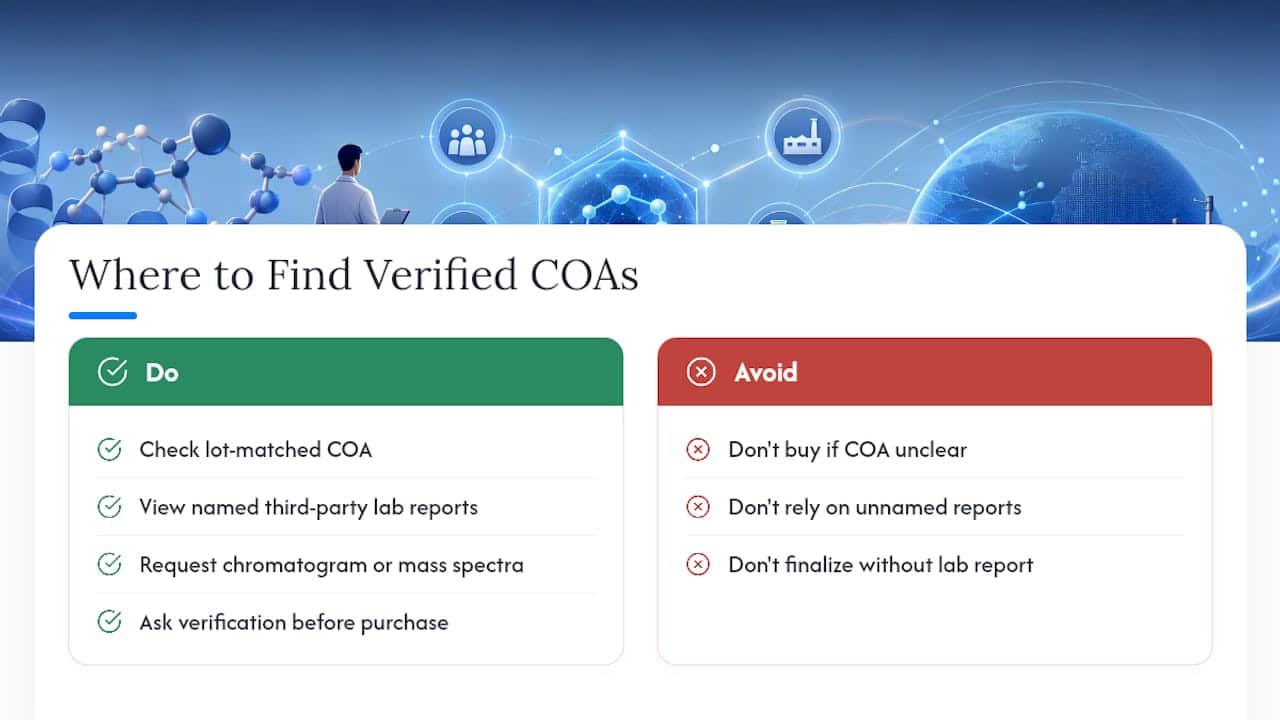
The Data Peptides shop lists current lab-grade research peptides with COA access for each listing, and the main product catalog is the fastest starting point if you are comparing options across categories. For researchers specifically working with cognition-related sequences, the research applications overview walks through documented lab use cases without straying into administration or dosing territory. If a COA on any listing raises a question, request the underlying lab report before you finalize an order.
Sources
- Peptide Vendor Transparency Red Flags: A CoA Checklist
- How to read a peptide COA & HPLC report · VialVerdict
- Peptide Certificates of Analysis: How to Read and Verify a COA (2026 Guide) | Peptidepedia
- How to store peptides (JPT blog)
FAQ
What makes a peptide COA trustworthy?
A trustworthy COA names the independent testing lab, matches the exact lot number on your vial, includes a chromatogram or mass spectrum, and offers a verification code that resolves on the lab’s own domain.
Does high HPLC purity mean the peptide identity is confirmed?
No. HPLC measures chromatographic purity only; co-elution can make a wrong molecule look like a clean, high-purity peak, so mass spectrometry is needed to confirm identity.
How should research-grade nootropic peptides be stored?
Store them lyophilized when possible, minimize freeze-thaw cycles, protect oxidation-prone sequences from moisture and oxygen, and prepare solutions fresh rather than storing reconstituted stock.
What should I do if a supplier’s COA doesn’t match the vial lot?
Request a retest or independent third-party reanalysis, and reject the batch if the supplier can’t produce lot-matched documentation.
Does Data Peptides provide lot-matched COAs for its research peptides?
Yes, Data Peptides provides lot-matched Certificates of Analysis with third-party lab reports and chromatogram or MS data where available, alongside support for verification questions.