

Peptides for recovery research most commonly means BPC-157, TB-500, and related sequences like Peptide 157, all used strictly as reference compounds in tissue-repair and inflammation-modulation studies. Before any of it touches a bench, one step matters more than the peptide you pick: authenticate a batch-specific Certificate of Analysis (CoA) that includes an HPLC chromatogram and mass spectrometry identity, not just a stated purity number. A purity percentage with no chromatogram is a marketing claim, not a lab result.
Everything discussed here applies to research-grade material intended for laboratory and preclinical use only.
- Common recovery-research reference peptides: BPC-157, TB-500, Peptide 157
- Non-negotiable verification: batch-level CoA with chromatogram + MS identity, ideally confirmed at the testing lab
- Scope: research-use-only, not intended for human or animal administration
Key Takeaways
Research-grade recovery peptides are only as reliable as the batch-specific CoA behind them, and net peptide content, not HPLC purity alone, determines real dosing accuracy.
| Point | Details |
|---|---|
| Verify before you buy | Trace every CoA verification code to the testing lab’s own domain, not a vendor-hosted PDF. |
| Purity and identity are separate | A chromatogram shows purity; mass spectrometry confirms it’s the right molecule. |
| Correct for net peptide content | A 98%-pure vial at 82.3% net content yields roughly 7.84 mg usable peptide from a 10 mg label. |
| Match purity to assay type | Use 95%+ for ELISA/Western blot, 98%+ for cell-based dose-response, 99%+ for structural work. |
| Spot-check incoming batches | Independently test 5 to 10% of critical batches to catch supplier drift early. |
| Data Peptides documentation standard | Data Peptides ships batch-level CoAs with chromatogram and mass-identity data behind its recovery-research peptides. |
Table of Contents
- Overview of Peptides Commonly Used in Recovery Research
- How to Read and Authenticate a Peptide Certificate of Analysis
- Core Analytical Methods: What HPLC, LC-MS, and AAA Actually Measure
- Matching Purity Specs to Your Assay, with a Worked Dosing Example
- Procurement and Incoming QA Practices Worth Building Into Your Workflow
- Publisher Standards: What Data Peptides Provides Against This Checklist
- The Biological Mechanisms Behind Peptide-Driven Recovery Research
- Safety Considerations Researchers Need to Document
- Dosage and Administration Protocols in Preclinical Study Design
- Peptides Versus Other Recovery-Research Agents
- What the Current Evidence Base Actually Shows
- Why CoA Literacy Matters More Than Brand Reputation
- Where to Source Research-Grade Recovery Peptides
- Sources
- FAQ
Overview of Peptides Commonly Used in Recovery Research
Researchers studying tissue repair and inflammation pathways tend to gravitate toward a small set of peptides with well-documented structural profiles and a long history in preclinical literature. None of what follows is a clinical recommendation. These are lab reagents studied for specific mechanistic questions, and each entry below should arrive with a batch-matched CoA before it goes anywhere near an assay plate.
- BPC-157 — a synthetic fragment studied in gastric and connective-tissue repair models, frequently used in tendon and ligament fibroblast migration assays.
- TB-500 — a synthetic peptide fragment derived from thymosin beta-4, studied in cell-migration and angiogenesis assays related to wound closure.
- Peptide 157 — used in some labs as an alternate designation within BPC-157 research lines; treat as a distinct catalog item requiring its own CoA verification.
- GHK-Cu — a copper-binding tripeptide studied in dermal fibroblast and collagen-synthesis models.
- Thymosin alpha-1 — examined in immune-modulation research relevant to inflammation resolution timelines.
- KPV — a tripeptide fragment studied in anti-inflammatory signaling assays, often in ex vivo gut or skin tissue models.
- AOD-9604 — occasionally included in metabolic-recovery adjacent research, though its primary literature centers on lipid metabolism.
Every one of these should ship as a third-party tested batch with its own CoA. A single generic certificate covering “all products in this line” is a documentation shortcut, not proof of what’s in your vial.
How to Read and Authenticate a Peptide Certificate of Analysis
A CoA is only useful if it is tied to the specific batch in your hand. A credible CoA is batch-specific and it should carry the testing lab’s name, a batch or lot number, the date of analysis, an HPLC chromatogram with stated method parameters, and mass spectrometry identity data comparing observed versus theoretical mass. Net peptide content from amino-acid analysis, when available, tells you something a purity number alone cannot.
What each field actually proves:
- Named lab and accreditation status: tells you who stands behind the numbers, and whether they’re audited to a standard like ISO/IEC 17025.
- Batch/lot number matching the vial: without this match, the certificate is describing a different vial than the one you’re holding.
- HPLC chromatogram with method details: shows retention time, column type, and mobile-phase modifiers, letting you judge separation quality rather than trusting a single summary number.
- MS identity (observed vs. theoretical mass): confirms the molecule is structurally what it claims to be, which purity alone never establishes.
- Verification code or lab-hosted lookup: a code that resolves on the testing lab’s own domain is far harder to fake than a vendor-hosted PDF.
Red flags worth rejecting outright: no lab name anywhere on the document, a generic certificate reused across multiple product SKUs, purity stated with no chromatogram attached, or a QR code that leads nowhere verifiable. Purity and identity are separate questions. A compound can show 99% purity on a chromatogram and still be the wrong molecule if no one ran mass spec against it.
Pro Tip: Before you order, ask the supplier for a sample CoA from a recent batch of the exact catalog number you want, then trace the verification code yourself. If it doesn’t resolve on the lab’s own site, treat that as a decline.
Core Analytical Methods: What HPLC, LC-MS, and AAA Actually Measure
RP-HPLC combined with intact mass LC-MS forms the minimum characterization package for any research-grade peptide. Each method answers a different question, and a CoA missing one of them is answering only part of what you need to know.
- RP-HPLC: separates the peptide from synthesis byproducts and reports retention time under stated conditions. Check the column type and whether the method used trifluoroacetic acid (TFA), formic acid (FA), or difluoroacetic acid (DFA) as a mobile-phase modifier, since that choice shifts retention behavior and affects downstream salt form.
- LC-MS intact mass: confirms the molecule’s mass matches the theoretical value for the sequence, catching deletions, oxidations, or incomplete synthesis that HPLC alone would miss.
- MS/MS sequencing: fragments the peptide to confirm the actual amino-acid order, the level of proof you want when sequence-level identity, not just mass, is the concern.
- Amino-acid analysis (AAA): determines net peptide content, correcting for counterions, salts, and residual moisture that gravimetric weight ignores entirely.
Reports pairing chromatograms with intact mass and MS/MS data expose co-eluting or isobaric impurities that a purity number alone would hide, which matters directly for experimental reproducibility. Request endotoxin, sterility, and heavy-metal testing as add-ons when the peptide will touch cell culture or any sensitive biological system.
Matching Purity Specs to Your Assay, with a Worked Dosing Example
Purity requirements aren’t uniform across experimental contexts, and purity thresholds do scale with application:
- ELISA or Western blot work: 95% purity or higher is generally adequate, since these assays tolerate a small impurity margin.
- Cell-based dose-response assays: 98% or higher is the safer floor, because low-level impurities can skew EC50 curves in ways that are hard to trace back.
- NMR or crystallography-grade structural work: 99%+ purity, where even trace contaminants distort structural data.
Impurity identity matters as much as impurity quantity; a 2% contaminant that’s a known degradation product behaves very differently from an unidentified 2% peak. Salt form matters too. Acetate salts or desalted material are generally preferred over TFA salts for sensitive cell assays, since residual TFA can introduce cytotoxicity at higher concentrations.
Here’s where net peptide content changes your math. A 10 mg vial at 98% HPLC purity but 82.3% net peptide content actually contains roughly 7.84 mg of usable peptide, not 9.8 mg.
Procurement and Incoming QA Practices Worth Building Into Your Workflow
Good documentation habits at intake save far more time than they cost. Require a batch-specific CoA with full method details before you place an order, not after, and favor suppliers using ISO/IEC 17025-accredited labs or ones offering a verifiable lookup rather than a static PDF.
- Tag every incoming vial with its batch number and file the matching CoA alongside it, since a certificate with no matching batch number on the vial is functionally worthless.
- Run independent confirmatory testing on 5 to 10% of incoming batches for anything feeding a critical assay, a spot-check ratio that catches supplier drift before it corrupts a dataset.
- Keep a CoA history per supplier so a shift in method parameters, lab name, or format shows up immediately rather than three orders later.
- Escalate any documentation discrepancy in writing and set a retention timeline for CoAs consistent with your institution’s QA policy.
Traceability discipline extends beyond peptides into raw-material sourcing generally, and the same supply-chain QA principles apply whether you’re vetting a peptide supplier or any other reagent stream feeding a controlled study.
Pro Tip: Build a simple spreadsheet tracking batch number, CoA date, verification status, and spot-check outcome for every order. Six months in, that log is the fastest way to spot a supplier whose documentation quality is slipping.
Publisher Standards: What Data Peptides Provides Against This Checklist
Data Peptides supplies research-grade material with the documentation this checklist demands. Every batch ships with comprehensive third-party testing and a matching Certificate of Analysis, and the CoA verification process is built around the same fields covered above: batch number, chromatogram data, and identity confirmation where available.
- Third-party testing on every batch, not spot-tested samples pulled from a general product line
- Product focus areas spanning recovery acceleration, tissue-repair research, and related preclinical categories
- Batch-level CoAs aligned with chromatogram and MS-identity expectations
- Fast, discreet US shipping with 24/7 support for order and documentation questions
- Explicit research-use-only framing on every product listing, with no ambiguity about intended use
This is Data Peptides describing its own documentation standard, not a neutral audit of the supplier market. Researchers should still run the verification steps outlined above on any batch they receive, from any source.
The Biological Mechanisms Behind Peptide-Driven Recovery Research
Recovery-focused peptides get studied because they intersect with a small number of well-characterized biological pathways, not because of a single universal mechanism. Tissue-repair research on peptides like BPC-157 typically centers on fibroblast migration and angiogenesis, the process by which new blood vessels form to support healing tissue. TB-500 research follows a related but distinct angle, examining how a thymosin beta-4 derived fragment influences actin regulation in migrating cells, a step that matters for how quickly wound edges close in culture models.

Inflammation modulation is the other major thread running through this literature. Many recovery peptides get studied for their effect on cytokine signaling, the chemical messaging system that determines whether an injury site stays in an inflammatory state or transitions into repair. KPV research, for instance, looks specifically at anti-inflammatory signaling in gut and skin tissue models, while thymosin alpha-1 studies tend to focus on immune modulation timelines rather than direct tissue rebuilding.
None of these mechanisms are interchangeable, and none of them are established human therapeutic pathways. They’re research questions being asked in specific assay systems, cell lines, and small-animal models, with results that vary by tissue type, dose, and experimental design. Anyone drawing a straight line from an in vitro migration assay to a claimed recovery outcome is skipping several unresolved steps.
Safety Considerations Researchers Need to Document
Handling recovery peptides in a lab setting carries the same baseline safety considerations as any bioactive research compound, plus a few specific to peptide chemistry. Endotoxin contamination is the first concern for anything touching cell culture. Endotoxin testing by LAL or rFC should be requested for any batch used in sensitive biological assays, since even trace bacterial endotoxin can confound cytokine or inflammation-pathway readouts.

Sterility screening matters for the same reason. A peptide that’s structurally pure but microbially contaminated will produce results that look like a biological effect but are actually an artifact of the culture conditions. Residual solvents and counterion content are the next layer. TFA residue, in particular, carries documented cytotoxicity risk at higher concentrations in cell-based work, which is part of why acetate salt forms are often preferred for sensitive assays.
Heavy metal contamination from synthesis catalysts is a lower-frequency but real concern, and it’s worth requesting when a supplier’s standard panel doesn’t already include it. None of these considerations apply to human or animal exposure in this context. They apply to keeping an experimental system clean enough that the data reflects the biology being studied, not an artifact of impure material. Any lab running these peptides should maintain safety data sheets, appropriate personal protective equipment protocols, and standard chemical hygiene practices consistent with institutional biosafety policy, the same as for any other bioactive research reagent.
Dosage and Administration Protocols in Preclinical Study Design
Dosing and delivery route in recovery-peptide research are experimental design variables, not treatment recommendations. In vitro work typically involves dose-response curves across a concentration range determined by the specific assay, often spanning several orders of magnitude to establish where an effect plateaus or disappears. Getting that concentration right depends entirely on knowing the actual usable peptide mass in a vial, which loops back to the net peptide content correction covered earlier. A miscalculated stock concentration undermines every downstream data point in a dose-response series.
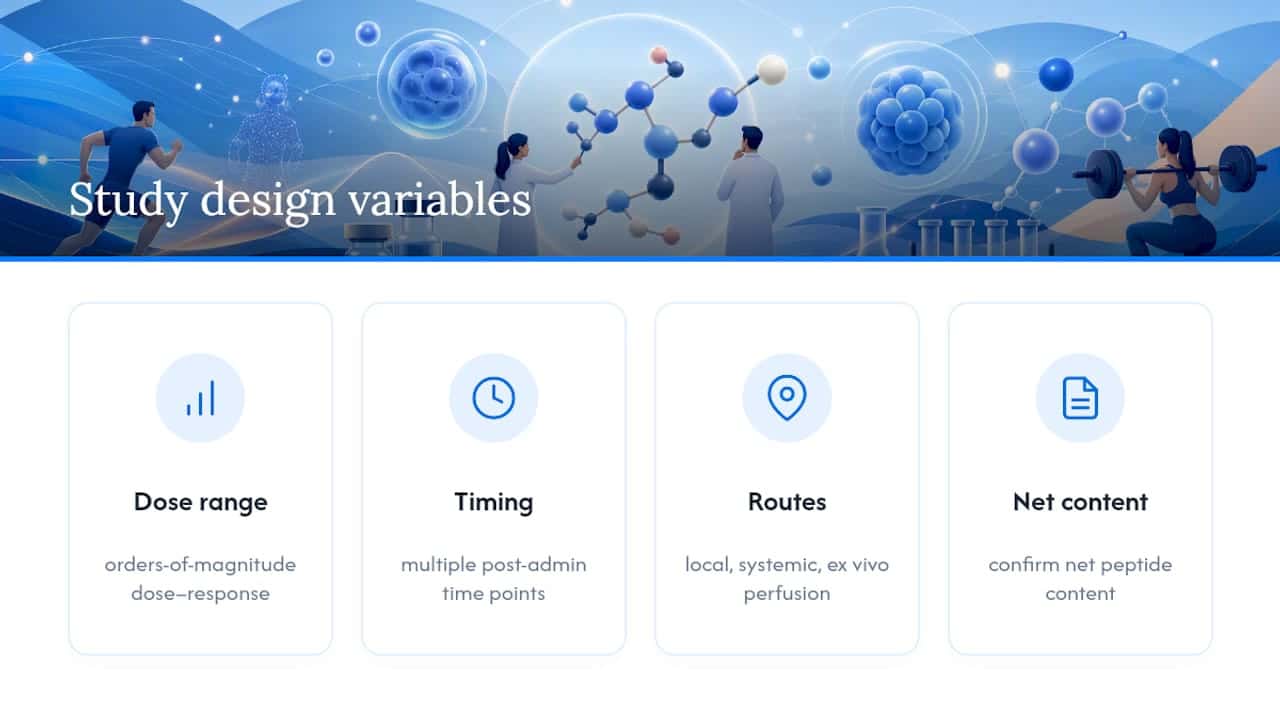
Small-animal preclinical models introduce timing as a second variable. Studies examining tissue-repair kinetics often track outcomes across multiple time points post-administration, since inflammation-resolution and tissue-remodeling pathways operate on different timescales. Route of delivery in these models, whether local injection at an injury site, systemic administration, or ex vivo tissue perfusion, is chosen based on the specific mechanistic question, and each route changes how quickly the peptide reaches target tissue and how it’s metabolized.
None of this constitutes a protocol for human or animal treatment. Institutional review boards and animal care committees govern preclinical dosing decisions, and any dosing schedule referenced in published research reflects that specific study’s design parameters, not a generalizable regimen. Researchers designing their own protocols should treat published dosing tables as a starting reference point for experimental design, then validate concentration and timing against their own net peptide content calculations and assay requirements.
Peptides Versus Other Recovery-Research Agents
Peptides occupy a specific niche in recovery-mechanism research, distinct from small-molecule anti-inflammatories, growth factor proteins, and physical intervention models like controlled mechanical loading. Small-molecule NSAIDs, for comparison, act broadly on cyclooxygenase pathways and are well characterized but offer less mechanistic specificity than a peptide targeting a single signaling cascade. That specificity is exactly why peptides get chosen for mechanistic studies asking narrow questions about a single pathway.
Growth factor proteins like recombinant human growth factors used in some tissue-engineering research share some overlap with peptide research goals, tissue repair and angiogenesis, but differ substantially in molecular size, stability, and production cost. Peptides are typically cheaper to synthesize at research scale and more stable in storage than full-length recombinant proteins, which is part of why they show up more often in exploratory-stage studies before a lab commits to more expensive protein-based reagents.
Physical and mechanical recovery models, such as controlled loading protocols in tendon research, answer a different category of question entirely. They test how mechanical stress itself influences tissue remodeling, independent of any biochemical intervention. Many labs combine approaches, using a peptide to probe a specific signaling pathway while a parallel mechanical-loading arm tests whether physical stimulus produces a comparable or additive effect. Neither approach replaces the other. They answer different parts of the same underlying question about how tissue repairs itself.
What the Current Evidence Base Actually Shows
The preclinical literature on recovery-focused peptides is real but narrower than marketing language around these compounds often suggests. Most published work sits at the in vitro and small-animal model stage, examining specific mechanistic questions, fibroblast migration rates, angiogenic marker expression, cytokine profiles, rather than establishing broad therapeutic efficacy claims. That’s a meaningful distinction for anyone designing a study or interpreting published results.
Cell-migration and wound-healing model data for peptides like BPC-157 and TB-500 show measurable effects on specific cellular processes under controlled conditions. Those findings support continued mechanistic research. They don’t, on their own, establish clinical efficacy, safe human dosing, or long-term outcomes, questions that sit well outside what in vitro and small-animal preclinical data can answer. Extrapolating from a fibroblast migration assay to a claimed recovery benefit skips the entire clinical-validation process that separates preclinical signal from established therapeutic use.
For a research organization, the practical takeaway is to treat this literature the way it’s actually built: a foundation of mechanistic questions still being answered, not a settled therapeutic conclusion. Study design should reflect that stage, with appropriate controls, dose-response characterization anchored to accurate net peptide content, and clear scope limits on what any single assay result can support. The gap between preclinical signal and clinical claim is exactly where careful researchers should be spending their skepticism.
Why CoA Literacy Matters More Than Brand Reputation
The peptide research space has a documentation problem that’s easy to underestimate until you’ve compared a dozen CoAs side by side. Most suppliers understand that researchers want a certificate. Far fewer understand, or bother to demonstrate, the difference between a certificate that proves identity and one that just states a number.
The conventional advice in this space stops at “buy third-party tested peptides,” as if third-party testing were a single fixed standard. It isn’t. A lab that runs HPLC purity and nothing else has tested for one thing. A lab running HPLC, intact mass LC-MS, and amino-acid analysis has tested for three separate, non-overlapping properties, and only that fuller picture protects a dose-response curve from a bad batch. Researchers who treat “tested” as a checkbox rather than a spectrum are the ones most likely to get burned by a technically-accurate-but-incomplete CoA.
If there’s one habit worth building before any other, it’s this: trace the verification code yourself, every time, on every new batch. Not once per supplier relationship. Every batch. Suppliers change labs, labs change methods, and a CoA that was legitimate for a past order tells you nothing about the vial in front of you now.
— Data Peptides
Where to Source Research-Grade Recovery Peptides
Everything covered here, the CoA fields, the analytical methods, the net peptide content math, points toward the same practical question: where do you actually get material that meets this standard without re-verifying every supplier from scratch? Data Peptides sells research-grade, third-party tested peptides with batch-level Certificates of Analysis built around the exact fields this article walks through, chromatogram data, mass identity, and documented purity, across recovery-focused compounds and other research categories.
That’s the concrete difference for a lab tired of chasing down verification codes that lead nowhere. Every batch comes with documentation designed to be checked, not just displayed, backed by 24/7 support if a discrepancy needs resolving fast. If you’re setting up a new recovery-mechanism study, browse the shop for current batches, or start directly at Data Peptides to review available Certificates of Analysis before you place an order.
Sources
FAQ
What Is the Most Important CoA Field to Check First?
The batch or lot number matching the vial in hand matters most, since a certificate for a different batch tells you nothing about what you’re actually testing.
Is BPC-157 FDA Approved for Human Use?
No. BPC-157 and related recovery-research peptides discussed here are sold and used strictly as research-use-only laboratory reagents, not approved therapeutics.
Why Does Net Peptide Content Differ From HPLC Purity?
HPLC purity measures separation from synthesis byproducts, while net peptide content accounts for counterions and residual moisture, so a vial can show high purity yet contain notably less usable peptide mass.
Does Data Peptides Provide Batch-Level Certificates of Analysis?
Yes. Data Peptides supplies batch-specific Certificates of Analysis with third-party testing for its research-use-only peptide catalog, including recovery-focused compounds.