

CJC-1295 is a synthetic GHRH analog engineered with Drug Affinity Complex (DAC) chemistry to bind serum albumin and extend its circulating half-life to roughly 5.8–8.1 days. In dose-escalation human trials, single injections produced dose-dependent GH increases of [2 to 10 times baseline] sustained for about six days, alongside IGF-1 increases of 1.5 to 3 times baseline(https://pubmed.ncbi.nlm.nih.gov/16352683/) for up to 11 days. Clinical development was discontinued and CJC-1295 carries no FDA approval for any use. It exists today strictly as a research compound, and any protocol involving human subjects requires IRB oversight and clear scientific justification.
Key Takeaways
CJC-1295 DAC produces sustained GH and IGF-1 elevation through albumin-bound GHRH receptor agonism, but it remains a discontinued, research-only compound with limited long-term human safety data.
| Point | Details |
|---|---|
| DAC extends half-life dramatically | CJC-1295 DAC’s half-life runs 5.8–8.1 days versus roughly 30 minutes for no-DAC Mod GRF 1-29. |
| GH and IGF-1 rise on different timelines | GH elevates 2 to 10 times baseline for about six days; IGF-1 rises 1.5 to 3 times for 9 to 11 days. |
| Evidence base is small but peer-reviewed | Primary human data comes from one dose-escalation trial with small cohorts and short follow-up. |
| Proteomic biomarkers need validation | Five serum protein spots shifted in an 11-subject study; only exploratory conclusions are warranted. |
| Research-only status is firm | No FDA approval exists, clinical development was discontinued, and IRB oversight is required for human use. |
| Material verification is non-negotiable | Data Peptides supplies research-grade CJC-1295 with Certificates of Analysis confirming DAC status and purity. |
Table of Contents
- What Is CJC-1295? Mechanism of Action Explained
- CJC-1295 Pharmacokinetics and Pharmacodynamics in Human Trials
- What Do Human Clinical Trials Show About CJC-1295?
- Safety Signals and Adverse Events Reported in Trials
- Proteomic Biomarkers Identified After CJC-1295 Exposure
- How Is CJC-1295 Used in Research, Including With Ipamorelin?
- Regulatory Status: Is CJC-1295 Legal for Research?
- Sourcing and Handling CJC-1295 for Laboratory Use
- Where to Source Research-Grade CJC-1295 Material
- Primary Sources and Further Reading
- Sources
- FAQ
What Is CJC-1295? Mechanism of Action Explained
CJC-1295 activates the GHRH receptor on pituitary somatotrophs, triggering the cAMP signaling cascade that drives GH synthesis and pulsatile release. That part of the mechanism is shared with every GHRH agonist. What separates CJC-1295 from earlier analogs is the DAC modification itself: a maleimidopropionic acid group that forms a covalent bond with cysteine-34 on circulating serum albumin.
That bond is why the compound persists in circulation for days instead of minutes. Contrast this with Mod GRF 1-29, the no-DAC version of the same core GHRH(1-29) sequence, which clears in about 30 minutes and is used specifically to study natural, pulsatile GH release rather than sustained elevation. Researchers designing or interpreting a study need to know which form was used, because interindividual albumin levels can theoretically influence pharmacodynamics in ways that a no-DAC protocol never encounters.
The functional chain runs: GHRH receptor binding → pituitary somatotroph activation → GH release → hepatic IGF-1 production, with DAC’s albumin anchor inserted right at the exposure step.
- GHRH receptor agonism initiates the cAMP pathway in somatotrophs.
- DAC’s albumin binding at Cys-34 extends systemic half-life roughly 280-fold over the no-DAC form.
- Downstream IGF-1 production in the liver follows GH elevation with a lag of several days.
Pro Tip: Always confirm DAC status before citing PK data from a paper — the half-life and dosing interval assumptions for DAC and no-DAC forms are not interchangeable, and mixing the literature between them is a common sourcing error.
CJC-1295 Pharmacokinetics and Pharmacodynamics in Human Trials
Pharmacokinetic data from the primary human trial put CJC-1295 DAC’s half-life at 5.8 to 8.1 days, compared to roughly 30 minutes for unmodified GRF(1-29). That single difference dictates almost everything about how a study should be designed around the compound, from sampling windows to redosing intervals.

Published dose-escalation work used single subcutaneous doses across a 30 to 120 mcg/kg range, with no serious adverse reactions reported at the 30 to 60 mcg/kg tier. GH elevations peaked early and stayed elevated for about six days; IGF-1 responses lagged, peaking later and persisting for nine to eleven days.
| Parameter | Reported Value |
|---|---|
| Half-life (DAC) | 5.8–8.1 days |
| Half-life (no-DAC, Mod GRF 1-29) | ~30 minutes |
| Dose range studied | a range of doses at or above 30 mcg/kg |
| Mean GH elevation | 2–10x baseline, ~6 days |
| Mean IGF-1 elevation | 1.5–3x baseline, ~9–11 days |
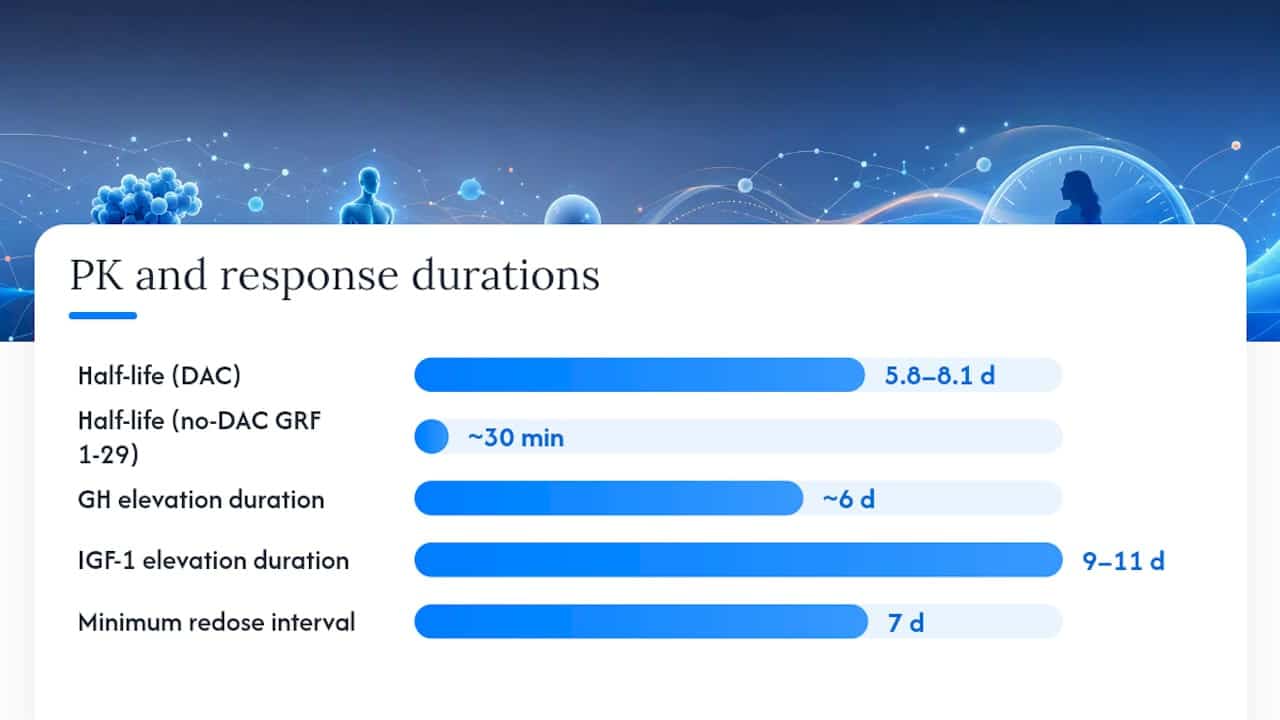
A seven-day-minimum interval between DAC doses respects the PK curve without stacking exposures unpredictably. Serial sampling protocols should anchor blood draws to this staggered GH/IGF-1 timeline rather than a single fixed timepoint, since a sample taken at day 2 and one taken at day 9 are measuring two different physiological windows entirely.
What Do Human Clinical Trials Show About CJC-1295?
The foundational human data comes from a randomized, placebo-controlled dose-escalation study published by Teichman et al. in the Journal of Clinical Endocrinology & Metabolism in 2006. Healthy adult volunteers received single or multiple subcutaneous doses of CJC-1295 DAC, with GH and IGF-1 tracked over multiple days post-injection. The trial reported the dose-dependent GH and IGF-1 fold-changes described above, along with a half-life estimate that has anchored every subsequent PK discussion of this molecule.
Preclinical work adds a mechanistic layer the human trial doesn’t cover directly. A study using GHRH knockout mice found that once-daily CJC-1295 administration normalized growth, confirming that the long-acting analog concept translates into real physiological effect when the native GHRH axis is absent. Related PubMed-indexed work has also documented preserved GH pulsatility during sustained CJC-1295 stimulation, addressing a legitimate concern that constant receptor occupancy might flatten the pulsatile GH pattern the body relies on for normal signaling.
None of this evidence is without gaps, and researchers citing it should account for the following:
- Sample sizes in the primary human trial were small, typical of early-phase PK/PD work rather than a large efficacy trial.
- Follow-up windows topped out around two weeks, leaving long-term effects unmeasured.
- Cohorts consisted of healthy volunteers, not patients with GH deficiency or other target conditions.
- Phase II clinical development was ultimately discontinued, meaning no larger confirmatory trial exists to extend these findings.
Anyone building a citation list should go straight to the primary sources: the Teichman 2006 PK/PD trial, the GHRH knockout mouse study, and the related PubMed record on preserved pulsatility.
Safety Signals and Adverse Events Reported in Trials
Adverse events reported in trial data have been mostly mild and localized: injection site reactions, headache, transient diarrhea, and flushing appear most often. Occasional transient hypotension has been noted following dosing.
The larger safety context matters more than the individual event list. Broader clinical development of CJC-1295 was discontinued, and the compound’s long-term human safety profile beyond the trial window described above remains undocumented. That gap alone is reason enough to treat every protocol as requiring active, structured monitoring rather than passive observation.
- Track injection site reactions systematically across all dosing arms.
- Monitor glucose and insulin sensitivity given GH’s known counter-regulatory metabolic effects.
- Watch for edema and musculoskeletal complaints, both reported with sustained GH/IGF-1 elevation.
- Consider baseline and follow-up ECG where cardiovascular risk factors are present in the study population.
Pro Tip: Draw baseline glucose, insulin, and IGF-1 panels before the first dose, then repeat them at the peak PD windows, around day 6 for GH-linked metrics and day 9 to 11 for IGF-1, to actually capture the metabolic shift instead of missing it between timepoints.
Proteomic Biomarkers Identified After CJC-1295 Exposure
Beyond GH and IGF-1 as headline endpoints, one study looked at what else changes in serum after CJC-1295 exposure. Sackmann-Sala et al. ran 2D gel electrophoresis followed by mass spectrometry on serum samples taken before and one week after a single CJC-1295 DAC injection in healthy men.
Five protein spots shifted significantly: an ApoA1 isoform and a transthyretin isoform decreased, while beta-hemoglobin and albumin fragments increased. One spot, an albumin/immunoglobulin fragment, correlated linearly with IGF-1 levels at r2=0.668, the strongest relationship reported in the dataset.
- The proteomic shift involved five identified spots, not a single marker.
- The r2=0.668 correlation applied to one specific spot, not the full protein panel.
- The analysis drew on an 11-subject subset, an exploratory sample size that calls for targeted validation with ELISA or targeted mass spectrometry before any spot is treated as a confirmed biomarker.
Researchers adding biomarker endpoints to a CJC-1295 protocol should synchronize sample collection to the PD curve itself, drawing serum at the same day-6 and day-9 to 11 windows used for GH and IGF-1 rather than on an arbitrary schedule.
How Is CJC-1295 Used in Research, Including With Ipamorelin?
CJC-1295 shows up across several experimental contexts: restoring GH pulsatility models, mapping downstream GH/IGF-1 signaling, tracking body composition endpoints, and biomarker discovery work like the proteomics study above.
Combination protocols pairing CJC-1295 with ghrelin mimetics such as ipamorelin rest on a straightforward receptor logic: CJC-1295 stimulates the GHRH receptor while ipamorelin acts on the separate GHSR pathway. Because the two act on independent receptors, stimulating both produces a larger combined GH response than either compound alone in experimental settings.
- No-DAC forms are often preferred pre-sleep to preserve a natural pulsatile spike; DAC forms suit protocols targeting sustained baseline elevation instead.
- Receptor saturation is a real design constraint. Higher doses of either compound don’t necessarily scale the response linearly.
- Stacked-response data needs careful controls. Attributing an outcome to either compound alone in a combination protocol without proper arms is a common design error.
Regulatory Status: Is CJC-1295 Legal for Research?
CJC-1295 has no FDA approval for any indication, its clinical development program was discontinued, and it is a research-only compound. WADA classifies it as a banned substance in sport.
U.S.-based labs should obtain research-grade material with a full Certificate of Analysis, secure IRB or IBC oversight before any human research use, and check import and controlled-substance rules where applicable. The Weight Loss Surgery Guide’s evidence and verification library documents the broader pattern of discontinued clinical programs and how to verify a compound’s actual regulatory posture rather than relying on marketing claims.
Sourcing and Handling CJC-1295 for Laboratory Use
Material identity is the single most common failure point in CJC-1295 research, because DAC and no-DAC forms get conflated constantly in casual literature. Before ordering, request a full Certificate of Analysis that specifies HPLC purity percentage, mass spec identity confirmation, counterion, and lot-specific stability data.
Store lyophilized peptide at the manufacturer-specified temperature, reconstitute according to established lab protocol, and aliquot immediately to avoid repeated freeze-thaw cycles that degrade peptide integrity. If your study cites Mod GRF 1-29 no-DAC data, confirm your physical material actually matches, since DAC and no-DAC pharmacokinetics are not interchangeable in any analysis.
Pro Tip: Require documentation that explicitly states DAC status and counterion on every batch. A supplier that can’t confirm which form you’re holding is a supplier whose data you can’t responsibly cite against the published literature.
A Note on Research Rigor
Rigorous, IRB-approved protocols and verified material identity are what separate credible CJC-1295 research from noise. Data Peptides is built to support that standard with documented, batch-verified material.
Where to Source Research-Grade CJC-1295 Material
Every claim in this article traces back to material where DAC status, purity, and identity were known and documented. That’s the standard Data Peptides builds around: lab-grade peptides backed by third-party testing, Certificates of Analysis, and batch-level documentation, sold strictly for research use. If your protocol depends on knowing exactly what’s in the vial, that documentation isn’t optional.
Before starting any study, check the COA for the exact batch you’re ordering and confirm it states DAC status and purity percentage clearly. For human research applications, secure IRB or IBC approval first. Browse the current peptide catalog to find CJC-1295 and related research compounds with documentation ready to match against your citation list.
Primary Sources and Further Reading
- PubChem compound 20515892: molecular identifiers for confirming CJC-1295 structure and identity.
This article is general information, not a substitute for advice from a qualified doctor. Consult a qualified healthcare professional about your own circumstances before acting on anything here.
Sources
- Activation of the GH/IGF-1 axis by CJC-1295, a long-acting GHRH analog, results in serum protein profile changes in normal adult subjects
- Prolonged stimulation of growth hormone (GH) and insulin-like growth factor I secretion by CJC-1295, a long-acting analog of GH-releasing hormone, in healthy adults
- Once-daily administration of CJC-1295, a long-acting growth hormone-releasing hormone (GHRH) analog, normalizes growth in the GHRH knockout mouse
- PubChem compound 20515892
FAQ
What Is the Difference Between CJC-1295 DAC and No-DAC?
DAC binds serum albumin and extends half-life to 5.8–8.1 days, while no-DAC (Mod GRF 1-29) clears in about 30 minutes and is used to study natural pulsatile GH release.
Is CJC-1295 FDA-Approved?
No. CJC-1295 has no FDA approval, its clinical development program was discontinued, and it exists only as a research compound.
What GH and IGF-1 Changes Does CJC-1295 Produce?
Human trials reported GH increases of 2 to 10 times baseline for about six days and IGF-1 increases of 1.5 to 3 times baseline for 9 to 11 days after a single dose.
Why Do Researchers Combine CJC-1295 With Ipamorelin?
CJC-1295 activates the GHRH receptor while ipamorelin activates the separate GHSR pathway, and stimulating both together produces a larger combined GH response in research settings.
What Should I Check Before Sourcing CJC-1295 for a Study?
Confirm DAC status, purity percentage, and identity through a Certificate of Analysis; Data Peptides provides batch-level documentation for this exact purpose.