

Preclinical studies show BPC-157 reliably promotes angiogenesis and structural repair across tendon, muscle, ligament, and bone injury models, largely through VEGFR2 activation and Akt-eNOS signaling. High-quality controlled human trials remain scarce, and regulatory bodies have flagged this gap directly. This synthesis organizes the evidence by outcome and mechanism, then translates it into practical research guidance.
TL;DR:
- Preclinical studies show BPC-157 promotes healing through VEGFR2 activation and nitric oxide pathways in tendon, muscle, ligament, and bone models, but human data remain limited.
- Dosing varies widely across studies, with rapid clearance under 30 minutes in animals, requiring precise early sampling for pharmacokinetic studies.
- Current human evidence is anecdotal and methodologically weak, with ongoing trials for tissue repair but no conclusive clinical effectiveness yet.
- Safety data from animal models indicate low acute toxicity, but long-term human safety and liver effects are still unknown.
- Future research should focus on standardized dosing, objective endpoint trials, and verified manufacturing quality to bridge the gap between preclinical promise and clinical application.
Table of Contents
- Preclinical Evidence Across Tendon, Ligament, Muscle, and Bone Models
- Molecular Mechanisms Behind the Repair Signal
- Pharmacokinetics: Half-Life, Tissue Uptake, and Detection Windows
- Human Evidence and Registered Clinical Trials
- Safety, Regulatory Status, and Analytical Quality
- Research Priorities for Moving the Field Forward
- Comparative Analysis Against Other Research Peptides
- Potential Interactions With Other Drugs or Supplements
- Assessing the Methodological Quality of the Existing Studies
- Ethical and Regulatory Challenges Specific to BPC-157
- Dosing Protocols Used in Preclinical and Clinical Settings
- Why the Preclinical-to-Human Gap Deserves More Attention Than It Gets
- How We Support BPC-157 Research With Documentation Researchers Can Verify
- FAQ
- Sources
Preclinical Evidence Across Tendon, Ligament, Muscle, and Bone Models
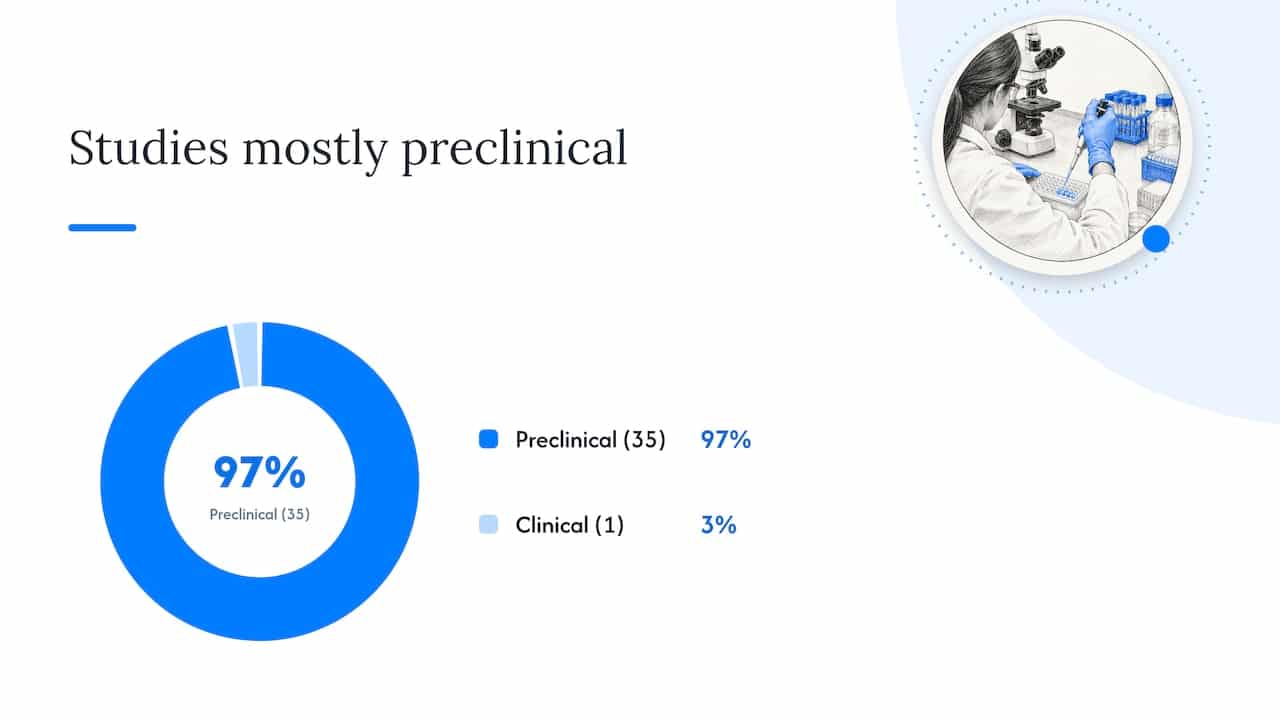
The bulk of BPC-157 research sits in animal injury models, and the pattern across them is consistent. A systematic review of BPC-157 in orthopedic sports medicine screened 544 initial articles and included 36 relevant studies, 35 preclinical and one clinical. Across those preclinical studies, BPC-157 improved structural, biomechanical, and functional recovery in tendon transection, ligament injury, muscle laceration, and bone fracture models.
Endpoints varied by tissue type but followed common categories:
- Histological improvement, including better collagen organization and reduced fibrosis in tendon and ligament repair models.
- Biomechanical recovery, measured as tensile strength or load-to-failure in repaired tendons and healing fractures.
- Functional recovery, such as gait normalization and grip strength in muscle injury models.
- Gastric and intestinal protection, with reduced ulceration and faster mucosal healing in GI injury models, the original context in which BPC-157 was studied.
Dosing and route of administration varied widely across the included studies, spanning intraperitoneal, intramuscular, and oral delivery at doses that differed by orders of magnitude between labs. That heterogeneity makes cross-study comparison difficult and limits any attempt to define a standard preclinical dose.
Several limitations temper enthusiasm for this body of work. Rodent models dominate the literature, and findings in rats or mice do not automatically translate to larger mammals or humans. Sample sizes in individual animal studies tend to be small, and the strong, consistently positive direction of results across so many independent labs raises the possibility of publication bias toward favorable outcomes. A narrative review of BPC-157 for musculoskeletal healing makes this point explicitly: the preclinical signal is abundant, but it stands on a disconnect with minimal human data.
Molecular Mechanisms Behind the Repair Signal
The repair effects seen across preclinical models trace back to a handful of overlapping signaling pathways rather than a single mechanism of action.
- VEGFR2 activation: BPC-157 appears to stimulate vascular endothelial growth factor receptor 2, promoting angiogenesis that supplies healing tendons and muscle with the blood flow repair requires.
- Akt-eNOS and nitric oxide modulation: activation of this axis supports endothelial nitric oxide production, which is tied to vasodilation, inflammation control, and neuromuscular stabilization in injured tissue.
- ERK1/2 signaling: this pathway contributes to cell proliferation and survival, reinforcing the growth and repair signals initiated upstream.
- Cytokine and antifibrotic effects: preclinical work describes modulation of inflammatory cytokines alongside signals that limit excess scar tissue formation during healing.
The 2025 MDPI review on BPC-157’s multifunctionality frames the peptide as pleiotropic, meaning it acts on multiple pathways simultaneously rather than a single receptor-ligand interaction. That same review notes BPC-157’s unusual chemical stability in acidic environments, a property of its proline-rich sequence that supports interest in oral formulations, though stability in gastric juice does not by itself establish oral bioavailability in a living organism.
Pleiotropy is a double-edged finding for research purposes. Multi-pathway action likely explains why BPC-157 produces benefits across such different tissue types, from tendon to gut lining. It also complicates target validation and safety profiling, since a molecule hitting several pathways at once is harder to isolate for mechanism-specific toxicology or dose-response modeling.
Pro Tip: When designing a mechanism study, pair a VEGFR2 blocking agent or antagonist control arm with your BPC-157 treatment group to confirm that observed angiogenic effects are pathway-specific rather than incidental.
Pharmacokinetics: Half-Life, Tissue Uptake, and Detection Windows
Preclinical pharmacokinetic work in rats and beagle dogs describes BPC-157 as a short-acting peptide with rapid clearance. Reported elimination half-life is under 30 minutes in preclinical models, a detail noted in systematic review data on BPC-157 metabolism, which carries direct implications for how researchers design sampling windows and dosing intervals in any follow-up study.
Key pharmacokinetic observations relevant to study design:
- Kinetics appear linear across tested dose ranges in animal models, simplifying dose-response extrapolation within the preclinical dose window studied.
- Intramuscular bioavailability differs substantially by species, and oral stability in gastric acid does not equate to confirmed oral bioavailability in vivo.
- Tissue distribution studies show high uptake in kidney, liver, and bile, with excretion occurring primarily through urine and bile rather than exhalation or sweat.
- High-resolution LC-MS methods have detected urinary metabolites for several days post-administration in animal models, with limits of detection in the low nanogram-per-milliliter range, as described in the systematic review’s analytical data.
For any lab planning a PK/PD bridging study, this combination of a sub-30-minute half-life and multi-day urinary metabolite detectability means plasma sampling needs tight early time points (minutes, not hours) while urinary metabolite sampling can extend over several days to capture a fuller excretion profile.
Human Evidence and Registered Clinical Trials
Human data on BPC-157 is thin relative to the preclinical literature, and what exists carries real methodological caveats.
- A small retrospective case series reported subjective knee pain improvement in 7 of 12 patients following intraarticular BPC-157 injection, sustained for more than six months, but the study lacked a control group and relied on patient-reported outcomes rather than objective imaging.
- Isolated reports describe intravesical use for interstitial cystitis and an intravenous safety pilot, both constrained by small sample sizes and the absence of blinding.
- Clinicaltrials, including a rotator cuff repair recovery pilot (NCT07803250) and a Phase 2 hamstring repair study, indicating that controlled human trials are now underway even though large-scale results are not yet available.
For BPC-157 to move toward clinical use, the field needs randomized, blinded trials with objective endpoints: imaging-confirmed tissue healing, standardized biomechanical testing, and structured adverse event monitoring rather than patient-reported symptom relief alone. The FDA’s own briefing materials on BPC-157 reach a similar conclusion, noting that current human evidence is too limited to support broader clinical or compounding use.
Safety, Regulatory Status, and Analytical Quality
Preclinical toxicology studies have generally failed to identify an acute lethal dose across wide intramuscular dose ranges in rats, which is a reassuring signal for animal safety margins but not evidence of human safety, since no controlled long-term human toxicology data exists.
- FDA briefing and PCAC evaluation documents reviewed BPC-157 free base and acetate forms for the 503A bulk drug substances list and proposed against inclusion, citing sparse human evidence and compounding-related safety concerns.
- Regulatory and safety commentary notes that WADA and sport-governing bodies treat unregulated peptide availability as a compliance risk, since research-use-only products bypass the approval safeguards that typically accompany clinical-grade drugs.
- Contamination and purity issues are a real analytical concern: without third-party Certificates of Analysis and endotoxin testing, researchers cannot confirm what is actually in a given vial.
- Laboratory work depends on validated LC-MS methods with documented detection limits; without them, metabolite identification and dose-response conclusions are unreliable.
Research Priorities for Moving the Field Forward
The gap between preclinical promise and human evidence defines the next phase of BPC-157 research. Closing it requires deliberate study design rather than more of the same animal work.
- Prioritize PK/PD bridging studies using validated LC-MS assays and confirmed metabolite identification, given the sub-30-minute half-life already documented in preclinical models.
- Standardize routes of administration and build proper dose-response cohorts rather than the scattered dosing seen across the existing literature.
- Design early human trials with blinded allocation, objective imaging or biomechanical endpoints, and structured adverse event follow-up, not retrospective symptom reports.
- Require Certificates of Analysis, endotoxin results, and batch traceability for any material used in a translational study. Our BPC-157 reconstitution and handling guide outlines lab-focused handling steps relevant to this kind of preparation.
- Report negative outcomes and adverse events alongside positive findings to correct the publication bias evident in the current literature.
Pro Tip: Given the short plasma half-life, schedule your earliest post-dose blood draws in minutes rather than hours, and extend urinary sampling across several days to capture the full metabolite excretion window.
Comparative Analysis Against Other Research Peptides
BPC-157 occupies a distinct niche relative to other commonly studied research peptides. Where growth hormone secretagogues and GLP-1 analogs act on well-characterized single receptor systems with established dose-response curves in humans, BPC-157’s pleiotropic, multi-pathway action makes it harder to benchmark against a single mechanism class.
Peptides studied for muscle and recovery applications, such as those explored in our guide to peptides for muscle, typically target anabolic signaling or growth hormone release, pathways with decades of human pharmacology behind them. BPC-157’s angiogenic and anti-inflammatory profile instead overlaps more with wound-healing and tissue-repair research, a category with far less clinical trial infrastructure built around it.
This distinction matters for researchers choosing between peptides for a given study design. A peptide with an established human PK/PD profile allows tighter dosing predictions and faster translation into pilot trials. BPC-157’s preclinical depth is substantial, but its human pharmacology is still being mapped, so comparative efficacy claims against better-characterized peptides remain premature. Any study aiming to position BPC-157 against an alternative compound needs matched animal models, equivalent dosing schedules, and shared outcome measures, conditions the current literature rarely meets across different peptide classes simultaneously.
Potential Interactions With Other Drugs or Supplements
Formal interaction studies for BPC-157 are not available in the published literature, which means any statement about drug or supplement interactions is necessarily inferential rather than established fact.
Because BPC-157’s mechanism touches nitric oxide signaling and angiogenesis, there is a plausible, though unconfirmed, basis for caution when combining it with other agents that affect vascular tone or clotting, such as anticoagulants or vasodilators, in any research protocol. Similarly, since preclinical work shows cytokine modulation, co-administration with other anti-inflammatory compounds in the same animal or cell model could confound outcome measures rather than cleanly isolate BPC-157’s independent effect.
For laboratory research design, the practical implication is methodological: any study layering BPC-157 with another active compound needs a factorial design or separate control arms to distinguish independent from combined effects. Researchers working with co-administered agents should document every compound, dose, and timing precisely, since no systematic interaction dataset currently exists to predict outcomes in advance. Our reconstitution and dosing guide covers handling practices relevant to maintaining consistent experimental conditions when multiple compounds are involved in a protocol.
Assessing the Methodological Quality of the Existing Studies
Most of the BPC-157 evidence base consists of preclinical animal studies, and their methodological quality varies considerably. The systematic review in orthopedic sports medicine that screened 544 articles down to 36 included studies found that 35 were preclinical and only one was clinical, a ratio that itself signals how far the field is from controlled human data.
Sample sizes in the animal literature tend to be small, often in the range typical of rodent injury models, and control group design varies by lab rather than following a shared standard. Blinding is inconsistent across studies, and few report pre-registered hypotheses or power calculations, both standard expectations in rigorous preclinical research today.
The single clinical report identified in the systematic review, the retrospective knee injection case series, illustrates the quality gap directly: no control arm, no blinding, and outcomes based on patient-reported pain rather than imaging-confirmed tissue change. A narrative review of BPC-157 reaches a parallel conclusion, describing a disconnect between consistently positive preclinical results and the near-absence of methodologically sound human evidence. Until randomized, blinded, adequately powered human trials exist, conclusions about clinical efficacy remain provisional at best.
Ethical and Regulatory Challenges Specific to BPC-157
BPC-157 sits in an unusual regulatory position: it is widely sold as a research chemical while simultaneously being evaluated by regulators for potential clinical and compounding pathways. The FDA’s briefing materials document the agency’s review of BPC-157 free base and acetate forms for the 503A bulk list and its proposal against inclusion, citing limited human safety data.
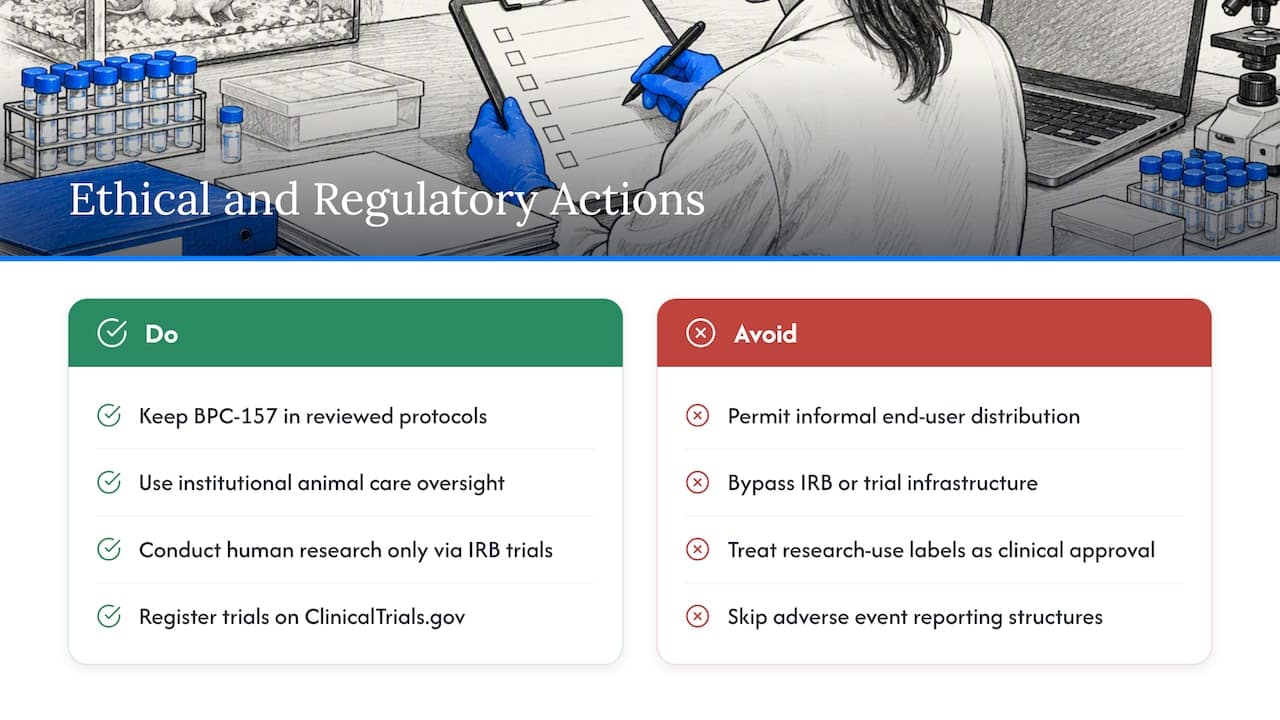
This creates a real ethical tension for the field. Research-use-only labeling is accurate and necessary given the state of the evidence, but it also means the product reaches end users outside the oversight that normally accompanies early-phase drug development, including institutional review board approval, informed consent protocols, and structured adverse event reporting. Regulatory commentary on BPC-157’s availability notes that this bypass of formal approval safeguards is a core concern for agencies monitoring the space.
For researchers and institutions, the ethical obligation is to keep BPC-157 within properly reviewed protocols: animal work under institutional animal care oversight, and any human-adjacent research only within registered, IRB-approved clinical trials rather than informal use. The growing number of ClinicalTrials.gov registrations suggests the field is moving in that direction, but the gap between informal availability and formal trial infrastructure remains the central regulatory challenge specific to this peptide.
Dosing Protocols Used in Preclinical and Clinical Settings
Dosing in the BPC-157 literature is notably inconsistent, which complicates both interpretation of existing results and design of new studies. Preclinical work spans intraperitoneal, intramuscular, and oral routes, with doses differing by orders of magnitude between labs and no single protocol treated as a reference standard across the field.
The limited human reports follow a similarly ad hoc pattern. The retrospective knee case series used intraarticular injection, while other isolated reports describe intravesical or intravenous administration for different indications entirely. None of these routes has been validated against the others in a head-to-head human trial, so no protocol can currently be called standardized in the clinical sense.
For researchers designing new preclinical work, the practical takeaway is to select a route and dose range that matches the specific injury model under study, tendon versus GI versus fracture healing, rather than importing a dose from a differently designed study. Those preparing reconstitution protocols for laboratory use can reference our BPC-157 reconstitution and dosing guide for handling practices suited to research settings, and partner resources like this bench-ready peptide reconstitution protocol offer additional detail on bacteriostatic versus sterile water considerations relevant to maintaining consistent dosing across a study.
Why the Preclinical-to-Human Gap Deserves More Attention Than It Gets
The conventional narrative around BPC-157 treats the volume of preclinical studies as if it were a substitute for human trial data. It is not. Thirty-five animal studies pointing the same direction is a strong mechanistic signal, but it is not clinical evidence, and conflating the two is the most common error in how this peptide gets discussed outside formal research circles.
The more interesting question is why the human evidence has not caught up. Part of the answer is structural: a peptide with a sub-30-minute half-life and multi-pathway action is genuinely harder to study in controlled human trials than a single-receptor drug with decades of pharmacology behind it. But part of the answer is also that informal availability has outpaced formal trial infrastructure, which reduces the institutional pressure to fund the randomized, blinded studies that would actually resolve the open questions. The recent appearance of registered trials for rotator cuff and hamstring repair suggests that pressure may finally be building, and that is the development worth watching, not another animal study confirming what the last thirty-five already showed.
— Data Peptides
How We Support BPC-157 Research With Documentation Researchers Can Verify
We supply BPC-157 as a lab-grade research peptide backed by third-party batch testing and documentation so investigators can confirm purity and identity before a compound ever enters a protocol. Every lot ships with documentation covering endotoxin data, and support is available to answer sourcing questions as studies get underway.
Our BPC-157 product page includes current specifications, and our reconstitution and dosing guide covers handling steps relevant to laboratory preparation. Researchers can browse our full shop for related compounds used in recovery and tissue-repair protocols. All products are intended for laboratory research use only, not for human or animal therapeutic use, and any study involving human subjects should proceed only under proper institutional review and regulatory approval.
This article is general information, not a substitute for advice from a qualified doctor. Consult a qualified healthcare professional about your own circumstances before acting on anything here.
FAQ
Does BPC-157 affect testosterone levels?
Published preclinical and limited human research on BPC-157 does not report a mechanism tied to testosterone regulation, and no hormonal pathway of this kind appears in the systematic review of BPC-157’s biological effects. Its documented pathways center on VEGFR2 and Akt-eNOS signaling, which relate to tissue repair and blood flow rather than endocrine function.
Is BPC-157 hard on the liver?
Preclinical toxicology work has not identified an acute lethal dose or organ toxicity signal across wide dose ranges tested in animal models, according to mechanistic review data. That said, no controlled long-term human safety studies exist, so liver effects with extended human use remain unknown rather than ruled out.
What is the most reliable source of information on BPC-157?
The strongest available evidence comes from peer-reviewed systematic reviews and pharmacokinetic studies rather than anecdotal or retail claims. The systematic review published in orthopedic sports medicine and FDA briefing documents are the most rigorous public references currently available.
Are there registered clinical trials studying BPC-157 in humans?
Yes, ClinicalTrials.gov lists active interventional studies, including a rotator cuff repair recovery pilot and a Phase 2 hamstring repair trial. These represent early steps toward the kind of controlled human data the existing preclinical literature has not yet produced.
What are the main side effects reported with BPC-157?
Formal human safety data is too limited to define a reliable side effect profile, and the systematic review notes that only one small clinical report exists alongside dozens of animal studies. Preclinical work has not identified acute toxicity at tested doses, but that finding does not establish a human safety profile.
Sources
- Multifunctionality and Possible Medical Application of the BPC 157 Peptide—Literature and Patent Review
- Regeneration or Risk? A Narrative Review of BPC‑157 for Musculoskeletal Healing
- FDA briefing materials and evaluation of BPC‑157-related bulk drug substances