

A peptide Certificate of Analysis is a batch-specific lab report, not a stamp of regulatory approval. Before trusting any batch, check three things: identity by mass spectrometry, purity by HPLC with a visible chromatogram, and a batch or lot number that matches the vial in front of you. If any of those three are missing, or the lab won’t share raw data, treat the document as incomplete and request the missing files or an independent test before you use the material.
TL;DR:
- A peptide COA reflects a specific batch’s test results and does not constitute regulatory approval, making raw data and method details essential for verification.
- Confirm the batch number matches the vial, and request raw chromatogram and mass spectrometry files if the COA lacks these details, especially for high-stakes experiments.
- HPLC purity percentages are only reliable when accompanied by chromatograms and method specifics, as impurities may be concealed without supporting visuals.
- Verify the lab’s accreditation and the presence of detailed test methods, raw data, and results for contamination or sterility when peptides are used in biological studies.
- Reuse multiple red flags—missing batch numbers, uniform purity figures, or identical COAs across lots—are strong indicators of untrustworthy documentation.
Table of Contents
- What Does a Peptide COA Actually Cover?
- How Do You Interpret the Test Results on a COA?
- What Are the Warning Signs of a Fake COA?
- What Should You Ask a Supplier for Missing COA Data?
- How Does Data Peptides Handle COA Transparency?
- Why Most Researchers Read COAs Backward
- Where to Get Peptides With Verifiable COAs
- Sources
- FAQ
What Does a Peptide COA Actually Cover?
A peptide certificate of analysis is a snapshot of one specific production run, sometimes called a lot or batch. It reports what a lab found when it tested that particular sample, not a general guarantee about every vial made under that product name. The FDA’s current Good Manufacturing Practice framework treats COAs as analytical records tied to a batch, and explicitly not as regulatory endorsements of the product itself.
That distinction matters for how you read the paperwork. A COA can tell you a peptide’s measured purity on a given date, tested by a named analyst, using a specific HPLC method, but the exact percentage should be interpreted with supporting data. It cannot tell you the product is approved for any particular use, and a supplier implying otherwise is stretching the document past what it’s built to do.
Here’s the practical anatomy of a well-built peptide COA and what each section should contain:
- Product identification: peptide name, amino acid sequence or CAS number, theoretical molecular weight, and the batch or lot number, which must match the vial label exactly.
- Administrative metadata: analysis date, the analyst’s name or initials, the lab’s name and physical address, and a unique report or certificate number you could reference in a follow-up email.
- Assay list with method references: each test (HPLC, MS, and any others) should name the method or instrument used, not just report a bare number.
- Purity and identity results: HPLC purity percentage alongside the chromatogram image, plus observed versus theoretical molecular weight from MS.
- Optional but workflow-critical fields: endotoxin levels and sterility results matter enormously if the peptide is headed for cell culture or in vivo work, and should be requested even when a standard research COA omits them.
If a section on this list is simply absent from the paperwork in front of you, that’s not automatically disqualifying. But it does tell you exactly what to ask the supplier for before you commit a batch to a sensitive experiment.
How Do You Interpret the Test Results on a COA?
Each test on a peptide COA answers a different question, and conflating them is where most misreads happen. Purity tells you how clean the sample is. Identity tells you whether it’s the right molecule at all. Content tells you how much of it is actually peptide versus salt, water, and counter-ions. Treating any one of these as a stand-in for the others is the single most common mistake researchers make when scanning a COA quickly.
- HPLC purity and the chromatogram. The percentage is only half the story. A high purity number without a visible chromatogram tells you almost nothing, because co-eluting impurities under the main peak can inflate the apparent result. HPLC purity has to be read alongside the chromatogram and the method parameters used to generate it, including column type, mobile phase, and run time.
- Mass spectrometry identity confirmation. This is the test that actually confirms you have the right molecule. Mass spectrometry compares observed mass against theoretical mass, and the acceptable deviation depends on the instrument. ESI-MS and MALDI-TOF have different resolution profiles, so a COA should specify which was used rather than reporting a bare mass match.
- Peptide content, or mass balance. Lyophilized powder isn’t pure peptide by weight. Counter-ions, residual moisture, and buffer salts all contribute mass, so the net peptide percentage often runs meaningfully below the HPLC purity figure. If you’re calculating dosing for a research protocol, this number matters more than purity does.
- Endotoxin and sterility. These only apply to specific workflows. Endotoxin is reported in EU/mg using the LAL assay, and sterility testing follows USP <71> incubation standards. Skip requesting these for basic in vitro screening; require them for anything touching live cells or animal models.
- Residual solvents and water content. These rarely appear on a standard research-use COA, but when they do, they usually follow ICH Q3C solvent-class guidance and Karl Fischer titration for water. Relevant mainly for peptides intended for long-term stability studies.
Ask for the net content number separately.*
What Are the Warning Signs of a Fake COA?
A missing batch number is the fastest tell. If the document can’t be tied to the specific vial you’re holding, everything else on the page is unverifiable, no matter how convincing the formatting looks.
Watch for these patterns together, since any single one might be an oversight, but several stacked at once is a real problem:
- No raw chromatogram or mass spectrum image, only a typed number with no supporting graphic.
- Purity reported as a suspiciously round figure like exactly 99% or 100% across multiple unrelated batches.
- The same COA file, or nearly identical wording and numbers, reused across different lot numbers.
- No analyst name, no lab address, or a lab name that doesn’t turn up in any accreditation registry.
- Method details absent entirely, meaning you can’t tell what column, mobile phase, or instrument produced the numbers on the page.
Verifying the lab itself is the next step, and it’s usually quick. ISO/IEC 17025 accreditation is the clearest external signal that a testing lab has demonstrated competence in the specific methods it’s using, and accreditation bodies publish searchable scopes online, so you can confirm a lab’s accreditation actually covers peptide analysis rather than an unrelated field.
Pro Tip: When a lab’s accreditation scope doesn’t list the exact test category you need, that’s a request for more information moment, not an automatic rejection. Ask the supplier which method was validated and against what standard.
Reject a batch outright when a supplier can’t or won’t produce a matching batch number and basic method details on request. Escalate to independent third-party testing when the batch is going into a high-stakes or costly experiment and you want confirmation beyond the supplier’s own paperwork.
What Should You Ask a Supplier for Missing COA Data?
Requesting missing information is usually a short email, not a confrontation. Most legitimate labs will respond within a few business days.
- Confirm the vial’s batch number matches the COA batch number exactly, including any suffix letters.
- Ask for the HPLC method parameters and the raw chromatogram image if only a percentage was provided.
- Request the raw MS file or spectrum rather than just the stated observed mass.
- Ask for peptide content or mass-balance data, plus water content, if precise dosing calculations depend on it.
- For any peptide going into cell culture or animal work, request endotoxin and sterility results specifically.
A workable request reads something like: “Can you send the raw HPLC chromatogram and MS spectrum for lot [number], along with the peptide content result if available?” If a supplier can’t produce that within a reasonable window, treat it as grounds to escalate to independent accredited lab testing before you use the batch. This is also the moment to double check that a COA was never meant to certify the peptide for cosmetic or medical use in the first place, a distinction worth keeping in mind regardless of how the marketing around a product is worded.
How Does Data Peptides Handle COA Transparency?
Data Peptides treats every batch COA as a working document, not a marketing sheet. That means the fields researchers actually need, matching lot numbers, named analytical methods, and identity confirmation data, are built into how batches get documented and released.
- Batch-specific COA files are tied to the exact lot number printed on the vial, matching the field-by-field standard covered above.
- COA details, including test methods and results, are accessible for review before or after ordering through the COA information page.
- Researchers who need method specifics, raw chromatograms, or clarification on a given batch can reach the support team directly rather than working from a static PDF alone.
If you’re building lab protocols around consistent testing standards, it’s worth cross-referencing lab quality-control practices alongside whatever COA you’re reviewing, since the two are meant to reinforce each other.
Why Most Researchers Read COAs Backward
The instinct is to scan straight to the purity percentage and stop there. That’s backward. Purity is the easiest number for a supplier to inflate or cherry-pick, and it’s the number that means the least without a chromatogram sitting next to it. Identity confirmation through mass spectrometry is the test that actually protects you from a mislabeled or substituted compound, and it’s the field researchers skip past most often because it looks technical rather than because it’s less important.
The conventional advice, “check the purity number,” isn’t wrong, it’s just incomplete to the point of being misleading on its own. That’s not a hypothetical; it’s exactly the failure mode MS confirmation exists to catch.
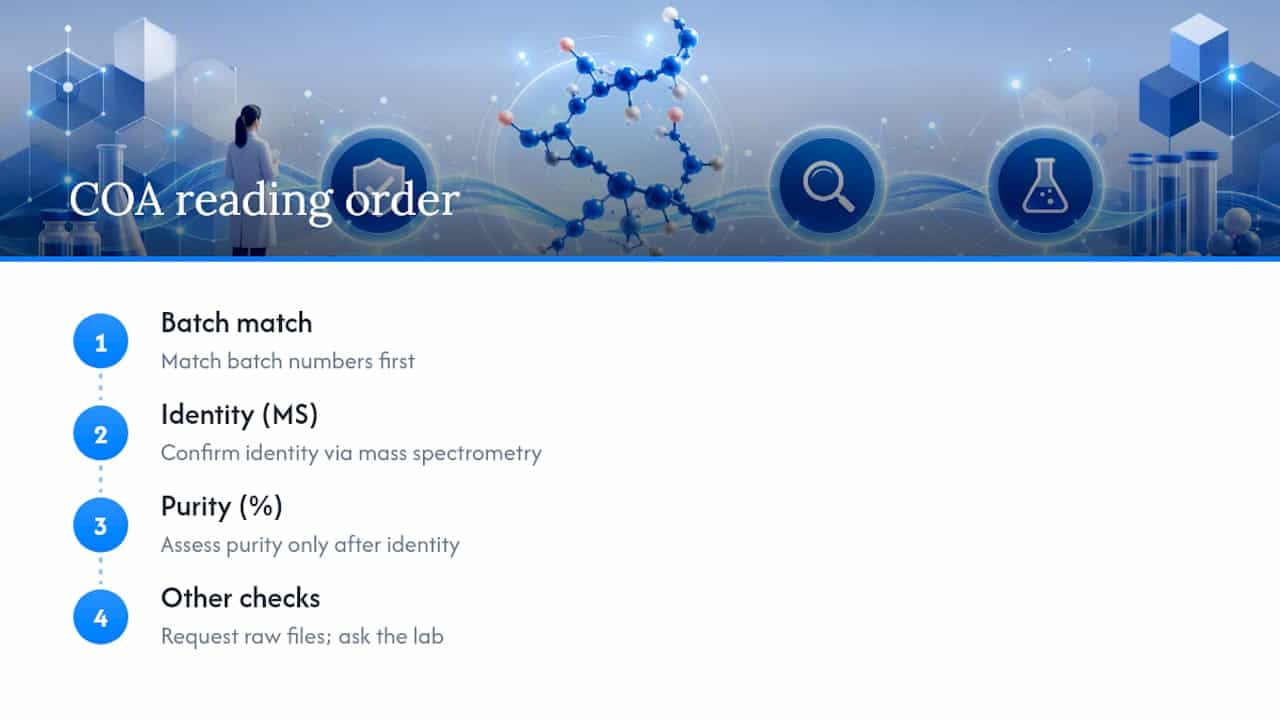
If there’s one habit worth building, it’s this: read a COA in the order that actually protects your data, batch match first, identity second, purity third, then everything else. Treat missing raw files as a request, not a dealbreaker, but never treat a confident-looking PDF as a substitute for asking the lab a direct question.
— Data Peptides
Where to Get Peptides With Verifiable COAs
Some peptide suppliers provide lab-grade research peptides with batch-matched Certificates of Analysis available for review to verify product quality. Many suppliers offer COA data specific to each batch rather than generic templates, which is considered best practice in peptide quality assurance.
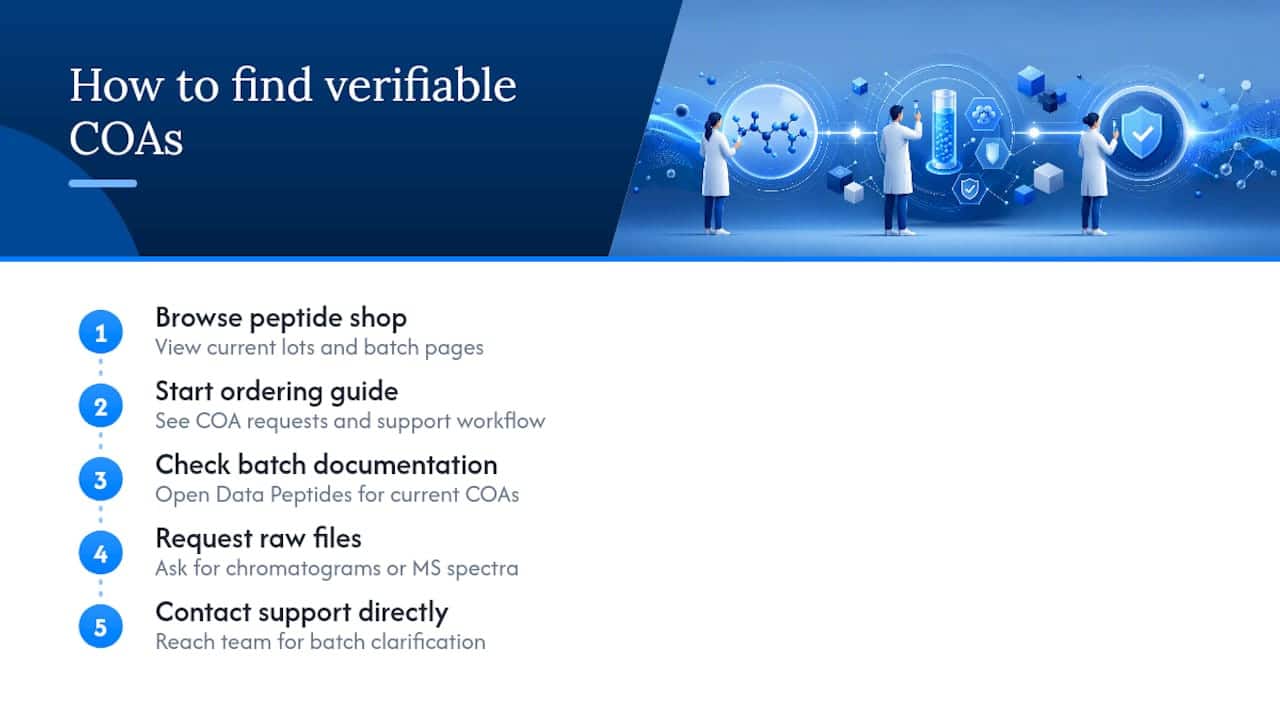
Browse current lots in the peptide shop, or start with the complete ordering guide if you want to see how COA requests and support work before placing an order. If you need raw chromatogram files, MS spectra, or clarification on a specific batch, the support team is reachable directly rather than routing you through a ticket queue. Products are intended for laboratory research use and not for human or animal consumption. Head to Data Peptides to check current batch documentation before you order.
Sources
The FDA’s cGMP guidance clarifies COA scope; ISO/IEC 17025 covers lab accreditation; FDA guidance search covers method validation standards referenced throughout this guide.
FAQ
What Is a Peptide COA, Exactly?
A peptide COA is a batch-specific laboratory report showing the analytical results, purity, identity, and sometimes content or contaminant data, for one specific production lot, not a general product guarantee.
How Do I Verify a COA Is Authentic?
Match the batch number on the COA to the vial, confirm the lab’s ISO/IEC 17025 accreditation covers the relevant test methods, and request raw chromatogram or MS files if only summary numbers are shown.
Why Does HPLC Purity Alone Not Prove Identity?
HPLC measures how much of the sample elutes as one dominant peak, but a pure compound can still be the wrong molecule; mass spectrometry is the test that confirms actual identity.
When Should I Request Endotoxin or Sterility Data?
Request these results specifically for any peptide going into cell culture or in vivo research; most standard research-use COAs don’t include them by default.
Does Data Peptides Provide COA Files for Its Products?
Yes, Data Peptides ties batch-specific COA documentation to each lot, viewable through its COA page, with support available for raw data requests.