

“Research use only” (RUO) means a product is intended for laboratory research and not for diagnosing or managing patient care. If you see this label, treat any results as unsuitable for clinical decisions until the lab qualifies the component itself. A Certificate of Analysis does not convert an RUO item into a diagnostic one.
TL;DR:
- Regulators assess intended use across labels, websites, advertising, and sales claims, so diagnostic promises can undermine an RUO label even when packaging says research only.
- A single RUO result reported to a physician or entered in a medical record can trigger misbranding concerns; test volume does not change that threshold.
- For an LDT using an RUO component, the laboratory must qualify it under its quality system and meet labeling rules; supplier documents do not suffice.
- Before use, check exact label wording, review available performance data, match the Certificate of Analysis to the shipped lot, and document qualification and lot traceability.
Table of Contents
- What RUO Means: The FDA Definition and How Intended Use Governs the Label
- Which Products Are Commonly Labeled RUO
- Why RUO Status Matters: Patient Risk and FDA Enforcement Signals
- RUO, IUO, and IVD: Telling the Categories Apart
- Laboratory Obligations When Reusing RUO Components in LDTs
- A Practical Checklist for Evaluating RUO Materials
- A Supplier’s View on Clear RUO Documentation
- Choosing a Documented Source for RUO Research Materials
- FAQ
- Sources
What RUO Means: The FDA Definition and How Intended Use Governs the Label
The FDA says in vitro diagnostic products shipped solely for research should bear the statement “For Research Use Only, Not for use in diagnostic procedures.” That phrase is not decorative. It marks a legal boundary: the product can be used to study test-kit methods, components, or analytes in a laboratory setting, but it cannot be used to assess a patient’s condition or inform a physician’s decision.
The concept that actually controls how a product may be used is “intended use,” not the acronym printed on the box. Regulators look at the totality of labeling, advertising, websites, and other representations a manufacturer makes about a product, not just the label itself. A reagent marked RUO that is marketed with language suggesting clinical accuracy, or sold alongside promotional claims about patient outcomes, can be judged to have a diagnostic intended use regardless of what the sticker says.
This matters because RUO status speaks only to permitted use, not to product safety or manufacturing quality. Those are separate questions a lab has to answer on its own, typically through a Certificate of Analysis, lot documentation, and its own verification work before any component enters a workflow, research or otherwise.
Which Products Are Commonly Labeled RUO
RUO labeling shows up across a wide swath of laboratory supply, not just finished test kits. Materials that fall into this category typically include:
- Reagents used in method development or assay optimization
- Instruments and platforms used for laboratory research
- Analyte-specific components sold for building custom assays
- Full assay kits intended for research-stage performance testing
- Cell lines, enzymes, and other biological materials used to characterize a new test system
Each category tends to map to a specific research task. A reagent might be used to test whether a chemistry performs consistently across sample types. An instrument might be evaluated for throughput before a lab ever considers submitting data for regulatory clearance. None of this activity involves reporting a result back to a treating physician or placing it in a patient’s medical record.
Why RUO Status Matters: Patient Risk and FDA Enforcement Signals
The FDA’s concern with RUO misuse is not bureaucratic box checking. It is about patient harm. Research-stage products often lack the established performance data and manufacturing controls that diagnostic products require, which means a result can look clinically plausible while still being wrong. A result that appears clinically plausible may still mislead a healthcare provider when the product’s performance has not been established for that use.
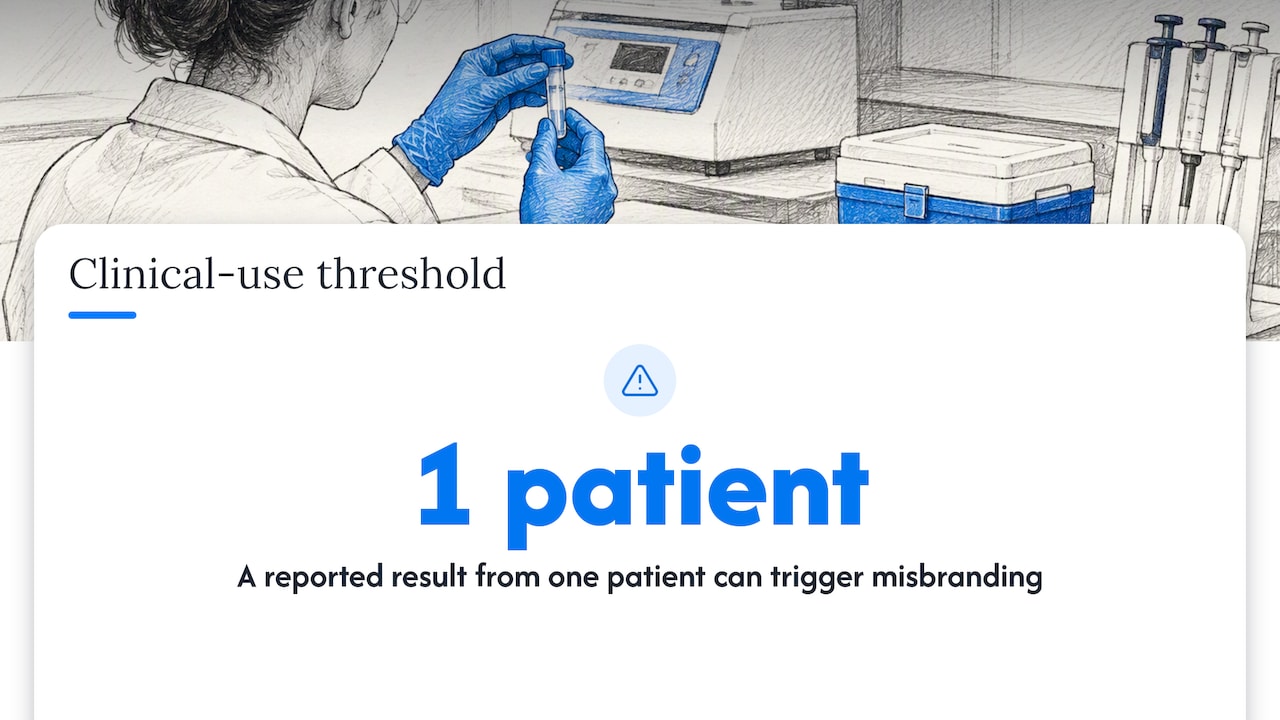
This is why the rule is stricter than most people expect. An RUO-labeled IVD can become misbranded if it is used in a clinical study for even a single patient, as long as that result is reported to a physician or entered into a medical record. Volume does not matter. One instance of clinical use is enough to trigger the issue.
The FDA has also published guidance specifically addressing when RUO or IUO labeling is appropriate, reminding manufacturers that the label has to match the product’s actual intended use. When a supplier’s conduct (marketing materials, sales conversations, technical claims) contradicts the RUO designation on the package, that mismatch is the kind of signal that draws regulatory attention. Labs buying from a supplier whose claims drift toward clinical promises should treat that as a warning sign, not a selling point.
RUO, IUO, and IVD: Telling the Categories Apart
Three labels get confused constantly, and the differences carry real consequences.
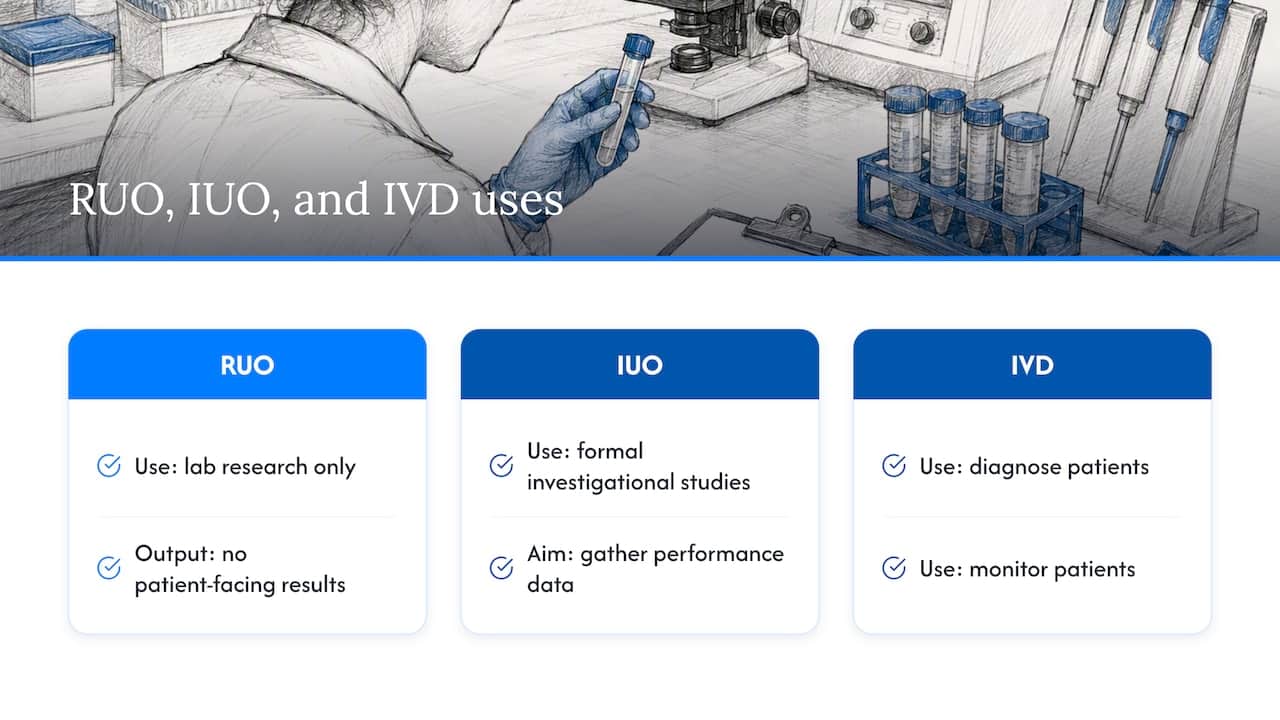
RUO products are for laboratory research only: method development, biological investigation, or component testing with no patient-facing output. IUO (investigational use only) products are a step closer to clinical application. They are typically used in formal investigational studies, often under protocols designed to gather the performance data a manufacturer eventually needs to support a diagnostic claim. IVD (in vitro diagnostic) products are intended for use in diagnosing or monitoring patients.
The clearest labeling cue separating a diagnostic product from an RUO one is the package insert. For laboratory-developed tests using RUO components, the laboratory must include applicable information in the test system labeling to meet 21 CFR 809.10(b) requirements. An RUO label indicates that the product is intended for research use, not diagnostic procedures.
A practical decision checklist: read the exact label wording, request the package insert if one exists, review any promotional or technical materials for diagnostic claims, and ask directly whether performance data supports clinical use. Intended use is the sum of everything a supplier communicates, not just the words printed on the box.
Laboratory Obligations When Reusing RUO Components in LDTs
Labs that build laboratory-developed tests (LDTs) using RUO reagents or instruments take on responsibility the moment they do it. The FDA’s LDT labeling guidance makes clear that the laboratory manufacturer, not the component supplier, is responsible for qualifying RUO components under its own quality system. That includes satisfying labeling requirements under 809.10(b)(5) and 809.10(b)(6) within the finished test system’s documentation.
An RUO reagent sitting inside a validated LDT does not inherit diagnostic status automatically. The lab has to generate its own qualification data, under its own quality system, before that component can be part of a test used for patient care. This work is separate from, and in addition to, whatever documentation the original supplier provided.
When a laboratory moves toward using a component in an investigational or human-subject context, additional frameworks can apply, including considerations tied to investigational device exemptions under 21 CFR Part 812. These protections exist because clinical use of unproven materials carries risk for the people being tested, not just regulatory risk for the lab.
The misbranding issue from earlier applies here directly: reusing an RUO component in a clinical context, where results get reported to a physician or recorded in a patient’s chart, can make that use misbranded even if the lab ran its own confirmatory testing. Internal verification does not substitute for the regulatory pathway a diagnostic use requires.
A Practical Checklist for Evaluating RUO Materials
Before any RUO material enters a workflow, a short qualification process protects both the lab and the integrity of the research:
- Confirm the exact label wording, including whether it states “For Research Use Only, Not for use in diagnostic procedures.”
- Request and review any package insert or performance data the supplier can provide.
- Obtain the Certificate of Analysis (COA) and verify it matches the specific lot received.
- Confirm lot traceability and ask about the manufacturing controls behind that batch.
- Document the qualification process and file the records in your lab’s quality system.
Supplier questions worth asking directly: Is this lot’s COA specific to the batch shipped, or a generic template? What testing method generated the purity and identity data? Is there a technical contact available if a result looks inconsistent with prior lots?
Pro Tip: File the COA and your own qualification notes in your quality system before the material touches any workflow that could eventually feed into patient-facing data, not after.
A Supplier’s View on Clear RUO Documentation
We treat the RUO label as a floor, not a formality. Every lot we ship carries its own Certificate of Analysis tied to that specific batch, because a generic COA tells a researcher nothing about the material actually in their hands. Researchers can ask suppliers whether they provide lot-specific documentation.
Clear documentation also protects the research itself. Keeping reagent documentation may help a lab troubleshoot unexpected results. For more on what qualifying a peptide source involves, our research peptides guide covers the purity benchmarks worth checking before you buy.
— Data Peptides
Choosing a Documented Source for RUO Research Materials
Finding a supplier that backs its RUO claims with real documentation saves a lab hours of qualification work later. We provide documentation with our shipments. Researchers should review it before using a material in a protocol. Shipping is fast and discreet from our US facility, and our support team is available around the clock if a question comes up about a specific lot.
If your lab needs peptides for a research protocol and wants the paperwork to match, our shop lists current research-grade options along with their documentation. For additional detail on distinguishing intent language across labels, our guide on what “Not for Human Consumption” means covers a related labeling distinction lab buyers run into often. And for peptide-specific quality benchmarks, our peptide laboratory standards resource walks through what to check before a lot ships.
This article is general information, not a substitute for advice from a qualified doctor. Consult a qualified healthcare professional about your own circumstances before acting on anything here.
FAQ
What is research use only?
Research use only (RUO) is a labeling designation stating that a product is intended solely for laboratory research, such as method development or component testing, and not for diagnosing or treating patients. The FDA requires this exact wording on in vitro diagnostic products shipped only for research purposes.
What does it mean for research purposes only?
“For research purposes only” signals that a product has not been validated for clinical use and that any data it generates should not be reported to a physician or placed in a patient’s medical record. The designation reflects intended use rather than a statement about the product’s underlying quality or safety.
What is the FDA definition of “research use only”?
The FDA describes RUO IVDs as limited to laboratory research activities such as identifying test-kit methods, components, or analytes, and says they must not be used to assess a patient’s condition. See FDA information on RUO IVDs.
What are research use only materials?
Research use only materials span reagents, instruments, analyte-specific components, and assay kits used to develop or evaluate test methods in a laboratory setting. For background on how these categories fit into broader biomedical research workflows, see this foundational guide to biomedical research.
How should a lab evaluate an RUO supplier before buying?
A lab should confirm the exact label wording, request a lot-specific Certificate of Analysis, and verify manufacturing controls before using any RUO material. One partner resource on lab compliance outlines why RUO labeling never substitutes for diagnostic approval, a distinction worth confirming with any supplier.