

Kisspeptin-10 (YNWNSFGLRF-NH2, also called KP10 or metastin 45–54) is a research reagent peptide, so use only lot-documented, third-party tested material labeled for research use only. Require identity confirmation by mass spectrometry before the vial enters an experiment. Then protect it: aliquot on arrival, avoid freeze-thaw cycles, and keep it cold.
TL;DR:
- Accept a lot only when its certificate is tied to the vial and includes an HPLC chromatogram, observed and theoretical mass, and third party identity confirmation.
- After receipt, let the sealed vial reach room temperature before opening, reconstitute gently, and freeze single use aliquots to avoid repeated thawing.
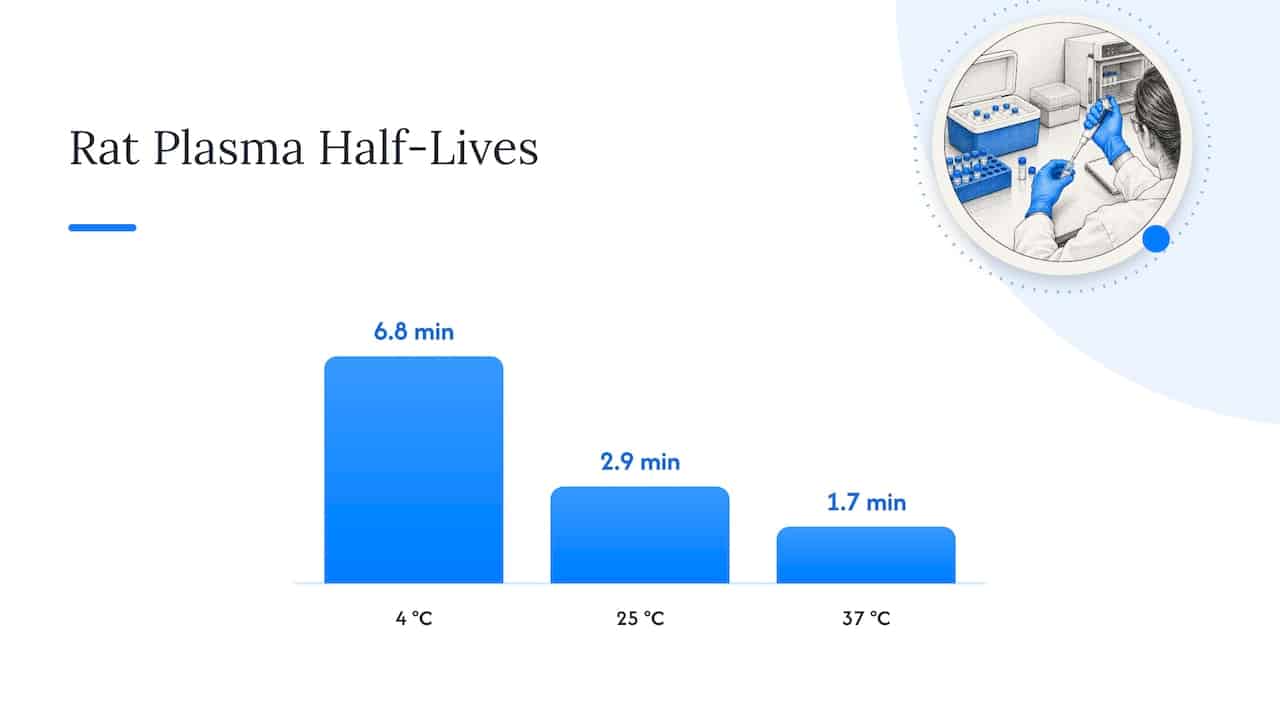
- In rat plasma, Kisspeptin 10 half life fell from about 6.8 minutes at 4°C to 1.7 minutes at 37°C, so process samples cold.
- Published hypothalamic cell studies use 1 nM to 10 µM, but verify intact peptide in your matrix and sample early because nominal exposure can mislead.
- Animal studies lack a consensus dose; choose one from primary literature for your species and endpoint, then schedule dense early sampling because clearance is rapid.
Table of Contents
- 1. What should a Kisspeptin-10 product page and COA show?
- 2. Why does mass spectrometry matter more than a purity percentage?
- 3. How should you receive, reconstitute and store the peptide?
- 4. What concentrations and timing work in vitro?
- 5. What do U.S. labs need to know about RUO labeling?
- 6. How is Kisspeptin-10 dosed in animal studies?
- 7. How does Kisspeptin-10 act in research models?
- 8. How does Kisspeptin-10 compare with other kisspeptin forms?
- 9. Which applications and endpoints show up most often?
- 10. What safety and compliance steps apply in the lab?
- 11. A publisher’s view: three habits that prevent failed experiments
- 12. Where to get COA-backed Kisspeptin-10 from us
- FAQ
- Sources
1. What should a Kisspeptin-10 product page and COA show?
Kisspeptin-10 is the C-terminal decapeptide fragment of kisspeptin, and the sequence YNWNSFGLRF-NH2 includes a C-terminal amide. That amide matters for receptor binding assays, because a free-acid variant or a truncated analog can behave differently at the receptor and give you results you cannot compare across labs. Check that the sequence on the label matches the sequence you cite in your methods section.
Most labs receive the peptide as a lyophilized powder in a sealed vial, shipped with a certificate of analysis (COA) tied to a specific lot. Our Kisspeptin product page is where we list specifications and where you can request lot documentation. Before you order or open a lot, confirm these items:
- HPLC purity reported as area percent, with the chromatogram available.
- Mass spectrometry identity, showing observed mass against the theoretical mass.
- Lot number that matches the vial label and the COA.
- Water content or peptide content, so you can calculate working concentrations accurately.
- Endotoxin data where your assay uses cells or in vivo models.
- Storage recommendations stated by the supplier.
- “For Research Use Only” labeling on the vial and documentation.
Our research peptides playbook covers how COA expectations and common purity thresholds fit together if you are building a supplier checklist from scratch.
2. Why does mass spectrometry matter more than a purity percentage?
An HPLC area-percent figure describes the fraction of the detected chromatographic signal belonging to the main peak. It tells you what fraction of the detected chromatographic signal belongs to the main peak. It does not tell you that the main peak is the right molecule. A truncated sequence, a deletion analog or a modified residue can co-elute or sit close enough to the main peak that area percent barely changes. Chromatographic purity and sequence identity answer two different questions, and a lot can pass the first while failing the second.
Mass spectrometry closes that gap. A measured molecular weight that matches the theoretical mass confirms the intact peptide, and MS/MS fragmentation can confirm the sequence and flag truncated products. The same technique is how published work quantifies the peptide. A validated LC–MS/MS assay for kisspeptin-10 in rat plasma characterized its decomposition product alongside the parent peptide, which shows how routine this verification is in the literature. Synthesis reports also describe Fmoc solid-phase synthesis with 1H-NMR and mass spectrometry characterization, so the analytical workflow is well established.
Practical acceptance criteria for a lot:
- An HPLC chromatogram, not just a stated percentage.
- Mass spec confirmation of identity, with observed and theoretical mass.
- Endotoxin testing where the assay is sensitive to it.
- A COA issued by a third-party laboratory and tied to the lot you received.
Pro Tip: When reproducibility is critical, ask for raw spectra or annotated COA pages. A peak table alone cannot show you shoulder peaks or unassigned fragments.
3. How should you receive, reconstitute and store the peptide?
Most degradation is preventable at the bench. Follow this sequence from receipt to storage:
- Move the sealed vial from the shipping container to cold storage, and log the receipt date and lot number.
- Before opening, let the vial reach room temperature so condensation does not wet the lyophilized cake.
- Add solvent slowly down the vial wall rather than onto the powder, which protects the cake and limits foaming.
- Mix gently by swirling. Avoid vigorous vortexing.
- Divide the solution into single-use aliquots sized for one experiment.
- Freeze aliquots according to the supplier’s storage recommendations, and record freeze-thaw counts on each tube.
Freeze-thaw discipline deserves its own emphasis. Researchers working with kisspeptin-10 in cell models report that binding stability matters and that repeated freeze-thaw cycles drive measurable activity loss. One thaw per aliquot removes that variable entirely.
Temperature also governs how fast the peptide disappears once it meets biological matrix. In the rat plasma study, the initial half-lives were about 6.8 minutes at 4 °C, 2.9 minutes at 25 °C and 1.7 minutes at 37 °C. Processed extracts stored at 4 °C or −80 °C stayed stable overnight, so extraction before holding is the safer order of operations. Our guides on peptide storage temperature and peptide laboratory standards go deeper on SOP wording.
Pro Tip: Label every aliquot with lot number, concentration, date and a tally box for thaws. A tube with an unknown history is a tube you should discard.
4. What concentrations and timing work in vitro?
Published cell work gives you a defensible window. Studies of hypothalamic cell models report kisspeptin-10 used at concentrations from 1 nM to 10 µM, with measurable effects on gene expression and neurotransmitter levels. Typical assay families include neurotransmitter release measurements, intracellular signaling readouts and neuroprotection models. Researchers have, for example, tested the peptide in cholinergic differentiated SHSY-5Y cells exposed to α-synuclein toxicity.
Stability shapes how you design those experiments. Because the peptide decomposes quickly in biological matrices, the exposure your cells actually experience can be much shorter than the nominal incubation time. Build that into the design:
- Validate integrity in your own matrix. Run spike-recovery tests and short-timepoint LC–MS/MS checks to see how much intact peptide remains at each sampling time.
- Sample early. Put timepoints inside the window where the peptide is still present rather than only at the endpoint.
- Limit proteolysis. Consider protease inhibitors or serum-free conditions where your cell model tolerates them.
- Include a positive control. A known responder confirms the assay itself is working when a result looks flat.
- Use a dose series. Spanning the published range tells you where your system sits instead of assuming it matches another lab’s.
5. What do U.S. labs need to know about RUO labeling?
FDA guidance defines how research-use products are labeled. According to its FAQ on analyte specific reagents, research use only products must carry the statement “For Research Use Only. Not for use in diagnostic procedures.” The same guidance explains that ASR requirements apply to clinical diagnostic use, not to research applications.
For a Kisspeptin-10 purchase, that translates into a short list:
- Expect the RUO statement on vendor labels and documentation, and treat its absence as a procurement flag.
- Understand that RUO and IUO designations belong to research and investigational contexts, not clinical diagnostics.
- Follow your institution’s procurement and biosafety rules when ordering.
- Document the intended research use in your purchasing records.
Our overview of USA research peptide quality standards outlines what to ask a supplier when your institution requires vendor qualification.
6. How is Kisspeptin-10 dosed in animal studies?
Animal work with kisspeptin-10 is pharmacokinetically demanding because the peptide clears and degrades fast. The best-documented example in our sources is the rat study that built the LC–MS/MS assay, where the peptide was quantified in plasma with rapid loss in the first half hour: more than 90% degraded in rat plasma within 30 minutes. That result sets expectations for any in vivo protocol: sampling schedules must be dense early, and any plasma held before processing must be kept cold.
Because we do not have a single consensus dose to cite, build your protocol from the primary literature for your species and endpoint rather than from a vendor page. Decide the route and vehicle first, since both change exposure. Prepare dosing solutions fresh from a single-use aliquot, keep them on ice, and record the time between reconstitution and administration.
Radiolabeled analogs show how short exposure can be. A DOTA-conjugated analog retained KISS1R activity and was radiolabeled for preclinical imaging work, with a reported blood half-life of about 18 ± 3 minutes for the radiolabeled analogue. Treat that figure as specific to that conjugate, not to native kisspeptin-10, and design sampling around the rapid clearance you are likely to see.
7. How does Kisspeptin-10 act in research models?
Kisspeptin-10 is studied as an agonist of the KISS1 receptor (KISS1R), a G protein-coupled receptor. In the radiopharmaceutical work, the DOTA analog’s value rested on the fact that it retained biological activity at KISS1R, which confirms that the decapeptide fragment carries the receptor-binding function the longer kisspeptin forms are known for.
Downstream readouts depend on the tissue. In hypothalamic cell models, kisspeptin-10 produced measurable effects on gene expression and neurotransmitter levels involved in appetite control. In neuronal models, it has been tested for protective effects against toxic insult, including the α-synuclein toxicity model in cholinergic differentiated SHSY-5Y cells.
For signaling studies, choose readouts that match the receptor biology: second messenger assays, phosphorylation of downstream kinases and transcript changes at defined timepoints. Because the peptide degrades quickly in matrix, pair every signaling timecourse with an integrity check. Otherwise, a fading response may reflect a vanishing ligand rather than receptor desensitization, and you will not be able to tell which.
8. How does Kisspeptin-10 compare with other kisspeptin forms?
Kisspeptin exists in several lengths derived from the same precursor, and Kisspeptin-10 is the shortest commonly used fragment, spanning residues 45–54 of the metastin sequence. Its appeal for reagent work is practical. A decapeptide is straightforward to make by solid-phase synthesis, and published methods describe Fmoc synthesis with standard protecting groups, characterized by 1H-NMR and mass spectrometry. Shorter sequences also make identity confirmation cleaner, since there are fewer places for a truncation or substitution to hide.
The tradeoff to plan around is stability. The rapid, temperature-dependent degradation documented in the rat plasma study is a property of this short fragment in biological matrix, and any comparison with a longer isoform should test stability in your own assay conditions rather than assume the same behavior. Likewise, do not carry concentration windows from one isoform to another. The 1 nM to 10 µM range we cited comes from studies using kisspeptin-10 specifically.
When choosing between forms, let the question decide. Receptor-binding and signaling work is well served by the decapeptide. Studies that depend on the full-length structure should use the form that matches the biology, with the same COA and mass spec expectations applied.
9. Which applications and endpoints show up most often?
The literature around kisspeptin-10 clusters into a few application families, each with characteristic endpoints:
- Appetite and hypothalamic signaling. Endpoints include neuropeptide gene expression and neurotransmitter levels in hypothalamic cell models.
- Neuroprotection. Cell viability and toxicity rescue are measured in neuronal lines, as in the SHSY-5Y α-synuclein model.
- Radiopharmaceutical development. Researchers conjugate the peptide to chelators such as DOTA and measure receptor retention, radiolabeling success, serum stability and blood clearance in preclinical PET and radioligand work.
- Analytical method development. Quantification, degradation products and pharmacokinetics are characterized by LC–MS/MS in plasma.
Across all four, the endpoint is only as trustworthy as the peptide behind it. A neuroprotection result or a clearance curve cannot be interpreted if the lot’s identity is unconfirmed or the aliquot has been thawed repeatedly. Report lot number, COA source and handling history alongside the endpoint in your methods.
10. What safety and compliance steps apply in the lab?
Treat Kisspeptin-10 as a bioactive research material. Our sources do not provide a hazard classification for it, so rely on the supplier’s documentation and your institution’s chemical hygiene plan rather than assumptions. Practical steps:
- Handle lyophilized powder in a way that avoids generating dust, and use standard laboratory personal protective equipment.
- Keep the material within research workflows only. The RUO label restricts use to research, consistent with the FDA statement that these products are not for use in diagnostic procedures.
- Store it in a labeled, access-controlled location with lot numbers recorded.
- Dispose of unused solutions and contaminated consumables according to your institution’s waste procedures.
- Retain COAs and purchasing records so the material can be traced if a question arises.
Radiolabeled work adds its own layer of radiation safety and licensing requirements, which your institution’s radiation safety office governs. Document intended use at purchase, and keep that record with the lot documentation.
11. A publisher’s view: three habits that prevent failed experiments
Most failed peptide experiments trace back to the reagent, not the biology. Three habits fix most of it. First, write COA review into your procurement SOP and require mass spec identity confirmation for any experiment you cannot afford to repeat. Second, record lot numbers and freeze-thaw counts in the experiment record itself, so an odd result can be checked against handling history. Third, ask vendors for endotoxin data and shipment conditions whenever the reagent is time-sensitive. A peptide that arrived warm is a different reagent from one that arrived cold, and you should know which one you have.
— Data Peptides
12. Where to get COA-backed Kisspeptin-10 from us
We offer research-grade peptides supported by certificates of analysis and third-party batch testing, with each lot documented for purity and identity. You can view specifications on our Kisspeptin product page, where you can also request detailed lot data before you order. Orders ship discreetly from our U.S. facility, and our support team is available around the clock to answer handling and documentation questions. To browse the full catalog or place an order, go to our shop and send us your documentation request with your lot number.
FAQ
What is Kisspeptin-10 used for in the lab?
Kisspeptin-10 is used as a research reagent in cell and animal models. Published work covers hypothalamic signaling, neuroprotection and radiopharmaceutical development, including DOTA-conjugated analogs for preclinical imaging.
How should Kisspeptin-10 be stored?
Allow the lyophilized vial to reach room temperature before opening, then reconstitute slowly and divide the solution into single-use aliquots. Store aliquots according to the supplier’s recommendations and avoid repeated freeze-thaw cycles, which researchers link to measurable activity loss.
Is an HPLC purity percentage enough to trust a lot?
No. HPLC area percent describes chromatographic purity but does not confirm the sequence, so a truncated analog could still pass. Pair it with mass spectrometry identity confirmation and a lot-matched COA.
What concentration range is used in cell studies?
Published hypothalamic cell studies report concentrations from 1 nM to 10 µM. Run a dose series in your own system and verify peptide integrity in the assay matrix.
Sources
- LC–MS/MS quantification of a neuropeptide fragment kisspeptin-10 (NSC 741805) and characterization of its decomposition product and pharmacokinetics in rats – PMC
- Commercially Distributed Analyte Specific Reagents (ASRs): Frequently Asked Questions | FDA
- Effects of Kisspeptin-10 on Hypothalamic Neuropeptides and Neurotransmitters Involved in Appetite Control
- [Kisspeptin-10 Rescues Cholinergic Differentiated SHSY-5Y Cells from α-Synuclein-Induced Toxicity In Vitro
- Synthesis and characterisation of DOTA-kisspeptin-10 as a potential gallium-68/lutetium-177 pan-tumour radiopharmaceutical – PubMed