
Oral peptide bioavailability is the fraction of a swallowed dose that reaches systemic circulation, judged by AUC and Cmax against an intravenous or subcutaneous reference. For most peptides it is under 1%, and oral semaglutide is the boundary case that works anyway. Fasting, water volume and post-dose waiting time change the result decisively.
TL;DR:
- Measure exposure with AUC and Cmax against an intravenous reference; use sensitive assays and report Tmax and variability, since low exposure can evade small studies.
- Peptides face digestive degradation, mucus, poor membrane passage, efflux, and first pass metabolism; candidates with short half lives may not reach useful levels.
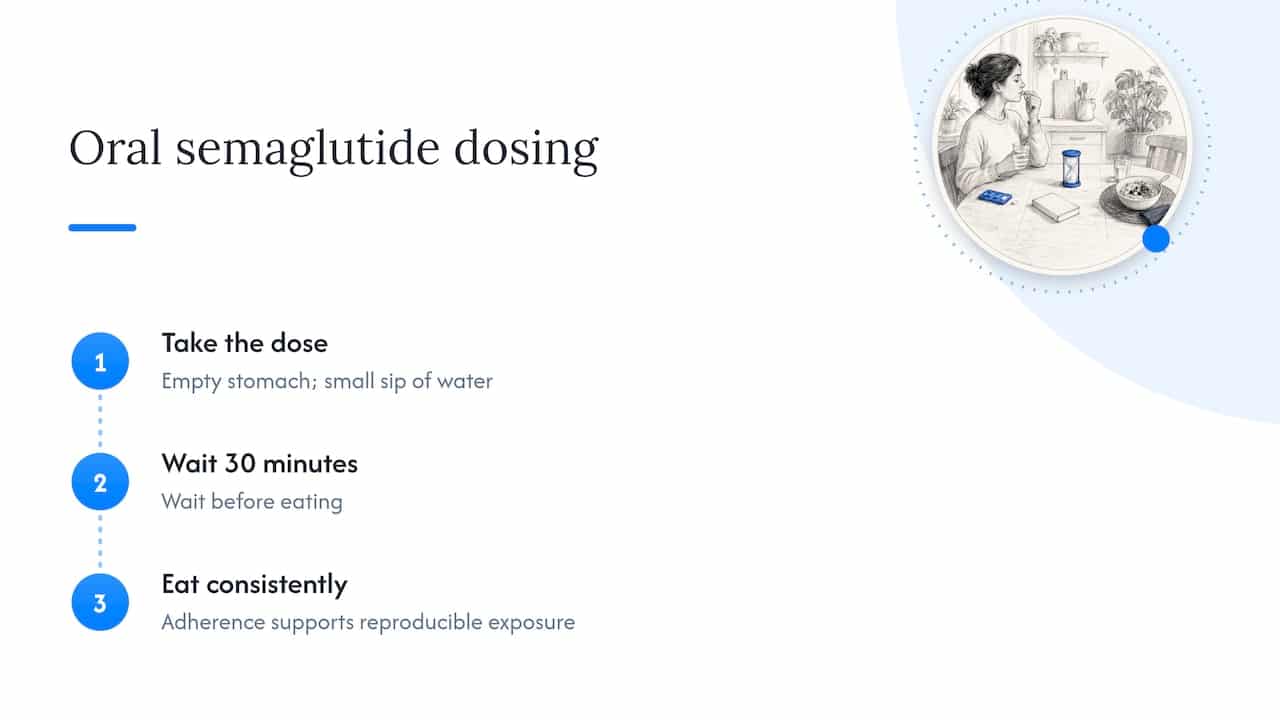
- Oral semaglutide reaches about 0.4% to 1% bioavailability with SNAC, but requires fasting, a small sip of water, and a 30 minute wait.
- Permeation enhancers are the most tested approach; nanoparticles and ingestible devices remain largely preclinical or early clinical, with safety and efficacy still unconfirmed.
- Screen stability and permeability first, then run pilot pharmacokinetics under fixed fasting, water, and timing after dosing before investing in formulation work.
Table of Contents
- How is oral peptide bioavailability measured?
- Why is peptide absorption so limited?
- Which delivery strategies raise exposure, and how do they compare?
- What does oral semaglutide teach developers?
- How should you use bioavailability numbers when planning research?
- Why do we lean toward cautious optimism?
- Where can you source well-characterized peptides for PK and stability work?
- FAQ
- Sources
How is oral peptide bioavailability measured?
The FDA’s general considerations for bioavailability studies tell sponsors to use clinically relevant systemic exposure measures such as AUC and Cmax, with the most accurate, sensitive and reproducible assays available. That guidance is the working standard for how a bioavailability study gets conducted.
- AUC: the area under the concentration-time curve, which captures total systemic exposure.
- Cmax: the peak concentration reached after dosing.
- Tmax: the time at which that peak occurs.
- Absolute bioavailability: the oral exposure divided by exposure from an intravenous reference, dose-normalized.
- Relative bioavailability: one formulation or route compared against another non-intravenous reference.
Single-dose PK studies give a clean snapshot, while population PK modeling pools sparse samples from many subjects to estimate low F values that small volunteer studies may not resolve. Either way, assay sensitivity affects whether very low bioavailability can be measured.
Administration controls matter just as much. Fasting state, the volume of water and the delay before the next food or drink can swing exposure enough to bury a real signal, so reproducible low-F work fixes all three in the protocol.
Why is peptide absorption so limited?
A swallowed peptide faces a sequence of barriers, and each one removes a share of the dose before it can reach blood.
- Acid and proteases: peptides can face degradation in the digestive tract.
- Mucus and tight junctions: mucus and the intestinal barrier can limit peptide passage.
- Poor passive permeability: peptide properties can make it difficult for them to cross cell membranes.
- Efflux and first-pass metabolism: transport and metabolism can further limit the amount reaching circulation.
Low F can be a challenge when a peptide also has a short half-life. If little reaches circulation, the level may not accumulate to a useful range, and raising the dose may not solve the problem. Our own peptide stability testing protocols provide further reading on degradation problems. Size and structure matter too: small peptides sometimes cross more readily, while larger ones depend heavily on enhancers or modification, as our primer on small peptide structure explains.
Recent reviews report that oral peptide bioavailability is typically under 1%, and sometimes under 0.1%. That range sets the realistic expectation for any candidate without a protective or permeation strategy.
Which delivery strategies raise exposure, and how do they compare?
Permeation enhancers are the most widely tested approach, while ingestible devices and gut shuttles still need clinical studies to confirm safety and efficacy. Each strategy attacks a different barrier.
- Permeation enhancers (SNAC, sodium caprate): SNAC buffers local pH, reduces oligomerization and transiently fluidizes gastric epithelial membranes. The effect is reversible, and administration parameters strongly shape exposure.
- Molecular modification: approaches such as lipidation, PEGylation, cyclization and D-amino acids may be explored to address stability or half-life.
- Colloidal carriers and nanoparticles: these are possible delivery approaches, though their clinical usefulness remains to be established.
- Ingestible devices: some designs aim to deliver a drug without relying on classical absorption, though their practical constraints need evaluation.
- Sublingual, buccal and nasal routes: these bypass the stomach entirely and are conceptually different from swallowed delivery. A review of noninvasive routes notes that bioavailability is often low but can be improved with absorption enhancers or mucoadhesive systems.
| Method | Typical reported F% | Evidence level | Main administration constraints |
|---|---|---|---|
| SNAC co-formulation (oral semaglutide) | About 0.4–1% | Approved | Empty stomach, minimal water, post-dose delay |
| Lipidation, PEGylation, cyclization | Case-dependent | Preclinical to clinical | Potentially relevant when stability or half-life is a concern |
| Nanoparticles and colloidal carriers | Not established here | Mostly preclinical | Formulation and payload protection |
| Ingestible injection devices | Device-mediated, not classical absorption | Early clinical | Device and dose-capacity constraints |
| Sublingual, buccal, nasal | Route-dependent | Evidence varies by route and product | Absorption and local tolerability considerations |
Surveys of pipeline trends show injectables still dominate while oral is a small share, and even improved formulations still yield low and highly variable F.
What does oral semaglutide teach developers?
Oral semaglutide (Rybelsus) is co-formulated with SNAC, which lets the peptide be absorbed in the stomach. An analysis of the SNAC development program puts model-derived bioavailability at about 0.8% under recommended dosing, with variability reduced at steady state. The prescribing label documents population PK estimates of roughly 0.4% to 1%, a long half-life and the dosing rules that make exposure reproducible.
Absolute bioavailability of oral semaglutide is only about 0.4% to 1%, yet its long half-life helps make oral treatment feasible.
The rules are strict: take it on an empty stomach with a small sip of water and wait 30 minutes before eating. The clinical program review confirms that fasting dosing with limited water and a 30-minute post-dose fast are needed to obtain measurable exposure. Within-subject variability is the regulatory pressure point, so success depended on lowering it at steady state and monitoring adherence to dosing instructions.
How should you use bioavailability numbers when planning research?
A 2026 analysis of pharmacokinetic boundaries frames oral semaglutide as a rare alignment of potency, half-life and tolerable variability. Several questions can help triage a candidate: How potent is it? How long does it persist? How wide is the therapeutic window? What F would be required to hit target exposure?
- Validate an assay sensitive enough to quantify sub-1% exposure.
- Fix fasting state, water volume and post-dose delay before the first animal or subject is dosed.
- Include an intravenous or subcutaneous reference arm so absolute F can be calculated.
- Sample densely around Tmax, and use population PK to estimate low F.
- Report AUC, Cmax, Tmax and variability, not just a single F figure.
Dose escalation to compensate for low F usually fails on safety and cost, so treat it as a last resort.
Pro Tip: Run a pilot PK under tightly controlled dosing before investing in formulation work, so you know whether variability is already disqualifying.
Why do we lean toward cautious optimism?
Oral peptide success is rare and usually a boundary case, so enthusiasm should be earned by data. Our recommendation is to screen in vitro stability first, run permeability assays second, and commit to a controlled pilot PK third. Endpoints that separate feasible from infeasible candidates are exposure relative to target, and variability under fixed dosing.
— Data Peptides
Where can you source well-characterized peptides for PK and stability work?
We supply research-grade, third-party tested peptides with Certificates of Analysis, so your lots arrive documented and your absorption and stability studies start from reproducible material. Browse our research peptide shop to find supplies for your next study.
This article is general information, not a substitute for advice from a qualified doctor. Consult a qualified healthcare professional about your own circumstances before acting on anything here.
FAQ
What is the bioavailability of oral drugs?
It varies widely by compound. Small, permeable molecules can be absorbed well, while peptides are usually far lower, often under 1%.
Are there oral peptides that work?
Yes, but they are rare boundary cases. Oral semaglutide works because SNAC enables stomach absorption and its long half-life tolerates very low, variable exposure.
Can BPC-157 be absorbed through the skin?
We have no source that establishes transdermal absorption of BPC-157, so we make no claim either way. Noninvasive routes generally show low bioavailability due to limited permeability and enzymatic degradation, so any route should be tested with a controlled PK study.
What drug has 100% bioavailability?
Intravenous administration is the reference, since the whole dose enters circulation directly. That is why absolute oral bioavailability is calculated against an intravenous arm.
Sources
- Current Understanding of Sodium N-(8-2-Hydroxylbenzoyl Amino) Caprylate (SNAC) as an Absorption Enhancer: The Oral Semaglutide Experience – PMC
- Bioavailability Studies Submitted in NDAs or INDs – General Considerations
- Barriers and Strategies for Oral Peptide and Protein Therapeutics Delivery: Update on Clinical Advances
- Progress and limitations of oral peptide delivery as a potentially transformative therapy