

Hormone support peptides are short amino acid chains, mainly GHRH analogs, growth hormone secretagogues, and immune peptides such as thymosin alpha-1, that aim to nudge the body’s own signaling. A few have real trial histories, but most remain investigational for anti-aging or performance goals. Seek clinician-supervised evaluation, and insist on verified product quality, including a batch Certificate of Analysis (COA), before anything else.
TL;DR:
- Tesamorelin is approved for a defined condition, not age related or performance use; sermorelin and ipamorelin remain investigational for those goals.
- Thymosin alpha 1 trials have involved more than 11,000 subjects, but evidence supports specific conditions, not general immune boosting in healthy people.
- Before supervised care, request a Certificate of Analysis for the specific lot and independent testing, because vial identity, dose, and sterility can vary.
- Clinicians commonly check IGF 1, fasting glucose, HbA1c, and liver function before care, then repeat tests while tracking swelling, joint pain, and glucose changes.
Table of Contents
- 1. How the main peptide classes work
- 2. What the evidence and regulatory status actually say
- 3. Claimed benefits, ranked by strength of evidence
- 4. Safety, adverse effects, and quality concerns clinicians watch for
- 5. What clinicians evaluate, monitor, and document
- 6. How to find supervised peptide care and what to ask
- 7. An evidence-first note on sourcing and documentation
- 8. Research-grade sourcing from Data Peptides
- FAQ
- Sources
1. How the main peptide classes work
Most of the names you will meet fall into a handful of families. Knowing which family a peptide belongs to tells you what it is supposed to do, and what it is not.
GHRH analogs include CJC-1295 and sermorelin. They bind growth hormone releasing hormone receptors on the pituitary and prompt the gland to release its own growth hormone. Because the pituitary still controls the timing, release stays pulsatile, which is the main contrast with injecting exogenous growth hormone directly. Tesamorelin belongs to this family too and is the one with a formal regulatory history.
Growth hormone secretagogues include ipamorelin and the wider GHRP family. They act as agonists at the ghrelin receptor and stimulate growth hormone release from the anterior pituitary. Ipamorelin is noted for selectivity: regulatory meeting materials describe growth hormone release without cortisol or prolactin elevation. Narrative reviews add that even a selective design leaves its long-term safety uncharacterized for non-approved uses.
Other categories work differently and should not be lumped in with the first two:
- AOD-9604 is a fragment associated with lipolysis (fat breakdown), not a growth hormone releaser.
- BPC-157 is a regenerative peptide discussed mainly for tissue repair, with evidence that is largely preclinical.
- Thymosin alpha-1 (Ta1) is an immune modulator. It does not target the growth hormone axis at all.
- CJC-1295 and ipamorelin are often discussed together, and some research products combine them.
A 2026 therapeutic peptide review groups CJC-1295 and ipamorelin as growth hormone modulators with promising signals in preclinical and limited clinical work. The same review notes significant gaps in dosing, combination effects, and long-term safety. It also separates agents with robust trial evidence from the many that remain investigational.
Administration in clinical discussions is mostly by subcutaneous injection, and the intent matters. A secretagogue or GHRH analog tries to stimulate endogenous release. Growth hormone replacement substitutes for a deficient supply. Those are different clinical goals with different monitoring and different risk profiles.
If you want background on how researchers frame these mechanisms, our overview of peptide treatments and their research applications covers the basics. Keep one distinction in mind as you read on: a peptide that stimulates your own hormone production is not the same thing as hormone replacement therapy, and it is not a stand-alone fix. Clinicians generally build any protocol on individualized blood work, sleep, and nutrition, with the peptide added to that foundation rather than replacing it.
2. What the evidence and regulatory status actually say
Here is the hard part for anyone hoping for a clean answer. The human evidence for most hormone support peptides is thin, and the regulatory picture is uneven.
A 2026 narrative review of performance-enhancing peptides that modulate the GH-IGF1 axis concludes that safety and efficacy profiles for many of these agents remain unproven in large-scale human trials. That finding covers GHRPs, CJC-1295, and ipamorelin, the same names that dominate online discussion. A separate structured narrative review of injectable peptides in sports medicine, covering 2020 to 2025, reached a similar verdict. It found these products largely experimental, with uncertain safety, product-quality concerns, and antidoping implications. It recommended confining clinical use to approved indications or rigorously designed research protocols.
Reviewers’ bottom line: a 2026 narrative review finds safety and efficacy for most GH-modulating peptides unproven in large human trials, a gap between what patients self-administer and what clinical evidence supports.
Where does that leave specific agents?
Tesamorelin is the clearest example of a GHRH analog with an approved indication, which is why it anchors the “evidence” end of the class. Approval for a defined condition does not extend to anti-aging or performance use, and nothing in the reviews we cite says it does.
Sermorelin, CJC-1295, and ipamorelin are a different story. For anti-aging or performance goals they remain investigational, and they are not approved for those purposes. The therapeutic peptide review above describes dosing and combination questions that are still open.
Thymosin alpha-1 has the largest clinical track record among the immune peptides. A comprehensive review of thymosin alpha 1 in human clinical trials reports trial activity involving more than 11,000 subjects. It points to evidence supporting immune-modulating uses in certain conditions, including sepsis, COVID-19, melanoma, and hepatitis B, while noting that regulatory status and compounded formulation oversight remain complex. Thymalfasin, the generic name for the same molecule, has also been studied in registered trials such as Clinicaltrials. Approvals and indications differ by country, so availability in one place says little about another.
BPC-157 and AOD-9604 sit mostly at the preclinical or small-study end. Treat claims about them as hypotheses.
Quality is the other half of the regulatory story. Narrative reviews and regulatory inspection findings document compounding and sterility problems, which matter because the safety question is not only about the molecule. It is also about what is actually in the vial. The practical lesson is that “the peptide worked in a study” and “the product I am holding is that peptide, sterile, at the stated dose” are two separate claims. Our guide to peptide laboratory standards and best practices walks through the verification checks that bridge that gap, and our explainer on whether peptides are legal for research covers the legal framing researchers and clinicians work under.
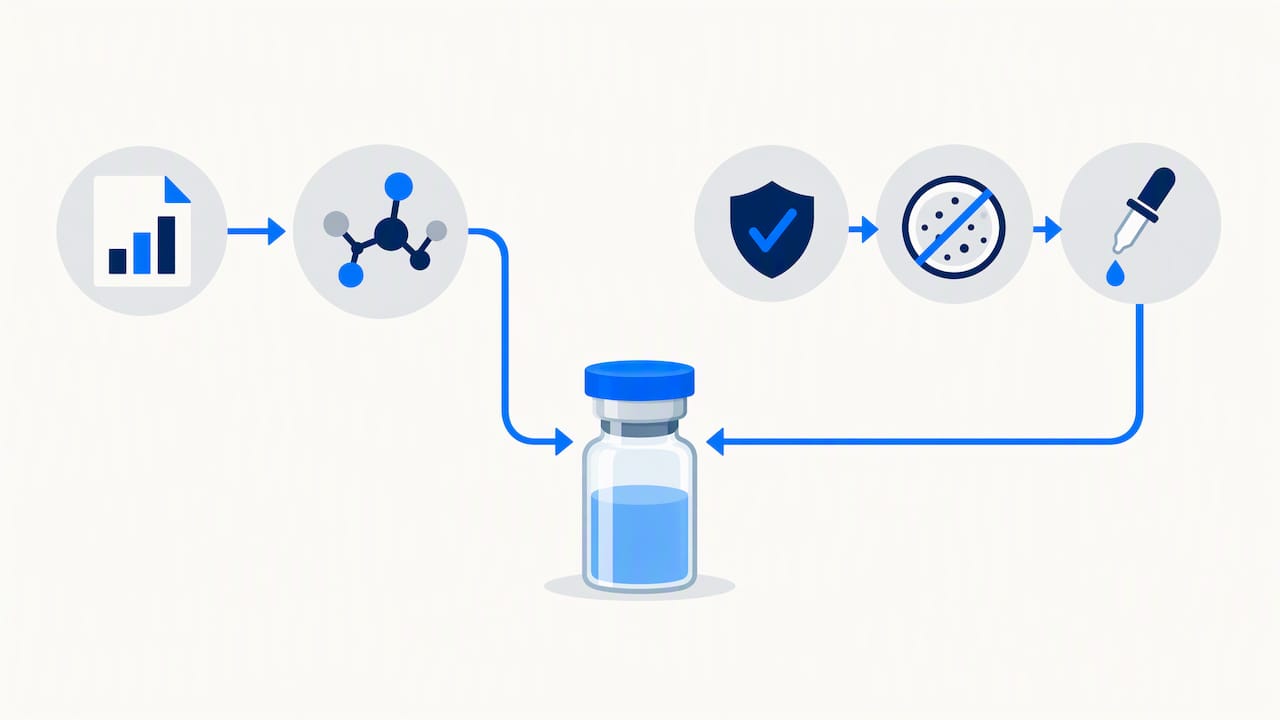
One clinician point is worth stating plainly. Hormonal peptide therapy is often described as stimulating natural production rather than substituting for it, but that framing does not lower the bar for evidence or for oversight. Without standard pharmaceutical-grade controls, batch variability and unknown contamination are real risks when product is sourced outside regulated channels.
3. Claimed benefits, ranked by strength of evidence
Readers meet a long menu of promised benefits. It helps to sort them by how well the evidence supports each one, and to keep animal findings from being quietly promoted into human facts.
Stronger evidence areas
- Immune modulation with thymosin alpha-1. This is the best-supported use among the peptides discussed here, with a large trial program in specific infectious and oncologic contexts. Support is condition-specific, so it does not generalize to “boosting immunity” in healthy people.
- Approved metabolic indications. Agents with formal approval for a defined condition have the most robust trial data, according to the therapeutic peptide review above.
Moderate or limited evidence
- Growth hormone support and body composition. There is a clear mechanistic rationale: stimulating the pituitary should raise growth hormone and, downstream, IGF-1. Some agents have limited clinical data behind that rationale. The leap from raising a hormone level to meaningful gains in muscle or reductions in fat, sustained over years and safe over that time, has not been shown in large trials.
- Adult growth hormone deficiency. This is a recognized medical condition with its own treatment pathway. The Endocrine Society guidance on adult growth hormone deficiency stresses individualized dosing, benefit-risk judgment, and careful evaluation, and it applies to treatment decisions in that setting.
Weak or mostly preclinical evidence
- Recovery and tissue repair. Claims for BPC-157 and related peptides rest mainly on animal and mechanistic work, plus small human studies. Treat them as promising questions, not settled answers.
- Anti-aging. The therapeutic peptide literature groups many agents under aging interventions, yet it also states that many remain investigational with knowledge gaps in dosing, combinations, and long-term safety.
A few cautions help when you weigh any specific claim:
- Ask whether the cited study was in people or animals.
- Ask whether the outcome was a lab value (such as IGF-1) or something you would feel or measure in daily life.
- Ask how long participants were followed, since long-term effects are exactly where the gaps are.
Some readers explore related topics such as peptides used for various research purposes to see how researchers categorize these applications. Those pages describe research contexts, not clinical promises. For recovery-minded readers, it is also worth knowing that non-drug approaches to musculoskeletal health exist alongside any peptide discussion. One example is drug-free bone health programs built on osteogenic loading, which show how foundational measures often matter more than any single compound.
4. Safety, adverse effects, and quality concerns clinicians watch for
Safety discussion starts with an uncomfortable fact: much of what is known about harms comes from self-administration contexts, not controlled trials. That means the picture is incomplete, and likely to stay incomplete for a while.
The 2026 narrative review of GH-IGF1 peptides reports a recognizable cluster of adverse effects in people self-administering these agents:
- Fluid retention, which can show up as swelling in the hands or ankles.
- Joint pain, including myalgia and arthralgia (muscle and joint aches).
- Injection-site reactions, such as redness, pain, or irritation where the product is given.
- Metabolic disturbances, including altered glucose levels, which is why glucose monitoring appears in clinical protocols.
Beyond that cluster, clinicians stay alert to endocrine imbalances when people combine multiple agents off label. Shifts in prolactin or cortisol are a known worry with some secretagogue stacks, which is one reason ipamorelin’s reported selectivity draws attention. There is also a theoretical concern tied to the growth hormone and IGF-1 pathways: because these pathways influence cell growth, clinicians are cautious in anyone with a cancer history. The word “theoretical” matters here. It marks a mechanism-based worry, not an established outcome.
Thymosin alpha-1 has a different tolerability profile. Registered clinical trial records and post-marketing experience point to generally mild events, such as transient injection-site pain, fever, nausea, and flu-like symptoms. Even so, “mild” in a monitored trial population does not guarantee the same experience with an unverified product.
Quality is a safety issue: the injectable peptides in sports medicine review flags product-quality concerns alongside uncertain safety, which is why it recommends restricting clinical use to approved indications or rigorous research protocols.
Product quality deserves its own paragraph. Documented compounding and sterility problems include non-pharmaceutical-grade components and cross-contamination risks. A peptide that is perfectly reasonable on paper can still cause harm if the vial is mislabeled, under-dosed, or not sterile. Verifying a lot-specific COA, ideally backed by independent third-party testing, is a baseline expectation, and our guide to quality and compliance when buying peptides explains what those documents should contain.
Athletes face an additional issue. Many of these peptides carry antidoping restrictions, as the sports medicine review notes. Anyone subject to testing should check with their sport’s governing body before using anything, and should not rely on a seller’s assurance.
Stop and seek care if you notice any of the following:
- Significant swelling, severe joint pain, or symptoms of abnormal blood sugar such as unusual thirst or frequent urination.
- Signs of infection at an injection site, including spreading redness, warmth, or fever.
- New or worsening symptoms after changing products or batches, which can point to a quality problem.
Document what happened, including the product and lot, and bring it to your clinician.
5. What clinicians evaluate, monitor, and document
Supervised care differs from self-directed use mainly in what gets measured before, during, and after. That measurement is the safety net.
Baseline evaluation usually starts with a medical history and a review of current medications and supplements, since interactions are a real consideration. When the clinical question involves a suspected pituitary problem, pituitary axis testing may be indicated. Common baseline labs include:
- IGF-1, the main downstream marker of growth hormone activity.
- Fasting glucose and HbA1c, because growth hormone pathways influence glucose handling.
- Liver function tests and other labs relevant to the individual’s history.
The Endocrine Society’s adult growth hormone deficiency guidance models the underlying logic: careful evaluation first, individualized dosing, and ongoing monitoring tied to benefit-risk judgment. Clinicians apply the same principles when they consider secretagogue-based approaches, even though those agents are not the guideline’s subject.
Monitoring cadence is individualized, but the pattern is consistent. IGF-1 and metabolic labs are rechecked at intervals chosen by the clinician. Symptom tracking runs alongside the labs. The goal is to catch fluid retention, joint symptoms, or glucose changes early, and to know whether the lab values are moving in a sensible direction. Imaging or specialist referral enters the picture when findings do not fit the expected pattern or when a condition such as a pituitary disorder is suspected.
Dosing principles matter because the whole appeal of GHRH analogs and secretagogues is preserving pulsatility, the natural rhythm of growth hormone release. Exogenous growth hormone replacement bypasses that rhythm. The reviews we cite are candid that dosing protocols, combination effects, and long-term safety remain gaps for most of these peptides, so any specific regimen is individualized and, for non-approved uses, investigational. We do not publish dosing instructions, because dosing belongs in a supervised plan built on your labs.
Practical steps a careful clinician takes when something goes wrong:
- Triage the adverse event by severity and decide whether to pause or stop the agent.
- Record the product, lot number, timing, and symptoms so the event can be traced.
- Recheck relevant labs and refer to an endocrinologist when the pattern is unclear.
Pro Tip: Keep a simple log of every dose, product lot, and symptom, and bring your COA to appointments. A clinician can interpret a lab change far better when they know exactly what you took and when.
Medication and supplement interactions deserve a direct conversation, since growth hormone pathways intersect with glucose-lowering drugs and other endocrine treatments. Do not assume that “natural” or “research grade” means interaction-free.
6. How to find supervised peptide care and what to ask
Finding good supervision takes a little homework, but a few filters narrow the field quickly.
Where to look. Endocrinologists are the most natural starting point, particularly for anyone with a suspected hormone problem. Hospital-affiliated specialists tend to work from documented lab protocols. Some clinics advertise physician-supervised peptide programs, and those can be legitimate, but treat the advertisement as a prompt for questions, not as proof of quality. Prefer programs that put lab protocols in writing. Clinician-facing resources, such as immune-aging biomarker summaries for clinical trials, can also help you see how clinicians think about monitoring in this area.
Questions to ask the clinician:
- What is the evidence for the specific peptide you are recommending, and is my use approved or off label?
- Which baseline labs will you order, and how often will you repeat them?
- What risks apply to me given my history, and what is the plan if something goes wrong?
- How is informed consent handled, and who do I call after hours?
Questions about product sourcing:
- Can I see a lot-specific COA and independent third-party test results?
- What are the credentials of the compounding pharmacy or supplier, and is sterility tested?
When to avoid therapy or ask for specialist referral:
- Personal history of cancer.
- Uncontrolled metabolic disease, including poorly controlled diabetes.
- Known pituitary disorders.
A clinician who cannot answer these questions plainly, or who discourages monitoring, is a red flag.
7. An evidence-first note on sourcing and documentation
We publish this explainer because we believe the conversation about peptides is better when it starts with evidence and documentation. For the research products we offer, that means third-party batch testing and Certificates of Analysis, so that a researcher or a clinician can check what is in the vial instead of taking our word for it.
Transparent documentation matters because verification is the step that most often gets skipped. A clinician designing a supervised protocol, or a lab validating a compound, needs identity, purity, and endotoxin data they can actually read. We also want to be direct about limits. Our products are for laboratory research use only. They are not offered as treatment, and they do not replace medical care. Any decision about your own health, including whether a peptide belongs in your plan at all, needs a clinician who knows your history and who can monitor you.
— Data Peptides
8. Research-grade sourcing from Data Peptides
If your work involves sourcing peptides for the laboratory, we built our catalog around verification. We supply third-party batch-tested peptides with COAs and endotoxin data, shipped fast and discreetly from our US facility, with our team available around the clock to answer questions about documentation.
Categories relevant to the topics above include:
- Growth hormone related research blends, such as our CJC / IPA Blend.
- Single-agent secretagogues, such as ipamorelin.
- Our thymosin alpha 1 research guide explains what to check on a COA before sourcing.
- Recovery and anti-aging research categories, available across our full shop.
Ordering is straightforward: pick the product, review the COA for your lot, and check out online. Every product is sold for laboratory research use only, not for human or animal consumption. Current prices are listed on our site.
FAQ
Are peptides the same as HRT?
No. Hormone replacement therapy supplies a hormone your body is not making enough of, while GHRH analogs and secretagogues aim to stimulate your own pituitary to release more. Peptides are not a substitute for HRT, and the two carry different evidence and monitoring needs.
Can I take CJC-1295, ipamorelin, and sermorelin together?
Combinations of these peptides are discussed online, but reviews of the evidence describe unresolved gaps in dosing and combination effects. Stacking agents can also shift other hormones such as prolactin or cortisol, so any combination belongs under clinician supervision with lab monitoring.
What is the mechanism of action of peptides?
It depends on the class. GHRH analogs such as CJC-1295 and sermorelin bind pituitary receptors to prompt growth hormone release, while ipamorelin and other secretagogues act on the ghrelin receptor. Thymosin alpha-1 works through immune modulation, which is a different pathway entirely.
What are peptide growth hormones?
The term usually means growth hormone releasing peptides and analogs that stimulate the pituitary to release its own growth hormone, not growth hormone itself. Most remain investigational for anti-aging or performance goals, and a 2026 narrative review found their safety and efficacy unproven in large human trials.
Do hormone peptides need lab monitoring?
Yes, for any supervised use. Clinicians typically check IGF-1, glucose or HbA1c, and liver function at baseline and repeat them at intervals, which is how they catch metabolic and endocrine changes early.
Sources
- The emerging landscape of performance-enhancing peptides modulating GH-IGF1 axis: bridging the gap between clinical evidence and patient self-administration
- Comprehensive Review of the Safety and Efficacy of Thymosin Alpha 1 in Human Clinical Trials – PubMed
- Therapeutic peptides in gerontology: mechanisms and applications for healthy aging – PMC
- Injectable Peptides in Sports Medicine: A Structured Narrative Review of Evidence, Safety, and Antidoping Implications – PubMed
- Thymalfasin (Thymosin Alpha 1) to Treat COVID-19 Infection