

Melanotan II (MT-II) is a synthetic analogue of alpha-melanocyte stimulating hormone (α-MSH). It was studied mainly in the 1990s and 2000s, first for skin pigmentation and then for erectile function. It is not an approved drug in the United States. Most of what is published comes from small, older trials and a growing set of case reports describing problems in people who used unregulated product. This article covers what the literature supports, what it doesn’t, and what a laboratory should check before working with the compound.
Everything here is for laboratory research discussion. Data Peptides sells Melanotan II for research use only, not for human or animal consumption and not as a treatment.
TL;DR
- Melanotan II is a non-selective agonist of melanocortin receptors MC1R through MC5R, which explains why it affects pigmentation, sexual response and appetite at the same time.
- Human data is thin and dated: small clinical studies from the 1990s and 2000s, mostly on erectile function and tolerability.
- The FDA treats Melanotan II as an unapproved new drug and has sent warning letters to companies marketing it.
- Published case reports link unlicensed use to atypical moles, changing lesions and one reported melanoma, so the safety questions are real.
- For lab work, the supply chain matters as much as the biology: lot-level identity, purity and endotoxin data are the minimum.
Table of Contents
- What Melanotan II is
- How it works: the melanocortin receptor system
- What the human studies actually found
- Safety signals in the literature
- Melanotan II legal status in the US
- Our perspective
- How to vet a Melanotan II batch for lab use
- Where to get Melanotan II for research
- Designing research around the evidence
- FAQ
- Sources
What Melanotan II is
Melanotan II is a cyclic peptide built from the α-MSH sequence, modified to resist breakdown and bind receptors more strongly. A review of the melanocortin ligand field lists it among the enzyme-resistant analogues developed from α-MSH, alongside NDP-α-MSH, which is the compound behind Melanotan I.
That family relationship matters. Melanotan I (afamelanotide) is a more selective agonist aimed mainly at MC1R for photoprotection, and it has gained regulatory approval in the EU for erythropoietic protoporphyria. Melanotan II is broader, and it remains an unapproved research chemical in the US. If you are comparing the two on paper, treat them as different tools with different selectivity, not as a strong and a mild version of the same thing.
How it works: the melanocortin receptor system
The melanocortin system has five G-protein coupled receptors, MC1R to MC5R. A 2018 overview describes them as involved in many key biological functions across multicellular animals. In simplified terms:
| Receptor | Main research association |
|---|---|
| MC1R | Skin pigmentation, photoprotection |
| MC2R | Adrenal signaling (ACTH receptor) |
| MC3R / MC4R | Energy homeostasis, appetite, sexual function |
| MC5R | Exocrine gland function |
Melanotan II binds across this whole set. According to the pharmacology literature, this non-selectivity is the main driver of its multi-system effects: tanning, sexual stimulation and metabolic modulation. It is also the reason modern work has moved on. Researchers such as Victor Hruby have described the aim of contemporary programs as designing ligands that bind a single receptor subtype, MC1R for skin or MC4R for metabolism, to avoid the off-target effects of early peptides, including nausea and autonomic responses.
What the human studies actually found
Pigmentation and early tolerability
The first human work was a pilot phase I study of Melanotan II, published in 1996. It documented a characteristic side effect profile: a yawning and stretching complex, transient nausea and appetite suppression. Those effects reappear in later literature, and they are a good reminder that the compound does more than darken skin.
Erectile function
Most of the controlled human data is on erections, not tanning. A double-blind, placebo-controlled crossover study from 1998 tested the peptide in men with psychogenic erectile dysfunction. A follow-up in men with organic erectile dysfunction assessed safety, erectogenic properties and effect on sexual desire.
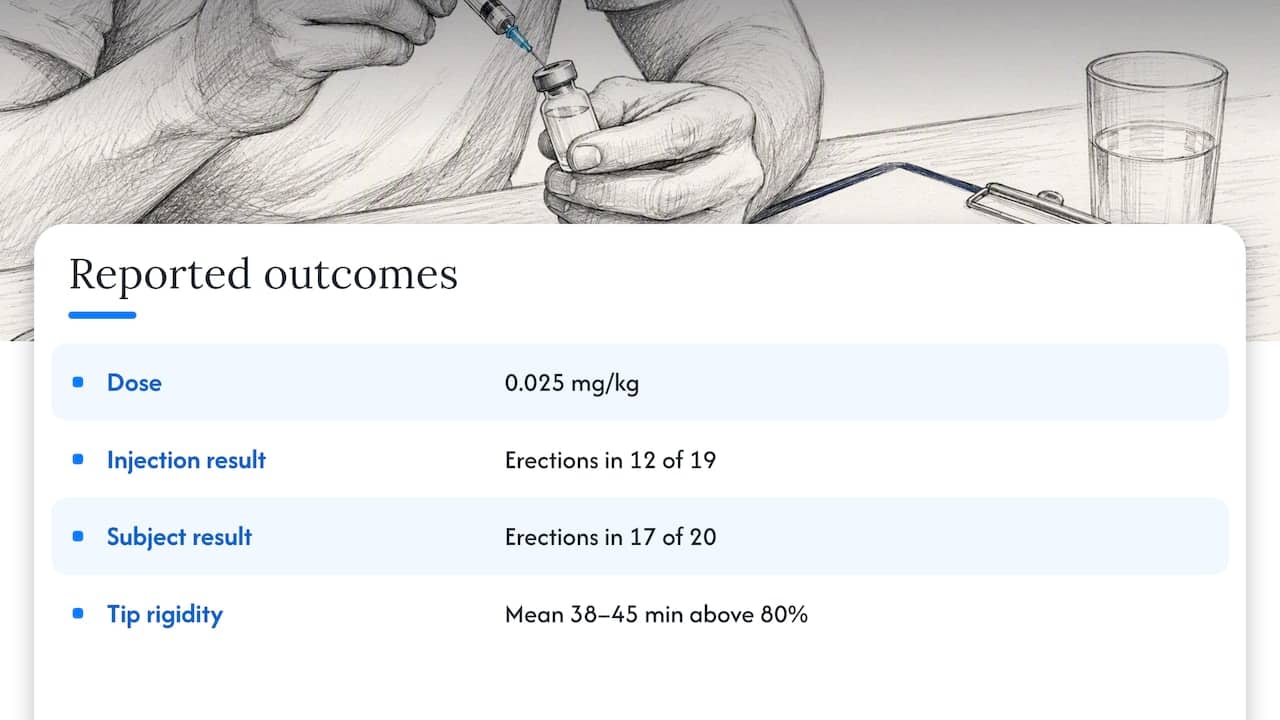
The investigators later summarized their experience in a review in the International Journal of Impotence Research. At 0.025 mg/kg, erections occurred in 12 of 19 injections in one study and in 17 of 20 subjects in another, with mean durations of tip rigidity above 80% of 38 to 45 minutes. The same review ties nausea to dosing at that level, which is a practical limit for the compound.
This line of work led to the development of bremelanotide, the metabolite-related analogue sold in research catalogs as PT-141. If your interest is sexual-function mechanisms specifically, PT-141 is the narrower tool to look at.
What is missing
There is no large modern randomized trial establishing Melanotan II as safe or effective for tanning, weight, or libido in the general population. A review of melanotropic peptides notes that the clinical literature is largely legacy trials, and that the field’s attention has shifted to more selective analogues. When a product page claims proven results, check what is cited. Often it is one of the studies above, extended well beyond what it measured.
Safety signals in the literature
This is the part that should shape any decision to work with the compound.
- Atypical moles. A case series from a dermatology department described atypical melanocytic naevi following melanotan injection.
- Melanoma. A case report describes melanoma associated with melanotan-II. It notes that unlicensed use for pigmentation had become prevalent among young people at fitness centers. A case report cannot prove causation, but it is the kind of signal dermatologists take seriously.
- Lesion changes and diagnostic confusion. Dermatologists cited in the melanotropic peptides review warn that melanogenic stimulation can change existing lesions and complicate monitoring of at-risk patients, especially alongside UV tanning.
- Oral mucosa changes. A 2026 case report followed a patient who self-administered injections over 64 days and tracked changes in the oral mucosa for three months.
- Supply chain. The same dermatology literature flags black-market product as a public health issue because it can be impure, unsterile or misidentified.
None of this is an argument that the peptide can’t be studied. It is an argument that you should be skeptical of anyone describing it as benign, and that in vitro and animal work needs documentation you can trust.
Melanotan II legal status in the US
The FDA classifies Melanotan II as an unapproved new drug. In a 2026 warning letter to a peptide seller, the agency states that it is not generally recognized as safe and effective for any use. It also states that introducing it into interstate commerce without an approved application violates the Federal Food, Drug, and Cosmetic Act.
For a buyer, the practical consequences are straightforward:
- It is not a supplement, cosmetic or tanning product, and nobody should be told it is.
- Legitimate purchase is framed around laboratory and investigational use only.
- Products sold for self-injection, tanning or human use are exactly what regulators have targeted.
- If you work under an institution, your compliance office should sign off on the intended use before purchase.
This article is not legal advice. If you are unsure whether your intended use is permitted, ask your institution’s compliance officer or an attorney who works with FDA regulations.
Our perspective
We get asked about Melanotan II more often than the volume of published research would justify, and the questions usually come from the tanning and libido angle. We answer them the same way each time.
The compound has a genuine place in melanocortin research as a reference agonist. Because it hits MC1R through MC5R, it is useful for studying what happens when the whole system is activated, and as a comparator when you test more selective ligands. That is a legitimate lab use, and it is the one we sell for.
What we won’t do is blur the line between a reference compound and a consumer product. The human literature is old, the safety reports are real, and the regulatory position is clear. Research buyers are better served by a supplier who says so than by one who promises results.
What we can control is documentation. Every lot we sell is third-party batch tested for purity and identity, with a Certificate of Analysis and endotoxin data. If a supplier can’t show you that for the specific lot in your freezer, the biology you generate from it is hard to interpret.
— Data Peptides
How to vet a Melanotan II batch for lab use
A peptide like this is only as good as the vial. Before you design an experiment around it, check these items.
- A lot-specific COA, not a generic one. The batch number on the document should match the batch on your vial. Look at our COA page for what a lot-level document should include.
- Identity by mass spectrometry. Purity alone doesn’t tell you the molecule is Melanotan II. A cyclic peptide can be mislabeled or contaminated by related sequences.
- Purity by HPLC, read carefully. A headline of 99% describes the chromatogram, not the net peptide content. Our note on why 99% purity can hide less actual peptide explains the gap and why it changes your molar calculations.
- Impurity thresholds. Small percentages of related impurities can matter in receptor assays. See how impurity thresholds change assessment.
- Endotoxin data. Essential for any cell-based work, where endotoxin can swamp the signal you are trying to measure.
- Third-party testing. An independent lab removes the seller from the grading role.
For broader background on the standards we hold ourselves to, see our research peptide buying guide and our page on US-made peptides.
Where to get Melanotan II for research
Our Melanotan-2 product page lists the research-grade compound with lot documentation. Orders ship discreetly from our US facility, and our support team is available 24/7 if you need to confirm a lot, a COA or storage handling before you order.
If you are exploring the wider melanocortin space, you can browse the full research peptide catalog, including categories for recovery, anti-aging and libido research. Every product is sold for laboratory research use only.
Designing research around the evidence
A few practical points for anyone planning work with MT-II, drawn from what the literature shows.
Treat it as a pan-agonist. If your hypothesis depends on one receptor, Melanotan II can’t isolate it. Pair it with a more selective ligand or an antagonist, or choose a different tool.
Plan for autonomic effects in animal models. The yawning, stretching, nausea and appetite changes seen in the early human work are likely to confound behavioral readouts. Control for them rather than discovering them later.
Be cautious with pigmentation endpoints. Because it stimulates melanogenesis, any lesion or pigment readout needs proper baselines. The dermatology case reports show how quickly appearance can change.
Don’t extrapolate to people. The clinical studies used specific doses under supervision in small groups. They don’t establish a safe or effective regimen for anyone outside a trial, and we don’t suggest one.
If you are comparing it with other peptide categories for research design, our guides on peptides used for different research areas and best peptides for research are good next reads.

FAQ
What is the mechanism of action of Melanotan II?
Melanotan II is a non-selective agonist of melanocortin receptors MC1R through MC5R. MC1R activation drives pigmentation, while central pathways involving MC3R and MC4R are linked to energy balance and sexual function. Its broad binding is why a single compound produces several different effects.
How is Melanotan I different from Melanotan II?
Melanotan I (afamelanotide) is more selective, mainly targeting MC1R, and it has regulatory approval in the EU for erythropoietic protoporphyria. Melanotan II binds all five melanocortin receptors and remains an unapproved research chemical in the US. The difference in selectivity explains the difference in side effects.
Is Melanotan II FDA-approved?
No. The FDA classifies it as an unapproved new drug and has issued warning letters to companies marketing it. It is sold by research suppliers for laboratory use only, not for human or animal consumption.
How long did the erectile effect last in studies?
In the clinical trials reviewed by the investigators, mean duration of tip rigidity above 80% ranged from 38 to 45 minutes at 0.025 mg/kg. Those were supervised studies in small groups, and nausea was a notable side effect at that dose. The results don’t translate into advice for anyone outside a trial.
Why are there so few recent Melanotan II studies?
The clinical literature is mostly from the 1990s and 2000s. Research attention has since moved toward receptor-selective analogues designed to avoid the off-target effects of Melanotan II, and the case reports of skin changes have added to the caution.
Sources
- Melanocortin receptor agonists, penile erection, and sexual motivation: human studies with Melanotan II
- Melanotropic peptides: more than just ‘Barbie drugs’ and ‘sun-tan jabs’?
- The Melanocortin Receptor System: A Target for Multiple Degenerative Diseases
- Ligands for Melanocortin Receptors: Beyond Melanocyte-Stimulating Hormones and Adrenocorticotropin
- Evaluation of melanotan-II in a pilot phase-I clinical study
- Synthetic melanotropic peptide initiates erections in men with psychogenic erectile dysfunction
- Effect of an α-MSH analog on penile erection and sexual desire in men with organic erectile dysfunction
- Atypical melanocytic naevi following melanotan injection
- Melanoma associated with the use of melanotan-II
- Changes in oral mucosa associated with Melanotan II injections: a case report
- FDA warning letter, August 2026