

A “For Research Use Only” label tells the buyer that a product belongs in a laboratory and nowhere else. It is a limit on use, not a loophole. In the US, FDA defines the phrase most precisely for in vitro diagnostic products, and it has made clear in recent warning letters that the words on a vial do not decide what a product is. How the seller describes, markets and bundles it does.
This guide explains what the label requires, where its legal force ends, and what a lab should check before it trusts a vendor’s use of it.
TL;DR
- RUO is a restriction: the product is for laboratory research and must not be used in diagnostic procedures or on patients.
- FDA’s formal RUO wording, “For Research Use Only. Not for use in diagnostic procedures,” comes from the diagnostic device rules, not from any peptide-specific rule.
- FDA looks at intended use. A website, a dosing chart or a bundled syringe kit can override a disclaimer on the label.
- Several 2025 and 2026 FDA warning letters to peptide sellers cite exactly this problem.
- A trustworthy RUO supplier documents each lot, sells to research buyers, and keeps its marketing consistent with its label.
Table of Contents
- Where the RUO label comes from
- What RUO does and does not permit
- Intended use beats the label
- How RUO differs from other labeling
- What a lab should check before trusting an RUO label
- Our perspective
- Buying for the bench
- FAQ
- Sources
Where the RUO label comes from
The phrase is rooted in device regulation. FDA’s Bioresearch Monitoring page for in vitro diagnostics states that IVDs shipped solely for research purposes must be labeled “For Research Use Only, Not for use in diagnostic procedures,” and that the research allowed under that label is limited to the laboratory phase of development.
The detailed expectations are in FDA’s guidance on distributing RUO and IUO products, issued in November 2013. It describes which labeling and distribution practices FDA considers appropriate, and which it does not. Those who built the habit of stamping RUO on non-diagnostic chemicals borrowed the phrase from this world, and borrowed its limits with it.
Two points follow from the source:
- The label is a promise about the product’s place in the supply chain. It tells every downstream handler that the item has no established clinical performance characteristics.
- The promise has to be true. FDA warns that labeling a product RUO when it is really meant for clinical use is false and misleading, and renders the product misbranded.
What RUO does and does not permit
It helps to separate what a research use only label allows from what it only appears to allow.
| Situation | Does RUO cover it? |
|---|---|
| Bench work: assay development, analytical reference, in vitro studies | Yes, this is the intended scope |
| Reporting results to a physician or putting them in a medical record | No. FDA’s guidance treats even one patient used this way as mislabeling |
| Use in a human clinical investigation without a proper exemption | No. Such work has to follow the device or drug investigational rules, for example 21 CFR Part 812 for devices |
| Marketing the product for weight loss, muscle growth or other body effects | No. That is a drug claim, whatever the label says |
| Selling it with supplies for reconstitution and injection | Highly risky. FDA reads it as evidence of intended human use |
The laboratory research phase is narrow. It excludes commercial, clinical and diagnostic applications.
RUO versus IUO
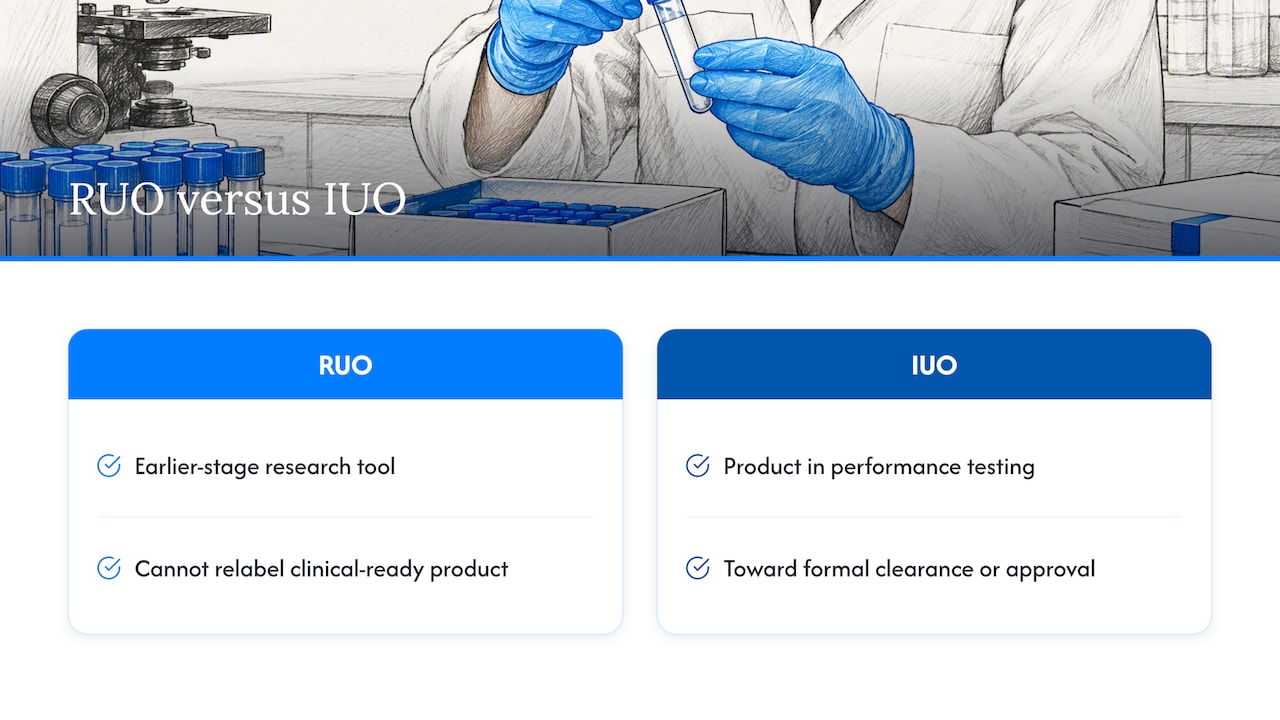
People confuse research use only with investigational use only. IUO products are in performance testing on a path toward formal clearance or approval. RUO products are earlier-stage tools. Each has its own labeling and distribution expectations, and a product ready for clinical investigation cannot be relabeled RUO to avoid the extra rules.
RUO is not off-label use
These terms get mixed up in forum posts. Off-label use is a health care provider prescribing an FDA-approved drug for a use not in its approved labeling, based on medical judgment, as FDA’s regulatory terminology guidance explains. It has nothing to do with a research chemical sold with a disclaimer. Calling an RUO peptide “off-label” mixes up two separate legal ideas, and no approval exists for the product to be off-label from.
Intended use beats the label
FDA does not ask only what a package says. It asks what the seller intends the product to be used for, judged from all of the seller’s communications. The agency’s own letters show how that works in practice.
In a March 2026 warning letter to Gram Peptides, FDA noted that despite statements on the labeling such as “Research Use Only” and “not intended for human consumption,” evidence from the firm’s website showed the products were intended as drugs. A letter to Mile High Compounds, also dated March 31, 2026, makes the same point about phrases like “in vitro research and educational purposes only.” Earlier, a December 2025 letter to Atomix LLC used nearly identical reasoning, and a June 2026 letter to Wholesale Peptide repeated it.
The pattern is consistent. The agency cites evidence such as:
- product pages that describe benefits for weight, muscle, mood or sexual function;
- dosing or “cycle” guidance;
- testimonials and before-and-after claims;
- bundles that pair peptides with items used for injection.
The legal basis cited in these actions is the Federal Food, Drug, and Cosmetic Act, which treats a product intended to affect the structure or function of the body as a drug. An unapproved new drug cannot be lawfully marketed.
The ancillary supplies question
Sellers of research peptides often also sell bacteriostatic water, syringes or alcohol swabs. These are ordinary lab supplies, and a real lab buys them. But FDA reads a bundle in context: when a peptide is promoted with the items needed to prepare and inject it, the pairing is treated as evidence of intended human use. Labs buying diluents should look for plain reagent specifications (grade, sterility testing, lot records) rather than lifestyle marketing. For a sense of what a reagent-focused product page contains, see this overview of bacteriostatic water specifications for research, which covers vial sizes and quality-control standards from a UK supplier.
How RUO differs from other labeling
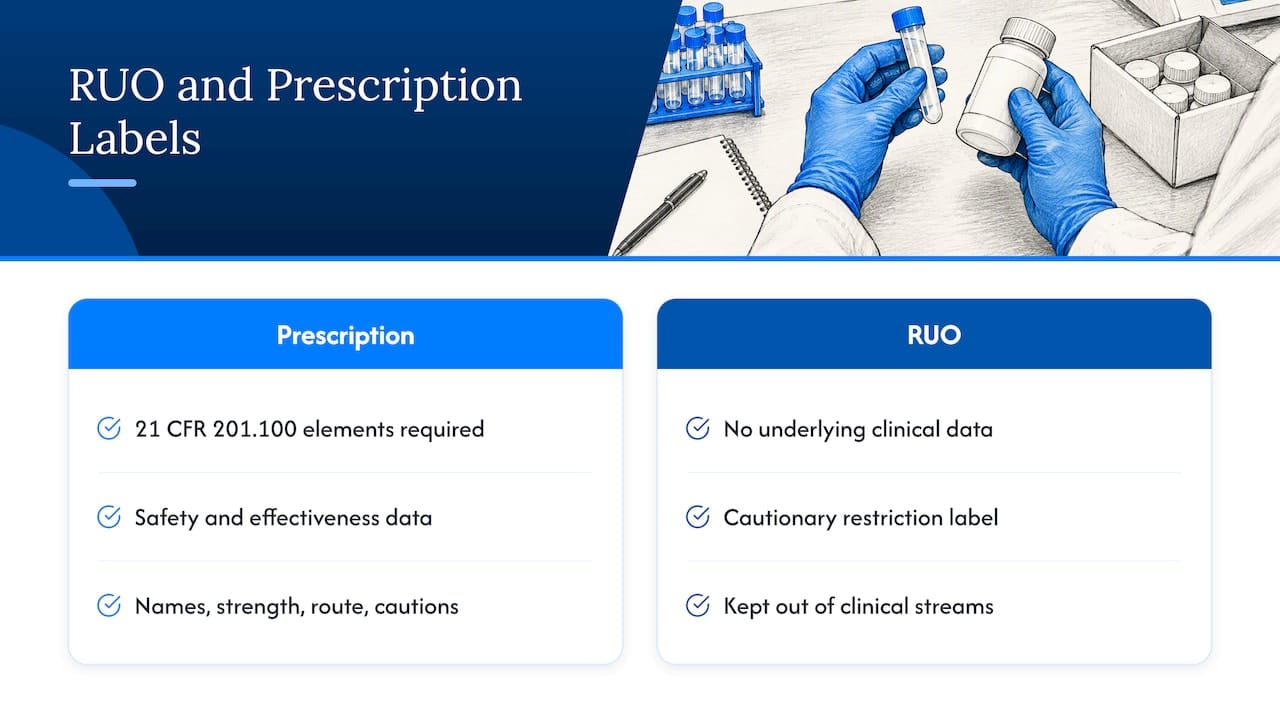
RUO labeling is not like prescription labeling. A drug label must contain specific elements under rules such as 21 CFR 201.100, and these rest on safety and effectiveness data. FDA’s guidance on container labels and carton labeling shows how much a medication label is expected to carry: names, strength, route of administration and cautionary statements. An RUO product has none of the underlying clinical data, so its label does the opposite job. It is a cautionary statement that keeps the item out of clinical streams.
That is why the label reads as a restriction. If a vial has the full set of dosing, route and patient instructions of a drug, it is no longer behaving like a research reagent.
What a lab should check before trusting an RUO label
Use this list when you qualify a supplier. It works for any research chemical, not only peptides.
- Consistency. Read the product pages, blog, social posts and checkout flow. Do they describe laboratory analysis, or personal results? The marketing should match the label.
- Lot-level documentation. Ask for a Certificate of Analysis for the exact lot you receive, with identity and purity by an analytical method such as HPLC and mass spectrometry. Endotoxin data matters for cell work.
- Independent testing. A COA from a third-party laboratory carries more weight than a seller’s own sheet. Check that the lab name, date and lot number match your vial.
- Buyer verification. A reputable supplier asks who is buying and why, and restricts sales to research applications.
- No consumption cues. No dosing tables, no “stack” suggestions, no routes of administration.
- Storage and handling. Look for lyophilized stability notes, storage temperature and expiry or retest dates.
- Records on your side. Keep the COA, invoice and a note of the experimental purpose in your lab file.
For related reading on documentation, our guides on what research use only means and peptide legality for research go further, and our buying guide walks through supplier checks in order.
Our perspective
We sell research peptides, so we read these FDA letters closely. Our view is simple: the label has to describe a real relationship with the customer. We are in business to supply laboratories, and that shapes how we work.
Every product we list is third-party batch tested for purity and identity, with a Certificate of Analysis and endotoxin data for each lot, so a researcher can check what is in the vial rather than take our word. We ship from our US facility, discreetly and quickly, and our support team is available around the clock to answer documentation questions.
We also think researchers should be skeptical. A disclaimer is not evidence of quality, and it is certainly not evidence of compliance. If a vendor’s site reads like a wellness store, the RUO sticker will not protect the vendor, and it will not protect you either. Ask for the paperwork, read the whole site, and buy from suppliers whose conduct matches their label. Our products are sold for laboratory research only, not for human or animal consumption, medical treatment or diagnosis.
— Data Peptides
Buying for the bench
If you are sourcing peptides for laboratory work, our shop lists research peptides by category, including weight loss, muscle growth, recovery, anti-aging, libido and ancillaries, each sold for research use only with lot-level documentation. If you are still deciding what to verify first, start with our guide to buying research peptides online.
FAQ
What does research use only mean?
It means the product is meant for laboratory research and not for diagnosis, treatment or use in people or animals. In FDA’s device rules, the wording is “For Research Use Only. Not for use in diagnostic procedures.” The label restricts use; it does not grant permission for anything beyond the lab.
Does an RUO label protect a seller from FDA enforcement?
No. FDA judges intended use from the whole of a seller’s communications, and its 2025 and 2026 warning letters to peptide vendors say that disclaimers like “not for human consumption” did not outweigh website evidence of drug use. Consistent, laboratory-focused marketing matters more than the sticker.
Is RUO the same as investigational use only?
No. IUO products are in performance testing along a path toward formal regulatory clearance, while RUO products are early-stage laboratory tools. FDA warns that labeling a product ready for investigation as RUO is false and misleading and makes it misbranded.
Is research use only the same as off-label use?
No. Off-label use is a clinician prescribing an approved drug for a use outside its approved labeling. RUO describes a product sold for laboratory work with no approved use at all.
What should a researcher ask a supplier to prove RUO status?
Ask for the lot-specific COA, the name of the testing laboratory, endotoxin results where relevant, and the supplier’s buyer-verification process. Then read the supplier’s whole website to confirm it contains no dosing or health-benefit language.
Sources
- FDA: Distribution of IVD products labeled RUO or IUO, guidance
- FDA: Bioresearch Monitoring Inspections, In Vitro Diagnostics Devices
- FDA: Understanding the regulatory terminology of potential preventions and treatments
- FDA: Safety considerations for container labels and carton labeling
- FDA warning letter: Gram Peptides, 03/31/2026
- FDA warning letter: Mile High Compounds LLC, 03/31/2026
- FDA warning letter: Atomix LLC, 12/12/2025
- FDA warning letter: Wholesale Peptide, 06/17/2026