

For research peptides, “not for human consumption” means the product is manufactured, tested, and sold strictly for laboratory research, not for people or animals to ingest, inject, or otherwise use. It carries no FDA approval and no clinical validation. Before you buy from any vendor, check the Certificate of Analysis and confirm the seller markets to labs, not consumers, because the label alone won’t shield anyone from regulatory scrutiny.
TL;DR:
- Most vendors claiming “not for human consumption” still risk FDA enforcement if marketing materials or sales practices target individual users.
- Legitimate research peptides are produced under non-GMP conditions, lack clinical safety data, and are sold mainly for laboratory use between institutions.
- Verifying third-party Certificates of Analysis (COA), checking for independent labs, and inspecting product descriptions are essential steps before ordering.
- FDA enforcement often hinges on marketing claims such as dosing guidance and consumer-targeted claims, invalidating “research use only” labels if present.
- Proper lab handling includes quarantining, accurate documentation, and retaining samples to avoid legal complications and meet regulatory expectations.
Table of Contents
- Not for Human Consumption Meaning Under FDA Rules
- Why Legitimate Suppliers Use the RUO Label
- The Vendor Checklist Every Buyer Should Run Before Ordering
- Enforcement Patterns That Turn RUO Labels Into Legal Liability
- Handling and Documenting RUO Peptides in the Lab
- How Data Peptides Backs Up Its Compliance Claims
- Where the Phrase “Not for Human Consumption” Came From
- How Labeling Rules Differ Across Countries
- Other Products Carrying the Same Warning
- “Not for Human Consumption” vs. “Not for Internal Use”
- Legal Consequences of Mislabeling or Misusing RUO Peptides
- What Happens When Someone Ignores the Label
- Why Documentation Beats Assumptions in Peptide Research
- Order Compliant Research Peptides With Full Documentation
- Sources
- FAQ
Not for Human Consumption Meaning Under FDA Rules
The FDA doesn’t stop at reading a label. It looks at the “totality of the circumstances,” a legal standard built on the intended-use doctrine codified in 21 CFR 201.128. A product stamped “research use only” (RUO) can still be treated as an unapproved drug if the agency finds evidence that it’s actually being sold for people to use on themselves.
That’s the practical answer to what “not for human consumption” means in this industry: a manufacturing and labeling classification, not a legal shield. FDA guidance on RUO and IUO labeled products states plainly that placing an RUO or IUO label on a product doesn’t exempt it from other applicable requirements. The label is a starting point for compliance, not the finish line.
Regulators build their case from a mix of evidence, including:
- Website copy that describes dosing ranges, cycles, or “protocols” for human use
- Bundled items like syringes, alcohol swabs, or bacteriostatic water sold alongside the peptide
- Customer reviews, testimonials, or before/after photos referencing personal results
- Sales funnels that route buyers through consumer marketing rather than institutional or lab-to-lab channels
- Marketing language borrowed from clinical or wellness contexts (weight loss, anti-aging, muscle building) aimed at individuals rather than researchers
A vendor can print “not for human consumption” on every label and still lose that argument the moment their marketing tells a different story. Legal analysis from Mintz makes this point directly: if you claim your product is RUO, it has to actually function as RUO across every touchpoint, not just the fine print.
Why Legitimate Suppliers Use the RUO Label
Research-use-only labeling exists because a large, legitimate market needs it. Peptide chemists, pharmacology labs, and contract research organizations buy RUO material constantly for in vitro assays, animal studies, and early-stage method development. ChemVerify’s explainer on RUO labeling notes that legitimate RUO commerce typically moves lab-to-lab or institution-to-institution, without consumer-facing dosing charts or reconstitution kits designed for self-administration.
The manufacturing gap between RUO and pharmaceutical-grade material is real and worth understanding before you buy:
- RUO peptides are produced for research reproducibility, not for the sterility, stability, and batch consistency required in clinical manufacturing
- GMP (Good Manufacturing Practice) facilities operate under FDA-audited quality systems; most RUO synthesis labs do not
- RUO products rarely carry the extensive stability and toxicology data pharmaceutical products require
- Documentation for RUO peptides centers on purity and identity testing, not clinical safety profiling
Healthline’s comparison of research chemicals and FDA-approved peptides makes the distinction concrete: research chemicals lack FDA approval and typically fall outside cGMP oversight entirely. If your work is ever going to feed into anything resembling clinical application, start sourcing GMP-grade material early. Revalidating a study built on non-GMP inputs later costs far more than paying for the right grade up front, a point Thermo Fisher’s RUO-to-GMP resource drives home for anyone planning a translational pipeline.
The Vendor Checklist Every Buyer Should Run Before Ordering
Treat every new peptide vendor like a pre-registration audit, not a shopping decision. Here’s the sequence that actually protects your lab and your budget.
- Pull the Certificate of Analysis first. A real COA names the testing lab, the method (usually HPLC and mass spec), the batch number, and the purity result. If a vendor emails a generic PDF with no lab name attached, that’s a dead giveaway.
- Verify the third-party testing lab exists and is independent. A quick search confirms whether the lab is a real accredited facility or an in-house rebrand. Data Peptides publishes its third-party COAs precisely so buyers can check this step without asking.
- Scan the product page for dosing language. Reconstitution ratios framed as “how to take,” injection frequency charts, or “recommended cycles” all signal consumer marketing dressed up as research copy.
- Check for bundled human-use accessories. Syringes, alcohol prep pads, or bacteriostatic water sold as a kit alongside the peptide are the exact pattern regulators cite as evidence of intended human use.
- Confirm lot traceability and retention samples. Ask whether the vendor retains samples from each batch and can trace your specific lot back to its synthesis run.
- Request stability and storage data. Legitimate RUO suppliers can tell you shelf life at minus 20 degrees Celsius versus refrigerated storage; vendors who can’t answer this usually haven’t tested for it.
- Loop in procurement or compliance before a large order. Institutional buyers should route any peptide purchase above a routine reorder through purchasing or legal review, especially for a new supplier.
Pro Tip: Save every COA you receive in a shared lab drive organized by vendor and lot number. When an auditor or granting agency asks for documentation six months later, you want that answer in thirty seconds, not thirty emails.
Data Peptides’ own buyer’s guide to purchasing research peptides walks through this same verification sequence in more detail if your institution needs a written procurement policy to reference.
Enforcement Patterns That Turn RUO Labels Into Legal Liability
The FDA’s recent actions against GLP-1 peptide sellers offer a clean case study. Multiple companies labeled semaglutide and tirzepatide products for “research use” while running marketing campaigns aimed squarely at consumers chasing weight loss. The FDA’s public statement on unapproved GLP-1 products flags dosing instructions and consumer-facing claims as the exact features that convert an RUO product into an unapproved drug in the agency’s eyes.
Common red flags regulators cite in these cases include:
- Dosing schedules printed on packaging or websites
- Bundled syringes, needles, or bacteriostatic water
- Weight-loss or muscle-building claims aimed at individuals rather than labs
- Before-and-after photos or customer testimonials describing personal use
Reporting on enforcement cases like the Gram Peptides warning letter shows how quickly a disclaimer becomes irrelevant once the surrounding sales funnel tells regulators a different story. For a vendor, that can mean a warning letter, seizure, or injunction. For the buying institution, it can mean a supply chain built on product that never had a valid chain of custody, which complicates any research relying on it.
Handling and Documenting RUO Peptides in the Lab
Good lab practice for RUO material starts the moment the shipment arrives. Segregate it physically from any clinical-grade or patient-facing supplies, and label storage containers clearly so nobody mistakes lot numbers between the two.
Attach the COA directly to the batch record before the peptide goes into any freezer or refrigerator. Keep a retention sample from each lot and log a simple chain-of-custody trail: who received it, when, and where it’s stored. If a COA doesn’t match what arrives, whether that’s a molecular weight discrepancy or a batch number mismatch, quarantine the material immediately and contact the vendor rather than proceeding with the experiment.
- Store RUO peptides separately from any clinical or patient-use inventory
- Log every lot number against its COA in your lab management system
- Keep retention samples for the duration of any related study, plus your institution’s standard retention period
- Flag and quarantine any shipment with a COA discrepancy before use
This is basic lab hygiene, and it also happens to be exactly what an auditor, journal reviewer, or grant compliance officer will ask to see.
How Data Peptides Backs Up Its Compliance Claims
Every buyer checklist item above needs a real answer behind it, and that’s where supplier transparency matters most. Data Peptides publishes third-party Certificates of Analysis for its catalog, covering identity and purity results from independent testing labs rather than in-house claims.
Product pages, including those for KPV and kisspeptin, list research applications and specifications without dosing charts or reconstitution instructions aimed at self-administration. A 24/7 support team answers vendor-verification questions directly, and orders ship discreetly within the United States.
- COAs tied to specific batches, not generic purity claims
- Independent lab verification instead of self-reported testing
- Product descriptions written for laboratory context, not consumer use
- Support staff available to answer sourcing and documentation questions
Where the Phrase “Not for Human Consumption” Came From
The phrase predates peptide research by decades. Its roots trace to industrial chemical labeling and agricultural product warnings, where manufacturers needed a clear line between materials safe for ingestion and those meant purely for laboratory, industrial, or veterinary applications outside direct animal or human use.
As the U.S. regulatory framework matured through the 20th century, particularly after the Federal Food, Drug, and Cosmetic Act established the FDA’s authority over drugs and devices, “research use only” language emerged as a formal labeling category. It gave manufacturers a legitimate way to distribute unapproved compounds, reagents, and diagnostic components to scientists without triggering the full drug-approval pathway, provided those products stayed within genuine research channels.
Peptide chemistry adopted the same framework once synthetic peptide production scaled up in the early 2000s. Compounds like BPC-157, TB-500, and various GLP-1 analogs entered the research supply chain years before, or in some cases without, formal pharmaceutical approval. Suppliers needed a way to sell these compounds to legitimate labs studying their mechanisms, and “not for human consumption” or “research use only” became the standard label bridging that gap.
The phrase carries the same legal weight today it always has: it describes a manufacturing and distribution category, not a moral disclaimer. What’s changed is the volume of consumer-facing sellers who’ve borrowed the label for products they market to individuals rather than institutions, which is exactly the pattern that draws FDA attention now.
How Labeling Rules Differ Across Countries
United States buyers operate under the FDA’s intended-use framework, but researchers sourcing internationally or shipping across borders should know the rules shift by jurisdiction. The European Union handles research chemicals and RUO products under a patchwork of national implementations of EU regulations, generally requiring similar documentation but with different enforcement bodies per member state rather than a single centralized agency like the FDA.
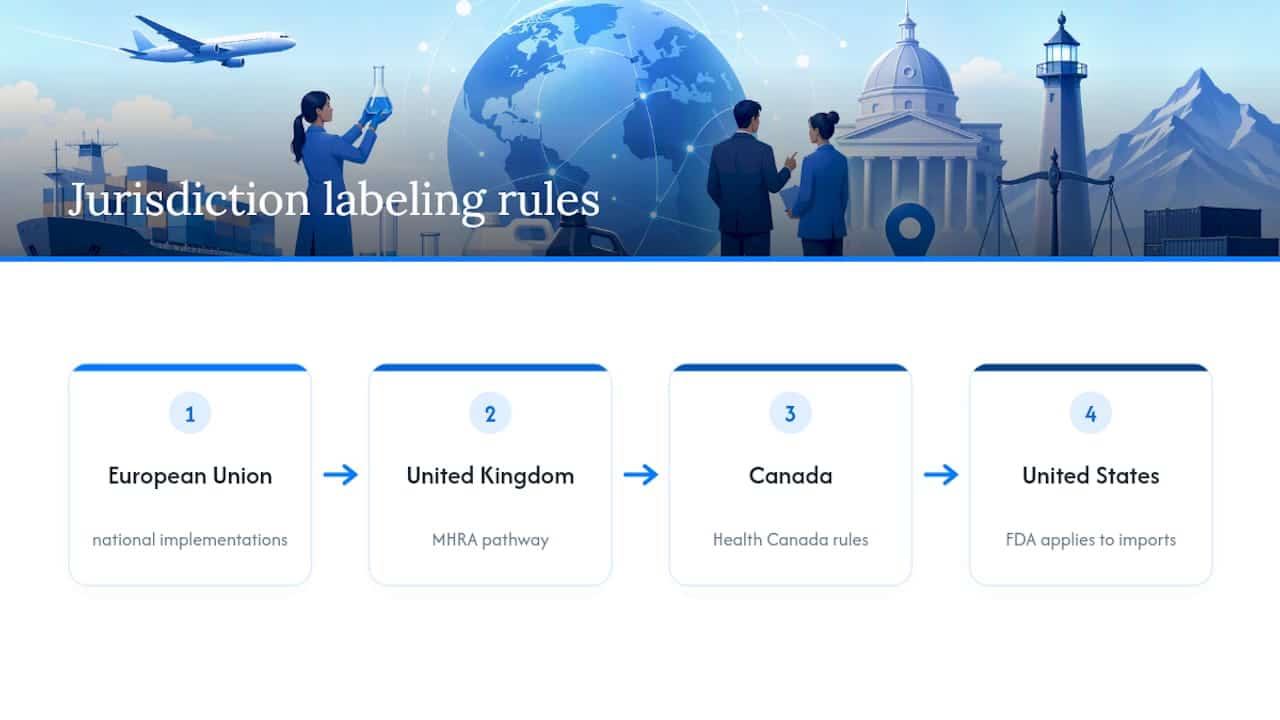
Canada regulates research-use compounds through Health Canada, which applies its own intended-use analysis similar in spirit to the FDA’s approach but with different documentation thresholds. The United Kingdom, post-Brexit, now runs its own regulatory pathway separate from the EU’s, administered by the Medicines and Healthcare products Regulatory Agency.
For a lab in the United States, the practical takeaway is straightforward: material imported from overseas suppliers still has to meet the same FDA intended-use standard once it enters U.S. commerce, regardless of how it was labeled or regulated in its country of origin. A COA issued under a different country’s testing standards doesn’t automatically satisfy what an FDA-facing compliance review expects.
This matters most for institutions receiving peptides from international RUO suppliers. If your compliance team can’t verify testing methodology against a recognized standard, that shipment creates the same documentation gap as buying from an unverified domestic vendor. Jurisdiction doesn’t lower the bar. It just changes who’s asking the questions.
Other Products Carrying the Same Warning
“Not for human consumption” shows up well outside peptide research, and seeing how it functions elsewhere clarifies what it actually communicates. Industrial solvents, laboratory reagents, and cleaning compounds carry the label because they’re chemically unsafe or simply untested for ingestion, a different rationale than research peptides, which may be safe in controlled settings but lack the approval and validation required for human use.
Certain dietary and nutritional products, including some creatine formulations sold in novelty formats, carry consumer safety warnings distinct from the RUO framework. Nu Sante Nutrition’s breakdown of creatine gummy safety illustrates how consumer supplement labeling addresses ingredient safety and dosing risk, a completely different regulatory lane than the intended-use doctrine governing research chemicals.
Veterinary compounds labeled for animal research only occupy a related but distinct category: approved for specific animal applications, explicitly barred from human use, and regulated under separate FDA veterinary guidance. Laboratory reference standards, calibration chemicals, and certain diagnostic reagents also carry RUO or “not for human consumption” language because they’re formulated for instrument calibration or assay development, not for any biological application at all.
The common thread across every one of these categories is the same one that governs peptides: the label signals that a product hasn’t gone through the approval pathway required for human use, whatever the underlying reason. Reading the label correctly means asking why it’s there, not just noting that it is.
“Not for Human Consumption” vs. “Not for Internal Use”
These phrases sound similar and get used interchangeably by people who haven’t looked closely, but they mean different things and come from different regulatory contexts. “Not for human consumption” is the language research peptide suppliers use to signal RUO status under the FDA’s intended-use framework, discussed throughout this article. It’s a distribution and manufacturing classification tied to drug approval status.
“Not for internal use” typically appears on topical products, cosmetics, and some industrial chemicals to warn against ingestion or injection when a product is designed for external application only. A topical cream or a cleaning solvent might carry “not for internal use” without ever touching the RUO/IUO framework at all, because it was never intended for any biological research application in the first place.
The practical difference matters for researchers: a peptide labeled “not for human consumption” under RUO rules is barred from human use specifically because it hasn’t cleared FDA approval for that purpose, even though the same compound might eventually become an approved drug once proper trials happen. A product labeled “not for internal use” is generally making a safety statement about its intended application method, not a regulatory statement about approval status.
Confusing the two leads buyers to underestimate the seriousness of RUO labeling. It’s not a generic safety caveat. It’s a legal classification tied directly to FDA enforcement authority, and treating it as interchangeable with a cosmetic warning label is exactly the kind of misunderstanding that gets both vendors and buyers into trouble.
Legal Consequences of Mislabeling or Misusing RUO Peptides
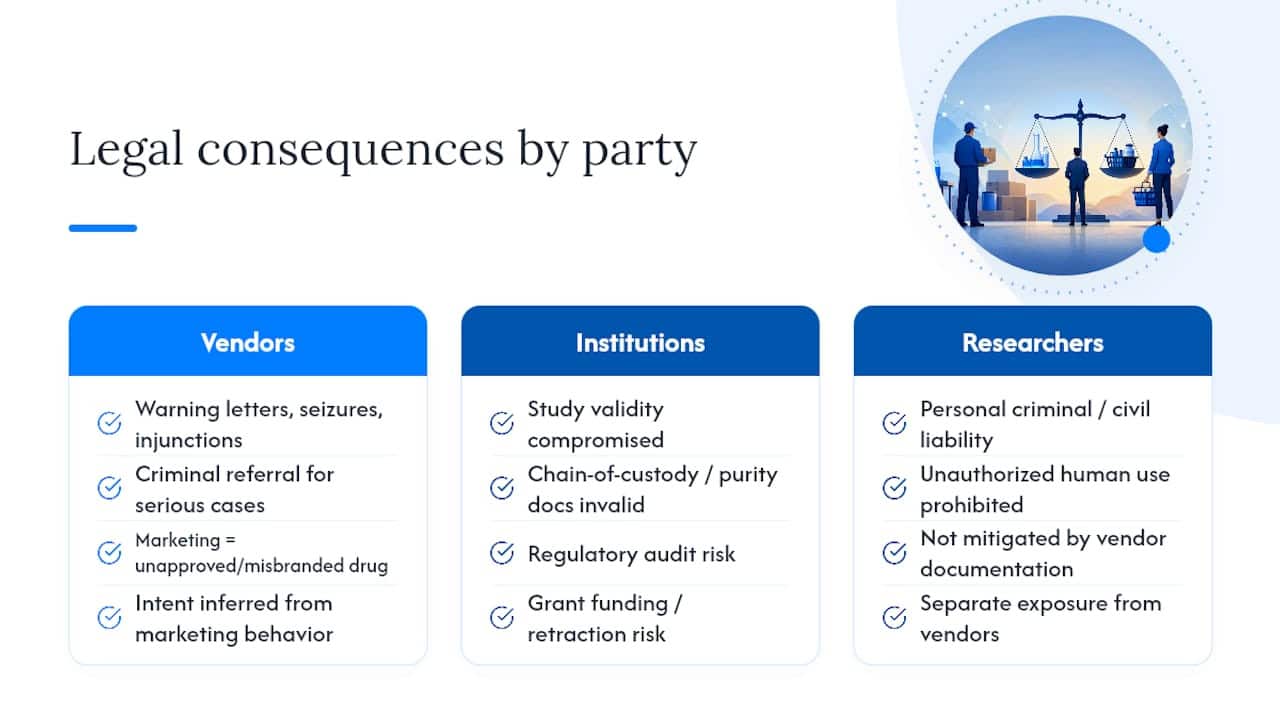
Mislabeling carries real legal weight on both sides of the transaction. For vendors, the FDA’s enforcement toolkit includes warning letters, product seizures, injunctions, and in serious or repeated cases, criminal referral under the Federal Food, Drug, and Cosmetic Act. A company that markets RUO peptides with consumer dosing instructions is, in the agency’s view, distributing an unapproved and potentially misbranded drug, regardless of what the label says.
For research institutions and buyers, the exposure looks different but still real. Purchasing from a vendor later found to be operating outside RUO boundaries can compromise the validity of any study built on that material, since chain-of-custody and purity documentation tied to a fraudulent operation won’t hold up under peer review or regulatory audit. Grant-funded research faces an added layer of risk: funding agencies increasingly expect documented procurement practices, and a compliance failure discovered after publication can force retraction.
Individual researchers who knowingly reroute RUO material into unauthorized human use, whether personal experimentation or unauthorized administration to others, face separate liability outside the vendor relationship entirely. That’s a personal legal exposure distinct from anything Data Peptides or any compliant supplier can mitigate through documentation. Data Peptides’ guide to peptide legality in the U.S. breaks down where those lines sit for researchers weighing what’s permissible.
The throughline across every enforcement case is the same: penalties scale with evidence of intent, and intent is inferred from marketing and distribution behavior, not just from what happens after purchase.
What Happens When Someone Ignores the Label
The safety case against treating RUO peptides as consumer products is straightforward: these compounds haven’t been through the toxicology, dosing, and clinical safety trials that establish a safe human dose, a safe administration route, or a predictable side-effect profile. A peptide that looks similar to an FDA-approved drug on paper may carry impurities, degradation products, or synthesis byproducts that clinical-grade manufacturing screens out and RUO synthesis often doesn’t.
Sterility is a separate and serious concern. RUO peptides aren’t manufactured or packaged under the sterile conditions required for injectable pharmaceutical products, which means unauthorized human use carries real infection risk beyond whatever pharmacological effect the compound itself might have.
There’s also no dosing guidance because none was ever established through trials, so anyone using RUO material outside its intended lab context is guessing at a safe amount with no clinical data to guide that guess. Legacy Meds’ safety information on GLP-1 medications underscores why consumer-facing dosing guidance matters so much for these compound classes specifically, precisely the guidance that’s absent when a peptide has only cleared RUO testing.
For anyone whose research might eventually support a clinical application, there’s a legitimate regulatory pathway for expanded human access, explained in this overview of FDA expanded access provisions, rather than sourcing around the approval process through RUO channels.
Why Documentation Beats Assumptions in Peptide Research
Every enforcement case that turns an RUO label into a legal problem starts the same way: someone assumed the label did the work instead of verifying the practice behind it. The compounds themselves aren’t the risk. The paperwork gap is.
Labs that demand full documentation from every vendor, and vendors that provide it without being asked, are the two halves of a system that actually reduces both misuse and regulatory exposure across the field.
— Data Peptides
Order Compliant Research Peptides With Full Documentation
Verifying COAs and vendor practices one supplier at a time gets tedious fast, especially when you need consistent lots across a multi-month study. Data Peptides built its ordering process around exactly the documentation gaps this article walks through: every batch ships with a third-party Certificate of Analysis, product listings stay focused on research specifications rather than consumer dosing language, and support staff are available around the clock to answer sourcing questions before you commit to an order.
Browse the full research peptide catalog to see current lots and testing documentation, or start with the step-by-step ordering guide if your institution needs a documented procurement trail for grant compliance or internal audit. Either way, you’re ordering material with traceable lot numbers and COAs attached from day one, not chasing down paperwork after the fact.
This article is general information, not a substitute for advice from a qualified doctor. Consult a qualified healthcare professional about your own circumstances before acting on anything here.
Sources
- Distribution of in vitro diagnostic products labeled “Research Use Only” or “Investigational Use Only” | FDA
- FDA warning letter is a stark reminder that if you claim your product is RUO, it has to be RUO | Mintz
FAQ
What Does “Not for Human Consumption” Mean on a Peptide Label?
It means the product is manufactured and sold for laboratory research only, without FDA approval or validation for human or veterinary use.
Does the RUO Label Protect a Vendor From FDA Action?
No. The FDA evaluates the totality of marketing, packaging, and sales practices, and can treat a product as an unapproved drug regardless of its RUO label.
What Documentation Should I Request Before Buying a Research Peptide?
Always request a Certificate of Analysis naming the independent testing lab, method, batch number, and purity result; Data Peptides publishes these for every product.
How Is “Not for Human Consumption” Different From “Not for Internal Use”?
“Not for human consumption” reflects RUO status under FDA drug-approval rules, while “not for internal use” typically warns against ingesting a topical or industrial product regardless of research status.
What Are the Biggest Red Flags When Evaluating a Peptide Vendor?
Watch for dosing instructions, bundled syringes or bacteriostatic water, weight-loss marketing aimed at individuals, and customer testimonials describing personal use.