

Lab-grade research peptides are legal to buy, possess, and use in U.S. laboratories when sold with clear “Research Use Only” (RUO) labeling, used strictly for non-clinical research, and handled with proper documentation. That’s the short answer. The longer one involves three federal agencies, a doctrine that can flip your legal exposure based on a single line of website copy, and state laws that may add another layer on top.
Before you order, run through these three steps:
- Confirm the compound isn’t scheduled under the Controlled Substances Act or treated as an analogue under 21 U.S.C. 813.
- Require a batch-specific Certificate of Analysis (COA) with HPLC and mass-spec data from any vendor.
- Obtain institutional sign-off (IACUC, IRB, or biosafety committee, depending on your research type) before the shipment arrives.
Key Takeaways
Research-grade peptides are legal for U.S. lab use when sold with RUO labeling, backed by batch-specific COAs, and used without any human-administration intent.
| Point | Details |
|---|---|
| Federal law allows RUO peptides | Unscheduled peptides with clear RUO labeling are treated as chemical supplies, not drugs, when marketing aligns with that claim. |
| Intent determines legal exposure | The Objective Intent Doctrine lets FDA treat a peptide as a drug based on dosing guides, testimonials, or bundled injection supplies, regardless of the label. |
| State laws add another layer | Some states schedule compounds independently; always check your state’s controlled-substance schedule before ordering. |
| DEA and NIDA apply to scheduled compounds | Schedule I/II research requires DEA registration, Form DEA-222 in some cases, and NIDA supply program documentation. |
| Datapeptides ships with full compliance documentation | Every order includes a batch-specific COA, HPLC and mass-spec data, and RUO labeling, supporting institutional compliance requirements. |
Table of Contents
- Are peptides legal under U.S. federal law? The three statutes that matter
- How state laws can change a peptide’s legal status
- How recent FDA compounding actions affect research supply
- Why your vendor’s marketing determines your legal exposure
- Compliance checklist for buying, importing, and storing research peptides
- When a peptide is scheduled: DEA and NIDA processes
- What to demand from any research peptide vendor
- Datapeptides: compliant U.S. research peptides with full documentation
- Sources
Are peptides legal under U.S. federal law? The three statutes that matter
Three federal frameworks govern whether a research peptide is legal to buy and use in a U.S. lab.
| Statute / Agency | What it covers | Research-use trigger |
|---|---|---|
| FD&C Act (FDA) | Unapproved new drugs, misbranding | Human-use claims, therapeutic marketing |
| Controlled Substances Act + Federal Analogue Act | Scheduled substances and analogues | Scheduling status; human-consumption intent |
| DEA / 21 CFR 1308 | Exempt chemical preparations | Lab/industrial use only; no human administration |
The FD&C Act is the primary enforcement tool. FDA targets sellers for introducing unapproved drugs into interstate commerce, and it uses the Objective Intent Doctrine to pierce RUO disclaimers when marketing or operational behavior signals human use. A disclaimer on a label means nothing if the product page includes dosing guides.
The Federal Analogue Act (21 U.S.C. 813) is the sleeper risk. It allows any substance substantially similar to a Schedule I or II drug to be treated as scheduled when intended for human consumption. Intent is inferred from marketing, distribution patterns, and bundled supplies, not from what a researcher says their purpose is.
DEA exemptions under 21 CFR 1308 offer a narrow safe harbor. Under 21 CFR 1308.23, manufacturers and distributors can apply for exemptions for chemical preparations intended for laboratory or research use, with documented application requirements. The catch: 21 CFR 1308.24 makes clear that distribution or possession is only lawful when the preparation is not intended for human or animal administration.
Key enforcement reality: Research-grade peptides with clear RUO labeling are generally treated as chemical supplies rather than drugs, so long as marketing and actual use stay consistent with that claim.
How state laws can change a peptide’s legal status
Federal clearance doesn’t mean you’re clear in every state. Several states have enacted analogue statutes that mirror or exceed the Federal Analogue Act, and some have explicitly scheduled compounds that remain unscheduled federally.
- Check your state’s controlled-substance schedule. States like Florida, Texas, and New York maintain independent schedules. A peptide unscheduled at the federal level may be a controlled substance under state law.
- Review your state pharmacy board’s guidance. Pharmacy boards regulate compounding and, in some states, the distribution of research chemicals that could be construed as drug precursors.
- Examine telehealth prescribing rules. If your research involves any human-adjacent application, state telehealth laws may affect what compounding pharmacies can legally supply.
Pro Tip: Contact your institution’s compliance office before ordering any compound that’s structurally similar to a scheduled substance. A 15-minute call can prevent a months-long regulatory headache.
How recent FDA compounding actions affect research supply

The FDA’s enforcement focus shifted noticeably in 2026. Advisory panels and warning letters targeted several unapproved peptides and the compounding pathway, with the agency citing safety concerns and cases where RUO labeling was directly contradicted by marketing content.
The distinction between compounding pharmacy routes (503A and 503B) and research-grade RUO suppliers matters here:
- 503A compounding pharmacies serve individual patients with valid prescriptions. FDA restrictions on bulk drug substances directly limit which peptides they can compound.
- 503B outsourcing facilities operate under stricter cGMP standards and supply healthcare facilities. Restrictions here cascade to clinical research settings.
- RUO research suppliers operate outside the compounding framework entirely, but Import Alert 66-41 gives FDA authority to detain shipments at the border without physical examination when a product is promoted for U.S. human use, even if labeled RUO.
The practical effect: compounding restrictions on popular peptides have tightened availability through pharmacy channels, pushing more researchers toward RUO suppliers. That shift increases the importance of vendor vetting.
Why your vendor’s marketing determines your legal exposure
The Objective Intent Doctrine (codified at 21 CFR 201.128) is how FDA decides whether a product is a drug. Regulators don’t just read the label. They read the website, the FAQ, the blog posts, and the order confirmation email.
FDA warning letters in March 2026 cited sellers for including bacteriostatic water and reconstitution instructions alongside peptide products, treating those bundled supplies as evidence of human-use intent. The RUO label on the vial was irrelevant.
What raises legal exposure:
- Dosing guides or administration schedules on product pages
- Customer testimonials describing personal health outcomes
- Bundled syringes, bacteriostatic water, or injection supplies
- Before-and-after photos or weight-loss claims
What reduces it:
- Clear RUO labeling with no therapeutic claims
- Batch-specific COA prominently displayed
- No human-use language anywhere in marketing or support materials
Pro Tip: When evaluating a vendor, run a site search for terms like “dose,” “inject,” or “results.” If those words appear in product descriptions rather than in a clearly separated scientific literature section, find a different supplier.
Compliance checklist for buying, importing, and storing research peptides
Follow this sequence before and after every order.
- Pre-purchase institutional approval. Obtain IACUC sign-off for animal studies, IRB approval for any human-adjacent research, and biosafety committee clearance if the compound requires containment.
- Legal review for high-risk compounds. Any peptide structurally similar to a scheduled substance warrants a brief review by institutional counsel before procurement.
- Vendor documentation requirements. Demand a batch-specific COA showing HPLC purity and mass-spec confirmation, a Safety Data Sheet (SDS/MSDS), and manufacturing site registration details. See the quality standards for research peptides that compliant suppliers provide.
- Import documentation. For international shipments, prepare a signed investigator statement affirming research-only use. Declared value must match invoice. CBP and FDA coordinate on flagged shipments under Import Alert 66-41.
- Receiving and storage. Log each shipment with lot number, quantity, and receipt date. Store under conditions specified in the SDS. Restrict access to authorized personnel only.
- Recordkeeping. Maintain chain-of-custody records for the life of the project plus the period your institution requires (typically five years minimum). Document any residue destruction.
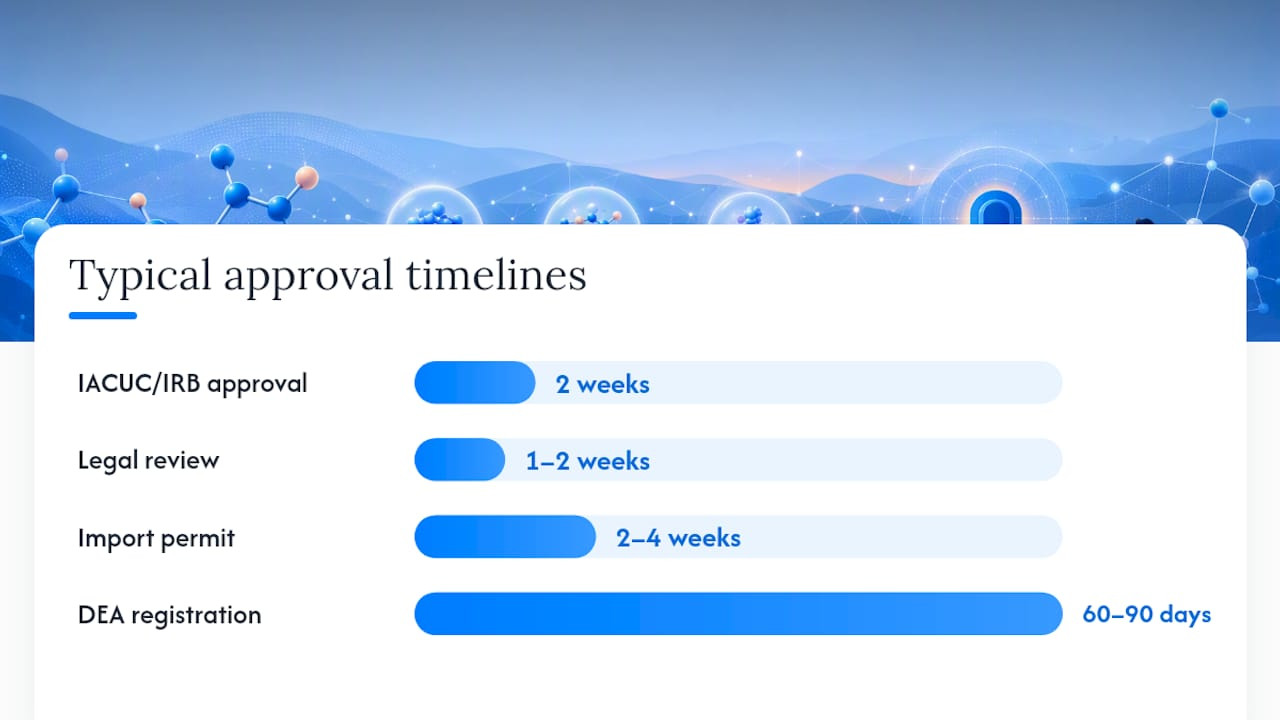
| Step | Typical timeline | Estimated cost |
|---|---|---|
| IACUC/IRB approval | 2 weeks | Institutional (often no direct cost) |
| Legal review (counsel) | 1–2 weeks | cost varies depending on complexity. |
| Import permit (if required) | 2–4 weeks | Varies by compound and quantity |
| DEA registration (if required) | 60–90 days | current DEA practitioner fee |
Pro Tip: Build import timelines into your research calendar. A shipment detained under Import Alert 66-41 can sit at the border for weeks with no guaranteed release date.
When a peptide is scheduled: DEA and NIDA processes
If a compound is scheduled or treated as an analogue, the compliance path changes substantially.
- Confirm scheduling status via the DEA’s controlled-substance schedules and cross-reference with the Federal Analogue Act analysis for structurally similar compounds.
- Obtain DEA registration. Schedule I research requires a Schedule I researcher registration. Schedule II compounds require a practitioner or researcher registration and, for ordering, Form DEA-222.
- Use the NIDA Drug Supply Program for controlled substances. NIDA requires a complete submission package including signed investigator statements. Some compounds, such as morphine, require Form DEA-222 and verified DEA registration before NIDA will process the order.
- Import permits. Controlled substances imported for research require DEA import permits in addition to FDA clearance. Plan for the 60–90 day DEA registration window before initiating the import process.
A substance that triggers the Federal Analogue Act is treated as Schedule I for enforcement purposes when intended for human consumption, even without formal scheduling.
What to demand from any research peptide vendor
Your procurement decision is also a legal decision. A vendor whose documentation is thin or whose marketing is sloppy creates exposure for your lab, not just for themselves.
Minimum documentation to require:
- Batch-specific COA with HPLC purity percentage and mass-spec molecular weight confirmation
- SDS/MSDS covering storage, handling, and disposal
- Manufacturing site name and, where available, registration number
- Lot number traceable to the COA
Red flags that should end the conversation:
- No COA, or a COA that covers a product line rather than a specific batch
- Dosing instructions, administration guides, or human-use testimonials anywhere on the site
- Bundled injection supplies sold alongside peptides
- No clear RUO labeling on product pages and packaging
Preferred vendors provide third-party tested peptides with traceable chain-of-custody documentation and no human-use claims anywhere in their materials.
How this guide was compiled and its scope
This guide draws on FDA notices and warning letters, DEA regulations (21 CFR 1308), NIDA ordering guidelines, CBP import enforcement policies, and published legal analyses of the FD&C Act and Federal Analogue Act.
A note on compliance-first procurement
Compliance in research peptide procurement isn’t a bureaucratic obstacle. It’s what separates a defensible research program from one that collapses under a single FDA inquiry. The documentation chain, the RUO labeling, the institutional approvals: these aren’t formalities. They’re the evidence that your work is legitimate science, not a workaround.
Datapeptides operates from that premise. Every product ships with a batch-specific COA, third-party testing results, and clear RUO labeling. That’s not a marketing claim; it’s the minimum standard a compliant lab should accept from any supplier.
Datapeptides: compliant U.S. research peptides with full documentation
Researchers who’ve worked through the compliance checklist above know exactly what a trustworthy supplier looks like. Datapeptides delivers it: every order includes a batch-specific COA with HPLC and mass-spec data, third-party testing verification, and RUO labeling with no human-use claims anywhere in the product materials.
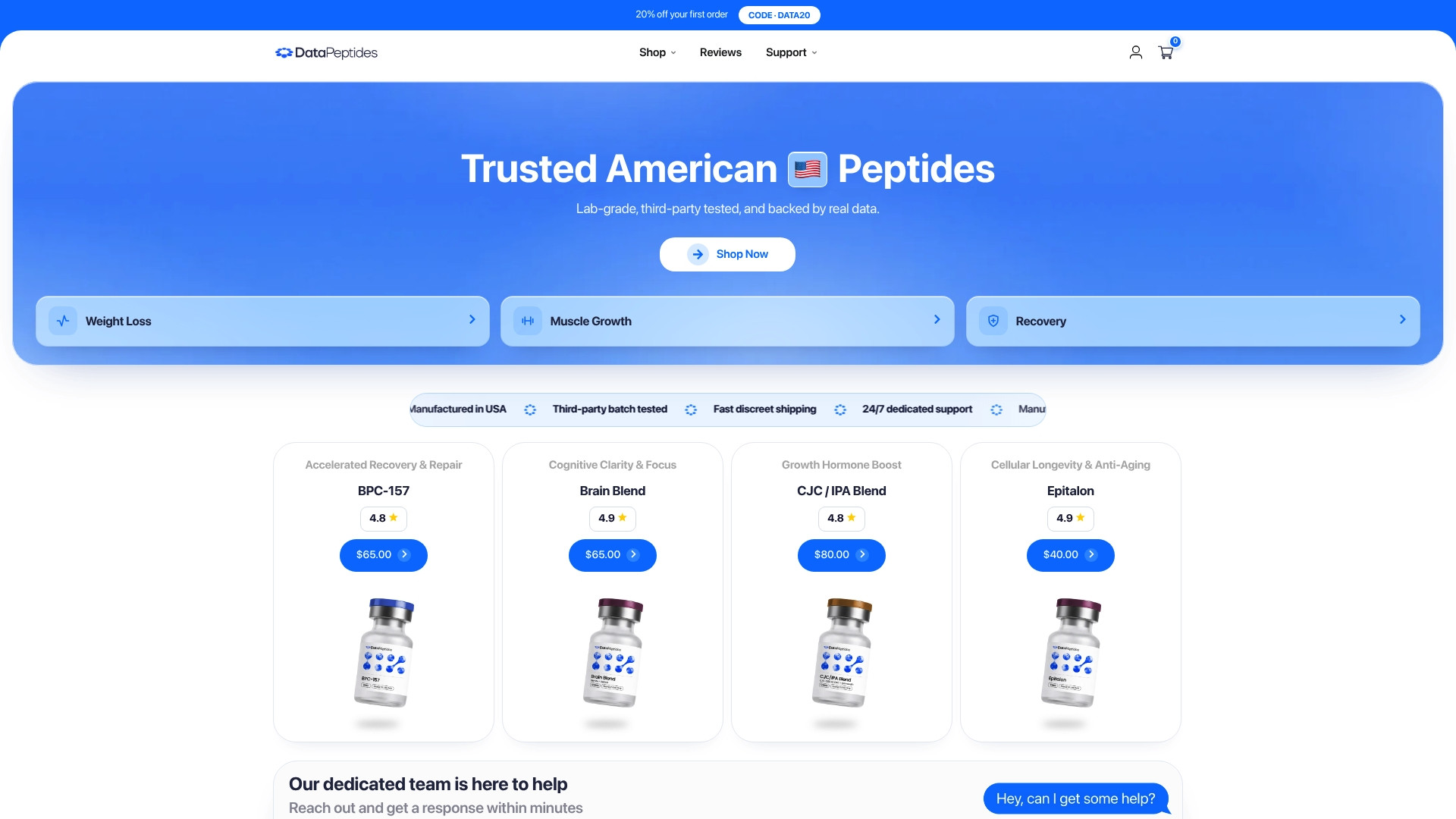
Fast, discreet U.S. shipping and a 24/7 support team mean you’re not waiting on a vendor when your research timeline is running. If your institution requires documentation beyond the standard COA, the support team can provide it. Browse the full catalog and order research-grade peptides with the documentation your compliance office will actually accept.
Sources
- NIDA Drug Supply Program — ordering guidelines for research chemicals and controlled substances
- FDA to weigh easing limits on unproven peptides
For any compound with scheduling risk or analogue characteristics, consult your institution’s compliance office or outside counsel before placing an order.
This article is general information, not a substitute for advice from a qualified lawyer. Consult a qualified legal professional about your own circumstances before acting on anything here.