

For laboratory use, research peptides are synthetic sequences sold exclusively for in vitro or preclinical work, never for human or animal administration, and the single most important purchasing rule is simple: require a full Certificate of Analysis covering mass spectrometry identity, HPLC purity and endotoxin data, then verify critical lots in-house before they enter a key experiment.
TL;DR:
- Purity tiers range from under 70% for early screening to over 95% for detailed structural or binding studies, necessitating careful selection based on application.
- A complete Certificate of Analysis should include mass spectrometry, HPLC purity, endotoxin levels, salt form, lot number, and raw data for thorough verification.
- Storage at -20°C or -80°C with aliquoting and minimal freeze-thaw cycles is essential to prevent degradation of lyophilized peptides.
- Endotoxin testing is crucial when peptides are used in immune or cell-based assays, following USP <85> guidelines for accurate detection.
Table of Contents
- What to require from suppliers: COA elements, purity tiers and red flags
- Practical ordering checklist: scale, modifications and QC requests
- Receiving, storage and reconstitution best practices
- Minimum and recommended in-house QC workflows
- Experimental controls and documentation for reproducibility
- Safety and handling precautions including toxicity and allergenicity
- Common applications and experimental uses of research peptides
- Troubleshooting common issues in peptide research
- Data Peptides’ perspective on procurement and verification
- Where to order verified research-grade peptides
- FAQ
- Sources
What to require from suppliers: COA elements, purity tiers and red flags
A usable Certificate of Analysis does more than state a purity percentage. It should show mass spectrometry confirming the peptide’s identity, an RP-HPLC or UPLC trace demonstrating purity, net peptide content from amino acid analysis, residual solvent levels, endotoxin results, the counter-ion or salt form, and a lot number that ties the document to the physical vial. The CPTAC/NCI consensus recommendations call for transparent procurement and well-characterized reference materials precisely because these details vary widely between vendors.
Purity tiers matter as much as the number itself.
- Crude material (typically under 70% purity) suits early screening where exact concentration is not critical.
- Desalted peptide removes counter-ions and byproducts for a cleaner, moderate-purity intermediate.
- Greater than 80% purity works for many functional assays where some impurity tolerance is acceptable.
- Greater than 95% purity is appropriate for quantitative binding studies, structural work or anything where impurities could skew results.
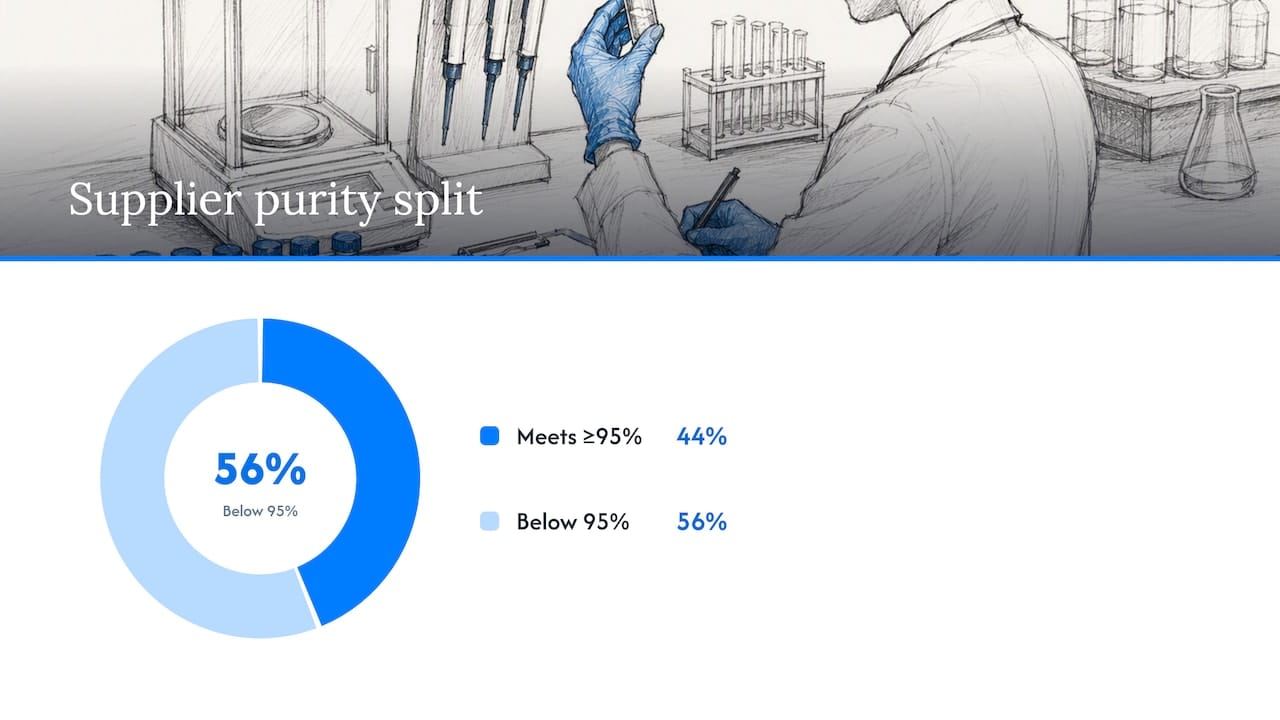
A peer-reviewed independent QC study found that only about 44% of tested peptides met their requested ≥95% purity when checked against supplier COAs, a gap that makes blind trust in paperwork risky for high-stakes work.
Watch for red flags: a COA with no MS trace, only one nonselective HPLC method, missing endotoxin data for immune-relevant work, or a lot number that does not match what shipped. Any one of these should trigger a question to the vendor before you proceed.
Pro Tip: Ask the supplier for the raw chromatogram and spectrum files, not just the summary numbers. A single purity figure can hide shoulder peaks and co-eluting impurities that the raw trace reveals.
Practical ordering checklist: scale, modifications and QC requests
Specifying an order precisely prevents the most common source of wasted material: receiving a peptide that technically matches the sequence but not the form your assay needs.
- State the exact sequence, including stereochemistry, with no ambiguity about D- versus L-amino acids.
- Specify terminal chemistry (free amine, amidation, acetylation) and any post-translational modifications.
- Note isotopic labeling requirements if the peptide will serve as an internal standard.
- Request the salt or counter-ion form, since this affects both solubility and molecular weight calculations.
- Define the purity tier needed for your application, referencing the tiers above.
- Ask for aliquoting at the scale you need per experiment to limit freeze-thaw exposure.
Turnaround depends on scale and purification level: crude synthesis ships faster, while HPLC-purified material at larger micromole scales takes longer because purification and QC add steps. Yields per µmol scale vary by sequence difficulty, so confirm expected net mass before committing a budget to a single lot.
Every order should come with:
- A complete COA matched to the lot number on the vial.
- Raw MS data when the vendor can provide it.
- Endotoxin test results for any peptide touching cell-based or immune assays.
- Clear documentation of packaging, aliquot size and shipping conditions.
For a sequence-by-sequence walkthrough of specifying these details, our ordering guide for researchers covers the paperwork side in more depth.
Receiving, storage and reconstitution best practices
What happens in the first ten minutes after a package arrives often determines whether a peptide performs consistently three months later.
On receipt, check the lot number against the COA, confirm desiccant is present and intact, inspect the vial visually for discoloration or clumping, and move the material to appropriate storage immediately rather than leaving it on a bench.
- Store lyophilized peptide at -20°C for short-term work or -80°C for long-term archives.
- Prepare working aliquots and freeze them separately to avoid repeated freeze-thaw cycles on your main stock.
- Use amber vials or foil wrapping for photolabile sequences and purge headspace with inert gas when long-term stability matters.
- Practical storage and handling guidance from proteomics researchers recommends these steps specifically to limit degradation and aggregation artifacts.
Reconstitution strategy depends on the sequence. Hydrophobic peptides often dissolve better starting in DMSO before dilution into aqueous buffer, while many sequences reconstitute cleanly in 5 to 30% acetonitrile with 0.1% formic acid. Adjust pH carefully for peptides with ionizable side chains, add a reducing agent when methionine or cysteine residues are present, and dilute slowly to avoid local supersaturation that triggers precipitation.
Pro Tip: Reconstitute at a slightly higher concentration than needed, then dilute to working concentration just before use. This limits the time any aliquot spends at dilute, aggregation-prone concentrations.
For a fuller lab protocol, see our laboratory standards and best practices page.
Minimum and recommended in-house QC workflows
The minimum acceptable QC for any peptide entering an experiment is identity confirmation by mass spectrometry paired with purity assessment by RP-HPLC. This pairing catches both wrong-sequence errors and purity overstatements that a single method might miss.
Endotoxin testing becomes necessary whenever a peptide will contact immune cells or a sensitive cell-based assay. The FDA’s guidance on pyrogen and endotoxin testing notes that standard sterilization does not remove endotoxin, and recommends Limulus Amebocyte Lysate testing under USP <85>, which offers gel-clot, turbidimetric and chromogenic method options depending on sensitivity needed.
For critical quantitative work, escalate beyond the basics:
- Use qNMR or amino acid analysis when exact concentration matters for calibration curves.
- Add elemental analysis when counter-ion content affects molecular weight calculations.
- Send material to an external lab for orthogonal confirmation when internal instrumentation cannot resolve closely related impurities.
The Assay Guidance Manual’s chapter on small-molecule characterization frames this as a matter of matching QC rigor to project phase: screening tolerates cruder material, while quantitative biomarker work demands full characterization.
When in-house results disagree with a supplier’s COA, the remediation path is straightforward: contact the supplier with your data, request reanalysis of the specific lot, repurify in-house if feasible, or reorder from a different lot before the discrepancy propagates into your results.
Experimental controls and documentation for reproducibility
Reproducibility problems in peptide work often trace back to records, not reagents. Document the lot number, the COA it came with, how the peptide was solubilized, and its storage history directly in the methods section, not just in a lab notebook that others cannot access.
- Run vehicle controls alongside any peptide treatment to separate solvent effects from peptide activity.
- Include blank matrix controls when working in complex biological samples.
- Test replicate lots when a result will inform a major decision, since lot-to-lot variation is common even among reputable suppliers.
- Validate activity with an orthogonal readout before trusting a single assay format, and consider re-purification or a different lot if impurities seem to be driving an unexpected result.
Safety and handling precautions including toxicity and allergenicity
Research peptides are handled under standard laboratory safety practices, not consumer-product assumptions. Many sequences carry unknown or poorly characterized toxicity profiles, and some can act as allergens or sensitizers with repeated skin or respiratory exposure during weighing and handling.
Work with lyophilized powder inside a fume hood or biosafety cabinet when feasible, since fine powders are the easiest form to inhale accidentally. Wear nitrile gloves, eye protection and a lab coat as a baseline, and treat any peptide with unknown endotoxin status as a potential irritant until testing says otherwise.
Dispose of peptide waste, contaminated consumables and reconstitution solvents according to your institution’s chemical waste protocols rather than standard trash, since solvents like DMSO and acetonitrile carry their own handling requirements. Label stock vials and working aliquots clearly with concentration, solvent and date prepared, both to protect colleagues and to prevent accidental misuse of material that was never intended for consumption.
Because these materials are restricted to laboratory research, institutions typically require documentation of intended use and appropriate containment before ordering, particularly for sequences with known biological activity in cell or tissue models. Keep safety data sheets on file for each peptide class in active use, and review them whenever a new researcher joins a project involving these materials.
Common applications and experimental uses of research peptides
Research peptides serve a wide variety of in vitro and preclinical investigations across biochemistry and cell biology. Receptor-binding studies use labeled or unlabeled peptide ligands to characterize how a target receptor responds, often as part of early-stage pharmacology work before any clinical consideration exists.
Cell signaling research relies on peptides to probe specific pathways, frequently as agonists or antagonists in cultured cell systems where researchers can control exposure precisely. Structural biology applications include peptides as calibration standards for mass spectrometry workflows, where the CPTAC recommendations specifically address their use as characterized reference materials for assay development.
Enzyme kinetics studies use peptide substrates to measure reaction rates under controlled conditions, and antibody development work often uses peptide antigens to raise or characterize antibodies in preclinical models. Peptide-based assay development, including ELISA and other immunoassays, depends on consistent, well-characterized peptide standards to produce comparable results across experimental runs.
Across all of these uses, the common thread is controlled, documented laboratory conditions rather than any form of direct administration. The quality bar shifts with the application: a peptide standard for mass spectrometry calibration needs tighter purity and characterization than one used in a preliminary binding screen, which is why matching purity tier to application matters more than defaulting to the highest grade available for every project.
Troubleshooting common issues in peptide research
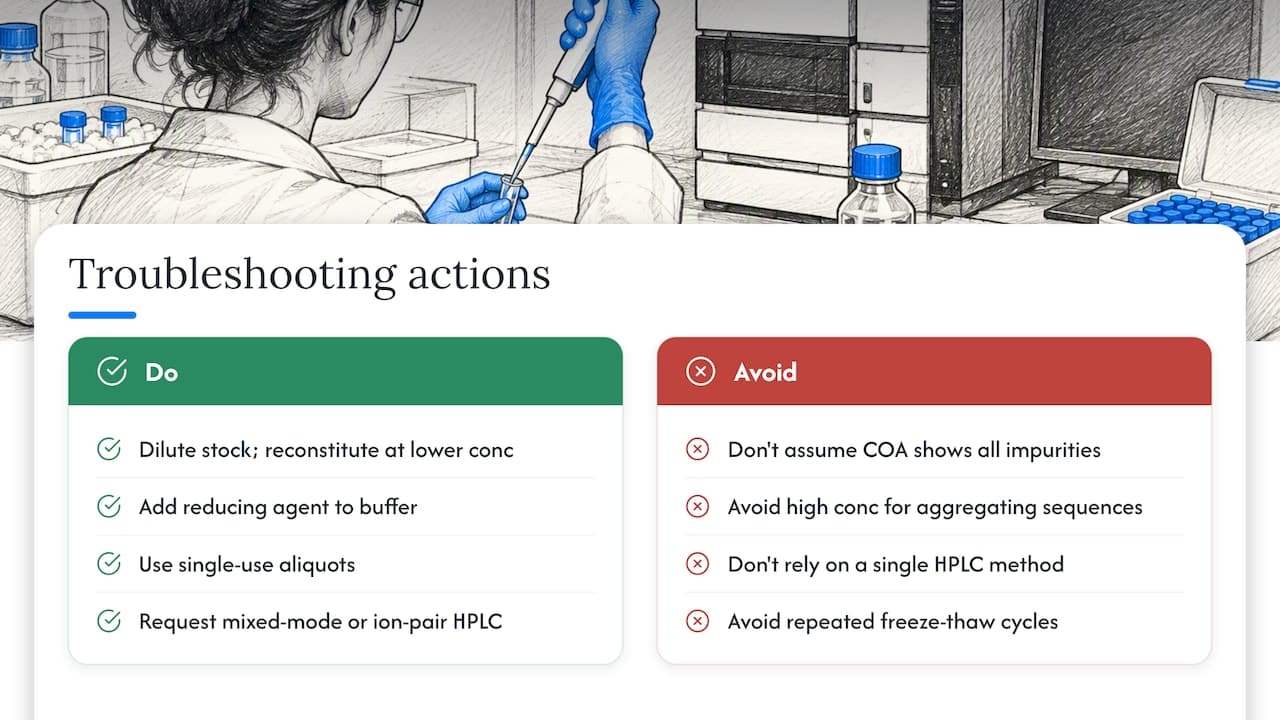
Aggregation is the most common complaint researchers report, and it usually traces to concentration, solvent choice or pH rather than a defective lot. Hydrophobic sequences and those rich in beta-sheet-forming residues aggregate readily at high concentration, so diluting the working stock and reconstituting at a lower starting concentration often resolves the problem.
Degradation during storage typically points to freeze-thaw cycling, temperature excursions during shipping, or oxidation of methionine and cysteine residues. Adding a reducing agent to the reconstitution buffer and limiting a single aliquot to one freeze-thaw cycle addresses most oxidation-related and mechanical degradation issues.
Unexpected low activity in an assay, despite a clean-looking COA, often means the purity figure did not capture everything relevant. Independent QC work on synthetic peptides found that single HPLC methods sometimes miss closely related impurities, particularly deletion peptides missing a single amino acid, which can act as competitive inhibitors in binding assays without showing up clearly on a standard trace.
Poor solubility despite following standard protocols sometimes means the sequence needs an alternative column chemistry or ion-pairing reagent to resolve properly during purification, a detail worth requesting from the supplier if a peptide behaves unexpectedly. HPLC method reviews for peptide separations note that mixed-mode and ion-exchange approaches can succeed where standard reversed-phase methods struggle, particularly for highly polar or highly hydrophilic sequences that barely retain on a C18 column.
Data Peptides’ perspective on procurement and verification
We built our testing process around the gap this guide describes: the difference between a COA that looks complete and one a researcher can actually verify. Every lot carries batch testing results and a Certificate of Analysis, with endotoxin data provided as applicable.
Support teams handle documentation requests directly, including raw data access and custom order specifications, to ensure prompt responses to inquiries. Timely, discreet shipping helps get material into appropriate storage sooner, supporting recommended best practices.
— Data Peptides
Where to order verified research-grade peptides
Applying this checklist means little without a supplier willing to answer every item on it. Third-party batch testing, Certificates of Analysis, and aliquoting options are available, with support for documentation inquiries.
- Browse the catalog of research peptide categories on the shop page.
- Review category-specific guidance on the laboratory research applications guide before placing a first order.
- For independent contract testing beyond in-house QC, CRO and biospecimen services offer an external verification option for critical lots.
Orders can be placed through the shop with documentation requests accommodated at checkout.
FAQ
What is the difference between research peptides and pharmaceutical peptides?
Research peptides are manufactured and sold strictly for laboratory use in vitro or in preclinical models, with documentation focused on identity, purity and endotoxin status rather than clinical safety data. Pharmaceutical peptides go through regulatory approval processes for human or animal administration, which research-grade material is never intended for.
How do I read a peptide Certificate of Analysis?
A complete COA shows mass spectrometry data confirming the peptide’s identity, an HPLC trace demonstrating purity, net peptide content, and endotoxin results tied to a specific lot number. The CPTAC consensus guidance recommends checking that these elements are present and that the lot number on the document matches the vial received.
Why would a peptide fail independent purity testing despite a high-purity COA?
A single HPLC method can miss closely related impurities such as deletion peptides, so the supplier’s stated purity may not reflect what an orthogonal method would find. An independent QC study found that roughly 44% of tested peptides failed to meet their claimed purity on reanalysis, which is why verification matters for critical experiments.
How should I store lyophilized peptides to prevent degradation?
Store lyophilized peptide at -20°C for shorter-term use or -80°C for long-term storage, and limit freeze-thaw cycles by preparing single-use aliquots. Practical storage guidance also recommends amber packaging for photolabile sequences and minimal headspace exposure to air.
When is endotoxin testing necessary for research peptides?
Endotoxin testing matters whenever a peptide will contact immune cells, sensitive cell cultures, or any assay where pyrogenic contamination could skew results. The FDA’s guidance on endotoxin testing points to USP <85> methods, including gel-clot, turbidimetric and chromogenic options, for quantifying endotoxin levels.
Sources
- FDA: Pyrogen and Endotoxins Testing: Questions and Answers
- Recommendations for the Generation, Quantification, Storage, and Handling of Peptides Used for Mass Spectrometry-Based Assays
- Practical Recommendations for Small-Molecule Characterization in Preclinical Research – Assay Guidance Manual
- Quality evaluation of synthetic quorum sensing peptides used in R&D