

HGH fragment 176-191 is a defined C-terminal peptide fragment with consistent preclinical evidence for selective effects on adipose lipid metabolism, but it lacks controlled human efficacy and safety trials. Rodent studies support adipose-selective lipolytic signals, while a 2022 nanoparticle study in MCF-7 cells shows the fragment’s reach into delivery research. AOD-9604, a related but distinct compound, has drawn separate FDA review attention that researchers sourcing either molecule should understand.
TL;DR:
- Human studies on HGH fragment 176-191 are nonexistent, making efficacy and safety in humans purely speculative at this stage.
- Researchers must verify the salt form and sequence match published materials, as these details influence dose, solubility, and reproducibility.
- The fragment likely promotes adipose lipolysis through mechanisms involving hormone-sensitive lipase and PPAR-gamma, but its receptor dependence remains unconfirmed.
- Preclinical evidence shows reduced weight gain in rodents and adipose effects, but these results are limited by small sample sizes, differing models, and delivery methods.
- Regulatory gaps include the lack of an FDA monograph for related compounds, emphasizing the need for rigorous testing of purity, impurities, aggregates, and microbial limits before use.
Table of Contents
- Biochemical Properties: Sequence, Identifiers, and Molecular Data
- How the Mechanism of Action Is Thought to Work
- Preclinical Evidence: What Rodent and Cell Studies Show
- The Human Evidence Gap and What Would Close It
- Chemistry and Pharmacology Considerations for Lab Use
- Regulatory Review and Safety Checks Before You Begin
- Research Methods and Measures for Reproducible Studies
- Where Research Should Go Next
- What Data Peptides Provides for Reproducible Research
- A Researcher’s Read on the Current Literature
- Sourcing Research-Grade HGH Fragment 176-191
- Sources
- FAQ
Biochemical Properties: Sequence, Identifiers, and Molecular Data
HGH fragment 176-191 corresponds to the C-terminal region of human growth hormone, commonly represented by the sequence most researchers reference in catalog and literature searches. The compound appears in PubChem under CID 172966176, which lists its molecular formula, synonyms including HGH Fragment 176-191 and GLXC-21568, and a computed molar mass of approximately 1,859.1 grams per mole, a figure that shifts depending on whether the material is supplied as a free base or an acetate salt.
That distinction between salt forms is not a technicality. Acetate content adds measurable mass and affects solubility, and a certificate of analysis that fails to specify the form makes dose calculations and cross-study comparisons unreliable. Researchers comparing results across labs or replicating a published protocol need the same chemical entity, not just a similar-sounding name.
Before ordering or citing material, record these identifiers for every batch:
- PubChem CID 172966176, the authoritative database entry for structure and formula verification.
- Molecular formula and salt form (free base versus acetate), since mass and solubility shift accordingly.
- Synonyms used in literature, including GLXC-21568, to avoid missing relevant studies during searches.
- Batch-specific molar mass, confirmed by the supplier’s certificate of analysis rather than assumed from a generic listing.
A mismatch between the sequence used in a published study and the sequence in a sourced product is one of the most common, and most overlooked, sources of failed replication in peptide research.
How the Mechanism of Action Is Thought to Work
The mechanistic case for fragment 176-191 centers on adipose-selective lipolysis without the broader growth-promoting signaling associated with full-length growth hormone. Proposed pathways include modulation of hormone-sensitive lipase (HSL) activity and interaction with PPAR-gamma and FSP27 regulation, processes studied directly in human adipocytes exposed to growth hormone itself. That human adipocyte research found that GH promotes PPAR-gamma phosphorylation and FSP27 downregulation, a combination tied to lipid mobilization but also to changes in insulin signaling, useful context for forming hypotheses about the fragment, though it does not confirm the fragment reproduces the same cascade.
Beta-3-adrenergic receptor involvement adds another layer. Chronic dosing studies in mice found increased beta-3-AR expression alongside fat reduction, yet knockout models still showed acute increases in energy expenditure, meaning the receptor accompanies metabolic change without being the sole driver of it. That nuance matters for anyone designing a mechanism-focused experiment:
- HSL activation and PPAR-gamma/FSP27 modulation are the leading mechanistic hypotheses for adipose-selective lipolysis.
- Beta-3-AR expression rises with chronic treatment, but receptor knockout studies show the pathway is not the only mediator.
- Fragment effects do not equal full GH receptor activation, so receptor-dependence must be tested directly rather than assumed.
Pro Tip: Pair lipolysis assays (glycerol or NEFA release) with receptor-blockade controls so mechanistic claims rest on functional evidence rather than correlation.
Preclinical Evidence: What Rodent and Cell Studies Show
The weight of evidence for fragment 176-191 and its close relative AOD-9604 comes from a small set of rodent and in vitro studies, each with specific designs worth understanding before citing them.
- Oral administration in ob/ob mice (2000). A synthetic fragment study compared saline (n=8) against AOD-9401 (n=10) in C57BL/6J ob/ob mice over 30 days. Treated mice showed significantly lower body-weight gain from day 16 onward with no difference in food intake, alongside ex vivo adipose tissue showing reduced lipogenesis and increased lipolysis.
- Chronic treatment and beta-3-AR knockout study (2001). A 14-day chronic dosing study in obese mice found that both human GH and the AOD9604 lipolytic fragment reduced body weight and increased lipolytic sensitivity, with beta-3-AR RNA expression rising under treatment. Knockout mice lacking the receptor did not show the same chronic weight and fat reductions, though acute energy expenditure increases persisted, indicating the receptor is involved but not solely responsible for the full effect.
- MCF-7 nanoparticle study (2022). A more recent investigation combined hGH fragment 176-191 with doxorubicin-loaded chitosan nanoparticles and tested the combination against MCF-7 breast cancer cells. Molecular docking and viability assays found the dual-loaded nanoparticles had a lower IC50 (1.5 micrograms per milliliter) than doxorubicin-loaded nanoparticles alone (1.7 to 1.85 micrograms per milliliter), a signal limited entirely to one cell line and one delivery system.
These three studies differ enough in route, formulation, and model that pooling their results into a single efficacy claim would misrepresent the evidence. The oral and chronic rodent studies point toward adipose-selective effects in whole-animal metabolism. The nanoparticle study is a different question entirely, concerned with drug delivery and target engagement in vitro, not systemic fat metabolism. Readers citing any one of these should state the model, route, and endpoint explicitly rather than generalizing across them.
The Human Evidence Gap and What Would Close It
Unmodified HGH fragment 176-191 has no published controlled human efficacy or safety trials. That stands in contrast to AOD-9604, a related compound with an additional N-terminal tyrosine, for which some nominations have been reviewed by the FDA, though that review process concerns manufacturing and characterization rather than an approval of clinical efficacy.
Pharmacokinetic data in humans are effectively absent for the unmodified fragment, which means dosing, half-life, and bioavailability cannot be inferred from the rodent work described above. A rodent oral study and a human clinical trial are not interchangeable in route, metabolism, or scale.
Closing the gap would require, at minimum:
- Randomized, controlled trial design with a defined comparator and blinding.
- Pharmacokinetic and pharmacodynamic profiling to establish dose, half-life, and exposure-response relationships.
- Metabolic endpoints such as fat mass, NEFA levels, and energy expenditure measured with validated methods.
- Safety panels including glucose and insulin monitoring, since GH-related signaling can affect insulin action even when the primary effect studied is lipolytic.
Until that work exists, any claim about human efficacy or safety for this fragment is an extrapolation from animal and in vitro data, not a finding.
Chemistry and Pharmacology Considerations for Lab Use
Formulation choices carry measurable consequences. Free base and acetate salt forms differ in mass and solubility, and a certificate that does not specify which form is present makes molarity calculations unreliable across experiments.
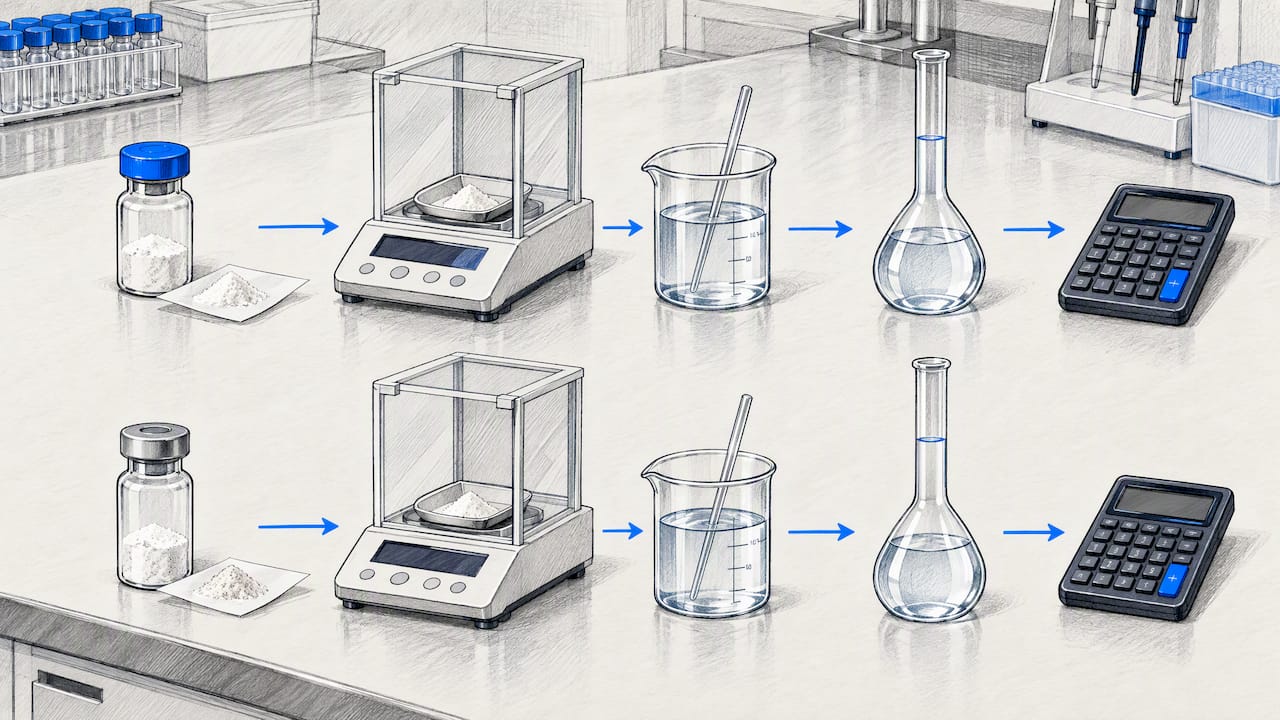
Aggregation is a separate concern from purity. A peptide can show high purity by one assay while still containing aggregates that affect solubility, assay readouts, or immunogenic potential in cell and animal models, which is why FDA review materials on the related AOD-9604 compound specifically flag aggregate and impurity testing as a gap in current characterization.
Recommended verification steps before use:
- LC-MS for sequence confirmation, verifying the exact amino acid sequence matches the intended fragment.
- HPLC for purity assessment, reported by both area and mass rather than a single percentage.
- Amino acid analysis to confirm composition independent of chromatographic purity.
- Endotoxin and aggregate testing, particularly for any work involving cell culture or in vivo dosing.
Systemic pharmacokinetic data for the unmodified fragment remain sparse, so researchers should treat absorption, distribution, and clearance as open questions rather than known quantities. For broader context on sourcing and quality standards relevant to research peptides generally, that groundwork applies directly here.
Regulatory Review and Safety Checks Before You Begin
The FDA’s Pharmacy Compounding Advisory Committee has reviewed nominations tied to AOD-9604, and the resulting FDA PCAC documentation raises specific concerns: the compound lacks a USP monograph, free base and acetate forms are distinct bulk drug substances with different characterization needs, and testing gaps exist around impurities, aggregates, and microbial limits.
No USP or NF monograph currently exists for AOD-9604, according to FDA review materials, which means there is no standardized reference method that labs can default to for identity and purity confirmation. That absence puts the burden on individual suppliers and labs to document their own assay methods clearly.
Practical safety checks to request or perform:
- Endotoxin limits, especially relevant for any in vivo or cell culture application.
- Microbial limit testing, confirming the material is free of contaminating organisms.
- Aggregate testing, since aggregated peptide can behave differently than monomeric material in both assays and animals.
- Immunogenicity screening where chronic or repeated dosing in animal models is planned.
Any in vivo work requires IACUC approval, and human-adjacent research requires IRB oversight; procurement records should document batch numbers, certificates of analysis, and supplier identity for traceability.
Research Methods and Measures for Reproducible Studies
Model selection should match the question. In vitro adipocyte cultures suit mechanistic screening, ex vivo human adipose explants bridge toward physiological relevance, and chronic rodent models remain the standard for whole-body metabolic endpoints.
Essential controls include a vehicle-only group, a scrambled-peptide control to rule out nonspecific effects, and either receptor antagonists or knockout models when testing a specific pathway hypothesis. Primary endpoints worth prioritizing include body composition, circulating NEFA, HSL phosphorylation status, and energy expenditure, with glucose tolerance as a necessary secondary measure given the insulin-action concerns raised in GH-adipose literature.
A basic setup checklist:
- Define the model (cell line, explant, or rodent strain) and justify its relevance to the question.
- Include vehicle and scrambled-peptide controls alongside the treatment arm.
- Pre-register primary and secondary endpoints before data collection begins.
- Power the study based on expected effect size from prior rodent data rather than convenience sampling.
- Report dose, route, and formulation in enough detail for independent replication.
Pro Tip: Run a pilot dose-response arm before committing to a full study design; the rodent literature shows route and formulation substantially affect measured outcomes.
Where Research Should Go Next
Several gaps stand between the current preclinical picture and any translational claim. Priority experiments include formal pharmacokinetic and pharmacodynamic studies, GLP-compliant toxicology work, multi-species dose-response comparisons, and functional receptor studies that isolate the fragment’s mechanism from correlated changes like beta-3-AR expression.
Before any clinical-stage consideration, three milestones need to be met:
- Well-characterized reference material, including a resolved monograph gap and consistent salt-form reporting.
- GLP toxicology data, currently absent from the public record for the unmodified fragment.
- Reproducible pharmacodynamic signals across independent labs, not just the original studies.
The nanoparticle delivery angle from the 2022 MCF-7 work is worth exploring further as an exploratory research direction, not a therapeutic claim, particularly in combination with other targeted delivery systems. Any researcher observing unexpected toxicity, off-target binding, or inconsistent lipolytic response across batches should document and report it, since negative signals are as valuable as positive ones in a literature this early.
What Data Peptides Provides for Reproducible Research
Reproducible results start with knowing exactly what is in the vial. Research peptide suppliers provide batch testing and certificates of analysis for research peptide catalogs, sometimes with support for sourcing and documentation questions.
When requesting a certificate of analysis for any fragment, confirm it includes:
- Sequence identity confirmed by mass spectrometry, not inferred from supplier labeling alone.
- Assay method and purity reported by both area and mass.
- Water content and residual solvent data, relevant to accurate molarity calculations.
- Endotoxin and aggregate results, particularly for cell culture or in vivo applications.
All products are intended for laboratory research use only, and any in vivo work remains subject to institutional oversight requirements described above.
A Researcher’s Read on the Current Literature
The mechanistic story for fragment 176-191 is plausible and partly supported, but the field is still working from a handful of rodent studies and one delivery-focused cell study. Cautious optimism is warranted on the mechanism side. What is missing is replication across independent labs, transparent reporting of salt form and purity, and the pharmacokinetic groundwork that would make human translation a reasonable next step rather than a leap. Anyone citing this literature owes readers the same caveats the original studies carry: small sample sizes, model-specific findings, and no controlled human data yet.
— Data Peptides
Sourcing Research-Grade HGH Fragment 176-191
Researchers working with fragment 176-191 need material that matches what the literature actually tested, not a loosely labeled substitute. Data Peptides lists batch-tested research peptides, including compounds in the weight loss category, on its shop page, with certificates of analysis available for review before or after purchase.
- Request batch-specific COA data directly through customer support before finalizing an order.
- Confirm salt form and sequence against the identifiers discussed above, not a generic product description.
- Reach out with assay or sourcing questions any time, since support is available continuously for research account holders.
None of this constitutes clinical advice, and every product is sold strictly for laboratory research use, not for human or animal consumption. For researchers comparing lipid-metabolism-focused peptides more broadly, the weight loss research guide offers additional cross-reference material.
This article is general information, not a substitute for advice from a qualified doctor. Consult a qualified healthcare professional about your own circumstances before acting on anything here.
Sources
- Human Growth Hormone Fragment 176–191 Peptide Enhances the Toxicity of Doxorubicin‑Loaded Chitosan Nanoparticles Against MCF‑7 Breast Cancer Cells – PMC
- Effects of oral administration of a synthetic fragment of human growth hormone on lipid metabolism – PubMed
- The Effects of Human GH and Its Lipolytic Fragment (AOD9604) on Lipid Metabolism Following Chronic Treatment in Obese Mice andβ3‑AR Knock‑Out Mice
- FDA PCAC materials: Evaluation of AOD‑9604 (free base) and AOD‑9604 acetate (PDF) – FDA
FAQ
What are the potential benefits of HGH Fragment 176-191 peptide therapy?
Preclinical rodent studies link the fragment to adipose-selective lipolysis and reduced weight gain, with the 2000 oral administration study showing lower weight gain from day 16 without changes in food intake. These findings come from animal models, not controlled human trials, so any benefit claim is bound to that preclinical context.
What are the potential side effects of taking HGH fragment 176/191?
No controlled human safety data exist for the unmodified fragment, so side effects in humans are not established in the published literature. Related GH-adipose research flags insulin action changes as a monitoring concern, meaning glucose and insulin tracking would be a necessary safety measure in any future human study.
What’s the difference between HGH and HGH Fragment 176-191?
Full-length human growth hormone activates broad growth and metabolic signaling through the GH receptor, while HGH fragment 176-191 represents only the C-terminal portion associated with adipose-selective effects in animal studies. The fragment does not reproduce full GH receptor activation, a distinction researchers should test directly rather than assume.
Does HGH 191 build muscle?
The available rodent and cell-line research on fragment 176-191 centers on lipid metabolism and adipose tissue, not muscle growth endpoints. No cited study in this body of evidence measured muscle mass or strength outcomes, so a muscle-building claim is not supported by the current literature.