

GHRH analogs work by binding pituitary GHRH receptors to trigger a physiologic pulse of growth hormone, while growth hormone secretagogues (GHS) act through the ghrelin receptor, GHS-R1a, using a parallel signaling route that amplifies and reshapes that same pulse. The practical split matters: tesamorelin, ibutamoren, and macimorelin sit on different sides of this divide, and each carries its own dosing pattern, approval status, and monitoring demands, from IGF-1 and glucose tracking to fluid retention checks. Combining a GHRH analog with a GHS tends to produce larger, more consistent GH pulses than either alone, though sex, body fat, and somatostatin tone all shift the outcome.
TL;DR:
- Combining GHRH analogs with GHS compounds produces larger and more consistent growth hormone pulses than using either alone, especially when dosing protocols account for sex, body fat, and somatostatin tone.
- FDA-approved tesamorelin is limited to treating HIV-associated lipodystrophy and carries an immunogenicity concern, with long-term safety data still uncertain.
- Oral GHS like ibutamoren are investigational and lack regulatory approval, though they enable longer, more convenient dosing in research settings.
- Glucose intolerance and fluid retention are common side effects across GHRH and GHS classes and require metabolic monitoring during prolonged use.
- Proper sourcing demands third-party testing, certification, and meticulous documentation to ensure peptide purity, safety, and reproducibility in research.
Table of Contents
- How GHRH and GHS fit into the growth hormone axis
- Mapping the compounds: GHRH analogs, peptide GHS, and oral secretagogues
- Where each class stands with regulators: approvals and diagnostic roles
- Safety and monitoring: what changes by compound class
- Study design: dosing ranges and the case for combining GHRH with GHS
- Sex and physiology shift how the GH axis responds
- What to verify before sourcing research peptides
- Choosing a pathway for common research goals
- Sourcing research-grade peptides for GH axis studies
- FAQ
- Sources
How GHRH and GHS fit into the growth hormone axis
Growth hormone release is not a simple on-off switch. It is governed by three signals working against and with each other: GHRH, which stimulates the pituitary; somatostatin, which suppresses it; and ghrelin (along with synthetic GHS compounds), which stimulates through a separate pathway. This three-signal ensemble produces the pulsatile pattern of GH secretion seen in blood sampling studies, and it explains why isolated single-receptor experiments can give inconsistent results depending on background somatostatin tone, mechanistic studies show.
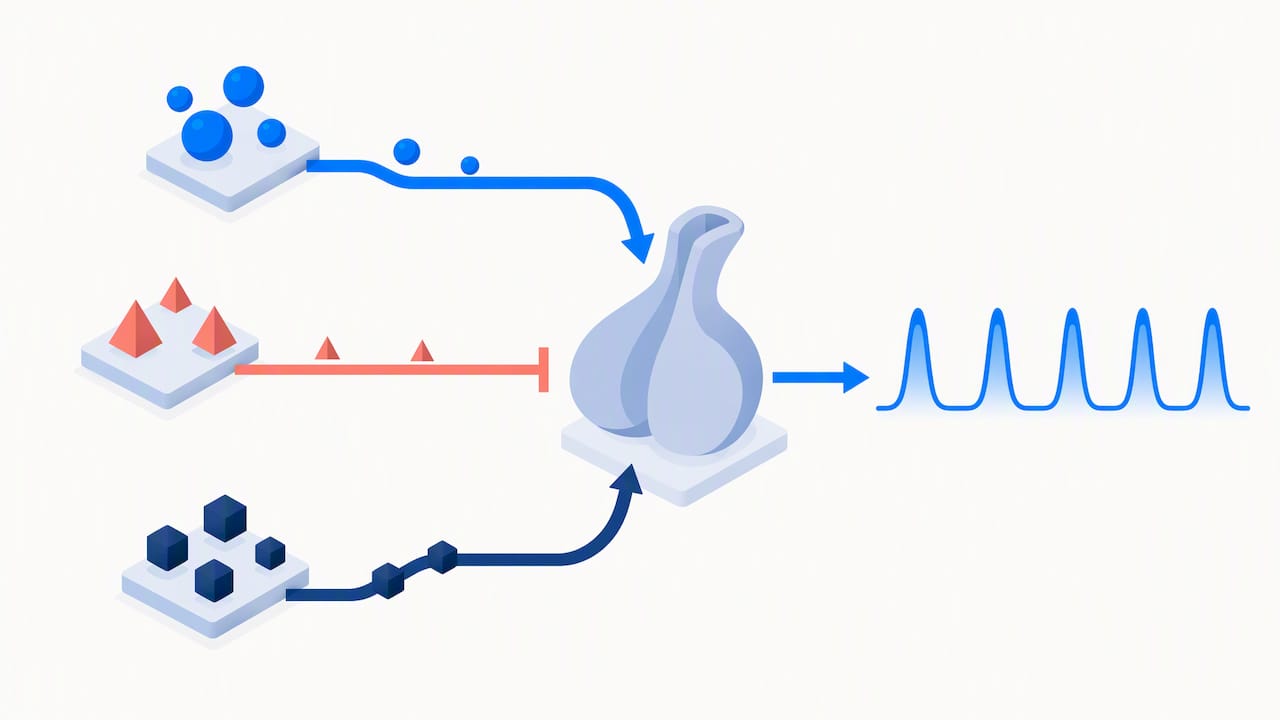
GHRH acts on GHRH receptors expressed on pituitary somatotroph cells, the hormone-producing cells that make and release growth hormone. This receptor activates a cyclic AMP pathway that drives both GH synthesis and immediate release. GHS compounds, by contrast, work through GHS-R1a, a receptor expressed in the hypothalamus and pituitary that responds to ghrelin and to synthetic mimetics. Activation here uses a different intracellular cascade, one that converges on GH release but also touches appetite centers in the hypothalamus, which is why several GHS compounds carry noticeable appetite effects.
Downstream of either pathway, released GH travels to the liver and peripheral tissues, where it drives IGF-1 production. IGF-1 then feeds back to suppress further GH release, part of the broader JAK-STAT and PI3K/AKT signaling network that governs GH action and its metabolic consequences, including the glucose intolerance and insulin resistance risks that show up with chronic GH axis activation, recent reviews of GH signaling note.
What this means for experimental design:
- Somatostatin tone varies by time of day, feeding state, and individual physiology, and it can mask or exaggerate a GHRH or GHS effect if left uncontrolled.
- Peripheral metabolic signals, including glucose and free fatty acids, modulate net GH output independent of which receptor a compound targets.
- A single-pathway stimulus (GHRH alone or GHS alone) tends to produce smaller, less reproducible pulses than a combined stimulus, a pattern worth planning around before fixing a protocol.
Mapping the compounds: GHRH analogs, peptide GHS, and oral secretagogues
Research and clinical literature group these molecules into three practical categories, each with distinct pharmacologies.
GHRH analogs are synthetic versions of growth hormone-releasing hormone, engineered for longer half-life than native GHRH. Tesamorelin is the clearest example: a subcutaneously injected GHRH analog with a defined clinical dose and an FDA-approved indication, discussed in more detail in the next section. Research use of GHRH peptide compounds generally follows this same receptor-targeted logic, aiming to reproduce a physiologic GH pulse rather than override it.
Peptide GHS, often called GHRPs (growth hormone-releasing peptides), include compounds such as GHRP-2, GHRP-6, hexarelin, and ipamorelin. These bind GHS-R1a directly and are typically delivered by injection in research settings. GHRP-2 and GHRP-6 differ mainly in their appetite-stimulating potency and receptor selectivity, with ipamorelin generally regarded as more selective for GH release with less appetite impact, a distinction that matters when appetite effects would confound a study’s endpoints.
Non-peptide GHS represent a chemically distinct subclass. Ibutamoren (MK-0677) is the most studied example: an orally active small molecule that activates GHS-R1a without needing injection. Its oral bioavailability makes it attractive for longer research protocols, though appetite increase and fluid retention are consistently reported signals worth tracking.
Macimorelin stands apart from both groups in practical use. It is an orally active GHS-R1a agonist, but its primary role in the literature is diagnostic rather than therapeutic, used to provoke a measurable GH response for testing adult growth hormone deficiency rather than for sustained GH elevation.
- GHRH analogs replicate the pituitary’s own stimulatory signal and are generally injected.
- Peptide GHS (GHRP-2, GHRP-6, hexarelin, ipamorelin) bind GHS-R1a directly and vary in appetite-related side effects.
- Ibutamoren offers oral GHS-R1a activation, useful where injection frequency is a study constraint.
- Macimorelin is used almost exclusively as a diagnostic probe rather than a chronic-use compound.
Where each class stands with regulators: approvals and diagnostic roles
Regulatory status is the single clearest line separating these compounds in practice, and it should shape any research protocol that aims for translational relevance.
Tesamorelin holds FDA approval, but only for a specific indication: reducing excess abdominal fat in patients with HIV-associated lipodystrophy. The prescribing information specifies daily subcutaneous dosing at either 1.4 mg or 2 mg depending on formulation, and it explicitly notes that long-term cardiovascular safety has not been established, alongside immunogenicity findings worth flagging for any long-duration study design.
Anti-tesamorelin antibodies were detected in a substantial fraction of trial participants in studies cited in the FDA label, a signal that complicates interpretation of long-term efficacy and safety data for any GHRH analog used repeatedly over months.
Macimorelin carries a narrower but distinct regulatory status: approval as a diagnostic agent for adult growth hormone deficiency. Its oral administration and defined provocative-test protocol offer a practical advantage over older insulin-tolerance or arginine-based tests, which require infusion and closer monitoring, diagnostic reviews of macimorelin note.
Ibutamoren, by contrast, remains investigational. Trial records document use at 25 mg per day, Clinicaltrials, with endpoints including fat-free mass changes and appetite effects, but no approved therapeutic indication exists for it.
- Tesamorelin: approved, HIV-associated lipodystrophy only, not a general GH-boosting therapy.
- Macimorelin: approved for diagnostic use, not for chronic GH elevation.
- Ibutamoren: investigational, studied at defined doses but without regulatory clearance.
- Research use of any of these compounds is distinct from therapeutic use, and protocols should treat regulatory status as a hard boundary, not a formality.
Safety and monitoring: what changes by compound class
Both classes converge on a shared risk: chronic elevation of the GH-IGF-1 axis. But the monitoring emphasis shifts depending on which receptor pathway is driving that elevation.
IGF-1 tracking is the backbone of any GH axis study. Sustained elevation above normal reference ranges raises theoretical concerns about malignancy risk, a caution carried directly in tesamorelin’s label and echoed across GH signaling reviews.
Glucose intolerance and fluid retention are recurring findings across GH axis manipulation studies, documented in both drug labeling and recent signaling reviews, meaning fasting glucose and HbA1c checks belong in any protocol lasting more than a few weeks. Readers tracking broader metabolic context may find it useful to understand how insulin interacts with hormone regulation more generally, since GH and insulin signaling intersect at several points.
- Fluid retention, arthralgia, and carpal tunnel-type symptoms appear with both GHRH analogs and potent GHS compounds, particularly at higher relative doses.
- Immunogenicity, meaning the development of anti-drug antibodies, is a documented concern specifically with peptide analogs like tesamorelin, and it can blunt efficacy or complicate safety readouts over repeated dosing.
- A reasonable monitoring cadence includes a baseline IGF-1 and metabolic panel, an early follow-up around four to six weeks, and periodic rechecks thereafter, with any sharp IGF-1 rise or new glucose abnormality treated as a stop-and-reassess signal.
Study design: dosing ranges and the case for combining GHRH with GHS
Published research gives fairly consistent dosing anchors. Ibutamoren has been studied at 25 mg per day in trials tracking fat-free mass and appetite, per ClinicalTrials.gov records, while tesamorelin’s clinical dosing sits at 1.4 mg or 2 mg daily depending on formulation, per its FDA label. Neither figure should be assumed to transfer directly to a different study population or compound without its own dose-finding work, and verifying purity and identity of any research material before use is a baseline requirement, not an afterthought.
The strongest design insight from the literature is synergy. Pairing a GHRH analog with a GHS or GHRP produces larger, more reproducible GH pulses than either stimulus alone, a finding replicated across multiple dual-effector stimulation studies, as mechanistic pairing research shows. This synergy reflects the three-signal ensemble: GHRH and GHS activate complementary receptors while partially overriding somatostatin’s suppressive tone at the same time.
- Fix the timing of administration relative to feeding or fasting, since somatostatin tone shifts with meals and will otherwise confound pulse amplitude readings.
- Use frequent blood sampling, often every 10 to 20 minutes over several hours, paired with a pulse-detection algorithm to separate amplitude effects from frequency effects, as pulsatility research recommends.
- Report area under the curve, peak pulse amplitude, and IGF-1 response together rather than any single metric in isolation.
Pro Tip: When testing GHRH or GHS compounds, consider a somatostatin-suppression clamp, such as a low-dose arginine infusion, to reduce background variability before layering on your experimental stimulus.
Sex and physiology shift how the GH axis responds
Human studies consistently find that combined GHRH and GHRP stimulation produces markedly different burst-like GH responses between men and women, a pattern strong enough that sex should be treated as a planned covariate rather than an afterthought in GH axis research, dual-effector stimulation studies report.
Circulating estradiol and testosterone levels correlate with the size of the GH response to combined stimulation, which suggests that hormonal status, not just chromosomal sex, deserves tracking or stratification in study design.
- Obesity blunts GH pulse amplitude independent of which stimulatory pathway is used, a confound worth matching for across study arms.
- Age reduces both baseline and stimulated GH output, meaning cross-age comparisons require careful normalization.
- Reporting raw GH values without accounting for these modifiers risks misattributing a physiological difference to the compound itself.
What to verify before sourcing research peptides
Reproducible results start with knowing exactly what is in the vial. A defensible sourcing checklist includes a Certificate of Analysis for the specific lot, a third-party purity assay, an endotoxin report, documented storage and chain-of-custody records, and a traceable lot number tied to all of the above.
Third-party testing matters beyond quality assurance: contaminants can produce effects, from injection-site reactions to unexpected metabolic readings, that mimic the adverse effects researchers are trying to measure, muddying safety data in ways that are hard to untangle after the fact.
- Require a Certificate of Analysis and an endotoxin report for every lot, not just a product line.
- Confirm third-party purity testing, independent of the seller’s own internal assay.
- Keep lot numbers and storage records on file for any compound used in a published or shared dataset.
We maintain this documentation for the tesamorelin and HGH peptide lines we carry, consistent with the sourcing standard above.
Choosing a pathway for common research goals
For protocols aiming at physiologic pituitary stimulation or translational relevance, a GHRH analog is the more direct match. For designs where oral dosing convenience or a distinct receptor mechanism matters more than mimicking native physiology, a GHS offers that leverage instead. The real tradeoff is intensity of monitoring against interpretability: GHRH analogs carry more immunogenicity concern, GHS compounds carry more metabolic and appetite confounds, and both demand transparent methods reporting if the field is going to build on this work reliably.
— Data Peptides
Sourcing research-grade peptides for GH axis studies
Third-party tested, research-grade peptides with a Certificate of Analysis and endotoxin data for every lot are supplied, shipped from a US facility with support available around the clock. For GHRH analog and GHS research, our tesamorelin product page and broader HGH peptide therapy resources carry the documentation researchers need before starting a protocol. Browse the full catalog in our research peptide shop to compare lots and documentation before your next order.
This article is general information, not a substitute for advice from a qualified doctor. Consult a qualified healthcare professional about your own circumstances before acting on anything here.
FAQ
What is the difference between GH and GHRH?
Growth hormone (GH) is the hormone itself, released from the pituitary gland and acting on tissues throughout the body, largely through IGF-1 production in the liver. GHRH is the upstream signal that tells the pituitary to release GH, acting on GHRH receptors on somatotroph cells rather than acting on peripheral tissue directly.
Why is human growth hormone banned?
Exogenous human growth hormone is restricted outside of diagnosed medical need because of documented risks including glucose intolerance, fluid retention, and joint pain with sustained use, along with theoretical malignancy concerns tied to chronic IGF-1 elevation, as reflected in GH signaling safety reviews. Regulatory restriction reflects these safety and misuse concerns rather than a judgment on its approved medical uses.
Which is safer, HGH or TRT?
Both GH-axis therapies and testosterone replacement therapy (TRT) carry distinct, non-interchangeable risk profiles, and neither is uniformly “safer” since they act on different hormonal systems with different monitoring needs. Any comparison depends entirely on the specific indication, dose, and individual health profile involved, which is a decision for a qualified clinician rather than a general comparison.
Which is better, HGH or HGH peptides?
Approved recombinant HGH and GHRH analogs or GHS peptides are not fully interchangeable: HGH delivers the hormone directly, while peptides like tesamorelin or ibutamoren stimulate the body’s own pituitary release through different receptor pathways. Which fits a given research or clinical question depends on the specific endpoint, whether that is physiologic pulsatility, diagnostic testing, or sustained IGF-1 elevation.
What is GHRH therapy used for in research?
GHRH analog research, most notably with tesamorelin, has focused on restoring physiologic GH pulses and the metabolic effects that follow, including body composition changes studied under its approved indication for HIV-associated lipodystrophy. Outside that approved use, GHRH analog research remains investigational and subject to the same monitoring standards described for any GH axis study.
Sources
- FULL PRESCRIBING INFORMATION: EGRIFTA SV (tesamorelin) label (FDA)
- Clinicaltrials
- Growth hormone signaling and clinical implications: from molecular to therapeutic perspectives (PubMed)