

Store sealed lyophilized peptide vials at −20°C or colder for long-term stability, and reserve 2–8°C for active vials you’ll use within weeks to months. Keep the original vial sealed, dry, and out of direct light. Room temperature is fine for brief transit, never for storage. The one rule that trips up more researchers than any other: let a frozen, sealed vial warm to room temperature before you crack it open, or condensation will undo months of careful freezing.
TL;DR:
- Peptides stored at −20°C typically remain stable for 12 to 36 months, with longer shelf life possible at −80°C, especially for oxidation-prone sequences.
- Always let a frozen, sealed vial warm to room temperature before opening to prevent moisture condensation that can cause rapid degradation.
- Keep lyophilized peptides in their original sealed vials and containers, with desiccants, protected from light and physical shocks to prevent moisture uptake and photo-oxidation.
- Reconstituted solutions must be refrigerated at 2 to 8°C immediately after preparation and never frozen, as freezing damages peptide structures irreversibly.
- Short-term ambient transit of one to three days is acceptable for lyophilized peptides if they are kept out of heat and direct sunlight, but long-term storage must adhere to strict temperature controls.
Table of Contents
- Lyophilized Peptide Storage Temperatures and Shelf Life
- Moisture Control: Desiccants, Sealed Vials, and Headspace
- Protecting the Cake From Light and Physical Stress
- Thawing, Opening, and Aliquoting Without Damage
- Shipping and Transit: What’s Safe Outside the Freezer
- Reconstitution: Solvent Choice and Short-Term Storage Windows
- Signs of Degradation and Quick QC Checks
- Practical Peptide Storage Checklist for Labs
- Certificates of Analysis and Why Documentation Matters for Storage Decisions
- Container Material and Closure Integrity
- Long-Term Storage Beyond the Typical Shelf-Life Window
- Does Peptide Sequence Change Storage Requirements?
- Monitoring and Logging Storage Conditions
- Microbial Contamination Risk During Storage
- Where the Rules Bend in a Real Lab
- Get Verified Lab-Grade Peptides With Documentation Included
- Sources
- FAQ
Lyophilized Peptide Storage Temperatures and Shelf Life
Cold storage works because it slows molecular motion. Below a substance’s glass transition temperature, the dried peptide cake sits in a rigid, low-mobility state where degradation reactions like hydrolysis and aggregation happen at a crawl. Warm it up, and molecules gain the freedom to react with each other, with trace moisture, or with oxygen. This is the entire logic behind lyophilized peptide storage: the colder and drier the material, the further you keep it from that mobility threshold.
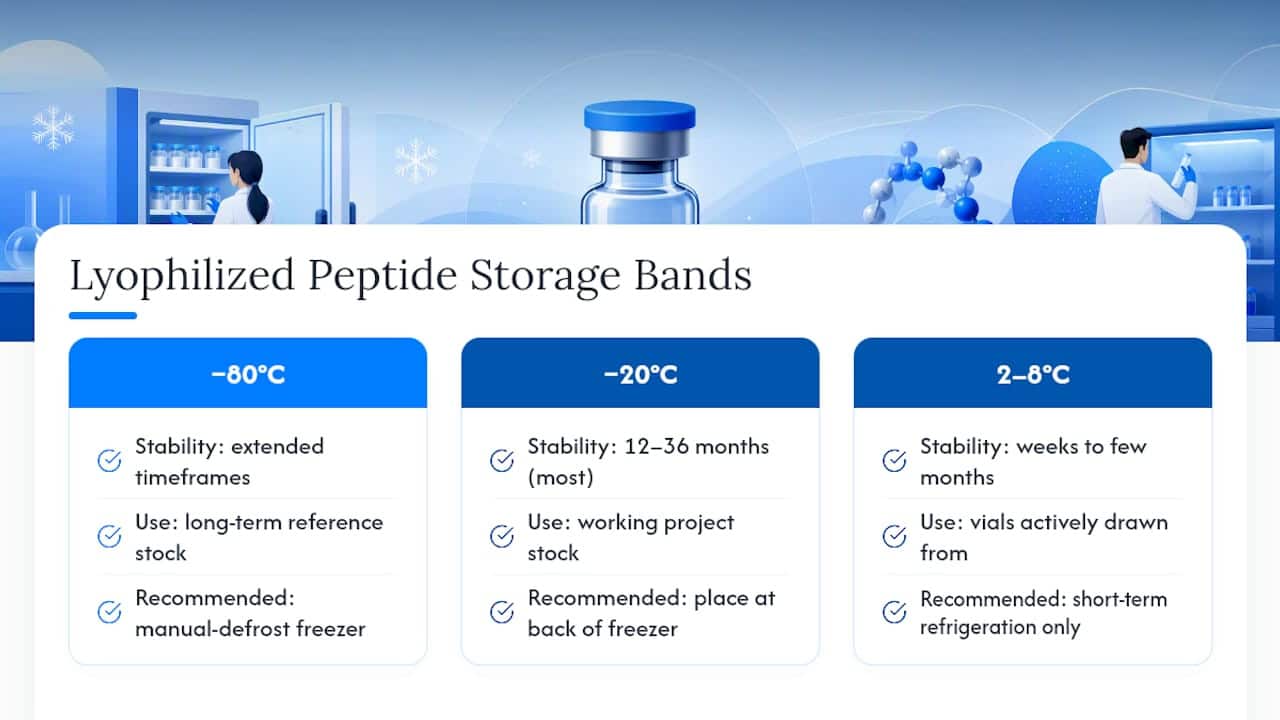
In practice, that translates to three usable temperature bands. At −80°C, most lyophilized peptides remain stable for extended timeframes, which makes it the right call for oxidation-prone sequences or material you want as a long-term reference stock. At −20°C, the standard freezer setpoint most labs actually have, you can expect 12 to 36 months or longer of stability for most peptides, which covers the working life of nearly every research project. At 2 to 8°C, refrigeration is appropriate only for shorter windows, weeks to a few months, and typically for vials you’re actively drawing from rather than long-term stock.
Room temperature belongs in exactly one place: transit. It is not a storage condition.
Freezer choice matters more than most researchers assume. Frost-free freezers cycle temperature to prevent ice buildup, and that cycling introduces small thermal excursions every single defrost cycle. Over months, those excursions add up. Where possible, use a manual-defrost freezer for peptide stock, or place vials at the back of a frost-free unit, away from the door and the defrost coil, ideally inside an insulated box that buffers against the temperature swing.
Moisture Control: Desiccants, Sealed Vials, and Headspace
Moisture, not heat, is the primary chemical threat to a lyophilized peptide. The dried cake is hygroscopic, meaning it pulls water vapor out of the air around it. That absorbed moisture (deliquescence, in the technical sense) lowers the glass transition temperature of the cake and reintroduces the exact molecular mobility that freezing was supposed to prevent. A peptide can be sitting in a −20°C freezer and still degrade faster than expected if the vial seal has failed or the cap was left loose after a partial opening.
Good moisture control comes down to a handful of concrete habits:
- Keep the peptide in its original vial and carton. Vendor packaging is chosen for a reason, and every unnecessary transfer to a new container is a chance to introduce ambient moisture.
- Store vials inside a sealed container or a small desiccator cabinet, not loose on a shelf.
- Add a silica gel packet or molecular sieve inside that outer container to absorb any stray humidity that gets in when you open it.
- For especially oxidation-sensitive or hygroscopic sequences, consider an inert-gas flush (nitrogen or argon) on the vial headspace before resealing.
- Avoid splitting a single lyophilized vial into multiple containers unless you have a real reason. Every transfer step is a moisture-exposure event.
Pro Tip: Keep a small tray of silica packets inside your peptide freezer box and swap them out every few months. Silica gel saturates quietly. You won’t see a visible sign until the peptide inside has already been degrading for weeks.
Protecting the Cake From Light and Physical Stress
Light exposure degrades peptides through a slower, easier-to-miss pathway than moisture: photo-oxidation. Amino acid residues like tryptophan, tyrosine, and methionine are particularly reactive under ultraviolet and even ambient light, and repeated exposure damages the peptide chain over time. This matters most for sequences rich in aromatic or sulfur-containing residues, but it’s cheap insurance to apply the rule broadly.
Vibration is the second overlooked stressor. Peptide storage next to a compressor, on a freezer door shelf, or anywhere subject to frequent motion can physically stress the lyophilized cake, contributing to fragmentation and increasing surface area exposed to air and moisture.
A few habits address both risks at once:
- Store vials in their original cardboard carton or an opaque secondary container rather than leaving them exposed under freezer lighting.
- Use amber vials or wrap clear vials in foil if you’ve had to repackage material.
- Position stock away from the compressor unit and away from door shelves, which see the most temperature and vibration cycling in any freezer.
- Handle vials gently during retrieval. Dropping or shaking a lyophilized cake can fracture it, which increases the surface area exposed to moisture the moment the vial is opened.
Thawing, Opening, and Aliquoting Without Damage
The single most common handling mistake in peptide labs is opening a cold vial straight out of the freezer. The temperature difference between the vial and the room causes ambient moisture to condense on the inside walls and on the lyophilized cake itself the instant you break the seal, and that moisture then drives the same degradation you spent months preventing with cold storage.
The fix is simple and takes almost no extra time:
- Remove the sealed vial from the freezer and let it sit, unopened, at room temperature for 10 to 30 minutes depending on vial size and packaging.
- Open only once the vial has fully equilibrated and any exterior condensation has evaporated.
- Aliquot immediately into single-use portions sized to your actual experiment needs, and label each with the peptide name, concentration, and date.
- Return unused lyophilized material to the freezer promptly rather than leaving it on the bench between steps.
Pro Tip: If you’re constantly reopening one master vial for small draws, you’re accumulating risk with every cycle. Aliquoting the dry peptide into smaller working vials up front costs a few minutes and saves you from repeated freeze-warm cycling on your entire stock.
Shipping and Transit: What’s Safe Outside the Freezer
Lyophilized peptide tolerates short ambient transit far better than most researchers expect. One to three days at room temperature during shipping is generally acceptable for the dry, lyophilized form, as long as it isn’t sitting in direct heat. That’s the whole reason vendors can ship lyophilized product without dry ice in most cases. Reconstituted peptide solutions are a different story entirely and need a maintained cold chain from the moment they’re mixed.
A few packaging and handling notes keep transit risk low:
- Use insulated shipping boxes with a cold pack for anything already in solution, and dry ice only when a carrier and packaging are rated for it.
- Avoid shipping lyophilized stock during heat waves or through carrier hubs known for hot, unconditioned storage.
- Label packages clearly so warehouse or mailroom staff don’t leave them on a loading dock in direct sun.
- Move product into proper cold storage the moment it arrives. Ambient tolerance during transit is not an invitation to leave it on a desk overnight.
Reviewing cold chain management fundamentals is worth the time if your lab regularly receives or ships temperature-sensitive biological material, since the same principles governing specimen handling apply directly to peptide solutions in transit.
Reconstitution: Solvent Choice and Short-Term Storage Windows
Reconstitution is where a peptide’s storage clock resets, and where the rules change completely. Bacteriostatic water is the standard solvent for most research applications because its preservative content extends usable solution life, typically supporting storage windows around 28 days under refrigeration. Sterile water without a preservative offers a much shorter usable window and is generally reserved for immediate, same-day use.
A reconstitution volume calculator takes the guesswork out of hitting a target concentration, which matters more than it sounds. Getting concentration wrong doesn’t just mess up your dosing math. It also means more of the peptide sits in solution longer than intended while you troubleshoot, adding avoidable degradation risk.
Practical reconstitution steps worth following every time:
- Reconstitute using slow, gentle addition of solvent down the vial wall, never a direct forceful stream onto the lyophilized cake.
- Swirl gently rather than shaking. Shaking can denature peptide structure at the air-liquid interface.
- Filter if your protocol calls for it, then aliquot the reconstituted solution into single-use portions immediately.
- Store reconstituted solution at 2 to 8°C, and track the reconstitution date on the label.
Pro Tip: Never freeze a reconstituted peptide solution. Ice crystal formation during freezing physically disrupts the peptide structure and drives aggregation, and that damage does not reverse when you thaw it again. If you need long-term storage, keep the material lyophilized and reconstitute only what you’ll use.
For a fuller walkthrough of solvent selection and post-reconstitution handling, the step-by-step reconstitution guide covers the process in more depth than a single section can.
Signs of Degradation and Quick QC Checks
A quick visual and functional check before every experiment catches most compromised vials before they cost you a run. Cake collapse, discoloration, liquefaction, or visible insoluble particulates after reconstitution are the clearest red flags, and an unusual odor, while rare, is worth noting too.
Run through this before using any vial you’re uncertain about:
- Inspect the vial for cake collapse, color change, or moisture beading on the interior glass.
- Reconstitute a small test volume and check for clarity and full dissolution rather than cloudiness or residue.
- Cross-check the lot number and receive date against your records and the Certificate of Analysis.
- If anything looks off, quarantine the vial, document what you observed, and contact the supplier before running it in a real experiment.
Practical Peptide Storage Checklist for Labs
Print this, tape it to the freezer, and move on with your day:
- Default to −20°C or colder for stock storage; use 2 to 8°C only for active, short-term vials.
- Keep peptides in original vials and cartons; avoid unnecessary transfers.
- Store with a desiccant in a sealed box or desiccator.
- Aliquot into single-use portions sized to your protocol.
- Always warm sealed vials to room temperature before opening.
- Never freeze a reconstituted solution, ever.
- Label every vial with lot number, receive date, and open date.
| Situation | Action |
|---|---|
| Vial arrives by mail | Inspect, log receive date, move to −20°C or colder immediately |
| About to open a frozen vial | Let it sit sealed at room temp for 10 to 30 minutes first |
| Reconstituted solution left over | Refrigerate at 2 to 8°C, never freeze, use within the labeled window |
| Vial shows collapse or discoloration | Quarantine, document, contact the supplier |
| Suspected transit heat exposure | Note it on the log, run a QC check before use |
Certificates of Analysis and Why Documentation Matters for Storage Decisions
Storage guidance only works if you know what you’re storing. That’s where a Certificate of Analysis (COA) earns its place in a lab’s decision process, not as paperwork, but as the baseline data that tells you how a specific lot was tested and what purity and identity it actually carries. Vendors typically assign conservative storage windows based on their own stability data, and following that lot-specific guidance beats defaulting to a generic rule whenever the two disagree.
Third-party batch testing and Certificates of Analysis, including endotoxin data, are published for peptides sold by vendors. For sensitive assay work, that endotoxin figure alone can determine whether a given lot is appropriate for your application. A deeper technical breakdown of how storage temperature affects both chemical stability and sterility is available on the peptide storage temperature guide, and researchers building out a full lab SOP can reference the laboratory standards and best practices resource for a more complete protocol. If a storage or handling question falls outside standard guidance, reaching out to a supplier’s support team directly beats guessing.
Container Material and Closure Integrity
The glass vial itself is part of your stability strategy, not just a container. Most lyophilized peptides ship in borosilicate glass vials with rubber stoppers under a crimped aluminum seal, and that combination exists because borosilicate resists the chemical leaching that can occur with lower-grade glass over long storage periods. The rubber stopper is the weak point to watch. Repeated piercing with a needle, or storing a partially used vial for extended periods, degrades the seal and creates a slow path for moisture ingress that undermines everything else you’re doing right.
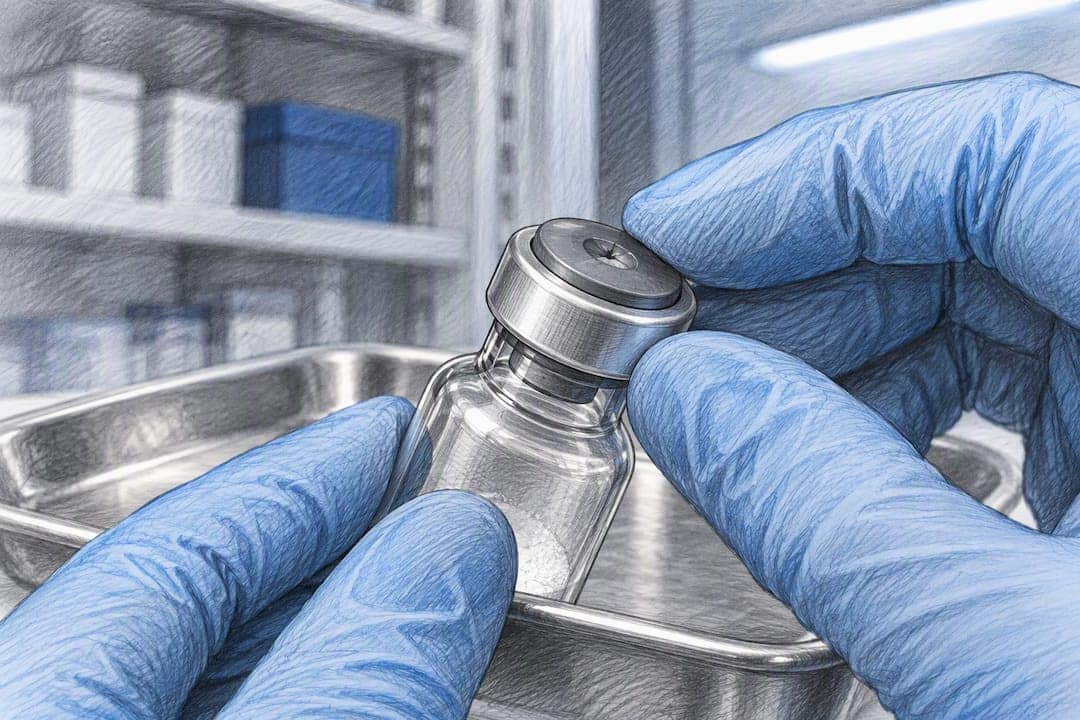
Closure integrity failures are often invisible until it’s too late. A stopper that looks intact can still have lost its seal at a microscopic level after several needle punctures, letting humid air creep in over weeks. If a vial has been accessed multiple times, treat it with more suspicion during your QC check, not less, since it carries more accumulated risk than a freshly opened one.
For labs repackaging material into secondary containers, glass remains the safer choice over most plastics. Certain plastics are gas-permeable at a level that matters over months of storage, allowing slow moisture exchange even when a cap appears tightly sealed. If a secondary container is unavoidable, choose glass with a tight-sealing lid, and never store lyophilized peptide long-term in a container that wasn’t purpose-built for it. The extra step of checking that a cap seats fully and evenly, rather than just glancing at whether it’s “closed,” catches a surprising number of near-miss storage failures before they become real ones.
Long-Term Storage Beyond the Typical Shelf-Life Window
Vendor shelf-life figures are conservative by design, built to cover the range of storage conditions a peptide might realistically encounter in transit and in an average lab freezer. That doesn’t mean a peptide stored at −80°C under ideal conditions suddenly stops being usable the day after its labeled window closes. It means the data supporting extended use past that point gets thinner, and the decision to keep using older stock shifts from “follow the label” to “verify before you trust it.”
If you’re holding lyophilized material well past its assigned shelf life, the QC checks already covered (visual inspection, a small-scale reconstitution and clarity test, cross-referencing the original COA) become mandatory rather than optional. Running a side-by-side comparison against a freshly sourced lot, when the experiment allows for it, is the most reliable way to catch subtle potency loss that a visual check alone would miss.
Peptides stored at −80°C generally hold up better over extended timeframes than those at −20°C, simply because there’s less residual molecular mobility at the lower temperature. But no amount of cold compensates for a compromised seal or accumulated moisture exposure from repeated access. A ten-year-old vial that has never been opened and was stored at −80°C in original packaging is a fundamentally different bet than a two-year-old vial that’s been punctured a dozen times. Age alone is a poor predictor of usability. Handling history matters just as much, sometimes more.
Does Peptide Sequence Change Storage Requirements?
Not every peptide degrades the same way, and sequence composition drives real differences in how cautious you need to be. Peptides containing methionine, tryptophan, or cysteine residues are more prone to oxidative degradation, which pushes the recommendation toward stricter light protection and, in some cases, an inert-gas headspace flush rather than standard sealed storage.
Modified peptides, including those with PEGylation, acetylation, or amidated termini, often carry different stability profiles than their unmodified counterparts. Some modifications improve stability by protecting against enzymatic or chemical attack. Others introduce new vulnerabilities, particularly around the modification site itself, which can be more reactive under heat or light than the rest of the chain. There’s no universal rule that covers every modified peptide equally, which is exactly why lot-specific vendor guidance matters more for these sequences than for a simple, unmodified linear peptide.
Larger, more complex peptides and those with multiple disulfide bonds also tend to be more sensitive to physical handling, since disulfide bonds can scramble or reform incorrectly if the cake is stressed mechanically or exposed to fluctuating humidity. When in doubt about a specific sequence’s sensitivities, the safest default is to apply the stricter end of standard guidance: −20°C or colder, full light protection, and minimal handling, until supplier documentation says otherwise.
Monitoring and Logging Storage Conditions
A freezer that “seems fine” isn’t the same as a freezer with a documented temperature record, and the difference matters the moment you need to explain an unexpected result. A simple continuous temperature logger, the kind widely used across lab cold storage, catches the compressor failure or door-left-open incident that a daily glance would miss entirely.
At minimum, a peptide storage log should capture the freezer or refrigerator temperature at a regular interval, the date each vial was received, the date it was first opened, and any incident where a vial was removed from proper storage for an extended period, intentionally or not. This doesn’t need to be complicated. A shared spreadsheet with a column for each of these fields, updated at intake and at first use, covers most lab needs without adding meaningful overhead to the workflow.
The real payoff shows up when something goes wrong. If a result looks off partway through a project, a storage log lets you rule peptide degradation in or out quickly, instead of guessing. Labs that skip this step often end up troubleshooting an experiment for days before someone finally checks whether the freezer had a temperature excursion three weeks earlier.
Microbial Contamination Risk During Storage
Dry lyophilized peptide carries very low microbial risk on its own. There’s simply not enough moisture present to support microbial growth in a properly sealed, intact vial. The risk profile changes entirely the moment a peptide is reconstituted into an aqueous solution, particularly if that solution is drawn from repeatedly with a needle over a period of days or weeks.
Bacteriostatic water helps manage this risk because its preservative content (typically benzyl alcohol) actively suppresses microbial growth during that multi-week window, which is part of why it’s the standard reconstitution solvent for solutions intended for repeated draws. Sterile water without a preservative offers no such protection, and a solution reconstituted with it should be treated as usable for a single session, not stored for later draws.
Aseptic technique during every draw matters more than most researchers treat it. Swabbing the stopper with an alcohol wipe before each needle insertion, using a fresh sterile needle every time rather than reusing one, and minimizing how long a vial sits at room temperature during active use all reduce the chance of introducing contamination through repeated access. A solution that smells off, looks cloudy, or shows any particulate matter that wasn’t there at reconstitution should be discarded rather than used, regardless of how much material remains.
Where the Rules Bend in a Real Lab
Freezer space is finite, and every lab eventually runs a mix of −80°C reference stock, −20°C working supply, and a fridge full of active reconstituted vials, because that’s simply how research budgets and bench space work. The fix isn’t more freezer capacity. It’s tighter aliquoting discipline, so a limited −20°C shelf holds single-use portions instead of one master vial getting reopened forty times a semester.
Edge cases (an unusual sequence, an oddly long transit delay, a vial that looks slightly off) deserve a direct check against supplier documentation or a quick message to support rather than a guess based on general rules.
— Data Peptides
Get Verified Lab-Grade Peptides With Documentation Included
Storage discipline only protects a peptide that was high purity to begin with. Data Peptides supplies lab-grade research peptides backed by third-party batch testing, with Certificates of Analysis and endotoxin data provided for every lot, so you know exactly what arrived in that vial before it ever reaches your freezer. Orders ship quickly and discreetly from US facilities, with support teams available for storage, handling, or documentation questions related to your project.
Browse the current lineup, including options for weight loss and recovery-focused research, in the Data Peptides shop, and pull the COA for your lot before you finalize your storage plan.
Sources
- Peptide Storage and Handling Guidelines — GenScript
- Peptide storage guide — Peptide Protocol Wiki
- Peptide storage notes — NIBSC
FAQ
How Should I Store Lyophilized Peptides?
Keep sealed vials at −20°C or colder for long-term stability, in original packaging, protected from light, with a desiccant if possible. Reserve 2 to 8°C refrigeration for vials in active short-term use, and never leave lyophilized peptide at room temperature outside of brief transit.
Can I Store Lyophilized Peptides in the Fridge?
Yes, but only for a limited window. Refrigeration at 2 to 8°C is appropriate for weeks to a few months, while −20°C or colder remains the better choice for anything you’re holding longer term.
Do Reconstituted Peptides Need to Be Refrigerated?
Yes, always. Once reconstituted, a peptide solution needs refrigeration at 2 to 8°C and should never be frozen, since ice crystal formation damages the peptide structure and causes aggregation that doesn’t reverse.
How Long Does a Lyophilized Peptide Last?
Most lyophilized peptides remain stable for 12 to 36 months or longer at −20°C, with multi-year stability achievable at −80°C. Exact shelf life depends on the sequence and the Certificate of Analysis for that specific lot, so vendor-specific guidance should take priority over general rules whenever it’s available.