

FDA peptides policy has not legalized wider compounding access, no matter what recent headlines imply. The Pharmacy Compounding Advisory Committee’s July 2026 votes are advisory only, and formal rulemaking or explicit FDA interim action still has to happen before compounding pharmacies gain new legal authority. Until that happens, treat every peptide outside an approved drug label as unauthorized for clinical use, keep it documented as research-use-only, and hold your suppliers to the same paperwork standard the FDA itself is now demanding.
TL;DR:
- The July 2026 PCAC vote recommended certain peptides for compounding but remains only advisory with no current legal authority change.
- Peptides market claims trigger drug requirements under Section 505, regardless of how or where they are sourced or sold.
- The FDA now requires stricter characterization, impurity testing, and immunogenicity assessment for generic peptide applications, making compliance more demanding.
- A peptide becomes eligible for the Section 503A bulks list only after a multi-step process including nomination, review, FDA assessment, and formal rulemaking that takes over a year.
- Current enforcement focuses on safety risks like immune reactions and labeling claims, urging suppliers and compounders to tighten documentation and testing practices immediately.
Table of Contents
- What the July 2026 PCAC Meeting That Actually Changed
- Section 505, ANDA Pathways, and the New Peptide Guidances
- How a Peptide Actually Gets Onto the 503A Bulks List
- Where FDA’s Safety and Enforcement Attention Is Focused
- A Compliance Checklist While the Rules Are Still Moving
- What This Policy Inflection Actually Signals
- Research-Grade Peptides for Labs Tracking This Policy Shift
- Primary Sources Worth Bookmarking
- Sources
- FAQ
What the July 2026 PCAC Meeting That Actually Changed
The Pharmacy Compounding Advisory Committee met on July 23 and 24, 2026, and voted to recommend that compounding pharmacies be allowed to formulate several peptide substances, rejecting one of them. The PCAC meeting record lists substances that have circulated widely in wellness and longevity circles, including compounds in the same category as:
- BPC-157
- TB-500
- MOTS-c
- Semax
- Epitalon
That vote does not put any of these substances on the Section 503A bulks list. PCAC recommendations are advisory, and FDA staff reviewers frequently disagree with the committee on identity, efficacy, and impurity grounds, according to legal analysis from ArentFox Schiff. The FDA retains full discretion over whether, and how, to act on the recommendation.
Two interim paths exist in theory: the agency could grant an interim Category 1 listing, or it could simply exercise enforcement discretion while formal rulemaking proceeds. Neither is guaranteed, and both carry legal exposure for anyone who treats them as settled before the FDA says so. CNN’s coverage of the vote noted the substances remain in regulatory limbo pending further agency action, a point worth repeating to anyone assuming the vote itself changed the law.
Section 505, ANDA Pathways, and the New Peptide Guidances
A peptide becomes a drug under Section 505 of the FD&C Act the moment it’s marketed with a medical claim, regardless of how it’s sourced or sold. At that point it needs an approved New Drug Application, an Abbreviated New Drug Application, or, where applicable, a biologics license. There is no gray zone based on dosage form or “research” labeling once a marketing claim crosses that line.
On July 28, 2026, the FDA published revised draft product-specific guidances covering generic peptide products. The agency issued multiple guidances that raise the bar for what counts as adequate characterization:
- Tighter impurity thresholds for generic peptide applications
- Higher-order structure assessment requirements, not just primary sequence confirmation
- Innate immune response testing to catch reactions standard purity assays miss
- Clearer pathways intended to facilitate ANDA filings once the science is nailed down
Fact: FDA’s companion Clinical Pharmacology Considerations for Peptide Drug Products guidance defines peptides, for guidance purposes, as polymers of 40 or fewer amino acids, and it lays out expectations for immunogenicity risk assessment, QTc evaluation, and drug interaction testing.
For sponsors and generic applicants, the message is unambiguous: cGMP manufacturing, lot-to-lot consistency data, and immunogenicity testing are no longer optional line items. They are now baseline expectations the FDA has put in writing.
How a Peptide Actually Gets Onto the 503A Bulks List
Getting a bulk substance approved for compounding is a multi-step legal process, not a single vote. Here’s how it actually works:
- Nomination. Any interested party, often a compounding pharmacy trade group or manufacturer, submits a substance for PCAC review, along with available safety and efficacy data.
- PCAC evaluation. The committee reviews identity, characterization, and clinical evidence, then votes on whether to recommend inclusion on the Section 503A bulks list.
- FDA staff assessment. FDA scientists conduct their own independent review, which can and does diverge from the committee’s conclusions, particularly on impurity and efficacy questions.
- Notice-and-comment rulemaking. Only formal rulemaking, published in the Federal Register with a public comment period, can actually amend the bulks list. This step is where most of the delay lives.
A favorable PCAC vote is a strong political signal, but it’s step two of four. Rulemaking of this kind routinely runs past a year, and the FDA can choose not to act at all. Interim enforcement discretion remains possible but rare, and betting a compounding business model on it is a legal gamble few attorneys would recommend.
Where FDA’s Safety and Enforcement Attention Is Focused
Immunogenicity is the recurring theme across every recent FDA peptide document, and for good reason. Injectable peptides with impurities, aggregates, or inconsistent higher-order structure carry meaningfully higher risk of triggering an immune response than a well-characterized small molecule. That’s precisely why the clinical pharmacology guidance recommends multi-tiered immunogenicity assays rather than a single pass/fail test.
Identity and impurity characterization sits right behind immunogenicity as an FDA staff concern. Host-cell proteins, residual solvents, endotoxins, and aggregate content all factor into whether a peptide behaves the way its label claims.
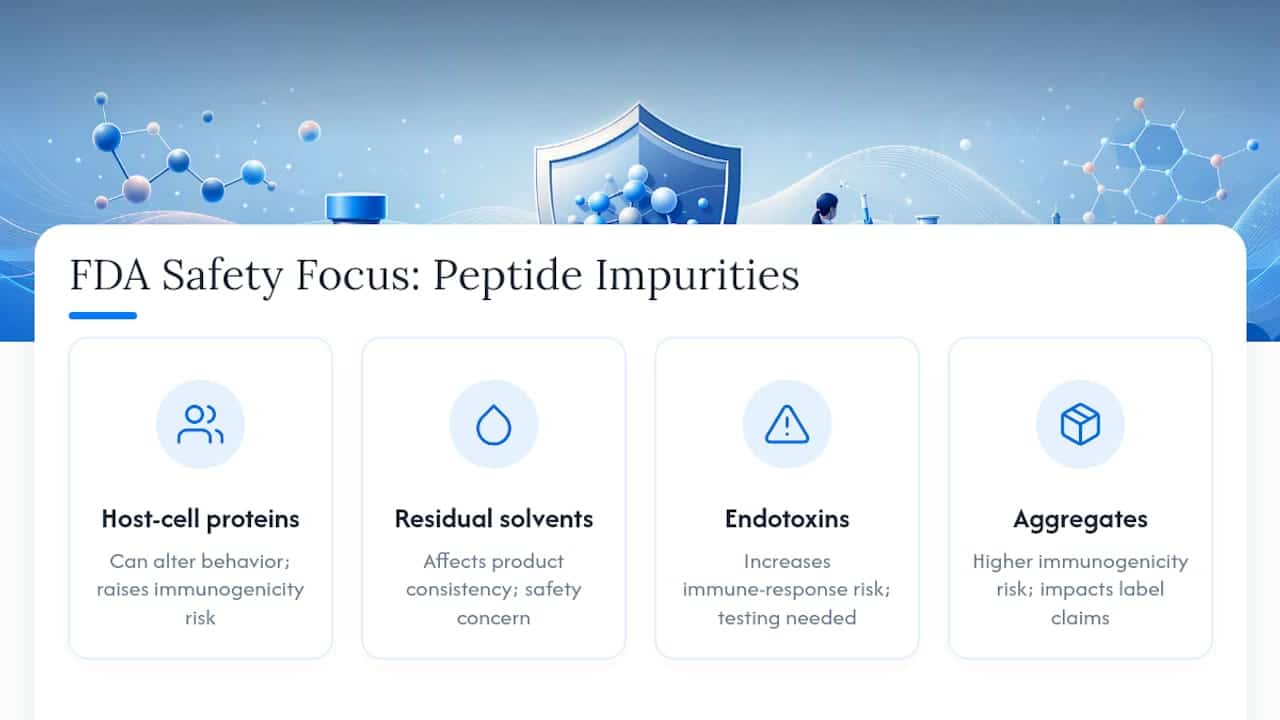
Pro Tip: Don’t assume a Certificate of Analysis that confirms mass and sequence also confirms safety. Ask your supplier specifically whether their testing covers endotoxins and higher-order structure, not just identity.
Enforcement isn’t waiting for rulemaking to catch up; understanding red light therapy side effects offers a useful parallel on how wellness modalities face regulatory scrutiny. The FDA has issued warning letters against compounders and telehealth platforms over marketing language that creates a misleading “net impression” under Section 502(a), a standard that applies whether or not the underlying product is later authorized. AP News reported that enforcement actions specifically target claims implying FDA approval where none exists. Labeling and adverse-event reporting expectations apply regardless of a product’s compounding status.
A Compliance Checklist While the Rules Are Still Moving
Regulatory teams don’t have to wait for rulemaking to finish before tightening their own house. Work through these now:
- Verify documentation. Confirm every Certificate of Analysis matches lot numbers, and keep independent impurity testing on file rather than relying solely on supplier claims.
- Maintain traceability. Document chain of custody from supplier to bench, including research-use-only labeling at every handoff.
- Track the rulemaking. Monitor Federal Register dockets tied to the FDA’s product-specific guidances and submit comments where your organization has standing to weigh in.
- Build the science early. Design immunogenicity and impurity assays now, aligned with the clinical pharmacology guidance, rather than scrambling once a review division asks for them.
- Audit your language. Scrub promotional and procurement copy for anything implying approval or clinical suitability, and stand up an adverse-event reporting workflow before you need one.
Pro Tip: If your organization is large enough to have regulatory affairs staff, request an early FDA meeting rather than guessing at expectations from guidance documents alone. It’s a formal option, and it’s underused.
Learn more about research-use-only labeling requirements and how to document it properly across your supply chain.
What This Policy Inflection Actually Signals
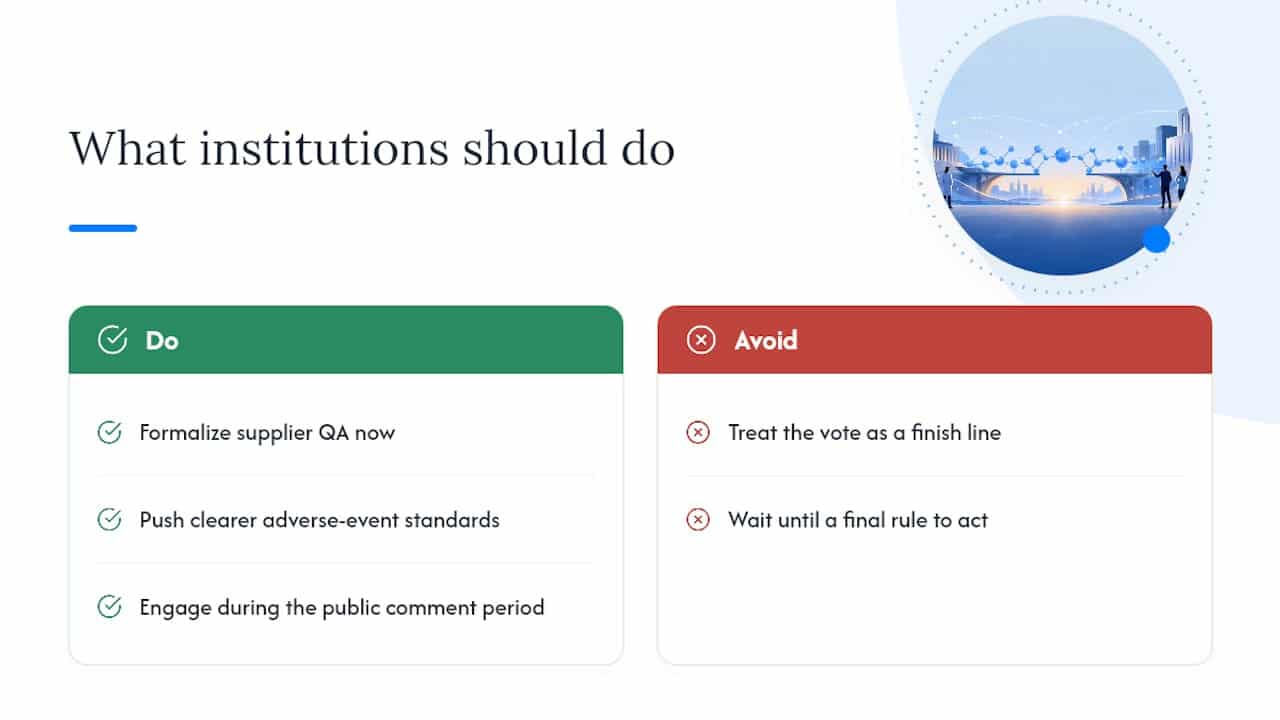
The PCAC vote is a genuine inflection point, but calling it “legalization” overstates what happened. FDA staff pushed back hard on several of these substances over identity and efficacy gaps, and that friction doesn’t disappear because a committee voted a certain way. Advocacy groups celebrating the vote as a finish line are setting up their members for a rude surprise when rulemaking drags into 2027 or beyond.
The smarter move for institutions is to use this window, not wait it out. Formalize supplier QA now, push for clearer adverse-event collection standards, and engage directly during any comment period rather than reacting after a final rule drops. Quality infrastructure built today doesn’t become wasted effort if the rules shift again. It becomes the baseline everyone else has to catch up to.
— Data Peptides
Research-Grade Peptides for Labs Tracking This Policy Shift
If your work depends on consistent, well-characterized material while this regulatory picture keeps moving, sourcing matters more than ever. Data Peptides supplies lab-grade research peptides with third-party batch testing and a Certificate of Analysis for every lot, with support available around the clock. Every product is positioned strictly for laboratory research use, not clinical administration.
For teams that need documented, traceable material for immunogenicity or impurity assay work, the Data Peptides shop is a straightforward starting point. Browse current lots, review the available documentation, and place an order backed by the testing paperwork your protocols already require.
Primary Sources Worth Bookmarking
Skip the secondhand summaries and go straight to the source material shaping this policy. Start with FDA’s revised product-specific guidances and Clinical Pharmacology Considerations guidance, then read the PCAC meeting record and ArentFox Schiff’s legal breakdown of what happens next.
This article is general information, not a substitute for advice from a qualified doctor. Consult a qualified healthcare professional about your own circumstances before acting on anything here.
Sources
- FDA publishes revised draft product-specific guidances for certain generic peptide products
- Pharmacy Compounding Advisory Committee meeting — July 23–24, 2026
- Clinical Pharmacology Considerations for Peptide Drug Products (FDA guidance)
- The (Pep)Tides Turn: FDA Panel Recommends Six of Seven for Compounding | ArentFox Schiff
FAQ
Are Peptides FDA Approved?
Only a small number of therapeutic peptides, such as semaglutide, have gone through full FDA approval with clinical trials and cGMP manufacturing controls. Most peptides sold through compounding or research-chemical channels remain unapproved, regardless of any PCAC recommendation.
Are Peptides Legal in the US for Research Use?
Peptides sold and labeled strictly for laboratory research use are legal to purchase and handle under that designation, but they are not legal for human or animal treatment unless FDA-approved. Selling or marketing a research peptide with a medical claim triggers Section 505 drug requirements. Learn more about research-use-only compliance and what documentation to keep.
Did the July 2026 PCAC Vote Legalize Peptide Compounding?
No. The committee’s vote recommended six substances for the Section 503A bulks list, but PCAC votes are advisory. Formal notice-and-comment rulemaking, which can take well over a year, is still required before compounding pharmacies gain legal authority to formulate them.
What Does FDA’s Clinical Pharmacology Guidance Require for Peptide Products?
The guidance calls for immunogenicity risk assessment, QTc evaluation, and drug interaction testing for peptide drug products, generally defined as 40 or fewer amino acids. It applies to both new peptide drug applications and generic peptide submissions.
Does Data Peptides Sell FDA-Approved Peptides?
Data Peptides sells lab-grade peptides positioned strictly for research use, not as FDA-approved clinical products. Every product ships with third-party batch testing and a Certificate of Analysis, and current pricing is available directly on the shop page.