

For researchers, “anti aging peptides” means research‑use‑only, lab‑grade peptides used to study cellular and molecular aging pathways, not a skincare ingredient. The single procurement rule that matters most: never accept a lot without a batch‑specific third‑party Certificate of Analysis showing a raw HPLC chromatogram and mass spec identity. Store the lyophilized material at or below −20°C, and aliquot immediately after reconstitution to avoid freeze‑thaw losses.
TL;DR:
- Always verify that a peptide’s COA includes a raw chromatogram, mass spectrum, and method details to confirm its identity and purity.
- Store lyophilized peptides at −20°C for up to two years and aliquot immediately after reconstitution to minimize degradation and chemical changes.
- For quantitative assays, select high-purity, isotope-labeled peptides with purity above 99% and confirm lot authenticity through direct lab verification.
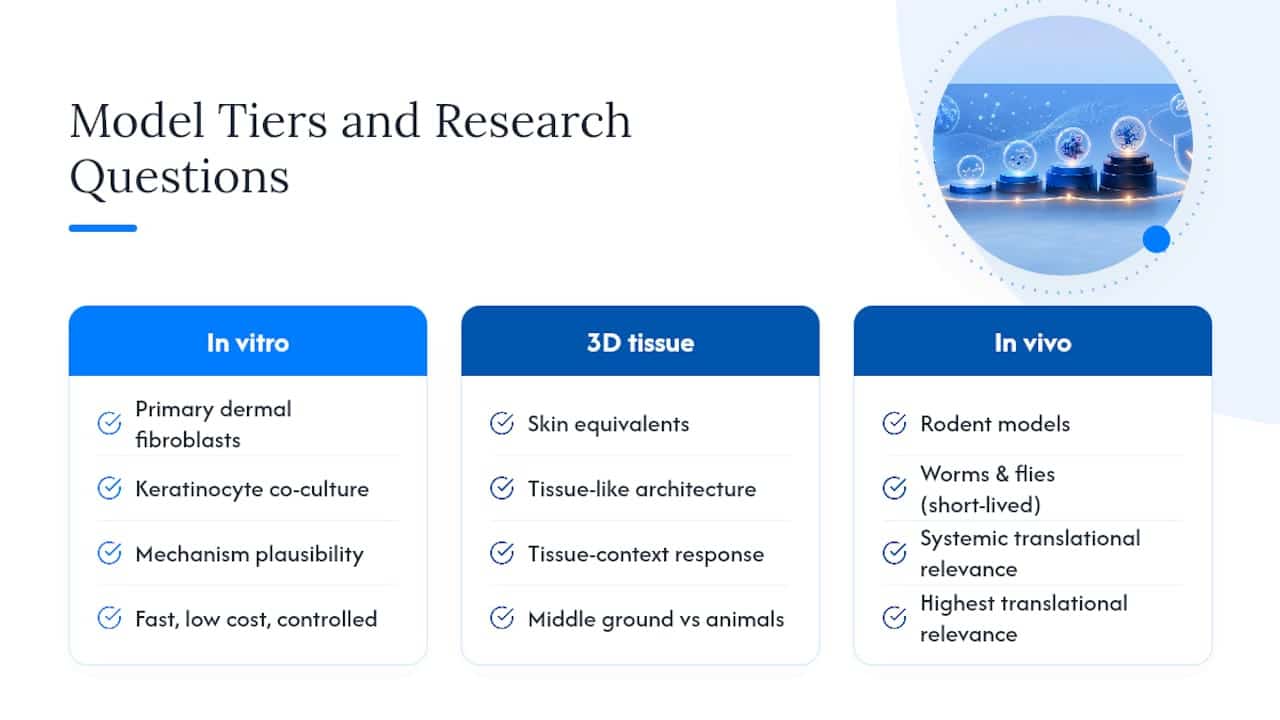
- Use in vitro models such as fibroblast cultures and 3D skin equivalents, along with rodent and short-lived organisms, to analyze different aging mechanisms and tissue responses.
- Ensure peptides are sourced with batch-specific third-party testing, and verify certificates quickly by matching lot numbers, checking for chromatograms, and contacting the issuing lab if needed.
Table of Contents
- What Are Anti Aging Peptides Used for in Research?
- What Quality Attributes Should a Peptide COA Show?
- How Should You Store and Reconstitute These Peptides?
- Which Purity Tier Fits Your Anti-Aging Experiment?
- How Do You Verify a COA Before You Trust the Lot?
- What Documentation Does Data Peptides Provide?
- What Mechanisms Do Anti Aging Peptides Typically Target?
- What Biological Targets and Pathways Matter Most?
- What Models Are Used to Study These Peptides?
- What Safety Considerations Apply in a Research Setting?
- How Should You Design an Anti-Aging Peptide Study?
- What Are the Current Limits of This Research?
- Where Careful Procurement Beats Careful Analysis
- Where to Find Research-Grade Anti-Aging Peptides
- Sources
- FAQ
What Are Anti Aging Peptides Used for in Research?
In a laboratory context, anti aging peptides are short chains of amino acids sold strictly for research use only (RUO), intended for benchtop investigation of senescence, collagen turnover, mitochondrial function, and related aging biology. They are not formulated, dosed, or labeled for human or animal consumption, and any vendor implying otherwise is outside the scope researchers should be buying from.
The experimental roles are fairly consistent across labs working on aging biology:
- In vitro dosing of fibroblast, keratinocyte, or myoblast cultures to observe changes in gene expression or protein output.
- Target validation, where a peptide is used to confirm a receptor or signaling node identified in earlier screening work.
- Spike-in controls added to biological matrices to test assay recovery and matrix effects.
- Comparative screening, running several peptide candidates side by side to rank potency or selectivity.
Purity requirements shift depending on which of these you’re running. A rough screening assay tolerates more chromatographic noise than a quantitative binding study that depends on knowing the exact peptide mass delivered to each well. That distinction drives almost every sourcing decision that follows.
What Quality Attributes Should a Peptide COA Show?
A Certificate of Analysis is only useful if it lets you independently confirm what’s in the vial, not just take the seller’s word for it. A valid COA should name the issuing laboratory, match the lot number printed on the vial, and include both the integrated HPLC chromatogram and the mass spectrum, along with the method parameters used to generate them. A COA missing the raw chromatogram, showing only a summary purity number, is not verifiable and should be treated as incomplete.
Five things to check before you trust a lot:
- Issuing lab identity and contact information. A COA with no traceable lab behind it is not third-party verification, it’s a printed claim.
- HPLC area percent versus absolute peptide content. A peptide reported at high HPLC purity can still contain substantially less actual peptide mass once residual TFA, moisture, and salts are accounted for, because chromatographic purity measures the ratio of peaks, not the dry mass of peptide in the vial.
- Salt or counterion form. TFA, acetate, and HCl salts all carry different residual mass, and TFA in particular can interfere with certain cell-based assays at higher concentrations.
- Endotoxin data, especially for any culture work where LAL or recombinant factor C (rFC) values above your assay’s tolerance will confound results.
- Method parameters, including the HPLC column and detection wavelength, since a purity percentage reported without those details cannot be compared against another lab’s number.
Pro Tip: Isotopic purity above 99% with a mass delta of 6 to 20 Da between labeled and unlabeled peptide is the standard guidance for isotope-labeled internal standards in quantitative mass spec assays, well worth the added cost if your endpoint is absolute concentration rather than relative comparison.
How Should You Store and Reconstitute These Peptides?
Storage failures ruin more experiments than bad peptide synthesis ever does. Lyophilized peptides held at −20°C typically remain stable for 24 to 48 months, while −80°C storage functions as an archival condition for material you won’t touch for years. Reconstituted solutions are a different story entirely: shelf life drops from months to days or weeks depending on the sequence, and repeated freeze‑thaw cycling degrades peptide integrity fast. Data Peptides’ own storage temperature guidance covers the chemical stability tradeoffs in more depth if you’re setting up a new freezer protocol.
Reconstitution is sequence-dependent, so a one-size-fits-all solvent choice is a mistake:
- Start with sterile water or a dilute acetic acid solution for most standard peptides.
- Move to an organic solvent like DMSO only when the peptide’s hydrophobicity or sequence composition demands it, and confirm compatibility with your downstream assay.
- Use brief sonication to help dissolve peptides that resist going into solution on the first attempt.
- Choose low-adsorption vials, since some peptides bind measurably to standard plastic surfaces, skewing concentration readings if you don’t account for it.
Aliquot immediately after reconstitution rather than pulling from one working stock repeatedly. Sequences containing methionine, cysteine, tryptophan, or asparagine and glutamine residues are especially prone to oxidation, disulfide scrambling, or deamidation, so treat those lots with extra caution around light and temperature exposure.
Which Purity Tier Fits Your Anti-Aging Experiment?
Not every experiment needs the same grade of peptide, and buying top-tier material for a rough screening run just burns budget you’ll need later for the assay that actually requires it. Three tiers cover most anti-aging research work:
- Tier 1, quantitative assays. These need isotope-labeled internal standards, high chromatographic purity, and often amino acid analysis (AAA) to pin down absolute concentration. Ideal reference standards for this tier avoid residues like tryptophan, methionine, cysteine, serine, and threonine that degrade during acid hydrolysis, and run 12 to 18 residues long for reliable AAA, with a tyrosine included where UV quantification helps.
- Tier 2, target validation and dose-response. Standard research-grade purity (commonly above 95% by HPLC) is usually sufficient, paired with a solid COA and confirmed identity by mass spec.
- Tier 3, exploratory screening. Crude or lower-purity material can work here, provided you’re comparing relative trends rather than reporting absolute values.
Isotope standards deserve a specific note: reserve them for work where you’re reporting a concentration number, not a fold-change. Tiering procurement this way keeps quantitative rigor where it’s needed without paying for it on every screening plate.
Vial fill size, minimum order quantities, and lot-to-lot comparability all matter more than researchers tend to expect going in. If your study spans multiple runs over several months, buying enough of a single lot upfront avoids introducing a lot-to-lot variable you’ll have to control for statistically later. Whatever tier you land on, plan for on-receipt verification before the peptide goes anywhere near your assay.
How Do You Verify a COA Before You Trust the Lot?
Four checks take less than ten minutes and catch most problems before they reach your bench:
- Confirm the issuing lab’s identity and that it’s a real, contactable third-party facility.
- Match the lot number on the COA against the number printed on the vial itself.
- Look for the actual raw chromatogram and mass spectrum attached, not just a summary purity line.
- Verify method parameters (column, wavelength, gradient) are stated, since purity without method context isn’t comparable to anything.
Contacting the issuing lab directly to confirm a report number is a fast way to catch fabricated or mismatched certificates before you spend money on independent retesting. If a COA fails any of these four checks, or if a basic on-receipt RP-HPLC run in your own lab produces a retention time or peak shape that doesn’t match the certificate, that’s a legitimate reason to send a blind, coded sample to an independent lab for HPLC and LC-MS confirmation. Red flags worth escalating include mismatched lot numbers, purity figures with no stated method, and chromatograms that look re-used across different product listings.
What Documentation Does Data Peptides Provide?
Suppliers typically provide lab-grade peptides across various research categories, often backed by batch-specific third-party testing and Certificates of Analysis documenting purity and identity. Every lot ships with the documentation researchers need to reproduce results across studies, not just a marketing claim of quality.
That documentation practice ties directly back to the checklist above. A COA is only as useful as what it discloses, and the endotoxin data, purity figures, and identity confirmation Data Peptides provides per lot exist so you can run the four verification checks yourself instead of taking anything on faith. Fast, discreet shipping and timely customer support are important practical considerations for research peptide procurement.
If you need a lot-specific COA that isn’t posted, or want to confirm assay fit for a particular purity tier, it is recommended to contact the supplier’s support channel before placing an order rather than after a batch arrives.
What Mechanisms Do Anti Aging Peptides Typically Target?
Most anti-aging peptides under active study work through a handful of recurring mechanisms rather than one universal pathway. Some act as signaling fragments that stimulate fibroblasts to increase collagen and elastin synthesis, which is why they show up so often in skin aging and elasticity research. Others function as enzyme inhibitors, blocking matrix metalloproteinases (MMPs) that break down existing collagen, effectively slowing degradation rather than boosting production.
A separate category works at the mitochondrial or cellular energy level, influencing markers tied to oxidative stress and cellular senescence. Peptides in this group are frequently studied for their effect on senescence-associated secretory phenotype (SASP) markers, the inflammatory signals aging cells release that accelerate tissue-level decline nearby. A third mechanism class involves growth factor mimicry or modulation, where a peptide sequence resembles part of a natural growth factor closely enough to trigger or dampen the same receptor signaling.
None of these mechanisms operate in isolation in a living system, which is exactly why in vitro work isolating one pathway at a time matters so much. A peptide that boosts collagen gene expression in a fibroblast assay may also carry off-target effects on inflammatory signaling that only show up once you widen the assay panel. Designing studies that separate these effects, rather than assuming a single clean mechanism, is where a lot of aging-biology research adds real value over marketing-driven claims about any single peptide.
What Biological Targets and Pathways Matter Most?
Aging research keeps returning to a similar set of molecular targets, regardless of which specific peptide is under study. Collagen types I and III synthesis pathways sit at the center of most skin and connective tissue work, alongside elastin production and the fibroblast signaling that drives both.
The mTOR and AMPK pathways, both central to cellular metabolism and autophagy regulation, come up constantly in longevity-focused peptide research, since deregulated nutrient sensing is one of the more consistently reproduced hallmarks of cellular aging. Sirtuin activity, particularly SIRT1, is another frequent target, tied to DNA repair and mitochondrial function. On the inflammatory side, NF-kB signaling and the broader SASP profile show up as targets because chronic low-grade inflammation, sometimes called inflammaging, is one of the more robust correlates of tissue aging across model systems.
Telomere-related pathways and markers of cellular senescence, including p16 and p21 expression, round out the list for labs studying replicative aging specifically. None of these targets are exclusive to one peptide class, and a well-designed study usually picks two or three related pathways to profile together rather than chasing every marker at once. Panel design matters more here than peptide selection alone, since a peptide that meaningfully shifts one pathway can look inert if you’re only measuring a marker three steps removed from where it actually acts.
What Models Are Used to Study These Peptides?
In vitro work dominates early-stage anti-aging peptide research, largely because it’s faster, cheaper, and easier to control than animal work. Primary human dermal fibroblast cultures are the most common cell model for collagen and elastin studies, often paired with keratinocyte co-culture setups when the research question involves skin barrier function alongside dermal aging. Senescence-induced cell models, typically generated through replicative exhaustion or oxidative stress exposure, let researchers test whether a peptide shifts senescence markers in a controlled, reproducible way.
Three-dimensional skin equivalent models have become more common as a middle ground between flat 2D cell culture and full animal studies, offering a tissue-like architecture without the cost and ethical overhead of in vivo work. For mitochondrial and metabolic pathway research, immortalized cell lines with reporter constructs let labs track pathway activation in real time across dose-response curves.
In vivo models remain the gold standard for translational relevance, most commonly rodent models used to study systemic markers of aging, skin thickness, and wound healing rates. Naturally short-lived model organisms, including certain nematode and fly models, give researchers a faster read on lifespan and healthspan effects than a multi-year rodent study allows. Each model tier answers a different question: cell culture tells you if a mechanism is plausible, 3D tissue models test it in a more realistic context, and animal models tell you whether it holds up systemically. Skipping straight to conclusions from a single cell-based assay is one of the more common overreach errors in this field.
What Safety Considerations Apply in a Research Setting?
Research-use-only peptides carry a different risk profile than consumer products, but that doesn’t mean lab safety is optional. Endotoxin contamination is the most consistent practical concern, since even trace bacterial endotoxin can confound cell culture results by triggering inflammatory signaling unrelated to the peptide itself. This is exactly why LAL or rFC endotoxin data on a COA isn’t a nice-to-have for cell-based work, it’s a control variable.
Peptide handling also carries standard lab chemical safety considerations. Dry peptide powder can become airborne during weighing, and repeated exposure to certain peptide classes has been associated with sensitization in lab personnel, so weighing under appropriate ventilation and using personal protective equipment matters regardless of how benign the peptide seems. Solvents used in reconstitution, particularly DMSO, carry their own handling precautions since DMSO is an efficient skin penetrant that can carry dissolved compounds through gloves not rated for it.

On the experimental side, off-target effects are a real concern precisely because many anti-aging peptides act on pathways, like mTOR or NF-kB signaling, that touch far more cellular processes than the one under study. A peptide that looks clean in one assay can produce confounding effects in a broader panel. None of this changes the RUO framing, but it does mean documentation, PPE, and proper disposal protocols for peptide waste and solvents belong in every experimental plan from the start.
How Should You Design an Anti-Aging Peptide Study?
Study design mistakes in this field tend to cluster around a few recurring gaps rather than a wide scatter of different errors. Dose-response curves are the first place to get specific: running a single concentration and calling it a positive or negative result throws away the information that actually distinguishes a real effect from noise. Include at least four to five concentrations spanning several orders of magnitude where feasible.
Vehicle and solvent controls matter more than they usually get credit for, especially with DMSO-reconstituted peptides, since DMSO itself has measurable biological effects at higher culture concentrations that can be mistaken for peptide activity if the control arm is missing or underpowered. Batch consistency is another frequent failure point: running a multi-week study across two different peptide lots without confirming lot-to-lot comparability first introduces a variable that undermines everything downstream.
Time-course design deserves more attention than a single endpoint measurement. Aging-related markers like SASP factors or senescence markers often shift on different timelines than acute signaling changes, so a 24-hour endpoint might miss an effect that only shows up at 72 or 96 hours. Finally, plan your assay panel before you plan your peptide sourcing tier. Deciding you need absolute quantification after you’ve already bought Tier 3 screening material means repeating the sourcing step, and that costs more time than getting the tier right up front.
What Are the Current Limits of This Research?
Anti-aging peptide research runs into a consistent translational gap: effects that look strong in fibroblast monolayers frequently shrink or disappear in 3D tissue models, and effects that hold in 3D models don’t always replicate in rodent studies. That gradient of attrition is well known across cell biology generally, but it’s particularly pronounced in aging research because so many of the underlying mechanisms, like SASP signaling, interact with an immune system that isolated cell cultures simply don’t have.
Standardization is another persistent problem. Because purity and potency reporting varies so widely across vendors, cross-study comparison is harder than it should be, a gap the PMC quantification guidelines try to address for mass-spec-based work specifically. Aging itself is also notoriously hard to measure as a single outcome. Researchers often substitute proxy markers, like SASP factor levels or telomere length, for the broader phenomenon of aging, and those proxies don’t always move together or predict the same downstream outcomes.
Longitudinal data is thin across the field generally, since most peptide studies run over weeks rather than the years it would take to observe genuine aging-related endpoints in a living model. That leaves a real gap between short-term mechanistic findings and any claim about long-term effects, one that careful researchers acknowledge in their own limitations sections rather than paper over.
Where Careful Procurement Beats Careful Analysis
The conventional advice in this field spends most of its attention on assay design, and almost none on the five minutes it takes to actually read a Certificate of Analysis. That’s backwards. You can run a flawless dose-response curve with a beautifully controlled vehicle arm, and still generate meaningless data if the peptide in the vial isn’t what the label says it is.
What gets overlooked most is the gap between HPLC purity and actual peptide content. Counterion mass, residual moisture, and salt form all eat into that number before your assay ever sees the material.
Our position is straightforward: match your procurement tier to your assay before you shop, verify the COA in the ten minutes it actually takes, and treat isotope-labeled standards as mandatory rather than optional the moment your endpoint is a number rather than a trend. Third-party testing isn’t a box to check, it’s the only real evidence that the tier you paid for is the tier you received.
— Data Peptides
Where to Find Research-Grade Anti-Aging Peptides
Some providers carry anti-aging peptides alongside other research categories, sometimes offering third-party batch testing and documented Certificates of Analysis. Purity and identity data may be provided with the product to allow verification upon receipt.
If you need a lot-specific COA that isn’t already posted, or want help matching a peptide’s purity tier to your assay design, Support teams are often available to assist with documentation questions before ordering. Timely and discreet shipping is important to maintain cold chain integrity for research peptides.
Browse the current research peptide catalog to compare categories and lot documentation, or start with the anti-aging research overview if you’re still narrowing down which tier fits your study.
Sources
For deeper method detail, the PMC guidance on peptide quantification and internal standards covers isotope-labeled standard design in full. The COA verification guide and peptide storage protocol referenced throughout this article are worth bookmarking. Labs needing assay reagents alongside peptides can check ABMIUM’s research reagent catalog.
- Recommendations for the generation, quantification, storage and handling of peptides used for mass spectrometry-based assays – PMC
- How to Verify a Peptide COA
FAQ
What Does “Anti-Aging Peptides” Mean for Researchers?
It refers to research-use-only, lab-grade peptides studied for their effects on cellular and molecular aging pathways, such as collagen synthesis or senescence markers, never a consumer skincare or therapeutic product. Every lot should come with a batch-specific Certificate of Analysis before it’s used in an assay.
What Purity Level Should I Require for Quantitative Assays?
Quantitative work typically calls for high-purity peptide paired with an isotope-labeled internal standard at isotopic purity above 99%, since HPLC area percent alone doesn’t confirm absolute peptide content. Screening assays can often tolerate standard research-grade purity without the isotope standard.
How Long Do Lyophilized Peptides Stay Stable?
Lyophilized peptides stored at −20°C typically remain stable for 24 to 48 months, while −80°C works as an archival condition for longer-term storage. Reconstituted solutions are far less stable and should be aliquoted and used within a much shorter window.
How Do I Quickly Check if a COA Is Legitimate?
Confirm the issuing lab’s identity, match the lot number to the vial, and look for a raw HPLC chromatogram and mass spectrum rather than a summary number alone. Contacting the issuing lab directly to confirm the report number catches most fabricated or mismatched certificates quickly.
Does Data Peptides Provide Third-Party COAs?
Yes, Data Peptides provides batch-specific third-party Certificates of Analysis for its research peptide categories, including anti-aging, with documentation available through its shop page. Current pricing and lot-specific documentation are listed on the site itself.