

Gonadorelin is the synthetic decapeptide identical to endogenous GnRH, used to stimulate LH and FSH release from the anterior pituitary. Its effects depend entirely on how it’s delivered: a single diagnostic dose triggers one hormone spike for pituitary function testing, while pulsatile pump infusion every 90 to 120 minutes mimics natural physiology closely enough to restart spermatogenesis or ovulation in hypogonadotropic patients. Get the delivery pattern wrong, and the same molecule that stimulates the axis can shut it down.
TL;DR:
- Pulsatile gonadorelin delivery at 90 to 120-minute intervals is essential to avoid receptor desensitization and effectively restore reproductive hormone function.
- Standard diagnostic doses are 0.1 mg IV or SC once, while therapeutic protocols require titrated microgram pulses administered via pump infusion for months.
- Formulation differences significantly impact pharmacodynamic responses, with the same dose producing higher LH peaks and ovulation rates in cows depending on the product used.
- Proper storage, handling, and assay timing are critical to maintain gonadorelin’s stability and ensure reliable research outcomes.
- Anti-doping regulations classify gonadorelin as a prohibited substance, so protocols involving athletes must account for compliance and explicit ethical considerations.
Table of Contents
- Gonadorelin Research: Molecular Identity and Pulse-Dependent Pharmacology
- Clinical and Research Applications of Gonadorelin
- Gonadorelin Dosing and Administration Protocols
- What the Research Evidence Actually Shows
- Lab Practices That Reduce Variability in Gonadorelin Studies
- Safety, Contraindications, and Anti-Doping Status
- Verifying Research-Grade Gonadorelin Before You Use It
- Where Gonadorelin Research Should Go From Here
- Sourcing Research-Grade Gonadorelin From Data Peptides
- Sources
- FAQ
Gonadorelin Research: Molecular Identity and Pulse-Dependent Pharmacology
Gonadorelin’s structure is not up for debate. It’s a decapeptide with the same amino acid sequence as the body’s own gonadotropin-releasing hormone, listed under ChEBI ID CHEBI:5520 with a defined molecular formula and physicochemical profile in PubChem’s compound entry. That identity matters for anyone designing a study: gonadorelin is not an analog with tweaked binding kinetics. It is the native ligand, which is exactly why its behavior in the body is so unforgiving of dosing mistakes.
The mechanism runs through the GnRH receptor on gonadotrope cells in the anterior pituitary. Receptor binding triggers a G-protein coupled signaling cascade that releases LH and, to a lesser degree, FSH into circulation. So far, that sounds simple. The complication is that this receptor desensitizes fast under constant exposure.
Pulse frequency, not just dose, determines the outcome. Deliver gonadorelin in short, spaced pulses and the receptor keeps resensitizing between exposures, producing sustained LH and FSH output. Deliver it continuously, or at pulses too close together, and the receptor internalizes and stops responding. This is the physiological basis for why continuous GnRH agonist exposure is used clinically to suppress the reproductive axis (as in some cancer therapies), while pulsatile exposure at the right interval restores it.
A few pharmacokinetic facts shape every protocol decision:
- Gonadorelin has a short circulating half-life, generally cited in minutes rather than hours, which is why single injections can’t sustain a therapeutic effect.
- The molecule is enzymatically labile in plasma, meaning it degrades quickly once outside a stable formulation.
- Pharmacology references note that this short duration of action is precisely what makes infusion pumps, not intermittent injections, the standard for pulsatile therapy.
- Route of administration (IV versus subcutaneous) changes absorption speed but not the underlying pulse-dependence of the receptor response.
For researchers, this means study design has to account for the pump or injection schedule as a variable in its own right, not just the total dose delivered. Two protocols with identical daily gonadorelin totals can produce opposite hormonal outcomes if one uses 90-minute pulses and the other delivers a slow continuous drip.
Clinical and Research Applications of Gonadorelin
Gonadorelin does different jobs depending on how and why it’s given, and conflating those uses is a common source of confused protocol design.
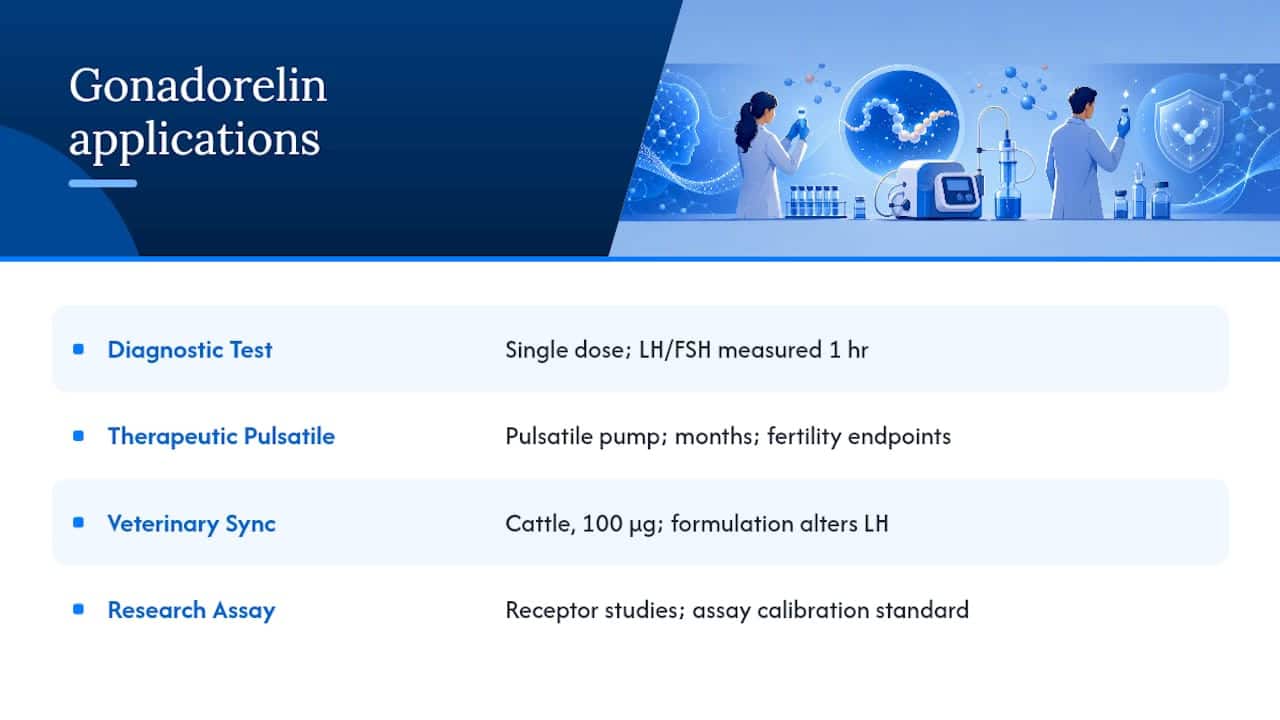
Diagnostic pituitary and hypothalamic testing is the most common single-dose application. A clinician gives one dose and measures the LH and FSH response over the following hour. A robust rise indicates the pituitary gonadotrope population is intact and responsive; a blunted or absent response points toward pituitary or hypothalamic dysfunction. This test differentiates hypothalamic causes of hypogonadism from primary pituitary failure, which changes the entire treatment pathway for the patient.
Therapeutic pulsatile use targets congenital hypogonadotropic hypogonadism (CHH), where the hypothalamus fails to generate its own GnRH pulses. Here the goal shifts from a single measurement to reconstructing a functioning axis over months. Success is measured in testosterone normalization, ovulation induction, or, in men wanting fertility, spermatogenesis. Programmable infusion pumps deliver gonadorelin continuously in the timed pulses the body would otherwise generate on its own.
Veterinary applications, particularly in cattle reproduction, use gonadorelin to synchronize ovulation timing in structured breeding protocols. A study comparing three gonadorelin formulations in Holstein cows found that formulation choice measurably changed LH peak concentration and ovulatory response at the same 100 microgram dose. That finding has translational weight beyond veterinary medicine. It’s direct evidence that formulation, not just the parent molecule, changes the pharmacodynamic signal.
Research and assay applications span receptor pharmacology studies, GnRH receptor expression profiling in hormone-sensitive tumors, and use as a calibration standard in LH and FSH assay validation. Because gonadorelin is the native ligand, it serves as the reference point against which synthetic GnRH agonists and antagonists get benchmarked in receptor binding and functional assays.
The common thread across all four uses: outcome depends less on “how much gonadorelin” and more on “delivered how, and measured when.” A single dose answers a diagnostic question in an hour. A pulsatile regimen answers a therapeutic question over months. Confusing the two protocols in a study design produces uninterpretable data.
Gonadorelin Dosing and Administration Protocols
Diagnostic and therapeutic gonadorelin use call for entirely different administration strategies, and the numbers matter enough that they should be treated as fixed reference points rather than rough guidelines.
For single-dose diagnostic testing, Mayo Clinic’s dosing reference lists standard adult dosing at 0.1 mg given once, by intravenous or subcutaneous injection. For children 12 years and older, the dose scales to 2 mcg/kg, capped at 100 mcg per single administration. These are single-shot protocols meant to provoke one measurable hormone response, not to sustain axis function.
| Parameter | Diagnostic single dose | Pulsatile therapy |
|---|---|---|
| Typical dose | 0.1 mg (adults); 2 mcg/kg up to 100 mcg (children ≥12) | Micrograms per pulse, titrated to response |
| Route | IV or SC injection | SC pump infusion |
| Frequency | Single administration | Every 90 to 120 minutes, continuously |
| Purpose | Provoke measurable LH/FSH spike | Reconstruct physiological pulse pattern |
| Duration | One test session | Weeks to months |
Pulsatile pump protocols work on a different logic entirely. Programmable subcutaneous pumps deliver small, repeated boluses at intervals commonly set between 90 and 120 minutes, echoing the natural pulse frequency of hypothalamic GnRH secretion. Clinicians typically start at a conservative per-pulse dose and titrate upward based on serial LH measurements, since the pulse interval itself changes downstream LH and FSH patterns even when the total daily dose stays fixed. A pulse set too close together risks the same receptor desensitization seen with continuous infusion; too far apart, and the signal may not reliably trigger release.
Administration routes split cleanly along these lines:
- Intravenous bolus is standard for diagnostic testing, giving the fastest and most predictable single response curve.
- Subcutaneous injection works for diagnostic testing where IV access is impractical, with a slightly slower onset.
- Subcutaneous pump infusion is the only practical route for sustained pulsatile therapy, since no injection schedule can realistically replicate dosing every 90 minutes around the clock.
Blood sampling for LH and FSH after a diagnostic dose is typically drawn at baseline, then at intervals across the following 60 to 120 minutes to capture the full response curve. In pulsatile pump studies, sampling protocols get more demanding: serial draws timed relative to pulse delivery are needed to characterize whether the pump is producing a genuine LH pulse train rather than a flattened, desensitized response.
What the Research Evidence Actually Shows
The strongest clinical evidence for pulsatile gonadorelin therapy comes from a study on men with congenital hypogonadotropic hypogonadism, and the numbers are worth sitting with.
In that trial, 90% of men on the pulsatile gonadorelin pump (PGP) achieved spermatogenesis, with a median time of 6 months. The comparison group on cyclical gonadotropin therapy reached spermatogenesis in 83.3% of cases, with a median time of 14 months. That’s a difference of more than double the speed to a clinically meaningful endpoint, drawn from a study published examining PGP versus cyclical gonadotropin therapy in CHH men. The implication for research design is straightforward: pulsatile delivery appears to restore a more physiologically authentic signal to the hypothalamic-pituitary-gonadal axis than bolus gonadotropin dosing, at least on this specific fertility endpoint.
That evidence comes with real caveats. Sample sizes in pulsatile pump trials tend to be small, and CHH itself is a rare condition, which limits statistical power and makes broad generalization risky. The comparison also involves two genuinely different treatment philosophies, pulsatile GnRH replacement versus direct gonadotropin replacement, so the mechanism behind the timing difference isn’t fully isolated in the data.
On the animal research side, the cattle formulation study comparing three gonadorelin products adds a different but equally important lesson: formulation is not a neutral variable. At an identical 100 microgram dose, one formulation produced higher peak plasma LH concentrations and a higher ovulatory rate in Holstein cows than the other two products tested. That’s a formulation-dependent pharmacodynamic effect, not a dose effect, and it carries directly into human research design.
A few things this study should make every researcher check before starting a comparative protocol:
- Confirm the exact salt form and formulation (hydrochloride versus diacetate tetrahydrate, for instance) before comparing results across different product sources.
- Never assume two “gonadorelin” products behave identically at the same labeled dose without formulation-matched validation.
- Treat cross-study comparisons cautiously when formulation details aren’t disclosed in the methods section.
- Use molecular reference data from PubChem and ChEBI to confirm identity and structural integrity when validating a new lot or source.
The open questions in this field are still substantial. There’s limited large-scale randomized data comparing pulsatile pump therapy against alternative fertility induction strategies across diverse patient populations. Geographic and formulation variability across studies makes meta-analysis difficult. And a review of GnRH-based therapy adoption points out that even where efficacy signals look strong, the logistical burden of pump-based dosing has kept pulsatile gonadorelin therapy from becoming a first-line option in most clinical settings, despite the proof-of-concept results.
Lab Practices That Reduce Variability in Gonadorelin Studies
Study design can be sound and still produce noisy data if the peptide itself isn’t handled consistently. Gonadorelin’s chemical fragility makes storage and handling protocol decisions, not just dosing decisions.
Reconstitution and storage practices deserve their own checklist:
- Reconstitute lyophilized gonadorelin according to the manufacturer’s specified diluent and concentration, since improper reconstitution introduces variability before the first dose is even given.
- Store reconstituted material cold, generally at −20°C or below, and avoid repeated freeze-thaw cycles that accelerate degradation of the peptide bond structure.
- Pre-portion reconstituted material into single-use aliquots at the start of a study rather than repeatedly accessing one stock vial.
- Verify concentration and identity with an appropriate assay if a batch will be stored for an extended period before use.
Pro Tip: If your protocol spans multiple months, run a spot-check potency assay on a held-back aliquot partway through the study. Silent degradation in stored gonadorelin is one of the most common, and least discussed, sources of drift in longitudinal pulsatile pump data.
Pump selection and maintenance carry their own variability risks. Pulse resolution, meaning how precisely the pump can deliver small, timed boluses, needs to match the interval the protocol specifies, whether that’s every 90 minutes or every 2 hours. Reservoirs need scheduled changes to prevent degraded peptide from sitting in the line, and injection site rotation reduces localized skin reactions that can otherwise force early discontinuation in longer studies.
Assay timing has to be built around the pulse schedule, not around convenient lab hours. LH and FSH assay sensitivity varies by platform, and sampling that doesn’t align with pulse delivery timing can produce a hormone curve that looks flat even when the pump is functioning correctly. Serial sampling protocols validated in the pulsatile pump spermatogenesis study offer a useful reference point for timing draws relative to pulse delivery.
QC documentation closes the loop. A Certificate of Analysis confirming identity and purity, endotoxin testing results, and lot traceability records should accompany every batch used in a study intended for peer-reviewed reporting. Reviewers increasingly expect this level of sourcing transparency, and it’s far easier to gather upfront than to reconstruct after the fact. Readers building out a broader endocrine panel alongside gonadorelin work may also find it useful to review testosterone-related peptide mechanisms for context on downstream LH-mediated effects.
Safety, Contraindications, and Anti-Doping Status
Gonadorelin is generally well tolerated at diagnostic and therapeutic doses, but it’s not free of risk, and the risk profile changes with the delivery method.
Injection-site reactions, including localized redness, swelling, or discomfort, are the most frequently reported issue with both single-dose testing and pump-based therapy, per Mayo Clinic’s safety information. Systemic reactions, including headache, nausea, or flushing, occur less often but should be monitored, particularly in the first administration when a patient’s individual response is unknown.
Contraindications and monitoring needs center on patients with pituitary adenomas or hormone-dependent tumors, where stimulating LH and FSH release could theoretically aggravate an existing hormone-sensitive condition. Researchers screening study participants should treat any known pituitary pathology or hormone-dependent malignancy as an exclusion criterion pending further clinical evaluation.
A critical regulatory point for any research involving athletes: gonadorelin is included on the World Anti-Doping Agency’s prohibited list under its S2 peptide hormone class, and WADA maintains minimum required performance levels (MRPLs) to standardize laboratory detection of exogenous administration. Any research protocol involving competitive athletes, or any study whose data might intersect with anti-doping reporting, needs to account for this status explicitly in its ethical review and consent documentation.
A short list of whom to flag or exclude from protocols:
- Patients with known pituitary adenomas or other pituitary tumors.
- Individuals with hormone-dependent cancers (breast, prostate, and similar).
- Athletes subject to competition testing, unless the research explicitly operates within a sanctioned exemption framework.
- Anyone with a known hypersensitivity to GnRH or gonadorelin formulations from prior exposure.
Verifying Research-Grade Gonadorelin Before You Use It
Sourcing quality is not a side issue in gonadorelin research. It’s a variable that determines whether your data means anything.
Before running a single protocol, request documentation that confirms what’s actually in the vial:
- A Certificate of Analysis confirming identity and purity, ideally showing 99%+ purity by HPLC or mass spectrometry.
- Endotoxin testing results, since endotoxin contamination can confound both in vivo response data and animal welfare outcomes.
- Lot traceability records, so any anomaly in results can be traced back to a specific production batch.
- Stability data or storage guidance specific to that formulation, not generic peptide storage advice.
- Confirmation of research-use-only labeling and, where applicable, institutional approval documentation appropriate to the study’s ethical review requirements.
A USP reference standard for gonadorelin hydrochloride exists specifically to support this kind of identity and potency verification, and cross-checking a new lot against a reference standard is good practice whenever reproducibility matters. Treat sourcing documentation with the same rigor you’d apply to any other reagent that determines whether your results replicate.
Where Gonadorelin Research Should Go From Here
Three things would meaningfully sharpen this field. First, protocol design needs to treat pulse interval as a primary experimental variable, not an afterthought, given how much a 30-minute shift in timing can change LH output. Second, formulation disclosure should be standard in every published study, since the cattle data makes clear that “gonadorelin” alone doesn’t specify a single pharmacodynamic profile. Third, quality control documentation, from Certificates of Analysis to endotoxin data, belongs in methods sections as a matter of course.
The biggest open question remains whether pulsatile therapy’s speed advantage in small CHH trials holds up in larger, more diverse cohorts. Researchers who can contribute sampling schedules, pump parameters, and raw hormone curves to shared repositories will do more for this field than any single new trial.
— Data Peptides
Sourcing Research-Grade Gonadorelin From Data Peptides
Orders ship with third-party testing and a Certificate of Analysis covering identity, purity, and endotoxin data, so the documentation checklist above isn’t something you have to chase down separately. Orders ship quickly and discreetly from a US facility, and customer support is available for questions about lot specifics or handling. If you’re setting up a pulsatile delivery protocol or a diagnostic comparison study, the research peptide shop is where to check current specifications and place an order with the paperwork already attached.
This article is general information, not a substitute for advice from a qualified doctor. Consult a qualified healthcare professional about your own circumstances before acting on anything here.
Sources
- Gonadorelin (intravenous route, injection route) – Side effects & dosage – Mayo Clinic
- The effects of 3 gonadorelin products on luteinizing hormone release, ovulation, and follicular wave emergence in cattle – PMC
- PubChem compound summary for gonadorelin
- ChEBI entry for gonadorelin (CHEBI:5520)
FAQ
Does Gonadorelin Actually Work?
Yes, within its studied context: a pulsatile pump trial in men with congenital hypogonadotropic hypogonadism found 90% achieved spermatogenesis at a median of 6 months, versus 83.3% at 14 months on cyclical gonadotropin therapy.
Can Gonadorelin Promote Muscle Growth?
Gonadorelin’s documented mechanism is stimulating LH and FSH release to raise endogenous testosterone in hypogonadotropic patients, not a direct muscle-building action, so any strength effect would be secondary to that hormonal shift.
What Does Gonadorelin Do for a Man?
In men, gonadorelin stimulates the pituitary to release LH and FSH, which in turn drives testicular testosterone production and spermatogenesis, making it useful both diagnostically and in pulsatile fertility therapy for hypogonadotropic hypogonadism.
Does Gonadorelin Boost Testosterone?
Indirectly, yes. Gonadorelin doesn’t act on testosterone directly; it raises LH, which then signals the testes to produce more testosterone, an effect documented in the spermatogenesis outcomes of pulsatile pump therapy.