

GLP governs the integrity of nonclinical study data; GMP governs the control of manufacturing and product quality. GLP falls under 21 CFR Part 58, GMP under 21 CFR Parts 210 and 211. Use the “study versus product” test: if the output is a data point supporting a regulatory finding, think GLP. If the output is a batch that gets sold or used, think GMP.
TL;DR:
- GLP applies specifically to nonclinical safety studies supporting regulatory submissions, requiring a study plan, a designated Study Director, and independent QA oversight.
- GMP is batch-based, ensuring manufacturing processes, facilities, and batch records meet minimum standards for product identity, strength, and safety.
- The object of control distinguishes the frameworks: a study data point indicates GLP, while a product batch indicates GMP, and the same instrument can serve both systems with different documentation.
- Verify vendor claims by reviewing study plans or master schedules and asking for explicit documentation, rather than relying on labels like “GLP certified” or COAs.
- Most compliance issues arise from misunderstandings of scope, such as assuming GMP paperwork proves GLP compliance, or confusing ISO accreditation with GLP status.
Table of Contents
- GLP vs GMP: What Does GLP Actually Cover?
- GLP vs GMP: What Does GMP (CGMP) Actually Cover?
- How Do You Tell Which Framework Applies?
- Where Do GLP, GMP, and GCP Fit in a Development Program?
- What Are the Most Common Compliance Pitfalls?
- Why the “Study vs Product” Mental Model Beats Memorizing Rules
- Sources
- FAQ
GLP vs GMP: What Does GLP Actually Cover?
GLP exists because regulators needed a way to trust nonclinical safety data before it ever reaches a human trial or a marketing application. The FDA built GLP requirements after 1970s inspections uncovered unreliable and sometimes fabricated toxicology studies. That history matters: GLP isn’t about tidy benches. It’s about whether a study’s data can be reconstructed and defended years later.
GLP applies to toxicology, pharmacology, and biocompatibility studies that support regulatory submissions. It does not automatically cover basic research, human clinical work, discovery toxicology, or many bioanalytical activities unless those are folded into a covered nonclinical study.
Operationally, GLP runs on a specific skeleton:
- A written, dated study plan approved before work starts
- A single accountable Study Director overseeing the entire study
- An independent, study-level Quality Assurance function
- Raw data traceability and validated computerized systems
- Archiving of records, specimens, and the final signed report
The OECD GLP framework makes the Study Director the single point of control for the entire study. No committee, no shared ownership. One name, one signature, one accountable party.
GLP vs GMP: What Does GMP (CGMP) Actually Cover?
GMP exists to assure that a drug product is what its label says it is, every time it’s made. CGMP regulations set minimum requirements for the methods, facilities, and controls used in manufacturing, processing, packing, and holding drug products, all aimed at identity, strength, quality, purity, and safety.
The scope is different from GLP in a fundamental way: GMP is batch oriented, not study oriented. It covers manufacturing runs, packaging, holding conditions, release testing, and the qualification of suppliers who feed materials into the process.
Core GMP mechanics include:
- A quality unit independent of production, with release authority
- Validated manufacturing processes and qualified facilities/equipment
- Batch records documenting every step of a specific production run
- Formal deviation and investigation procedures when something goes off spec
FDA guidance on §211.110 explicitly allows validated process models and advanced manufacturing approaches, as long as the manufacturer can still demonstrate batch uniformity and product integrity see FDA guidance on §211.110. GMP flexes on method. It does not flex on proof.
How Do You Tell Which Framework Applies?
The fastest way to sort a GLP question from a GMP question is to ask what’s being controlled: a data point in a study, or a unit in a batch. Everything else in the comparison flows from that one distinction.
| Axis | GLP | GMP |
|---|---|---|
| Object of control | Study data supporting a safety finding | Product batches and manufacturing process |
| Accountable role | Study Director | Quality unit / production management |
| Core record | Study plan, raw data, final report | Batch record, specification, deviation log |
| Change control | Documented protocol amendments | Change control procedures, revalidation |
| Typical inspection | Protocol, raw data, and report audit | Facility, batch record, and release audit |
The confusion usually shows up when the same physical instrument sits in both worlds. A mass spectrometer used to generate toxicology data in a GLP study needs a validated method tied to that study’s protocol. The same instrument used to release a manufactured lot needs a validated analytical method tied to a product specification. Same box, two completely different documentation trails.
Common mislabels worth flagging before you sign a contract or cite a vendor’s paperwork:
- Assuming a lab is “GLP certified” because it has ISO/IEC 17025 accreditation
- Treating a Certificate of Analysis as proof that GLP or GMP standards were met
- Assuming any regulated-sounding paperwork transfers between the two systems
To verify which system actually governs the work, ask for the study plan or master schedule, the QA statement, and whether the facility permits inspection access. If those don’t exist for a “GLP” claim, the claim doesn’t hold up.
Pro Tip: Before accepting a vendor’s compliance claim at face value, ask them to name their Study Director (for GLP) or their quality unit’s release authority (for GMP). If they can’t answer in one sentence, the claim probably isn’t real.
Where Do GLP, GMP, and GCP Fit in a Development Program?
Most investigational products move through a predictable sequence, and skipping a step doesn’t work because each system protects a different kind of decision.
- GLP generates the nonclinical safety evidence that justifies moving a compound into humans at all.
- GMP controls the manufacture of the material used in that trial, and later the commercial product.
- GCP governs how the actual human trial is conducted and how patient data gets collected.
None of these substitutes for another, and regulators expect separate compliance packages for each. When work gets outsourced across multiple sites, the risk concentrates at the handoffs. A contract lab running a GLP toxicology study and a contract manufacturer producing GMP material need separate, explicit scope statements, not a shared assumption that “the other lab has it covered.” Keep the study plan, master schedule, and quality agreement as the three documents that travel with the work, and require sign off at each transition rather than after the fact.
What Are the Most Common Compliance Pitfalls?
Most GLP and GMP disputes trace back to a handful of repeatable mistakes. Before signing a contract or accepting a vendor’s paperwork, run through this short checklist:
- Identify the object of control: is this a study datum or a manufactured batch?
- Confirm the intended use of the data and which regulator will see it.
- Match the contract scope to the actual framework, not the framework the vendor advertises.
- Request the study plan, master schedule, or quality agreement in writing before work starts.
The pitfalls that show up again and again:
- Treating a Certificate of Analysis as automatic proof of GLP or GMP compliance, when a COA describes a specific lot or test, not a compliance status
- Confusing ISO/IEC 17025 lab accreditation with GLP status. OECD guidance is explicit that 17025 does not cover Study Director or study-level QA requirements
- Amending a GLP protocol late in a study, which forces every raw-data correction and deviation to stay traceable and justified, adding real cost to last-minute changes
- Assuming GMP batch paperwork proves anything about a GLP study, or vice versa
When qualifying a new vendor, ask for their scope statement, their master schedule (for GLP work), their QA statement, and explicit inspection access. Put responsibility for each of these in the quality agreement, not in a verbal understanding.
Pro Tip: Ask any vendor claiming GLP or GMP status one direct question: “Can I see your master schedule or your batch release SOP?” A vendor with nothing to show isn’t operating under either system, whatever their marketing says.
Why the “Study vs Product” Mental Model Beats Memorizing Rules
Most professionals try to memorize GLP and GMP requirements clause by clause, and that approach falls apart the first time a real contract lands on the desk. The model that actually holds up under pressure is simpler: ask whether the work produces a study finding or a saleable batch, then let the answer dictate the paperwork you demand.
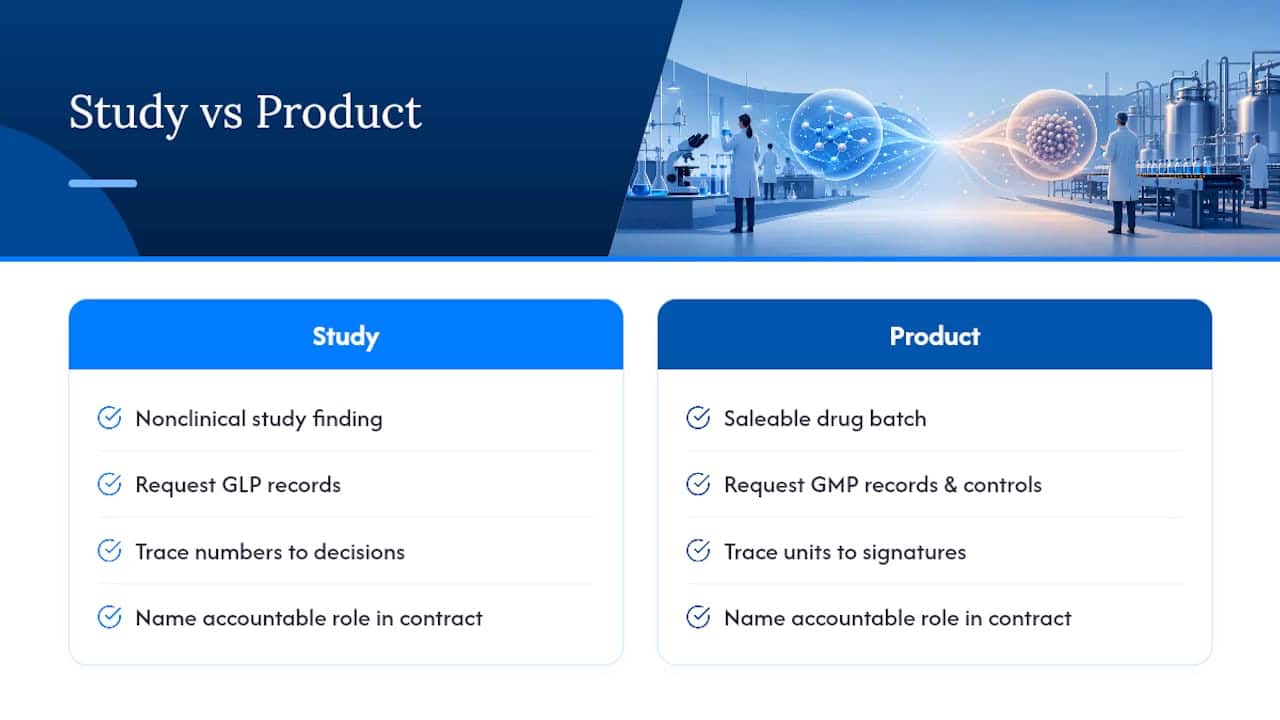
Compliance isn’t about how clean a lab looks on a tour. It’s about whether every number in a report or every unit in a batch can be traced back to a decision, a signature, and a justification. That’s true whether you’re evaluating a contract toxicology study or qualifying a peptide supplier for research-grade material. Write your contracts to name the accountable role, the applicable framework, and the documents you expect to see, before the first sample ships. Decide that up front and most disputes never happen.
Sources
- OECD: Good Laboratory Practice and compliance monitoring
- CP 7348.808 Bioresearch monitoring – GLP inspection program | FDA
FAQ
What Is the Difference Between GMP and GLP?
GLP governs the integrity of nonclinical laboratory studies, like toxicology testing, that support regulatory submissions. GMP governs the manufacturing, packaging, and release of actual drug product batches under 21 CFR Parts 210 and 211. One protects study data; the other protects product quality.
Is GMP the Same as GLP?
No. They cover different objects of control and different accountable roles: GLP centers on a Study Director and study-level QA, while GMP centers on an independent quality unit with batch release authority. A facility can be compliant with one and not the other.
What Is the Difference Between GMP, GCP, and GLP?
GLP covers nonclinical safety studies, GMP covers manufacturing and product control, and GCP covers the conduct of human clinical trials. In a typical development program, work moves through GLP, then GMP, then GCP, and each system requires its own separate compliance package.
Is GMP Certification Legit?
GMP compliance is assessed through FDA inspection against 21 CFR Parts 210 and 211, not through a single certificate a company can simply purchase. A legitimate claim of GMP compliance should be backed by inspection history, validated processes, and batch records a buyer can actually request to see.