

Disqualify any vendor that can’t produce a lot-specific Certificate of Analysis backed by orthogonal testing, meaning HPLC/LC-MS data plus a second confirming method. Before you place an order, request the lot-specific COA and the raw chromatogram or spectrum behind it. If a supplier hesitates, that’s your answer.
TL;DR:
- Only purchase from vendors that provide lot-specific Certificates of Analysis backed by orthogonal testing, including HPLC or LC-MS plus a second independent method.
- Verify the COA explicitly matches your shipment lot, includes the testing lab’s name, test date, method details, and acceptance criteria before ordering.
- Ensure the supplier can supply raw chromatograms or spectra on request and clearly states their testing methods for purity and identity.
- Be cautious of “research use only” labels, and check for signs of human-use indications such as dosing instructions, reconstitution sales, or testimonials on the vendor’s website.
- Prioritize vendors demonstrating operational transparency, quick technical support, and a track record of consistent, verified testing over shipping speed or low price.
Table of Contents
- How Do You Choose a Peptide Supplier? Start With This Checklist
- What Should a Peptide COA Actually Show You?
- Why “Research Use Only” Doesn’t Always Protect You
- What Shipping and Storage Standards Should You Require?
- What Questions Should Go Into Your RFQ?
- How Trusted American Peptides Maps to This Checklist
- Does Supplier Reputation Actually Predict Quality?
- What Return and Refund Terms Should You Expect?
- Why Communication Quality Matters More Than You’d Think
- Disciplined Documentation Protects Your Experiments
- Where to Start Once You’ve Set Your Criteria
- Sources
- FAQ
How Do You Choose a Peptide Supplier? Start With This Checklist
Choosing a peptide supplier comes down to verifying paper trails before you verify anything else. Price, shipping speed, and website polish matter later. First, confirm the vendor can document exactly what’s in the vial, at what concentration, tested by whom, and how.
Run every candidate vendor through this sequence, in order:
- Lot-specific COA: not a generic “representative” document, but one tied to the exact lot number on your shipment, with the testing lab named, the test date listed, the method specified, and acceptance criteria stated.
- Orthogonal testing: HPLC or LC-MS for purity and mass confirmation, plus a second independent method (mass spectrometry, NMR, or amino-acid analysis) when identity confirmation matters. USP’s reference standards guidance treats a single test as insufficient for confirming both identity and purity.
- Traceability: a real lot numbering system that lets you match a specific vial back to a specific test report, not a batch number that changes meaning between orders.
- Operational transparency: does the vendor name its third-party test lab? Do they answer technical questions about method parameters, or dodge them?
- Commercial clarity: published pricing, stated lead times, and clear minimum order quantities, rather than “contact us for a quote” on everything.
Weight these unevenly. A vendor with excellent documentation and slightly slower shipping beats a vendor with same-day shipping and vague paperwork every time. You’re buying data integrity for your experiments, not convenience.
Pro Tip: Ask for the COA and the raw chromatogram before you ask about price. Vendors who lead with pricing and stall on documentation are telling you something about their priorities.
Comparing peptide suppliers side by side gets easier once you treat these five criteria as a scorecard rather than a gut check. Score each vendor 1 to 3 on each item, and you’ll find the real leaders separate from the pack fast, usually well before price ever enters the conversation.
What Should a Peptide COA Actually Show You?
A Certificate of Analysis is only as good as the data behind the number on the page.
Chromatographic purity (the area-normalized percentage from an HPLC trace) tells you how clean the peak looks relative to other peaks in that same run. Assay or content purity tells you how much of the vial’s mass is actually your target peptide, accounting for water, counter-ions, and residual solvents. A peptide’s chromatographic purity can be high while its content purity is lower, because the chromatogram doesn’t account for everything else in the vial. Procurement teams that don’t ask which basis a supplier used for the given "99%, research shows this exact confusion is a common analytical error, one that leads labs to compare numbers that aren’t measuring the same thing.
Here’s what separates a credible COA from decoration:
- Lot number matched to your shipment: not a “typical” or “representative” COA pulled from a template.
- Test date and testing lab named: internal testing alone isn’t disqualifying, but a supplier that only ever self-certifies deserves more scrutiny.
- Method stated explicitly: RP-HPLC, LC-MS, or another named technique, not just “tested for purity.”
- Impurity profile: not just a top-line purity number, but what else showed up and at what levels.
- Acceptance criteria: the specification the lot was measured against, so you know what “pass” meant.
Orthogonal testing matters because no single method catches everything. HPLC chromatograms confirm purity and retention time but can miss closely related impurities that co-elute with the main peak. LC-MS confirms molecular mass, catching substitutions or truncations that HPLC alone might not flag. NMR and amino-acid analysis go further for structural confirmation, and USP recommends this combination specifically because each method’s blind spots get covered by the others.
If you’re running quantitative or regulated work, generic verification isn’t enough. USP’s GLP-1 impurity ARM program offers analytical reference materials built specifically to strengthen impurity profiling for peptides where lot-to-lot comparability actually matters to your results.
Why “Research Use Only” Doesn’t Always Protect You
An RUO label on the vial doesn’t settle the question of intended use, and recent enforcement makes that clear. The FDA evaluates a seller’s entire commercial context, not just the label printed on the packaging.
In August 2026, the FDA issued a warning letter to NuScience Peptides LLC citing website content that indicated intended human use, despite RUO labeling on the products themselves. A March 2026 letter to Gram Peptides cited the combined sale of peptides alongside bacteriostatic water and product pages carrying human-use indications as evidence of intent. Neither case turned on the RUO label itself. Both turned on what else appeared on the site.
For procurement, that means the vendor’s marketing is part of your risk assessment, not a separate concern. Watch for these signals when you’re screening a supplier:
- Dosing instructions or injection tutorials anywhere on the product page or in supplementary content.
- Sale of reconstitution supplies like bacteriostatic water marketed alongside the peptides themselves.
- Testimonials describing personal results, especially physical or health outcomes, rather than research applications.
- Language implying human administration, even indirectly (“take,” “dose,” “cycle” instead of “reconstitute for research use”).
Document what you checked and when. If your institution has a compliance or legal review process, a vendor that trips two or more of these flags is exactly the case to escalate rather than quietly avoid. Keeping a short written record of the vendor’s site content at time of purchase protects your own procurement decisions if anyone asks later why a given supplier was approved.
What Shipping and Storage Standards Should You Require?
Peptide integrity depends on how a shipment is handled after it leaves the lab, not just what the COA said at the point of manufacture. Storage requirements differ meaningfully between lyophilized (freeze-dried) peptides and reconstituted solutions, and a supplier’s shipping practices should reflect that difference.

Lyophilized peptides are generally more stable at room temperature for short periods but still specify a recommended storage range, usually refrigerated or frozen for longer-term stability, and most are moisture-sensitive enough that packaging matters as much as temperature. Reconstituted solutions are far less forgiving and typically require cold-chain handling from the moment they’re mixed. Method-transfer literature on peptide stability makes clear that storage conditions used during characterization need to travel with the product, not just live in a technical data sheet nobody reads.
Follow this sequence when a shipment arrives:
- Inspect packaging before opening, checking for temperature indicators or condition logs if the product required cold-chain shipping.
- Confirm the lot number on the physical shipment matches the COA you were sent before ordering, not just a general product page.
- Log the receipt date and condition in your own records, including any deviation from expected packaging.
- Quarantine anything questionable rather than putting it directly into active experiments, especially if temperature indicators show excursion.
Pro Tip: Keep the supplier’s stated storage conditions and shipping method attached to your own receiving log, not just filed with the invoice. If a result doesn’t reproduce six months later, that record is often the fastest way to rule out a handling problem. Our storage temperature guide breaks down the stability differences between lyophilized and solution-based peptides in more depth.
What Questions Should Go Into Your RFQ?
Your purchase order should function as a filter, not just a price agreement. The questions you put in front of a vendor, and how precisely they answer, tell you more than any marketing page will.
Ask these directly, in writing, before the order goes out:
- Can you provide the lot-specific COA for the exact lot shipped, not a representative sample?
- Can you provide the raw chromatogram or mass spectrum behind the reported purity figure?
- What method was used to generate the purity number, and is it area-normalized HPLC purity or assay content by mass?
- What is your typical lead time from order to ship, and does that change for custom quantities?
- What are your minimum order quantities, and do they scale for repeat or larger orders?
- Who do we contact if a shipment arrives outside expected condition, and what is your response time?
Set your acceptance specs before the quotes come back, not after. USP guidance on peptide testing is explicit that these tolerances should be experiment-specific rather than a blanket industry default, since a screening assay and a quantitative dose-response study don’t carry the same risk profile.
Score vendor responses on a simple rubric: full and specific answers score highest, vague or deflected answers score lowest, and no answer at all is a disqualified on its own. Our guide to ordering peptides includes RFQ language you can adapt directly for this process.
How Trusted American Peptides Maps to This Checklist
Every claim a supplier makes should be checkable against the same standard you’d apply to anyone else. Trusted American Peptides states that its products undergo third-party batch testing for purity and identity, with Certificates of Analysis and endotoxin data issued for every lot, alongside fast, discreet shipping from a US facility and 24/7 support for order questions.
Verify those claims the same way you’d verify any vendor’s:
- Request the lot-specific COA for your exact order, not a general product-page document.
- Ask for the third-party testing lab’s report alongside the COA, matched to method and lot.
- Confirm shipping and handling records if your peptide requires cold-chain conditions.
- Check support responsiveness before you order by asking a specific technical question and timing the reply.
The point isn’t to take any vendor’s word, including this one. It’s to apply one consistent standard to every supplier you evaluate.
Does Supplier Reputation Actually Predict Quality?
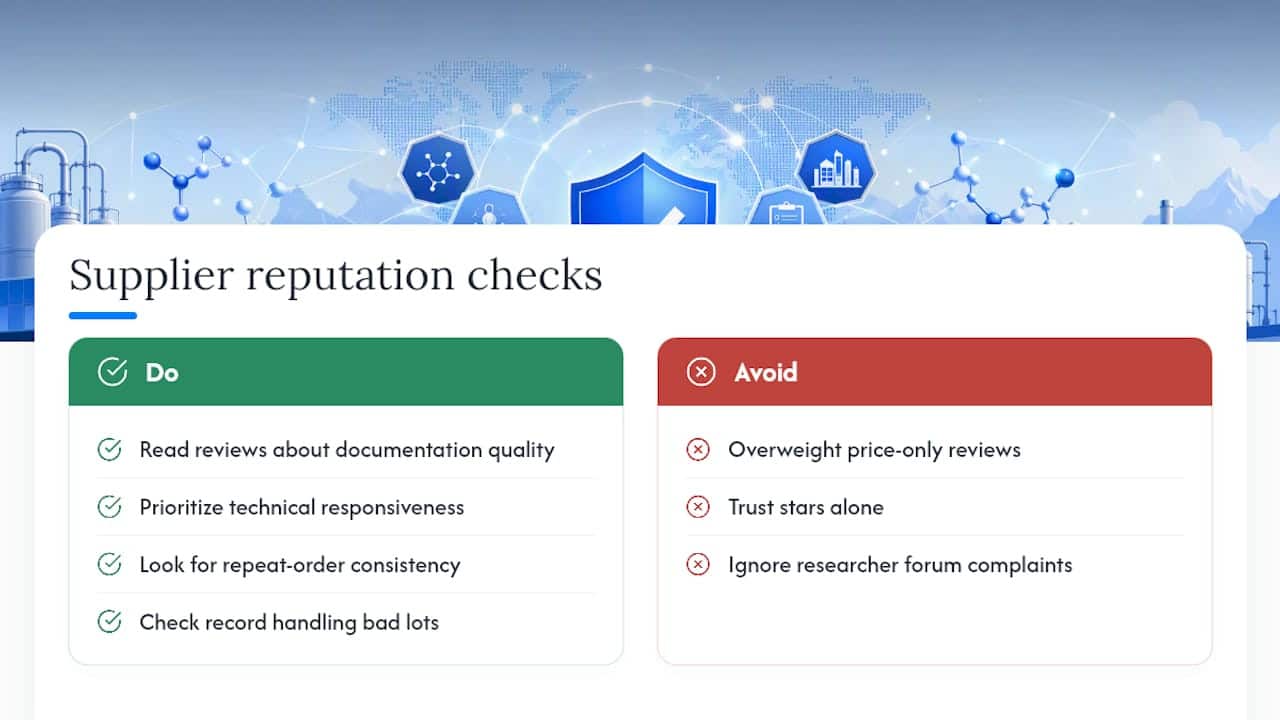
Reputation is a useful screen, but only when you’re reading past the star rating. A vendor with hundreds of five-star reviews focused on shipping speed tells you nothing about whether their COAs are lot-matched or their impurity data is real.
Look specifically for reviews or testimonials that mention documentation quality, responsiveness to technical questions, or consistency across repeat orders. Those signals correlate with the operational discipline that actually protects your experiments. Reviews that focus purely on price or delivery speed are worth reading but shouldn’t carry the same weight in your decision.
Third-party review platforms and forums frequented by researchers tend to surface documentation complaints faster than general consumer review sites, since researchers are more likely to flag a mismatched lot number or an unresponsive support line as a real problem rather than a minor inconvenience. Treat a pattern of complaints about inconsistent COAs or unexplained delays as a stronger warning sign than a handful of one-star reviews about shipping cost.
A supplier’s public track record over time, meaning how it handled a batch that didn’t meet spec or a shipment that arrived damaged, tells you more than any individual transaction. Vendors that quietly replace or refund a bad lot without argument are showing you how they’ll behave the next time something goes wrong. Vendors that get defensive or stall are showing you that too.
What Return and Refund Terms Should You Expect?
A clear return and refund policy is part of the same transparency standard you’re applying to testing documentation. If a supplier is vague about what happens when a lot fails to meet spec on arrival, that’s a signal worth weighing before you order.
At minimum, expect a written policy covering what happens if the shipment arrives damaged, if the COA doesn’t match the physical lot received, or if independent testing on your end contradicts the supplier’s stated purity. Reasonable suppliers will accept a return or issue a refund when the documentation itself is the problem, not just when the product is physically damaged in transit.
Ask about the return policy before you order, not after a problem shows up. Suppliers that only publish refund terms in response to a direct question, rather than stating them clearly on the site, are worth a second look. A policy that requires you to prove fault before any resolution is offered puts the burden entirely on the buyer, which isn’t how a supplier confident in its own testing typically operates.
Why Communication Quality Matters More Than You’d Think
Support responsiveness is a leading indicator of documentation quality, not a separate customer-service metric. A vendor that answers technical questions quickly and specifically is usually the same vendor that keeps its COAs organized and lot-matched. A vendor that goes quiet when you ask about method parameters is telling you something about how carefully the rest of their operation runs.
Test this before you place your first order. Ask a specific technical question, something like which orthogonal method confirmed identity on a recent lot, and note how long the response takes and how precise the answer is. A knowledgeable, prompt reply is a good sign. A generic answer that doesn’t address your actual question, or a multi-day delay, tells you what to expect if something goes wrong with a shipment later.
24/7 support availability matters most when a shipment problem needs fast resolution, particularly for cold-chain products where a delayed response could mean the difference between a usable lot and a wasted one. Availability alone isn’t enough, though. The quality of the answer matters as much as the speed of the reply.
Disciplined Documentation Protects Your Experiments
The instinct to chase the lowest price on a peptide order is understandable and usually costs more than it saves. A cheaper vial with no lot-matched COA is not a bargain, it’s an unknown variable sitting in your freezer.
Reproducibility depends on documentation you can trust six months from now, not just a number that looked good at checkout. Prioritize traceability over price every time those two things conflict. The lab that insists on paperwork now spends less time explaining a failed replication later.
— Data Peptides
Where to Start Once You’ve Set Your Criteria
A research-grade supplier should be built around the standards this article lays out: lot-specific Certificates of Analysis, third-party batch testing for purity and identity, endotoxin data on every lot, and fast, discreet shipping from a US facility backed by 24/7 support. That’s not a claim to take at face value any more than any other vendor’s. It’s a claim you can verify with the same questions you’d send to anyone else.
If you’re ready to apply the checklist, start with the shop page to see current lots and categories, from weight loss and muscle growth research compounds to recovery and anti-aging formulations. Before you order, contact support and request the lot-specific COA and a procurement packet for the product you’re considering. A supplier confident in its documentation will have that ready without hesitation.
Sources
- Reference standards to support quality of synthetic peptide therapeutics — USP
- NuScience Peptides LLC – Warning Letter — FDA (2026-08-24)
FAQ
How Do I Find a Reliable Peptide Supplier?
Look for a supplier that provides lot-specific COAs backed by orthogonal testing (HPLC/LC-MS plus a second method), names its testing lab, and documents shipping and storage conditions. A vendor willing to send raw chromatogram or spectrum data on request, without hesitation, is usually reliable.
Who Is the Most Trusted Peptide Supplier?
There’s no single universally agreed answer, since trust depends on verifiable documentation rather than reputation alone. The most trustworthy suppliers are the ones that provide lot-matched COAs, orthogonal test data, and transparent method details for every order, criteria you can check directly with Data Peptides or any vendor you’re considering.
How Do I Pick a Peptide Company for Research Use?
Match the supplier’s documentation rigor to your project’s risk level. Basic screening work needs verified identity and purity; quantitative or regulated work needs characterized reference materials and impurity standards. Confirm the company can meet whichever tier your research actually requires.
Why Does a 99% Purity Claim Sometimes Mean Different Things?
Always ask which basis a supplier used, since USP flags this ambiguity as a common source of procurement error.
What Should I Do if a Supplier Won’t Provide a Lot-Specific COA?
Treat that as a disqualifying red flag and move to the next vendor on your list. A supplier unwilling to match documentation to the exact lot you’re purchasing is asking you to trust a claim it won’t actually back with evidence.