

FOXO4-DRI is a synthetic D-retro-inverso peptide that competitively disrupts FOXO4–p53 binding inside senescent cells, forcing p53 out of the nucleus and triggering selective, caspase-dependent apoptosis. Multiple independent preclinical models confirm this cascade, from irradiated fibroblasts to aged mouse aortas. None of it has been tested in humans, and clearing senescent cells does not automatically restore the tissue function those cells left behind.
TL;DR:
- FOXO4-DRI selectively kills senescent cells by disrupting their nuclear retention of p53, triggering apoptosis without harming healthy cells.
- In vitro and in vivo studies show the peptide’s mechanism involves p53 phosphorylation, mitochondrial relocation, and activation of caspase-3, confirming its targeted action.
- Clearing senescent cells does not automatically restore tissue function; efficacy depends on tissue type, with functional improvements observed mainly in mouse models.
- Proper experimental design requires confirming senescence with multiple markers, including p53 localization, and using well-verified, stereochemically confirmed peptides.
- Future research should focus on pharmacokinetic data, long-term safety, and tissue-specific responses to translate these findings into potential therapies.
Table of Contents
- What Does FOXO4-DRI Research Actually Show?
- How Does FOXO4-DRI Disrupt the FOXO4-p53 Axis?
- What Do the Major Preclinical Studies Show?
- How Should You Design a Reproducible FOXO4-DRI Experiment?
- What Are the Biggest Gaps in FOXO4-DRI Research?
- Where Should FOXO4-DRI Research Go Next?
- What This Research Really Tells Us
- How Data Peptides Supports Reproducible Senescence Research
- Sources
- FAQ
What Does FOXO4-DRI Research Actually Show?
The core finding across every major study is consistent: FOXO4-DRI kills senescent cells while sparing healthy ones, and it does this through a specific, traceable biochemical route rather than blunt cytotoxicity.
That selectivity is the entire point of the peptide’s design. Senescent cells rely on nuclear FOXO4 to hold phosphorylated p53 hostage, blocking apoptosis and keeping the cell alive in a zombie-like, secretory state. FOXO4-DRI hijacks that interaction. Once it displaces p53 from FOXO4’s grip, p53 exits the nucleus, migrates toward mitochondria, and switches on the intrinsic apoptotic pathway. Non-senescent cells, which don’t depend on this same FOXO4 tether, largely tolerate the peptide without dying.
- Senescent human fibroblasts, chondrocytes, keloid fibroblasts, and endothelial cells all show selective clearance after FOXO4-DRI exposure, across four separate research groups and model systems.
- The mechanistic readout is nearly identical everywhere it’s tested: p53 serine-15 phosphorylation, nuclear exclusion, BAX activation, and cleaved caspase-3.
- Clearance and functional recovery are not the same outcome. Huang et al. found that removing senescent chondrocytes from expanded human cell pellets reduced SASP markers but did not reliably restore chondrogenic function.
- The strongest in vivo signal comes from aged-mouse and chemotoxicity models, where clearance tracked with measurable tissue-level improvement rather than just cell counts.
Key data point: the foundational Baar et al. study demonstrated that a single course of FOXO4-DRI restored fitness, fur density, and renal function markers in aged and chemotoxin-treated mice, an effect attributed directly to senescent-cell apoptosis rather than any off-target drug action.
The assays behind these claims aren’t casual observations. Researchers combined SA-β-gal staining with p16/p21 expression, cell-cycle profiling, and direct immunofluorescence tracking of p53 localization, because any single marker on its own tends to overstate or understate true senescence burden.
How Does FOXO4-DRI Disrupt the FOXO4-p53 Axis?
FOXO4 is a forkhead-family transcription factor that senescent cells lean on heavily. In a senescent nucleus, FOXO4 physically binds phosphorylated p53 and keeps it sequestered there, which prevents p53 from triggering the mitochondrial apoptosis program it would otherwise activate. This is one of the defining survival tricks of senescent biology: cells stop dividing but refuse to die, in part because their p53 is stuck in the wrong compartment doing the wrong job.
FOXO4-DRI works by competing directly for the same binding surface. The peptide targets the p53 transactivation domain, an intrinsically disordered stretch of the protein that both native FOXO4 and the synthetic peptide recognize, according to structural work on the disordered p53 transactivation domain. Because FOXO4-DRI binds this region with high affinity, it outcompetes endogenous FOXO4 and frees p53 from nuclear retention.
Stereochemistry is not a footnote here, it’s the reason the peptide works at all. FOXO4-DRI is built as a D-retro-inverso peptide, meaning the amino acid sequence is reversed and built from D-amino acids instead of the natural L-form. That inversion preserves the three-dimensional shape needed to engage the p53 binding pocket while making the peptide far more resistant to proteolytic degradation than a standard L-peptide would be. Comparative work cited in the foundational literature notes that L-isoform versions of the same sequence lack equivalent activity, which is why any research protocol needs to confirm and report exact stereochemistry rather than assuming it.
Once p53 is released from FOXO4, the downstream signaling is fairly linear:
- p53 gets phosphorylated at serine-15, a mark associated with active DNA-damage-response signaling.
- Phospho-p53 exits the nucleus and relocates toward the mitochondria instead of activating cell-cycle arrest genes.
- At the mitochondrial membrane, p53 promotes BAX activation, which permeabilizes the outer membrane.
- Caspase-3 gets cleaved and activated, executing the intrinsic apoptotic program specifically in the senescent population.
Several published protocols deliver FOXO4-DRI as a cell-penetrating construct, often fused to a TAT sequence, to get the peptide across the plasma membrane efficiently without relying on transfection reagents or electroporation. That delivery choice matters for uptake kinetics and dosing comparisons across studies. A TAT-fused peptide and a bare peptide dosed at the same nominal concentration will not necessarily produce equivalent intracellular exposure, which is worth flagging before comparing effect sizes across papers that used different constructs.
What Do the Major Preclinical Studies Show?
Four studies anchor the current FOXO4-DRI evidence base, and each one adds a different tissue context to the same mechanistic story.
Baar et al., the foundational paper. This study established the entire model using IMR90 human fibroblasts driven into senescence by irradiation or doxorubicin exposure. The peptide selectively triggered apoptosis in the senescent fraction, confirmed as p53-dependent through knockdown controls. In vivo, aged mice and chemotoxicity-treated mice receiving FOXO4-DRI showed restored fur density, improved renal function, and increased overall fitness, endpoints that moved this from a cell-culture curiosity into a genuine aging-biology finding. This paper is the reference point every later study measures itself against.
Huang et al. (2021), chondrocyte senescence. Published in the peer-reviewed record as Senolytic Peptide FOXO4-DRI Selectively Removes Senescent Cells From in vitro Expanded Human Chondrocytes, this study applied the peptide to PDL9 expanded human chondrocytes, a population known to accumulate senescence during in vitro expansion for cartilage repair research. FOXO4-DRI selectively cleared senescent chondrocytes and reduced SASP-associated markers in the surviving population. The catch: chondrogenic pellet culture outcomes, the functional readout researchers actually care about for cartilage regeneration, did not reliably improve. Fewer senescent cells did not translate into better tissue formation in this model, a result that should temper any assumption that clearance alone fixes downstream repair biology.
Kong et al. (2025), keloid organ culture. Reported in FOXO4-DRI induces keloid senescent fibroblast apoptosis by promoting nuclear exclusion of upregulated p53-serine 15 phosphorylation, this work extended the mechanism into keloid tissue, a fibrotic condition partly driven by senescent fibroblast accumulation. The peptide induced nuclear exclusion of p53-pS15 and drove selective apoptosis in senescent keloid fibroblasts, both in isolated cells and in organ-culture explants that preserve more of the native tissue architecture. This is one of the clearer demonstrations that the mechanism holds up outside a simple monolayer dish.
Frontiers (2025), endothelial senescence and vascular aging. The study FOXO4-DRI regulates endothelial cell senescence via the P53 signaling pathway used oxygen-glucose deprivation to induce endothelial senescence, then confirmed the same FOXO4-p53 disruption, phospho-p53 export, and BAX/caspase-3 activation seen in earlier work. In aged mice, injected FOXO4-DRI suppressed markers of aortic aging and improved aortic function, with no overt liver or kidney toxicity detected in the reported assays. That’s a meaningful data point for anyone tracking organ-level safety signals, though it’s a single study’s assay panel, not a comprehensive toxicology package.
Across all four papers, a few operational patterns repeat:
- Exposure windows cluster in the tens-of-hours range rather than multi-day chronic dosing, though exact timing varies by cell type and inducer.
- Senescence confirmation always combines at least two of SA-β-gal, p16/p21 expression, and cell-cycle arrest markers before treatment begins.
- Apoptosis confirmation relies on caspase-3 cleavage, and several papers add TUNEL staining or Annexin V flow cytometry as a second, independent apoptosis readout.
- In vivo work so far leans on mouse models, either naturally aged animals or chemotoxicity-induced senescence, with functional organ endpoints layered on top of histological clearance.
How Should You Design a Reproducible FOXO4-DRI Experiment?
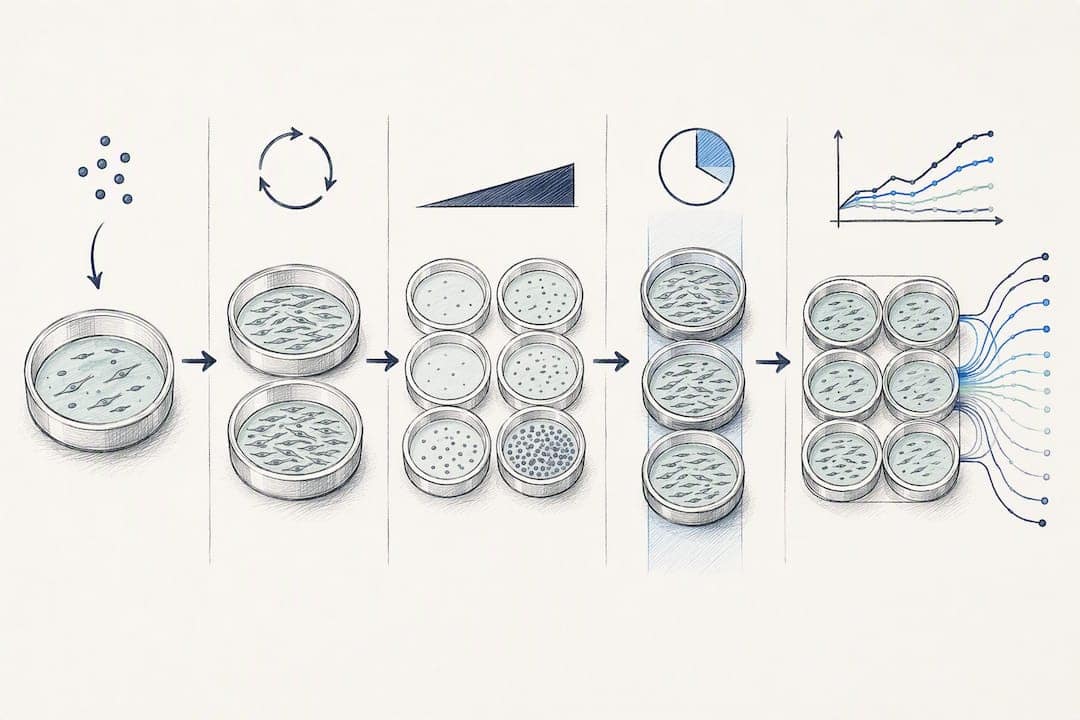
Reproducibility problems in senolytic research rarely come from bad peptide, they come from underspecified methods. A few protocol decisions determine whether your results will actually compare to the published literature.
Start with marker breadth, not marker convenience. Relying on SA-β-gal staining alone to define your senescent population is a documented source of misclassification, since the stain flags lysosomal beta-galactosidase activity that isn’t unique to senescence. Pair it with p16 and p21 expression, cell-cycle profiling, and a SASP panel before you ever add the peptide.
- Confirm senescence induction with at least two orthogonal markers (SA-β-gal plus p16/p21 or a cell-cycle assay) before treating any well with FOXO4-DRI.
- Run four parallel arms: non-senescent untreated, non-senescent treated, senescent untreated, and senescent treated, so peptide toxicity and senescence-selectivity aren’t confounded.
- Add a mechanistic control arm, either p53 knockdown or a pan-caspase inhibitor, to confirm the apoptosis you’re seeing is actually running through the expected pathway.
- Confirm apoptosis with at least two methods, such as caspase-3 cleavage by western blot plus TUNEL staining or Annexin V/flow cytometry, rather than viability counts alone.
- Document p53 localization directly with immunofluorescence imaging, since nuclear exclusion is the mechanistic fingerprint that separates FOXO4-DRI’s action from generic cytotoxicity.
Peptide-side reporting deserves its own checklist. Every methods section should state the exact sequence used, confirm D-retro-inverso stereochemistry rather than assuming it, note any fusion tag (TAT or otherwise), and include lot purity from a Certificate of Analysis along with the vehicle and formulation used to deliver it. A peptide sourced without third-party verification introduces a variable that no amount of careful cell culture technique can control for later.
Beyond the peptide itself, record the senescence inducer used, population doubling level at treatment time, seeding density, and the exact exposure window down to the hour. The response window reported in IMR90 experiments doesn’t generalize cleanly to chondrocytes, keloid fibroblasts, or endothelial cells, each of which appears to have its own kinetics.
Pro Tip: Share raw time-course viability traces and unprocessed immunofluorescence images alongside summary statistics whenever you publish or present. A single endpoint bar chart hides whether cell death happened in a tight 12-hour window or trickled out over three days, and that kinetic detail is often what other labs need to replicate your exact conditions.
What Are the Biggest Gaps in FOXO4-DRI Research?
Senescent cells are not one uniform population, and that heterogeneity is the single biggest translational obstacle in this literature. A senescent chondrocyte, a senescent endothelial cell, and a senescent keloid fibroblast arrived at their arrested state through different stressors and carry different SASP profiles, different phosphorylation states, and apparently different sensitivity to FOXO4-DRI.
The chondrocyte data make the clearance-versus-function gap concrete. Huang et al. removed the senescent cells successfully, yet chondrogenic pellet formation still fell short of what researchers would want for a regenerative application. Clearing damaged cells is necessary groundwork, but it isn’t automatically sufficient to rebuild the tissue architecture those cells were part of.
Pharmacokinetics and biodistribution data remain thin. Most published work reports local or intraperitoneal dosing with histological and functional endpoints, but detailed clearance rates, tissue penetration profiles, and long-term safety monitoring beyond the study window are largely absent from the current record. The Frontiers endothelial study’s finding of no overt liver or kidney toxicity is encouraging, but it comes from one assay panel in one model, not a systematic toxicology package.
There’s also a real biological risk worth sitting with: not every senescent cell is purely harmful. Some senescent populations contribute to wound healing and tissue patterning during development, and indiscriminate clearance could remove cells performing a useful, context-dependent job. That’s part of why tissue-specific and even senescent-subtype-specific targeting strategies matter more here than in a typical cytotoxic-drug program.
Where Should FOXO4-DRI Research Go Next?
The clearest priority is pairing every future clearance experiment with a functional readout measured well after treatment ends, not just at the moment senescent cells disappear. Organ function, regenerative capacity, and tissue architecture recovery need their own timelines, distinct from the apoptosis assay window.
Formal pharmacokinetic and GLP-style toxicity studies across multiple species would move this field from promising cell and organ-culture data toward something regulatory bodies could evaluate. Right now, dosing comparisons across papers are difficult because delivery constructs, exposure windows, and species differ study to study.
Single-cell and proteomic profiling before and after treatment would help map exactly which cell subpopulations respond, which survive, and whether FOXO4-DRI is quietly affecting SASP composition in cells that don’t outright die. That data would also clarify off-target effects that bulk-tissue assays can’t detect.
Finally, systematic comparison across senescent-cell subtypes, paired with delivery-optimization work beyond the TAT-fusion approach used in some current studies, would help settle which tissues are realistic near-term targets and which need a fundamentally different targeting strategy before FOXO4-DRI research can responsibly move toward translational work.
What This Research Really Tells Us
The conventional pitch around FOXO4-DRI treats it as a near-finished anti-aging solution. That framing undersells what actually makes this peptide interesting, and it overstates where the science stands. The real value of this body of work is methodological: it’s one of the cleanest demonstrations available of how a single, well-characterized molecular interaction can be exploited for cell-type-selective apoptosis, and it hands researchers a reproducible mechanistic fingerprint (p53 localization, BAX, caspase-3) to test against.
What gets underestimated is how much the chondrocyte result matters. A negative-adjacent finding, clearance without functional restoration, is often more informative than another confirmatory success story, because it tells the field exactly where the model breaks down. Rigorous peptide characterization, verified stereochemistry, and documented purity aren’t paperwork. They’re what separates a result you can trust from one you can’t.
— Data Peptides
How Data Peptides Supports Reproducible Senescence Research
Every FOXO4-DRI finding worth citing traces back to a peptide whose sequence, stereochemistry, and purity were actually verified, not assumed. Research-grade peptides supplied with third-party batch testing and a Certificate of Analysis provide the documentation trail that senolytic work like this demands: confirmed identity, quantified purity, and endotoxin data you can cite alongside your own methods section. That kind of paperwork is exactly what separates a replicable result from a one-off observation nobody else can reproduce. If your next experiment needs a well-characterized peptide with the paper trail to match, browse the current research peptide catalog and pull the COA before your next batch order.
This article is general information, not a substitute for advice from a qualified doctor. Consult a qualified healthcare professional about your own circumstances before acting on anything here.
Sources
- Senolytic Peptide FOXO4-DRI Selectively Removes Senescent Cells From in vitro Expanded Human Chondrocytes
- Targeted Apoptosis of Senescent Cells Restores Tissue Homeostasis in Response to Chemotoxicity and Aging (Baar et al.)
FAQ
What Is FOXO4-DRI Peptide Used For?
FOXO4-DRI is used in laboratory research to selectively trigger apoptosis in senescent cells while sparing healthy ones. Published studies have applied it to fibroblasts, chondrocytes, keloid fibroblasts, and endothelial cells. They use it as a tool to study senescent-cell clearance and its downstream tissue effects, not as an approved human therapy.
What Is the Difference Between FOXO4-DRI and FOXO4?
FOXO4 is a naturally occurring transcription factor that senescent cells use to keep damaged p53 trapped in the nucleus, preventing apoptosis. FOXO4-DRI is a synthetic, D-retro-inverso peptide mimic engineered to competitively displace that native interaction, releasing p53 and triggering cell death specifically in senescent cells.
How Do Researchers Confirm Senescent-Cell Clearance in FOXO4-DRI Studies?
Researchers combine multiple markers rather than relying on any single readout: SA-β-gal staining, p16/p21 expression, and cell-cycle arrest confirm senescence, while caspase-3 cleavage, TUNEL staining, and Annexin V flow cytometry confirm apoptosis. Published protocols also track p53 nuclear-to-cytoplasmic localization directly through immunofluorescence, since that shift is the mechanistic signature specific to FOXO4-DRI’s action.
Does Clearing Senescent Cells With FOXO4-DRI Restore Tissue Function?
Not automatically. Mouse aging and chemotoxicity models in the foundational study showed functional restoration alongside senescent-cell clearance, but the chondrocyte research found that removing senescent cells did not reliably restore chondrogenic pellet function. Functional recovery appears to depend heavily on tissue type and needs its own dedicated assays, separate from clearance counts.
Where Can Researchers Source Well-Documented FOXO4-DRI for Lab Use?
Research-grade peptides should come with a Certificate of Analysis confirming sequence identity, purity, and endotoxin levels for the specific lot received. Data Peptides provides that documentation with third-party batch testing across its research peptide catalog, which supports the kind of reproducibility researchers need when comparing results against published studies.