

Bacteriostatic water is sterile water for injection with a benzyl alcohol preservative added, packaged for multiple withdrawals. Sterile water contains no preservative and is meant for a single use. Choose bacteriostatic water when you need repeated draws from one vial and your compound tolerates benzyl alcohol; choose sterile water when the protocol calls for preservative-free diluent or the subject can’t tolerate benzyl alcohol at all. Neither one changes your dilution math, and both are hypotonic, meaning neither is ready for IV use without further adjustment.
TL;DR:
- Bacteriostatic water contains benzyl alcohol at around 0.9%, allowing the vial to be used over approximately 28 days, unlike sterile water which is single-use only.
- Benzyl alcohol in bacteriostatic water can be toxic to neonates and is contraindicated for neonatal subjects or sensitive models.
- Both diluents are hypotonic and require adjustment toward isotonicity before intravenous use, and neither affects dilution calculations.
- The main difference lies in storage and reuse capabilities; sterile water is for single use and must be discarded after opening.
- Always read the manufacturer’s label and Certificate of Analysis to determine the appropriate diluent, especially for sensitive compounds or populations.
Table of Contents
- Bacteriostatic Water vs Sterile Water: What Actually Separates Them
- Sterile Water for Injection: Single-Use by Design
- Sterile Water vs Bacteriostatic Water at a Glance
- Benzyl Alcohol Risks, Neonate Warnings, and Hemolysis
- How to Choose the Right Diluent for Your Protocol
- Reconstitution and Handling Without Cutting Corners
- What Fifteen Years of Reading Labels Has Taught Me
- Where to Source Research-Grade Peptides and Diluents
- Primary Sources Worth Bookmarking
- Sources
- FAQ
Bacteriostatic Water vs Sterile Water: What Actually Separates Them
The core difference comes down to one ingredient: benzyl alcohol. Bacteriostatic Water for Injection, USP, is manufactured with 0.9% benzyl alcohol as a preservative, though some formulations run at 1.1%. That preservative is what lets a single vial serve multiple draws instead of one.
The word “bacteriostatic” describes what benzyl alcohol does chemically: it suppresses bacterial growth inside the vial between uses. It does not sterilize the solution on contact, and it does not replace clean technique. Every time you insert a needle into that stopper, you’re relying on your own aseptic habits as much as the preservative itself.
Multi-dose bacteriostatic vials are typically labeled for use within about 28 days after the stopper is first punctured, assuming the vial is stored and handled aseptically the whole time. Past that window, the manufacturer’s data no longer backs its safety, regardless of how the liquid looks. This is exactly the kind of label detail worth checking on Dailymed or the FDA’s own product pages before you assume a vial is still good.
Sterile Water for Injection: Single-Use by Design
Sterile Water for Injection, USP, is the preservative-free counterpart. It contains no bacteriostat, no antimicrobial agent, and no added buffer, which is precisely why it’s supplied only in single-dose containers. Once you open it, use it or discard it. There’s no chemical safety net protecting a half-used vial sitting in a refrigerator overnight.
That preservative-free profile matters most when benzyl alcohol itself is a problem: certain sensitive research models, some peptide compounds with documented sensitivity to alcohol-based preservatives, and any protocol whose label or instructions explicitly call for preservative-free diluent. If a manufacturer’s instructions say “preservative-free water only,” sterile water isn’t a nice-to-have. It’s the only compliant option. As a straight preparation, it’s also hypotonic, so it still requires adjustment before any IV application.
Sterile Water vs Bacteriostatic Water at a Glance
The two diluents look identical in the vial, but they diverge on almost every practical axis that matters to a researcher.
| Factor | Bacteriostatic Water | Sterile Water |
|---|---|---|
| Preservative | Benzyl alcohol, 0.9% (sometimes 1.1%) | None |
| Container type | Multi-dose vial | Single-dose vial |
| In-use window after opening | Up to ~28 days, stored aseptically | Immediate use; discard remainder |
| Neonate use | Contraindicated | Preservative-free, often required |
| Tonicity | Hypotonic as supplied | Hypotonic as supplied |
| IV administration | Must be made approximately isotonic first | Must be made approximately isotonic first |
| Effect on dose/dilution math | None | None |
Notice that tonicity and IV guidance are identical for both. Neither diluent is safe to inject intravenously straight from the vial; both require enough solute, typically 0.9% sodium chloride, to bring the solution to roughly isotonic before it goes anywhere near a vein. The preservative in bacteriostatic water changes storage and reuse rules, not the physics of the solution itself.
Dilution math also stays constant regardless of which water you pick. If a vial calls for 2 mL of diluent to hit a target concentration, that’s true whether the 2 mL comes from a bacteriostatic or sterile source. The Peptide Calculator handles that conversion either way, since the diluent choice affects handling and safety, not the arithmetic.
Benzyl Alcohol Risks, Neonate Warnings, and Hemolysis
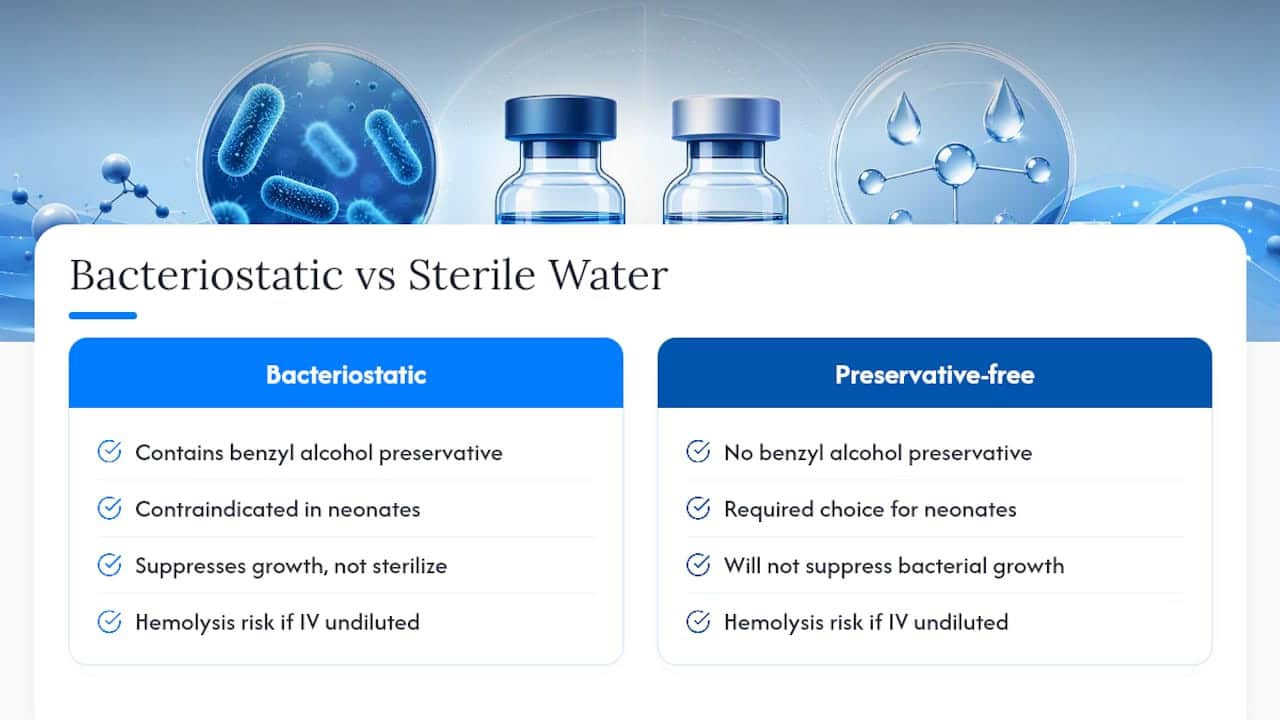
Benzyl alcohol has a documented toxicity history that shapes its labeling today. Decades of clinical use established a link between benzyl alcohol exposure and a life-threatening condition in newborns sometimes called gasping syndrome, which is why current labeling states plainly that bacteriostatic water is contraindicated in neonates. If your research model includes neonatal subjects, that’s not a gray area. Sterile, preservative-free water is the required choice.
Hemolysis is a separate risk that applies to both diluents, not just bacteriostatic water. Because both are hypotonic straight out of the vial, injecting either one directly into a vein can rupture red blood cells. The fix is the same either way: adjust the solution toward isotonicity before IV use. Subcutaneous and intramuscular peptide injections, where volumes are small, generally don’t carry the same isotonicity requirement, but confirm that against the specific product label rather than assuming.
Keep in mind, too, that bacteriostatic action has limits. Benzyl alcohol suppresses bacterial growth; it doesn’t sterilize a vial that’s been contaminated through poor technique, and it offers no protection against introducing pathogens with an unclean needle. Watch for red flags: neonatal or infant models, compounds with known sensitivity to alcohol-based preservatives, and any protocol explicitly demanding preservative-free water. When in doubt, the label wins the argument every time.
How to Choose the Right Diluent for Your Protocol
Run through this checklist before reconstituting anything:
- Check the manufacturer’s label and Certificate of Analysis first. Compound-specific instructions override general assumptions.
- Confirm whether the compound is labeled preservative-free-only, or whether benzyl alcohol compatibility is documented.
- Count your expected withdrawals. One-time use points toward sterile water; repeated draws over days point toward bacteriostatic.
- Assess your subject population for toxicity risk. Neonatal or benzyl-alcohol-sensitive models rule out bacteriostatic water outright.
If a label says nothing specific about preservative status, default to preservative-free water for sensitive populations and follow your institution’s review guidance rather than guessing. A Certificate of Analysis will often clarify stability data that the label alone doesn’t spell out.
Pro Tip: If you’re drawing from the same bacteriostatic vial repeatedly over its full 28-day window, keep a simple running log of cumulative benzyl alcohol exposure, especially in sensitive models. Adult metabolism generally clears it without issue, but some protocols set explicit cumulative limits worth tracking on paper, not memory.
Reconstitution and Handling Without Cutting Corners
Good technique matters more than which water you picked. Follow these steps every time:
- Wash your hands and disinfect your work surface before touching any vial or needle.
- Swab the rubber stopper on both the peptide vial and the diluent vial with an alcohol wipe, and let it dry.
- Draw the diluent slowly, then inject it against the vial wall rather than directly onto the peptide, letting it run down gently.
- Swirl the vial softly to mix. Never shake it, since agitation can degrade or aggregate the peptide.
- Label the vial with the reconstitution date immediately.
If your finished solution needs to go in intravenously, add 0.9% sodium chloride, or another appropriate solute, to bring it to roughly isotonic strength first. Plain water, bacteriostatic or sterile, is hemolytic when injected IV on its own.
Store reconstituted peptide under refrigeration unless the label says otherwise, and treat that 28-day bacteriostatic window as a hard outer limit, not a target. Discard immediately if you notice cloudiness, discoloration, or any sign of contamination. Some compounds are also known to interact with benzyl alcohol in ways that affect stability, so cross-check the Certificate of Analysis or the reconstitution guide before assuming compatibility.
What Fifteen Years of Reading Labels Has Taught Me
The mistake I see most often isn’t picking the wrong water. It’s skipping the label entirely and assuming one diluent is universally “safer” than the other. Neither is inherently better; they’re built for different jobs. The real safeguard is reading the manufacturer’s instructions and the Certificate of Analysis before you draw a single milliliter, then matching your choice to what’s actually written there.
Data Peptides documents Certificates of Analysis for exactly this reason. Researchers with questions about handling a specific compound, for research use only, can seek support rather than guessing from a forum post.
— Data Peptides
Where to Source Research-Grade Peptides and Diluents
There’s no shortage of ways to source lab supplies, but sourcing quality is where most researchers get burned. That documentation is exactly what feeds the decision checklist above: knowing your compound’s purity and stability profile makes the diluent choice straightforward instead of a coin flip.
Every product page pairs with its own COA, and the ordering guide walks through procurement from first order to delivery, with fast, discreet shipping and support available around the clock. If you’re ready to source your next batch, browse the bacteriostatic water product page or head to the shop to get started.
Primary Sources Worth Bookmarking
For anyone who wants to verify these details directly rather than take a secondhand summary at face value, start with the primary labels. Dailymed hosts the official Bacteriostatic Water for Injection label and the Sterile Water for Injection label, both of which spell out composition, warnings, and storage instructions verbatim.
For the hemolysis and tonicity risk specifically, the Patient Safety Advisory breaks down real incident data behind the isotonicity requirement. And for a broader look at how pharmaceutical water grades differ by purity and endotoxin standards, the ScienceDirect overview is a solid reference point.
This article is general information, not a substitute for advice from a qualified doctor. Consult a qualified healthcare professional about your own circumstances before acting on anything here.
Sources
- BACTERIOSTATIC WATER
- Patient Safety Advisory — Hypotonic/hemolysis risks
- Pfizer medical product information on bacteriostatic water (label warnings)
FAQ
Can I use sterile water instead of bacteriostatic water?
Yes, in most cases, though you lose the ability to store the reconstituted solution for multiple draws. Sterile water works fine for single-use applications and is required when a protocol calls for preservative-free diluent.
What can be substituted for bacteriostatic water?
Sterile water for injection is the direct substitute, provided your use case is single-draw and doesn’t need the extended in-use window. It cannot replicate the roughly 28 day multi-dose stability that benzyl alcohol provides.
Can I buy bacteriostatic water at CVS or Walgreens?
Retail pharmacy availability is generally limited; bacteriostatic water is typically sourced through medical supply distributors or specialized pharmaceutical suppliers rather than stocked as an over-the-counter pharmacy item. Research suppliers like Data Peptides offer it directly with documentation included.
Does the choice of diluent change how much peptide I’m actually dosing?
No. Dilution math is identical whether you reconstitute with bacteriostatic or sterile water, since the difference lies in the preservative, not the water’s volume or purity for calculation purposes.
Is bacteriostatic water safe for IV use straight from the vial?
No. Both bacteriostatic and sterile water are hypotonic and require adjustment to an approximately isotonic solution, typically with 0.9% sodium chloride, before any IV administration.