

Start with sterile water or buffer for charged peptides. Basic peptides usually dissolve better in 0.1% acetic acid, while acidic peptides respond to dilute ammonium hydroxide. If the sequence is hydrophobic or prone to aggregating, dissolve it in the smallest practical volume of DMSO, DMF, or acetonitrile first, then dilute slowly into buffer, keeping final DMSO low enough for whatever assay comes next. For synthesis work, DMF and NMP remain the standard solvents, with DCM reserved mostly for Boc chemistry. Whatever pathway you pick, check the vendor certificate of analysis before escalating to anything stronger.
TL;DR:
- Peptides with a net charge greater than plus or minus two generally dissolve directly in water or buffer for optimal results.
- Hydrophobic or aggregation-prone peptides usually require DMSO, DMF, or acetonitrile before slowly diluting into buffer to prevent clumping.
- Acidic peptides respond best to dilute ammonium hydroxide, while basic peptides favor 0.1% acetic acid as initial solvents.
- Proper removal of residual TFA from purification or avoiding oxidation of sensitive residues like methionine improves solubility and assay compatibility.
- Using a stepwise reconstitution protocol, starting from mild solvents and escalating carefully, enhances reproducibility and prevents peptide loss.
Table of Contents
- Peptide Solvents Used in Synthesis and Purification
- Matching Peptide Chemistry to the Right Solvent
- A Stepwise Protocol for Reconstituting Lyophilized Peptides
- Buffers and Additives That Affect Solubility
- Fixing Common Dissolution and Assay Problems
- A Quick Checklist Before You Reconstitute Anything
- Why Solvent Choice Is a Data Problem, Not a Guessing Game
- Get CoA-Backed Peptides and SOP Support From Data Peptides
- Sources
- FAQ
Peptide Solvents Used in Synthesis and Purification
Solid-phase peptide synthesis runs on a small set of solvents, and each one earns its place for a specific reason. DMF (dimethylformamide) and NMP (N-methylpyrrolidone) are the polar aprotic workhorses. They swell the resin, dissolve amino acid derivatives, and support efficient coupling at both room temperature and under microwave assistance. DCM (dichloromethane) shows up mainly for resin swelling and remains common in Boc-based protocols, though it reacts poorly with piperidine, so keep the two apart during Fmoc deprotection steps. DMA (dimethylacetamide) serves as a substitute when DMF sensitivity or supply issues come up.
Purification and analysis lean on a different pair: acetonitrile and water, usually modified with 0.1% trifluoroacetic acid (TFA) or formic acid for RP-HPLC and LC-MS work. Acetonitrile is the preferred organic modifier for ESI-LC/MS, but its volatility can throw off concentration calculations if you’re not careful about evaporation during handling.
A few compatibility notes worth pinning to the bench:
- DCM and piperidine do not mix well during Fmoc removal steps.
- DMF and NMP both require good ventilation. Neither should sit uncapped on an open bench.
- Spent synthesis solvents need proper halogenated or non-halogenated waste disposal. Check your institution’s EHS guidelines before pouring anything down a drain.
Matching Peptide Chemistry to the Right Solvent
Solvent choice for reconstitution isn’t guesswork. It follows directly from three sequence features: net charge, hydrophobicity, and length. Solubility depends heavily on amino acid composition and net charge. Mapping those properties to a solvent decision saves both time and material.
Start by estimating net charge at physiological pH. A peptide with a net charge greater than +2 or less than negative 2 will usually dissolve directly in water or a neutral buffer, because the charged side chains keep it from clumping.
Hydrophobicity is the next filter. As a practical rule of thumb, sequences where more than half the residues are hydrophobic, or where the calculated GRAVY score runs positive, typically need an organic co-solvent before they’ll go into solution at all.
From there, the escalation ladder looks like this:
- Basic peptides (net positive charge): try 0.1% acetic acid first.
- Acidic peptides (net negative charge): try dilute (0.1%) ammonium hydroxide.
- Neutral-to-hydrophobic peptides: move to 0.1% TFA, but note its cytotoxicity in cell-based work; ammonium hydroxide volatilizes cleanly during lyophilization, which makes it the gentler long-term option.
- Aggregated or misfolded peptides: 6 M urea or 6 M guanidine hydrochloride can break up aggregates, though both require dialysis or desalting before any biological assay.
Pro Tip: Calculate the theoretical net charge and GRAVY score before you touch a vial. A five-minute sequence check often tells you exactly which solvent tier to start on, instead of burning through three attempts on a peptide you only had 2 mg of.
A Stepwise Protocol for Reconstituting Lyophilized Peptides
Reconstitution goes wrong most often because someone skips a step or jumps straight to the strongest solvent available. A stepwise escalation approach protects both the peptide and your budget.
- Check the CoA. Warm the vial to room temperature inside a desiccator before opening; condensation on a cold vial invites both degradation and inaccurate weighing.
- Try mild solvent first. Sterile water or a neutral buffer at low concentration is always the first attempt for anything without a known aggregation problem.
- Escalate by charge. If step 2 fails, move to 0.1% acetic acid (basic peptides) or 0.1% ammonium hydroxide (acidic peptides).
- Go organic if needed. Dissolve in the smallest workable volume of DMSO, DMF, or acetonitrile, then dilute slowly into buffer while watching for cloudiness.
- Aid dissolution gently. A brief sonication cycle or mild warming (below 40°C) often finishes the job without damaging the peptide backbone.
- Aliquot and store. Split the final stock into single-use volumes immediately rather than reconstituting the whole vial for occasional use.
Concentration planning matters as much as solvent choice. Knowing the peptide’s molecular weight and target molarity before you add a drop of anything avoids the common mistake of ending up with a solution too dilute for the assay or too concentrated to pipette accurately. The Peptide Calculator handles that math directly, and pairing it with a full reconstitution walkthrough covers the handling and labeling details that matter for reproducibility.
Label every aliquot with solvent composition, concentration, and date. A vial without that information six months from now is a vial you can’t trust.
Buffers and Additives That Affect Solubility
The buffer you dilute into after reconstitution matters almost as much as the initial solvent. PBS is the default for most cell-based work, but phosphate can precipitate at high peptide concentrations or in the presence of certain divalent cations. HEPES sidesteps that precipitation risk, though it can interfere with some chromatography methods downstream, so check compatibility before committing to it for a purification workflow. Tris buffer works fine at room temperature but becomes chemically reactive with primary amines at elevated temperatures, which makes it a poor choice for anything involving heat.
A few additive notes worth keeping in mind:
- Ammonium-based counterions (ammonium acetate, ammonium bicarbonate) are volatile and disappear cleanly during lyophilization, useful when you plan to re-lyophilize later.
- Low concentrations of Tween 20 or Tween 80 (typically under 0.01%) can rescue a peptide that keeps sticking to tube walls.
- Surfactants above trace levels can interfere with both cell assays and LC-MS baseline, so use them sparingly and document the exact concentration.
Fixing Common Dissolution and Assay Problems
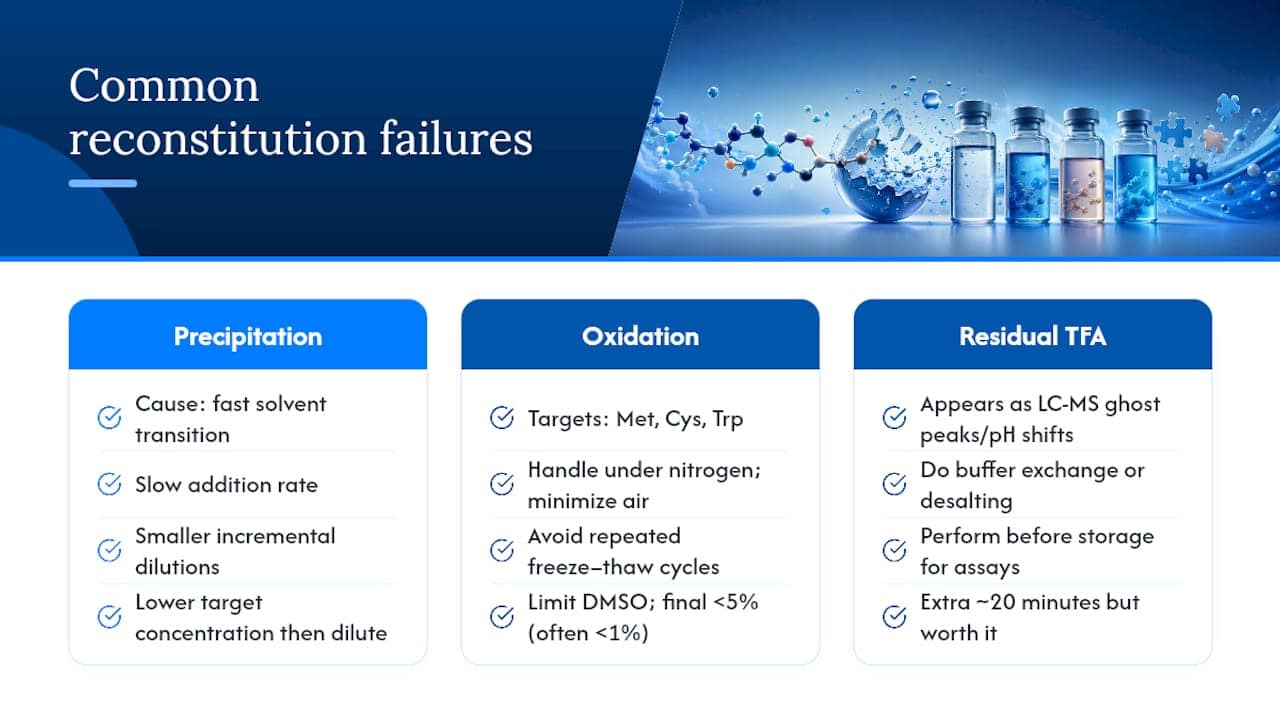
Most reconstitution failures fall into three buckets: precipitation, oxidation, and residual solvent artifacts. Each has a specific fix rather than a “try more solvent” answer.
Precipitation during dilution almost always means the organic-to-aqueous transition happened too fast. Slow the addition rate, dilute in smaller increments, or drop the target concentration and dilute further after full dissolution. A short sonication burst can also redissolve fine precipitate without heat damage.
Oxidation targets methionine, cysteine, and tryptophan residues specifically. Handling stocks under nitrogen or minimizing air exposure during aliquoting helps, and avoiding repeated freeze-thaw cycles matters more than most researchers assume. DMSO in particular can accelerate oxidation at these residues, and recommended final concentrations for cell-based assays commonly stay below 5%, often under 1% for sensitive cell types.
Residual TFA from HPLC purification shows up as ghost peaks in LC-MS or unexpected pH shifts in solution. A buffer exchange or desalting step before storage clears this up and is worth the extra 20 minutes if the peptide is headed into a sensitive assay.
Pro Tip: Keep a small log of which solvent combination worked for each peptide class you handle regularly. After a dozen entries, you’ll notice patterns that save you a full escalation cycle next time.
A Quick Checklist Before You Reconstitute Anything
Reproducibility starts before the vial is even opened. Run through this sequence every time:
- Confirm the lot-specific CoA matches the peptide in hand, and follow any vendor-specified solvent notes first.
- Reference the step-by-step reconstitution guide and the Peptide Calculator before calculating volumes.
- Record final solvent composition, pH, and storage temperature in your experiment log immediately after dissolution, not at the end of the day.
- Store solutions in glass or low-adsorption plastic, away from light, and at the temperature the CoA specifies rather than a lab default.
Skipping any one of these tends to show up later as an unexplained assay variance nobody can trace back.
Why Solvent Choice Is a Data Problem, Not a Guessing Game
Solvent selection gets treated as a minor technical step, but it’s often where reproducibility problems actually start. A peptide with an unknown or inconsistent purity profile makes every downstream solvent decision a guess dressed up as a protocol. Quality-controlled material with a real CoA removes one entire layer of uncertainty before you even pick up a pipette.
The other half of the equation is matching the solvent not just to the peptide’s chemistry but to what the assay downstream can tolerate. A perfectly dissolved peptide in 10% DMSO is useless if your cell line can’t handle more than 1%. And none of this happens in isolation. Every organic solvent on this list carries its own disposal requirements, and skipping that step isn’t a shortcut worth taking.
— Data Peptides
Get CoA-Backed Peptides and SOP Support From Data Peptides
Solvent choice only works as well as the peptide behind it. Research peptides with third-party testing and a Certificate of Analysis for each lot help ensure the solubility notes in your protocol match the material in the vial instead of a generic average. That consistency is what lets the stepwise reconstitution approach in this guide work the same way every time you run it.
Technical support is available if a specific peptide is giving you trouble in the reconstitution steps above. Browse the full research peptide catalog to find CoA-backed material for your next project, or start at the Data Peptides homepage to see current testing standards and shipping details.
Sources
- General Guidelines for Preparing Peptide Solutions (Pierce/Wolfson)
- Peptide solubility (Bachem Knowledge Hub)
- Solubility tips: Reconstituting a peptide (Biosynth PDF)
FAQ
What is the best solvent for peptides?
There isn’t one universal answer. Charged peptides dissolve best in water or buffer, while hydrophobic or aggregation-prone peptides need minimal DMSO, DMF, or acetonitrile diluted slowly into buffer afterward.
How do I dissolve peptides that won’t go into solution?
Escalate step by step: start with water or buffer, move to 0.1% acetic acid or ammonium hydroxide depending on charge, then use a small volume of DMSO or acetonitrile before diluting, aided by brief sonication or gentle warming if needed.
What are common peptide classes researchers reconstitute?
Research labs commonly work with growth factor peptides, metabolic peptides, and cognitive-support peptides, each with different charge and hydrophobicity profiles that call for different solvent starting points, which is why checking the vendor CoA before choosing a solvent path matters every time.
Can I use acetic acid for all peptides?
No. Acetic acid works well for basic peptides with a net positive charge, but acidic peptides typically dissolve better in dilute ammonium hydroxide, and hydrophobic peptides need an organic co-solvent regardless of charge.