

Yes: any peptide going into cell culture or animal work needs a batch-specific endotoxin figure, generated by LAL or recombinant Factor C (rFC), before it touches a sensitive system. The number should be reported in EU/mL or EU/mg with a stated method and lab name. If your current Certificate of Analysis doesn’t show that, treat the peptide as unverified and request the lot-matched report before you dose anything.
TL;DR:
- Peptides must be tested for endotoxin using batch-specific, validated methods like LAL or rFC assays before use in sensitive systems, with results reported in EU/mL or EU/mg.
- Endotoxin contamination can cause misleading immune or inflammatory responses in vivo, in cell assays, and with injections, confounding research outcomes.
- Proper sample preparation includes using endotoxin-free consumables, conducting spike recovery tests, and verifying interference controls to ensure accurate endotoxin measurement.
- A reliable Certificate of Analysis should match the lot number, specify the testing method, list the lab name, and include numeric results; blank fields indicate unverified or missing data.
- In-house kits offer quick results but lack third-party validation, while outsourcing to accredited labs provides document-proof, both requiring adherence to controls like spike recovery and standard curves.
Table of Contents
- What Is Endotoxin and Why It Matters for Research Peptides
- LAL Assay Formats and the rFC Alternative
- Preparing Peptide Samples to Avoid False Readings
- Reading the Numbers: EU/mL, EU/mg, and What Counts as Low Enough
- Removing and Preventing Endotoxin Contamination in Peptide Preparations
- How to Read a Peptide COA for Endotoxin Data
- Choosing an Assay: In-House Kits Versus Outsourcing
- Author Practices and What Data Peptides Verifies on Every Lot
- The Real Problem With Most Endotoxin Guidance
- Get Verified, Batch-Specific Peptides Without the Documentation Gap
- Sources
- FAQ
What Is Endotoxin and Why It Matters for Research Peptides
Endotoxin, more precisely lipopolysaccharide (LPS), is a structural component of the outer membrane of gram-negative bacteria. It sheds into solution during bacterial growth and death, including during peptide synthesis and purification, and it doesn’t care whether your peptide vial looks clean, clear, and perfectly lyophilized.
The problem researchers run into is that endotoxin survives processes that kill the bacteria that made it. Autoclaving, filtration, and standard sterilization eliminate live organisms but leave LPS largely intact. That is exactly why sterility testing (USP <71>) and endotoxin testing (USP <85>) answer two completely different questions on a Certificate of Analysis. A vendor should ideally report both separately rather than treating “sterile” as a stand in for “endotoxin free,” a distinction a practical CoA guide lays out clearly.
Why does any of this matter for a peptide sitting in a freezer? Because LPS is a potent activator of the innate immune system, triggering pyrogenic and inflammatory responses through Toll-like receptor 4 signaling. In practice, that means:
- In vivo dosing: even trace endotoxin can cause fever, hypotension, or cytokine storm in animal models, confounding the very effect you’re trying to measure.
- Immune cell assays: macrophages and monocytes are exquisitely sensitive to LPS, so a “positive” cytokine readout might just be endotoxin contamination, not your peptide.
- IV or injectable research protocols: endotoxin risk scales directly with route of administration and dose volume.
- Cell culture broadly: chronic low-level LPS exposure can shift proliferation, differentiation, or signaling baselines in ways that are easy to misattribute to the compound under study.
A peptide that looks pharmacologically active in vitro but was never checked for endotoxin is, at best, an ambiguous result.
LAL Assay Formats and the rFC Alternative
The workhorse standard here is the Limulus Amebocyte Lysate (LAL) test, and USP <85> defines three accepted formats.
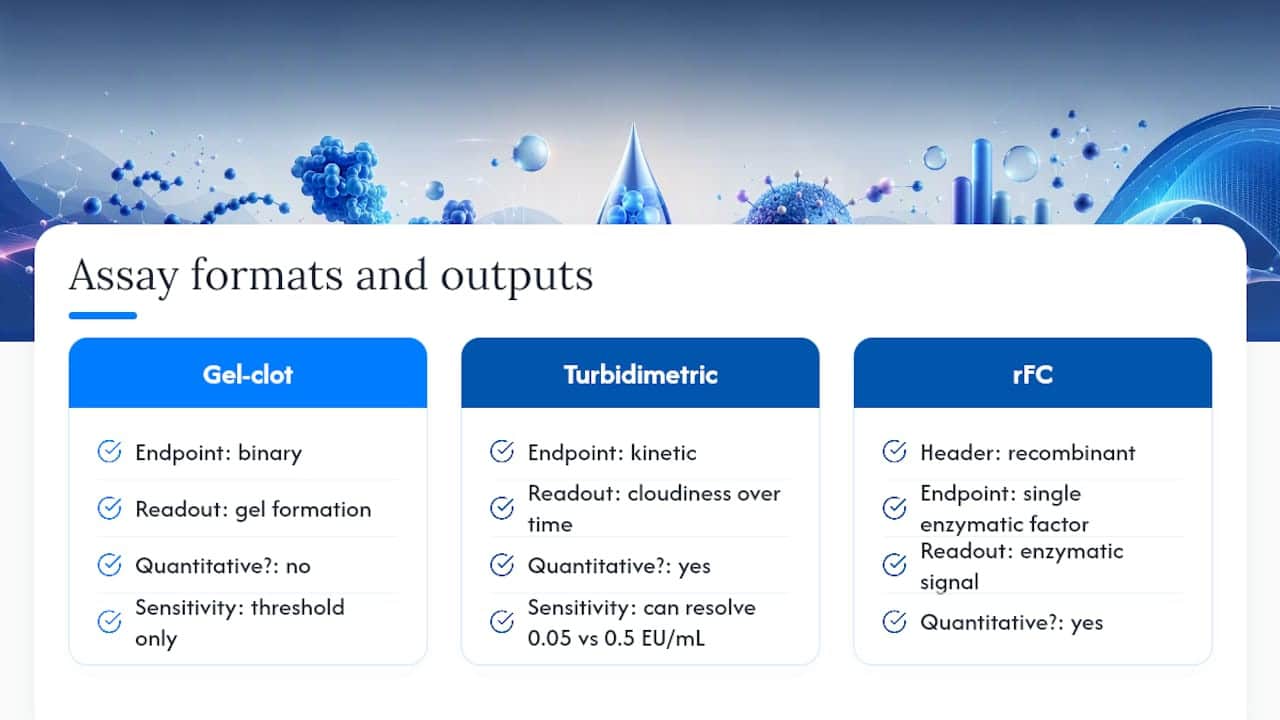
Gel-clot is the oldest and simplest: lysate mixed with sample either forms a firm gel (positive) or doesn’t (negative). It’s a binary endpoint test, cheap and low-tech, but it only tells you whether endotoxin is above or below a single threshold. It won’t give you a precise number.
Turbidimetric LAL measures the cloudiness that develops as the clotting reaction proceeds, read kinetically over time on a plate reader. This gives you a quantitative curve rather than a yes/no answer, which matters when you need to know if a peptide is at 0.05 EU/mL versus 0.5 EU/mL.
Chromogenic LAL uses a synthetic substrate that releases a colored compound proportional to enzymatic activity in the clotting cascade, read spectrophotometrically. It’s the format most commercial peptide-testing kits use, including the Thermo Scientific Pierce Chromogenic Endotoxin Quantitation Kit, which detects endotoxin down to roughly 0.01 EU/mL and is built for compatibility with protein and peptide samples.
Recombinant Factor C (rFC) is the animal-free alternative gaining traction as labs move away from horseshoe crab derived lysate. rFC assays use a single recombinant enzyme rather than the full LAL clotting cascade, which in many cases makes them less prone to false positives from beta-glucans, a known interferent in cascade-based LAL tests.
Sensitivity snapshot: Commercial kits, including Thermo Fisher’s chromogenic and fluorescent platforms, commonly reach detection ranges spanning roughly 0.01 to 10.0 EU/mL depending on format. That range is what makes them viable for pre-screening peptides destined for sensitive cell or animal studies.
None of these formats works reliably without preparatory controls. USP <85> requires inhibition and enhancement testing, sometimes called spike recovery, on every new sample matrix before you can trust a result. Skip that step and a masked or artificially inflated reading can slip through unnoticed.
Preparing Peptide Samples to Avoid False Readings
Getting a clean endotoxin result starts before the assay ever runs. Sample prep errors are the most common reason labs get results that don’t match reality.
- Use endotoxin-free consumables. Tubes, tips, and diluents all need to be certified LAL-reagent water or endotoxin-free equivalents. A “clean” tube from a general lab stock can carry enough residual LPS to skew a low-range result.
- Build a proper dilution series. Reconstitute the peptide, then dilute it across a range designed to land your expected concentration inside the assay’s validated dynamic range, not at the edges where sensitivity drops off.
- Run spike recovery (IECs) on every new matrix. Add a known quantity of endotoxin standard to a sample aliquot and confirm you recover it within the compendial acceptance window, generally 50% to 200% of the expected value. This is the step USP <85> makes non-negotiable, and it’s the step most commonly skipped by labs in a hurry.
- Watch for known interferents. Salts, detergents, chelators, and carrier proteins used in some peptide formulations can inhibit or enhance the LAL cascade. Diluting further, or switching to an rFC format less sensitive to beta-glucan-type interference, often resolves it.
- Send a pre-test aliquot if you’re unsure. Most accredited labs will run a small-scale inhibition/enhancement check before committing to a full quantitative run, saving you a wasted assay.
Pro Tip: Keep a frozen aliquot of every lot you test. If a result looks off, or a downstream cell assay behaves strangely, you want the exact same material available to retest without waiting on a new shipment.
Reading the Numbers: EU/mL, EU/mg, and What Counts as Low Enough
Endotoxin Units (EU) are the standardized measure of LPS activity, calibrated against a reference standard, not a direct mass measurement. That distinction matters because two peptides with identical mass-based purity can carry very different endotoxin loads.
Results get reported two ways. EU/mL reflects the concentration in a reconstituted solution, the number that matters the moment you’re pipetting peptide into a well or a syringe. EU/mg reflects endotoxin relative to the mass of peptide, useful for comparing lots or vendors independent of how you personally reconstitute the product. Converting between them requires knowing your exact reconstitution volume and total peptide mass, and any error in that math propagates directly into your working concentration. If a vendor only gives you EU/mg, do the conversion yourself before you assume a lot is safe at your dilution.
Threshold guidance varies by downstream use, and it’s worth treating these as practical planning ranges rather than fixed regulatory cutoffs for research reagents:
- Sensitive immune cell assays (macrophage, monocyte, dendritic cell work): researchers typically aim for the lowest detectable endotoxin possible, often at or below the assay’s limit of quantitation.
- Routine cell culture (non-immune cell lines): moderate tolerance is more common, but consistency across lots matters as much as the absolute number.
- In vivo dosing considerations: this is where lot-to-lot consistency and a documented, low EU/mL figure carry the most weight, given how directly endotoxin exposure scales with injected volume and frequency.
Whatever range you’re targeting, batch specificity is non-negotiable. A COA from a different lot number, even of the identical peptide from the identical vendor, tells you nothing about the vial in front of you. And no conversion or extrapolation replaces a fresh lot-specific measurement. Measurement uncertainty in LAL assays typically runs in the range of plus or minus one dilution step, which is one more reason to treat borderline results with caution rather than rounding down to “acceptable.”
Removing and Preventing Endotoxin Contamination in Peptide Preparations
When a lot comes back too high, manufacturers have a handful of real options, each with tradeoffs.
- Affinity resins (polymyxin B or similar ligands) bind LPS selectively and can pull endotoxin out of solution with relatively little loss of peptide, though resin capacity and nonspecific binding can affect yield on smaller-scale preps.
- Ultrafiltration separates by molecular size, which works well when the peptide is meaningfully smaller than LPS aggregates, but can be inefficient if the peptide and endotoxin micelles overlap in size.
- Two-phase extraction methods exploit differences in hydrophobicity, useful for certain peptide chemistries but not universally applicable.
- Heat-based depyrogenation, standard for glassware and heat-stable equipment, generally cannot be used on the peptide itself. Most peptides denature or degrade under the temperatures needed to destroy LPS, so this tool applies to your labware, not your product.
Prevention beats removal every time, because every purification step you add to fix a high-endotoxin lot risks degrading peptide integrity or losing yield. Upstream, that means endotoxin-free water and buffers throughout synthesis and purification, tightly controlled bioburden during any cell-based production step, and consistent use of depyrogenated glassware and single-use, certified-low-endotoxin plasticware.
After any removal step, retest before you use the material. A single passing result on a reworked lot should still meet the same inhibition/enhancement acceptance criteria as a first-pass lot. Treat it as a new lot, not a patched one.
How to Read a Peptide COA for Endotoxin Data
A trustworthy Certificate of Analysis makes verification simple. Here’s what to check, in order:
- Lot number match. The lot on the COA must match the lot on your physical vial exactly. Mismatches are the single most common documentation failure.
- Date of analysis and named lab. A COA with no lab name, or a date that predates the batch’s actual manufacturing, is a red flag.
- Method disclosed. It should state LAL (and which format) or rFC, not just “endotoxin tested.”
- Units reported. EU/mL or EU/mg, with enough context to know what dilution or mass basis was used.
- Spike recovery and LOD/LOQ noted, if the lab makes that available, confirming the result wasn’t masked by matrix interference.
- Sterility tested separately, where applicable, since it answers a different question than endotoxin.
Pro Tip: If the endotoxin field is simply blank, that is not the same as a passing result. A blank field is silence, not a pass, and the right move is a direct written request for the numeric result, method, and lab name before you use that lot.
Vendors serious about quality control will hand over that documentation without pushback. If they can’t or won’t, that hesitation tells you something too.
Choosing an Assay: In-House Kits Versus Outsourcing
If you’re testing occasionally and need fast turnaround, in-house chromogenic kits, including the Pierce kit or Invitrogen’s Quant-iT and Qubit endotoxin detection assays, let you screen samples same-day with a plate reader you likely already own. The tradeoff is that in-house results carry your lab’s own validation, not third-party accreditation.
Outsourcing to a GLP- or ISO/IEC 17025-accredited lab makes sense when you need documentation that will hold up in a publication, a regulatory submission, or a vendor dispute. Request the same items you’d check on any COA: lot match, method, units, and spike recovery data in the report itself, not just a pass/fail summary.
Whichever route you take, don’t skip the baseline controls:
- Inhibition/enhancement (spike recovery) on every new matrix
- A standard curve run alongside every batch
- Negative and positive controls in each assay run
Cutting these corners is how labs end up trusting numbers that were never actually valid.
Author Practices and What Data Peptides Verifies on Every Lot
A vendor may commission third-party testing on its research peptides and provide Certificates of Analysis documenting lot number, testing date, and method used, the exact fields this guide walks you through checking. That’s not a substitute for your own inhibition/enhancement testing once material arrives in your lab, but it gives you a documented starting point rather than a blank field.
When you receive a COA from any vendor, including Data Peptides, verify these items yourself:
- Lot number on the document matches the lot on the vial
- Testing lab is named, with method (LAL format or rFC) specified
- Endotoxin units are reported as EU/mL or EU/mg, not left ambiguous
- Date of analysis is recent relative to the batch
Guidance on peptide laboratory standards covers these documentation practices in more depth if you’re building out your own lab’s vendor-qualification checklist.
The Real Problem With Most Endotoxin Guidance
Most articles on this topic describe assays in detail and then stop, as if knowing how LAL works solves the researcher’s actual problem. It doesn’t. The real failure point isn’t the science of the chromogenic reaction. It’s the gap between a vendor’s marketing claim of “third-party tested” and a document that actually names a lab, a lot, a method, and a number.
Conventional advice treats endotoxin testing as a manufacturing checkbox, something that happened somewhere upstream and can be trusted by default. That’s backward for anyone running sensitive cell or animal work. The number on a COA is only as good as your ability to trace it to the exact vial in your hand, and a huge share of documentation failures aren’t fraud. They’re stale paperwork, mismatched lots, or a vendor that ran a method insensitive enough to miss a real problem.
If you take one thing from this guide, prioritize the lot match and the named lab before you even look at the EU/mL number. A precise figure attached to the wrong batch is worse than no figure at all, because it creates false confidence. Verify the paper trail first. Then trust the science.
— Data Peptides
Get Verified, Batch-Specific Peptides Without the Documentation Gap
Sourcing research peptides shouldn’t mean chasing a vendor for a lab name after the fact. A reputable peptide supplier may ship lab-grade peptides with Certificates of Analysis that name the testing lab, the lot, the method, and the date, so you can check the boxes this guide covers instead of guessing at them.
If you’re placing your next order, the ordering guide for researchers walks through what to check on your COA before you run a single assay, and the peptide shop has current lots available with documentation attached. Start there before your next batch goes into a plate.
Sources
- Bacterial Endotoxins Test (USP <85>)
- Overview of endotoxin testing methods | Thermo Fisher Scientific
- Peptide Endotoxin Testing: LAL Assay and COA Interpretation
FAQ
How Do You Test Peptides for Endotoxin?
Peptides are tested using LAL assays (gel-clot, turbidimetric, or chromogenic) per USP <85>, or with rFC as an animal-free alternative, after running inhibition/enhancement controls to confirm the result isn’t masked by sample interference.
How Much Endotoxin Is Acceptable in Research Peptides?
Acceptable levels depend on downstream use rather than one universal number: sensitive immune cell assays call for the lowest detectable result possible, routine cell culture tolerates a moderate range, and in vivo dosing work should prioritize a documented, lot-specific, low EU/mL figure with consistent results across batches.
Does Peptide Sciences Test for Endotoxin?
Endotoxin testing practices vary by vendor and aren’t something a third party can verify without seeing that specific company’s own documentation. The safest approach with any supplier is to request a lot-specific COA showing the method, lab name, and numeric endotoxin result rather than assuming testing occurred.
What Are the Symptoms of Endotoxin Exposure in Research Settings?
In animal models, endotoxin exposure commonly triggers fever, inflammatory cytokine release, and in higher doses hypotension or shock-like responses. In cell culture, it can appear as unexplained shifts in immune cell activation or cytokine output that get mistakenly attributed to the peptide under study.
What Should a Trustworthy Peptide COA Include for Endotoxin?
A reliable COA lists the lot number matching your vial, the testing lab’s name, the method used (LAL format or rFC), the date of analysis, and a numeric result in EU/mL or EU/mg. A blank endotoxin field is silence, not a passing result, and warrants a direct request for the missing data.