
GHK-Cu is a naturally occurring, copper-binding tripeptide with reproducible pro-repair effects across cell and animal models, driven by broad gene-expression changes rather than a single receptor pathway. Human evidence is strongest for topical cosmetic and wound applications, though the clinical record remains small and uneven. Formulation quality controls most of what a given study finds, and systemic use has no FDA approval and stays firmly in the research-only category.
TL;DR:
- GHK-Cu influences roughly 31.2% of human genes, mainly affecting extracellular matrix production, TGF-beta signaling, and antioxidant defense pathways.
- Topical GHK-Cu formulations consistently promote wound closure, collagen synthesis, and angiogenesis in animal models, but optimal dosing and vehicle influence outcomes significantly.
- Human clinical evidence remains limited and outdated, with only one small trial showing notable improvement in diabetic ulcer healing, pending validation from upcoming studies.
- The peptide’s biological activity is highly sensitive to formulation chemistry, especially pH and copper coordination, which can alter its effectiveness in topical applications.
- Systemic or injectable GHK-Cu lacks human safety data and regulatory approval, confining current research use to laboratory settings with strict quality and safety standards.
Table of Contents
- Biochemistry and mechanism: copper binding, speciation, and gene-expression effects
- Preclinical and in vivo evidence: wound healing, angiogenesis, and nerve growth
- Human clinical evidence and regulatory status: what trials actually show
- Formulation, delivery, and stability: what determines topical effectiveness
- Safety, side effects, and practical cautions for researchers
- Research gaps, standardization needs, and future directions
- Sourcing lab-grade GHK-Cu for research
- Where GHK-Cu research is heading next
- Research-grade GHK-Cu, documented and ready for the lab
- Sources
- FAQ
Biochemistry and mechanism: copper binding, speciation, and gene-expression effects
GHK-Cu is a naturally occurring human tripeptide (glycyl-L-histidyl-L-lysine bound to copper) detectable in plasma, saliva, and urine. It is released from extracellular matrix proteins such as SPARC and collagen during tissue injury, acting as a matrikine, a fragment of a larger protein that carries its own signaling message once freed. Plasma concentrations fall substantially with age, declining significantly by age 60 compared to age 20, a decline that tracks with reduced regenerative capacity according to the review GHK Peptide as a Natural Modulator of Multiple Cellular Pathways in Skin Regeneration.
The histidine residue in GHK gives the peptide its copper affinity, and that coordination chemistry is not fixed. Small shifts in pH, ionic strength, or the presence of competing ligands (albumin, other metals, buffer components) can push the complex between binary and ternary coordination states. Because biological activity depends on which state predominates, two labs using nominally the same peptide concentration can see different results if their buffers or vehicles differ, a point formulation researchers return to repeatedly, as discussed further below.
Mechanistically, copper delivery is central to GHK-Cu’s activity. The peptide helps shuttle copper to enzymes that depend on it, including lysyl oxidase, which cross-links collagen and elastin during matrix repair, and superoxide dismutase (SOD), a core antioxidant enzyme. Preclinical work summarized in Regenerative and Protective Actions of the GHK-Cu Peptide in the Light of the New Gene Data reports that GHK-Cu increases SOD activity, blocks copper-dependent LDL oxidation in vitro, and detoxifies reactive carbonyl species such as acrolein and 4-hydroxynonenal, byproducts of lipid peroxidation that otherwise damage proteins and DNA.
What separates GHK-Cu from a conventional single-target peptide is the scale of its transcriptional footprint. Bioinformatic work using Connectivity Map datasets, cited in reviews including PMC4180391, found that GHK-Cu can shift expression of roughly 31.2% of human genes by at least 50% in some analyses, moving overall gene profiles toward repair-associated patterns rather than degenerative ones.
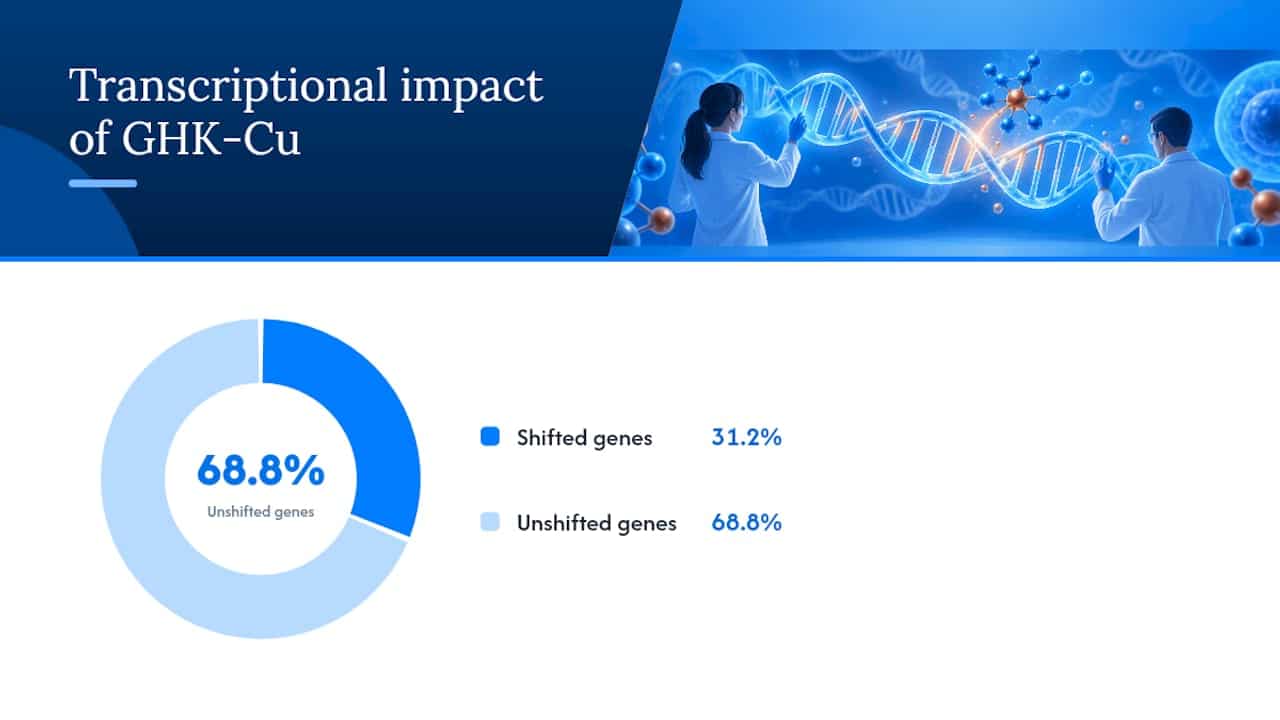
Roughly 31.2% of human genes show a 50%+ expression change in some Connectivity Map analyses of GHK-Cu, according to PMC4180391. That scale of transcriptional influence explains why the peptide’s effects show up across skin, lung, and nerve tissue rather than in one narrow pathway.
The gene programs most consistently affected include:
- Extracellular matrix genes: collagen, elastin, and proteoglycan synthesis pathways tied to structural repair.
- TGF-beta signaling: a pathway central to fibroblast activity and scar formation.
- NF-kB related inflammatory genes: modulation here underlies the antioxidant and anti-inflammatory effects seen in preclinical models.
- Antioxidant defense genes: including those governing SOD and glutathione-related enzymes.
For researchers designing new experiments, the practical implication is straightforward. A single-endpoint assay, say, only measuring collagen output, will miss most of what GHK-Cu is doing. Transcriptomic or multi-marker endpoints give a more honest read on mechanism and make it easier to draw causal conclusions rather than correlational ones. Background literature frames GHK-Cu as a network modulator that operates by delivering copper to key enzymes while simultaneously adjusting broad gene-expression programs, not as a conventional growth factor with one receptor and one downstream effect. Readers interested in the underlying chemistry of copper-binding peptides more broadly can find additional background in Copper Tripeptide: Research Mechanisms and Applications.
Preclinical and in vivo evidence: wound healing, angiogenesis, and nerve growth
The animal and cell-culture literature on GHK-Cu is where the mechanistic story gets tested against physiology, and the results are consistent enough across models to count as a genuine evidence base, even though most work stops short of human trials.
Wound-healing models are the most studied application. Across rodent and other animal wound models, topical GHK-Cu formulations have been associated with faster closure rates, increased collagen deposition, and greater new blood vessel formation compared to untreated or vehicle-only controls, per the mechanistic synthesis in Regenerative and Protective Actions of the GHK-Cu Peptide in the Light of the New Gene Data. These studies typically apply the peptide at low micromolar to low millimolar concentrations in a gel or cream vehicle, though exact dosing varies enough between papers that direct cross-study comparison is difficult without checking each paper’s vehicle and concentration units.
Beyond skin, systemic and organ-specific models show a parallel pattern. Lung injury models have reported reduced markers of inflammation, including lower TNF-alpha and IL-6 levels, alongside increased SOD activity, consistent with the antioxidant and anti-inflammatory mechanisms described in the biochemistry section above. Angiogenesis assays, both in animal tissue and in cultured endothelial cells, show increased vessel formation in the presence of GHK-Cu, an effect relevant to any application where blood supply limits healing. Nerve outgrowth studies in preclinical models have also reported enhanced neurite extension, suggesting a role beyond skin and vascular tissue.
At the cellular level, several consistent findings recur across independent studies:
- Fibroblast restoration: aged or senescent fibroblasts treated with GHK-Cu show renewed proliferation and increased collagen and glycosaminoglycan synthesis.
- Keratinocyte photoprotection: cultured keratinocytes exposed to UV damage show reduced oxidative injury when co-treated with GHK-Cu.
- MMP and TIMP modulation: GHK-Cu shifts the balance between matrix metalloproteinases (enzymes that break down collagen) and their tissue inhibitors, favoring net matrix stabilization rather than breakdown, an effect documented in the same preclinical synthesis cited above.
- Reduced lipid peroxidation byproducts: cultured cells and tissue extracts treated with GHK-Cu show lower levels of reactive carbonyl species, the same detoxification mechanism described in the biochemistry section.
These findings are reproducible enough across labs and models that the core biology, copper delivery, antioxidant protection, and ECM remodeling, is not seriously in dispute among researchers working in this space. The harder question is translation.
Three caveats matter for anyone trying to extrapolate preclinical results to human application. First, species differences in skin thickness, immune response, and wound-healing kinetics mean rodent closure rates do not map directly onto human timelines. Second, concentration disparities across studies, some reporting micromolar ranges, others millimolar, make it hard to identify an optimal dose without a head-to-head comparison, which the field currently lacks. Third, and most consistently underappreciated, the vehicle matters as much as the peptide. A GHK-Cu formulation tested in a simple aqueous gel behaves differently than the same peptide delivered in a liposomal carrier or lipid-based cream, because the surrounding chemistry changes copper coordination and skin penetration alike. Any lab attempting to replicate a published preclinical result should treat the vehicle as a variable worth controlling, not an incidental detail. Related background on peptide use in wound-repair research designs is available in Peptides for Healing: Research & Laboratory Applications.
Human clinical evidence and regulatory status: what trials actually show
Human data on GHK-Cu exist, but the record is thin, old in parts, and inconsistent in design, which is the main reason claims about the peptide often outrun what has actually been demonstrated in people.
The most frequently cited clinical result is a 1994 Phase III trial in diabetic ulcer patients (N=40), which reported a healing rate of 77% in the GHK-Cu treated group versus 45% in controls, according to the trial record summarized on PubMed. That gap is substantial, but the trial is decades old, small, and has not been replicated at scale with modern blinded methodology.
A 1994 diabetic ulcer trial (N=40) reported 77% healing in the GHK-Cu group versus 45% in controls, per the record on PubMed, a result that remains one of the strongest human signals for GHK-Cu but has not been confirmed by a comparably sized modern trial.
Cosmetic research tells a similar story of promise mixed with methodological limits. Facial cream trials over roughly 12-week periods have reported subjective improvements in fine lines and skin appearance, but many rely on self-reported or investigator-rated scales rather than blinded objective imaging. A small post-laser resurfacing study (N=13) tested topical GHK-Cu for recovery after CO2 laser treatment and did not meet its objective endpoints, despite some subjective improvement, per the same PubMed-indexed record. That mismatch between subjective and objective outcomes is a recurring theme in the human GHK-Cu literature.
The core problems limiting confidence in the clinical record include:
- Small sample sizes: most human trials enroll well under 100 participants, limiting statistical power.
- Inconsistent formulations: concentration, vehicle, and application frequency vary enough between studies that pooling results is not straightforward.
- Subjective versus objective endpoints: many cosmetic trials rely on patient-reported satisfaction rather than blinded photo-planimetry or histology.
- Publication age: several of the most-cited positive results predate current trial design standards.
The clearest step toward filling this gap is underway now. NCT07437586, known as the CuHeal trial, is a Phase 2 randomized, double-blind, vehicle-controlled split-wound study testing a topical GHK-Cu 0.1% w/w gel applied once daily for 14 days in an enrollment of 60 participants. The primary endpoint is time to complete re-epithelialization, with quantitative photographic planimetry and scar quality measures built into the design. Estimated primary completion is 2027, with full completion expected in 2028. This is the kind of blinded, controlled design the field has largely lacked, and its results will matter more than most of the existing literature combined.
On regulatory status, the distinction that matters most is route of administration. Topical cosmetic use of GHK-Cu is widespread and unregulated as a drug claim, the same way most cosmetic peptide ingredients are marketed. There is no FDA approval for GHK-Cu as a systemic or injectable therapeutic for any indication, and no primary regulatory pathway currently supports that use. For a broader view of where topical human evidence is strongest and where systemic claims outrun the data, see The potential of GHK as an anti-aging peptide.
Formulation, delivery, and stability: what determines topical effectiveness
Formulation is not a footnote in GHK-Cu research, it is often the reason two studies of the “same” peptide reach different conclusions. The peptide’s copper coordination state, and therefore its biological activity, is sensitive to pH, ionic composition, and the presence of competing ligands in the vehicle, a point reviewed in the pharmaceutics literature on peptide delivery (MDPI Pharmaceutics).
Delivery systems shape outcomes as much as concentration does:
- Standard aqueous gels or creams: the most common vehicle in cosmetic and early wound studies, adequate for surface-level application but limited in penetration depth.
- Liposomal encapsulation: improves transdermal bioavailability in experimental settings by protecting the peptide and aiding penetration through the stratum corneum.
- Microneedle-assisted delivery: creates microchannels that bypass the skin barrier, an approach used experimentally to improve peptide penetration beyond what topical application alone achieves.
- Post-procedure application: used after laser resurfacing or microneedling, when the skin barrier is already disrupted and peptide penetration is naturally higher.
Pro Tip: When comparing published GHK-Cu studies, check the vehicle and pH before comparing concentrations, since the same nominal dose can behave very differently depending on formulation chemistry.
For labs storing GHK-Cu as a research reagent, standard peptide handling practices apply: store lyophilized peptide at negative 20 degrees Celsius or below, protect reconstituted solutions from light and repeated freeze-thaw cycles, and confirm stability under the specific buffer conditions used in the experiment rather than assuming stability data from a different formulation will transfer. Because small changes in pH or trace ions can switch the peptide between binary and ternary copper complexes, running an analytical check, such as UV-visible spectroscopy or mass spectrometry, on a new batch or buffer system is worth the time before committing to a full experimental run. Background on how a related copper peptide’s delivery considerations compare is available in AHK-Cu: The Copper Peptide Transforming Hair Research.
Safety, side effects, and practical cautions for researchers
Topical GHK-Cu has a favorable safety profile in the contexts it has actually been tested. Cosmetic and small wound trials report good local tolerability, with no consistent signal of systemic toxicity when applied to intact or healing skin.
The safety picture changes for any route beyond topical application. Systemic or injectable use has essentially no human safety data, and copper homeostasis is a legitimate concern: copper is essential in small amounts but toxic in excess, and there is no established human dosing framework for systemic GHK-Cu administration. This is not a minor caveat, it is the main reason systemic use remains confined to preclinical models.
Practical cautions for labs working with GHK-Cu:
- Verify the Certificate of Analysis for every batch, confirming both identity and purity before use in any experiment.
- Check endotoxin data on lab-grade material, particularly for any application involving cell culture or in vivo work.
- Confirm intended-use statements match the experiment: research-use-only material is not qualified for human or animal administration outside an approved protocol.
- Apply the same caution to topical human studies as to any other trial: an IRB or equivalent ethics review is required for human research regardless of how benign the topical safety record appears.
Research gaps, standardization needs, and future directions
The single biggest obstacle to trusting GHK-Cu’s clinical potential is not the mechanism, it is inconsistency in how studies are built. Dose units vary between micromolar, millimolar, and percentage weight measures without conversion. Head-to-head comparisons of delivery systems, liposomal versus microneedle versus standard gel, are essentially absent from the literature.
Priorities for closing these gaps include:
- Standardized dosing and vehicle reporting, so a millimolar concentration in one paper can be compared directly to a percentage weight in another.
- Blinded, objective endpoints such as photo-planimetry for wound closure and validated scar-quality scales rather than investigator impression.
- Paired-wound trial designs, where treated and untreated sites exist on the same patient, reducing inter-subject variability.
- Integrated biomarker and transcriptomic endpoints, given how much of GHK-Cu’s activity operates at the gene-expression level rather than a single measurable protein.
- Combination and next-generation delivery studies, testing GHK-Cu alongside other regenerative peptides or within newer delivery platforms to see whether effects are additive.
The CuHeal trial (NCT07437586) is a meaningful step in this direction, and its 2027 to 2028 timeline gives the field its first modern, blinded, controlled dataset on topical GHK-Cu wound healing in years.
Sourcing lab-grade GHK-Cu for research
A Certificate of Analysis worth trusting confirms peptide identity (typically by mass spectrometry), purity percentage, and an endotoxin result, since contamination can confound cell-based and in vivo assays independent of the peptide itself. Before running an experiment, cross-check the batch-specific COA against the vendor’s stated specifications rather than a generic product page. Any GHK-Cu sourced for laboratory work should carry a clear research-use-only designation and never be represented as suitable for human or animal administration outside an approved protocol. Documentation and specifications for GHK-Cu are available on the GHK-Cu product page.
Where GHK-Cu research is heading next
The strongest evidence for GHK-Cu sits in mechanism and preclinical repair biology, not in the clinical record, which is still too small and too inconsistent to settle most practical questions. The main translational barrier is not the peptide’s biology, it is the absence of standardized dosing, vehicle, and endpoint reporting across studies, which makes cross-study comparison harder than it should be.
Labs working in this space would get more out of the field by adopting paired-wound designs and objective imaging endpoints, and by reporting concentration in a way that can be converted across units. Researchers interested in generating comparable, reproducible data, or in discussing standardized formulation approaches, are welcome to reach out with questions about documentation and batch specifications.
— Data Peptides
Research-grade GHK-Cu, documented and ready for the lab
Reproducible results start with knowing exactly what is in the vial. Research-grade GHK-Cu typically ships with third-party testing and a Certificate of Analysis covering identity and purity, so a formulation question in your protocol does not double as a question about the material itself. That documentation matters most when you are trying to compare your results against the published literature, where vehicle and concentration differences already introduce enough variability without adding uncertainty about the peptide.
These materials are sold for laboratory research use only. Researchers who need verified GHK-Cu, or want to browse related compounds for regenerative and recovery research, can find current documentation and specifications in the research peptide shop.
This article is general information, not a substitute for advice from a qualified doctor. Consult a qualified healthcare professional about your own circumstances before acting on anything here.
Sources
- GHK Peptide as a Natural Modulator of Multiple Cellular Pathways in Skin Regeneration – PMC
- Clinicaltrials
FAQ
Is GHK-Cu peptide FDA approved?
GHK-Cu is not FDA approved as a systemic or injectable therapeutic for any medical condition. It is commonly used as a cosmetic ingredient in topical products, which follows a different regulatory path than a drug approval, and it is sold elsewhere strictly for laboratory research use.
Is GHK-Cu worth the research attention it gets?
The mechanistic and preclinical evidence is genuinely strong, with reproducible antioxidant, anti-inflammatory, and matrix-remodeling effects across cell and animal models. The human clinical record is thinner and more inconsistent, so its reputation currently runs ahead of confirmed clinical outcomes, which is exactly why trials like NCT07437586 matter.
What are the main risks of using GHK-Cu?
Topical use in cosmetic and small wound studies has shown good local tolerability with no consistent systemic safety signal. Systemic or injectable use carries real theoretical risk tied to copper homeostasis disruption and has essentially no human safety data, which is why it remains confined to research settings rather than clinical use.
How strong is the clinical trial evidence for GHK-Cu wound healing?
The most cited human result is a 1994 diabetic ulcer trial (N=40) reporting 77% healing versus 45% in controls, according to the record on PubMed, but it has not been replicated at scale with modern blinded methods. A new Phase 2 trial, NCT07437586, is currently testing topical GHK-Cu gel with objective endpoints and is expected to complete around 2028.
What should researchers check before buying GHK-Cu for lab use?
Confirm the batch carries a Certificate of Analysis verifying both identity and purity, along with endotoxin testing if the material will be used in cell culture or in vivo work. Also confirm the product is explicitly labeled for laboratory research use only, since that designation determines what the material is qualified for.