

Frozen shipments need dry ice: nothing else holds items solidly below freezing for a full transit. Refrigerated shipments do better with gel packs, which hold a steady chilled band without the hazmat paperwork. The catch is that dry ice falls under strict carrier and DOT rules, while gel packs need more mass and better insulation to survive long, hot lanes.
TL;DR:
- Dry ice requires less mass than gel packs to maintain temperature for 24 hours, making it more weight-efficient on air routes, especially in hot conditions.
- Dry ice must be shipped following strict hazardous material regulations, including proper labeling, venting, and handling precautions to prevent dangerous pressure buildup.
- Gel packs are suitable for refrigerated products and some medications but cannot reliably keep items frozen over long or hot lane transits.
- Proper insulation and enlarging coolant mass, along with margin testing, significantly improve cold-chain reliability and shipping success.
- Using slightly more coolant than minimum calculated amounts leads to more dependable temperature control and avoids cold chain failures.
Table of Contents
- Quick comparison of temperature, safety, and cost
- Why sublimation and phase change behave so differently
- Matching the coolant to the shipment
- Handling rules for dry ice and safe practices for gel packs
- Sizing shipments and packing them correctly
- What coolant choice does to cost and carbon
- Lab shipping checklist for temperature-sensitive research materials
- Why margin beats minimums on real shipping lanes
- How temperature-sensitive research materials are shipped
- Sources
- FAQ
Quick comparison of temperature, safety, and cost
Dry ice sublimates at -109.3°F (-78.5°C), so it keeps payloads solidly frozen for the length of most transit windows. Gel packs are water or polymer-based phase-change materials built to hold a refrigerated band, generally 32 to 40 degrees Fahrenheit, and they cannot keep something frozen over a long haul.
Duration planning differs too. Dry ice is typically budgeted by pounds per 24 hours based on box size and insulation, while gel packs are sized by weight relative to the payload for 24 to 48 hour windows. Regulation is the other dividing line: dry ice ships under the UN1845 hazard designation with labeling and air-quantity limits, while gel packs are generally unregulated, though shippers should confirm the gel is food-safe when it touches edible products.
- Frozen goods (ice cream, frozen meat, some biologics): use dry ice.
- Refrigerated goods (produce, chocolates, many medications): use gel packs.
- Long or hot lanes: increase dry ice mass or upsize gel pack mass and insulation together.
In published lane testing, dry ice configurations validated at around 3.3 pounds (1.5 kg) for 24-hour reliability, compared with 4.4 to 6.6 pounds (2 to 3 kg) of gel packs needed for a similar window. That gap is the practical reason dry ice often wins on weight-sensitive air lanes.
Why sublimation and phase change behave so differently
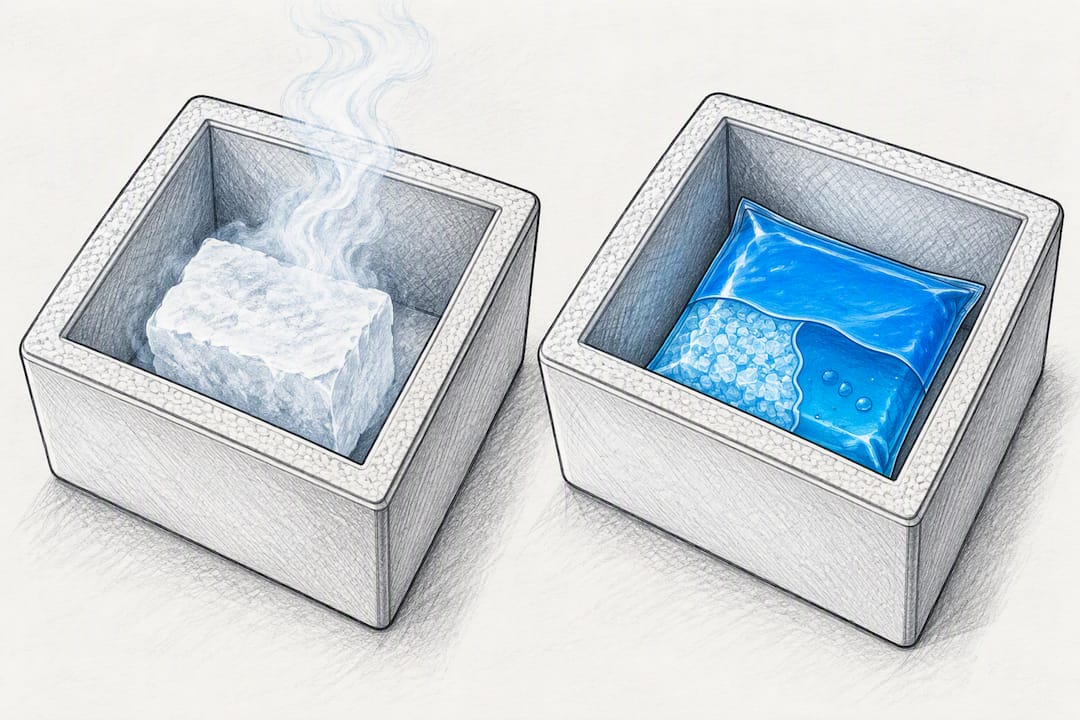
Dry ice is solid carbon dioxide. It skips the liquid stage entirely and converts straight to gas, a process called sublimation, at -109.3°F (-78.5°C). That transition absorbs a large amount of heat per pound, which is why a relatively small mass of dry ice can hold a deep freeze for an extended period.
Gel packs work through a milder phase change. Most contain water or an engineered polymer that melts near 32°F, or a formulated PCM tuned closer to typical refrigerator temperatures. Melting absorbs far less heat per pound than sublimation, so gel packs need more mass to do a comparable job.
- Insulation quality, box construction, and ambient temperature all change how long either coolant actually lasts in transit.
- A well-insulated container with a high R-value stretches the life of both dry ice and gel packs.
- Gel packs are more likely to fail on hot, air-connected summer lanes where ambient heat overwhelms their smaller thermal margin, while dry ice keeps a larger buffer even under stress.
Matching the coolant to the shipment
- Ice cream and frozen desserts: dry ice is the only practical choice since any partial thaw ruins texture and cannot be reversed by re-freezing.
- Frozen meat and seafood: dry ice preserves the frozen state through multi-day transit, which gel packs cannot guarantee.
- Frozen biological samples: some lab specimens require a hard freeze for the entire route, making dry ice the default.
- Refrigerated produce and chocolates: gel packs hold the cooler band without over-freezing delicate items that would bruise, weep, or seize up.
- Many medications: these often specify a refrigerated range rather than frozen, so gel packs match the requirement without risking damage from freezing.
- Mixed-temperature loads: pack frozen items with dry ice at the base and refrigerated items buffered by gel packs, separated by insulation so the two zones do not merge.
- Items that must never freeze: some vaccines, certain biologics, and specific produce items are damaged by freezing, so gel packs (never dry ice) are the right call even on longer routes.
Handling rules for dry ice and safe practices for gel packs
Dry ice ships as a hazardous material under the UN1845 designation, and packages need Class 9 labeling along with the net weight of dry ice marked on the outside. USPS packaging rules limit how much dry ice can move by air per mailpiece and require the “Dry Ice, UN1845” marking regardless of mode; surface shipments carry fewer restrictions but still need correct labeling. PHMSA interpretive guidance under 49 CFR 173.217 spells out the specific packaging and documentation exceptions that apply to dry ice shipments.
- Never seal dry ice in an airtight container. As it sublimates, it releases carbon dioxide gas that needs to vent, or pressure can build dangerously.
- Use insulated liners and boxes rated for the sublimation rate you expect over the shipping window.
- Wear gloves and use tongs when handling dry ice. Direct skin contact can cause frostbite-like burns within seconds.
- Notify recipients that a shipment contains dry ice so they know to ventilate the space when opening it and avoid enclosed storage.
FSIS mail-order food guidance calls for keeping perishable foods at 40°F or below on arrival and marking packages that contain dry ice. That 40-degree threshold is the practical benchmark for judging whether a refrigerated shipment succeeded.
Gel packs carry fewer regulatory demands, but shippers moving food or consumable products should confirm the gel formulation is labeled non-toxic and safe for incidental food contact, since not every gel pack on the market is built for that use.
Sizing shipments and packing them correctly
- Dry ice mass: plan for roughly 5 to 10 pounds per 24 hours in a mid-size insulated box under normal conditions, and lean toward the higher end for summer or air-connected lanes where ambient heat accelerates sublimation.
- Gel pack mass: a common starting rule is about one-third of the payload’s weight for a 48-hour refrigerated target, adjusted upward for hot routes or longer transit.
- Packing order: place dry ice at the bottom of the container, product in the center, and gel packs around the sides as a buffer, with insulating liners separating the coolant from the product where direct contact would cause freezer burn or over-chilling.
- Pre-shipment checklist: pre-freeze gel packs for 24 to 48 hours before packing, verify the container’s insulation rating, check the expected ambient temperature along the route, and label and document the package before it ships.
Pro Tip: Run a test shipment with a temperature data logger inside before committing to a coolant mass for a new lane, especially one that crosses a season change.
What coolant choice does to cost and carbon
Coolant mass is not free weight. On air-connected lanes, every extra pound of dry ice or gel pack multiplies both freight cost and the shipment’s carbon footprint, since carriers price and fuel by weight.
- Dry ice typically needs less mass than gel packs to hit the same thermal reliability target, which can make it the cheaper option overall despite the added handling and paperwork.
- Gel packs are operationally simpler. No hazmat labeling, no venting requirements, and some are reusable across multiple shipments, which cuts waste if a program collects and reuses them.
- Single-use gel packs that go straight to landfill erase much of that simplicity advantage once you account for the extra mass they require.
- Build freight-rate sensitivity and reuse plans into any cost model before locking in a coolant strategy at scale, since small mass differences compound quickly across repeat shipments.
Lab shipping checklist for temperature-sensitive research materials
Shipping research peptides and similar temperature-sensitive materials calls for the same rigor as any cold-chain shipment, plus documentation the receiving lab can verify.
- Maintain a written packing SOP that specifies coolant type, mass, and container configuration for each product line.
- Include a Certificate of Analysis with every shipment so the recipient can confirm identity and purity on arrival.
- Set a documented temperature-acceptance range for the payload and log conditions during transit where possible.
- Give recipients clear handling instructions, including what to do if a package arrives outside its expected temperature range.
Readers building or auditing a lab shipping process can find more detail on peptide storage temperature requirements and how Certificates of Analysis fit into a documented cold-chain record.
Why margin beats minimums on real shipping lanes
The instinct to ship the minimum coolant mass that “should” work is how cold chains fail. A slightly larger dry ice or gel pack allowance, tested against your actual lane and season, turns a fragile configuration into a reliable one. Confirm carrier rules, document the SOP, then scale.
— Data Peptides
How temperature-sensitive research materials are shipped
Research peptides degrade fast outside their intended temperature range, so shipments require documented cold-chain packing practices and fast, discreet delivery. Every order includes a Certificate of Analysis, and lab teams can review storage guidance or browse the current shop for research-grade peptides shipped with those same practices.
Sources
- Dry ice lab safety and properties — ECU OEHS
- USPS Pub 52 — Dry ice packaging and marking
- Mail order food safety — USDA FSIS
- Shipping cooling medium selection: Comparing dry ice, PCM & gel packs — Cold Jet blog
- PHMSA interpretive guidance on dry ice transport — DOT PHMSA
FAQ
How long will a gel pack stay cold?
A gel pack generally holds a refrigerated temperature for around 24 to 48 hours depending on its mass relative to the payload and the insulation around it. Larger gel packs, pre-frozen fully and packed with good insulation, last longer, especially on cooler or shorter lanes.
Does TSA allow frozen gel packs?
Frozen gel packs are generally permitted in both carry-on and checked baggage since they contain no hazardous material once fully frozen. Rules can vary by screening officer discretion, so travelers should confirm current guidance before flying with them.
Are gel ice packs hazardous?
Standard gel ice packs are not classified as hazardous materials and carry none of the regulatory requirements that apply to dry ice. Shippers moving food products should still verify that the specific gel formulation is labeled non-toxic and safe for incidental food contact.
Do gel ice packs get colder than ice?
No. Gel packs are designed to hold a steady chilled band, generally in the 32 to 40 degree Fahrenheit range, rather than reach temperatures colder than plain water ice. Dry ice, by contrast, sublimates at -109.3°F (-78.5°C) and is the only common coolant that reaches deep-freeze temperatures.