

Triptorelin is a GnRH agonist that reliably suppresses the hypothalamic-pituitary-gonadal axis after an initial hormonal surge, and the strongest trial evidence backs its use for prostate cancer castration and pediatric central precocious puberty. Evidence for fertility preservation during chemotherapy remains mixed, and endocrine-response research in PCOS and hypothalamic amenorrhea is active but still developing. Researchers should also weigh the FDA’s warnings on severe cutaneous reactions before designing or interpreting any triptorelin protocol.
TL;DR:
- Triptorelin’s initial hormone surge can temporarily worsen symptoms, so anti-androgens are often used at treatment start in prostate cancer.
- The three primary depot formulations (one, three, six months) are administered intramuscularly, and route substitution without validation can affect drug release.
- Evidence supports its use for castration in prostate cancer and puberty suppression, but data on fertility preservation during chemotherapy are mixed and underpowered.
- Endocrine responses vary significantly across populations, with ovarian reserve markers like AMH predicting response strength and influencing study design.
- FDA warnings highlight severe skin reactions, so dermatologic monitoring and strict safety protocols are essential in clinical triptorelin studies.
Table of Contents
- Mechanism of action and pharmacology
- Formulations, dosing regimens, and routes of administration
- How the clinical evidence stacks up across indications
- Endocrine response nuances across special populations
- Safety profile and monitoring for clinical studies
- Getting reproducible data: assays, timing, and protocol design
- Where the evidence still falls short
- Reading triptorelin evidence without overreaching
- Research-grade peptide sourcing and documentation
- Sources
- FAQ
Mechanism of action and pharmacology
Triptorelin binds and activates GnRH receptors on pituitary gonadotrophs, which triggers a transient release of luteinizing hormone and follicle-stimulating hormone before the receptors desensitize. This two-phase pattern, an initial gonadotropin surge followed by sustained suppression of sex steroids, is documented across pharmacology and clinical trial reports and underlies every therapeutic use of the drug, from oncology to pediatric endocrinology to assisted reproduction, according to research on triptorelin’s endocrine profile.
The initial surge, sometimes called the flare, appears within hours of the first dose and can transiently raise testosterone or estradiol before the downregulation phase takes over. Suppression to castrate or prepubertal hormone levels typically develops over two to four weeks, depending on the formulation and dose, a timeline that matters directly for how researchers schedule sampling and define trial endpoints.
Prolonged-release formulations rely on microsphere or PLGA-based depot technology, which slows absorption and extends the drug’s action across weeks or months. This has several practical implications:
- Onset kinetics vary by formulation, so a one-month depot and a six-month depot cannot be assumed to reach suppression on the same timeline without dedicated PK data.
- Elimination occurs primarily through renal and hepatic pathways, which means dose selection and monitoring intervals may need adjustment in patients with significant renal or hepatic impairment.
- Special populations, including older patients or those with reduced clearance capacity, may need closer early monitoring to confirm the expected suppression curve.
- Assay timing has to account for the flare phase separately from the suppression phase, since a single blood draw at the wrong moment can misrepresent the drug’s actual effect.
For researchers designing new protocols, the mechanism itself sets the rules: any endpoint measured before the desensitization phase is complete is measuring the flare, not the therapeutic suppression, and conflating the two is a common source of noisy or contradictory data in smaller trials.
Formulations, dosing regimens, and routes of administration
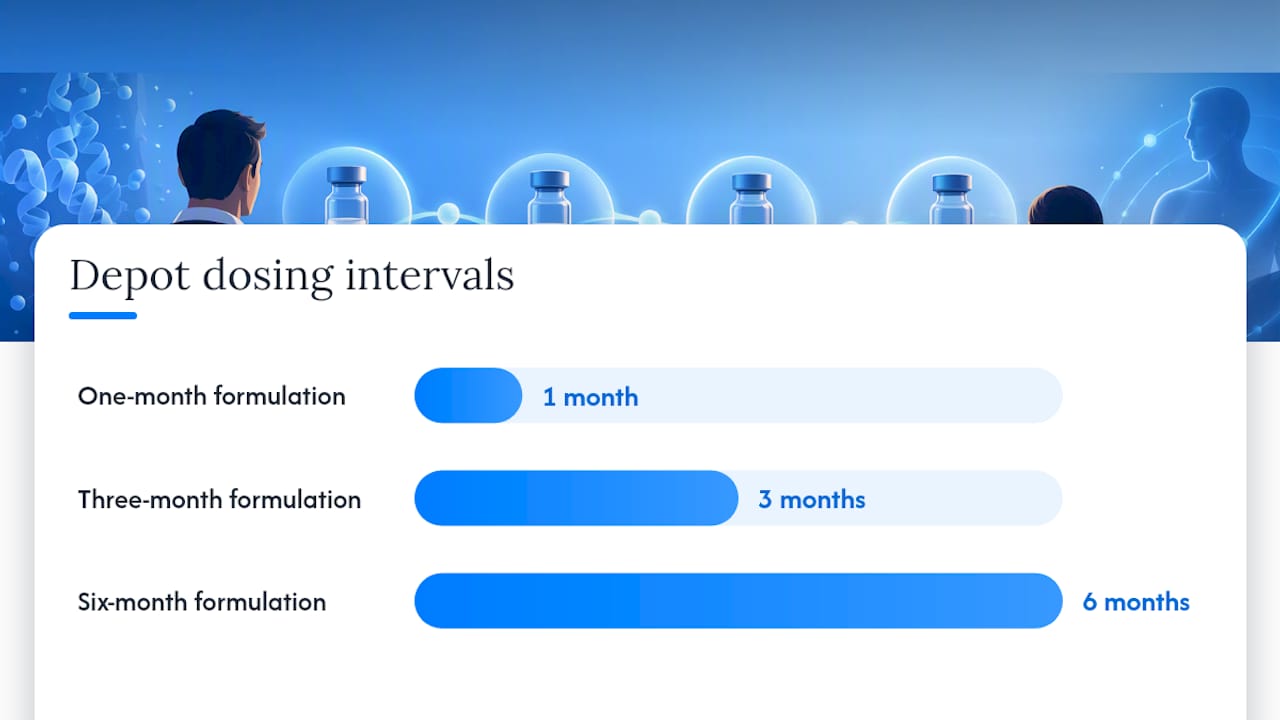
Triptorelin is marketed and studied primarily as a pamoate (embonate) salt formulated into prolonged-release microspheres, with dosing intervals built around three depot options:
- A one-month formulation typically dosed at a lower strength for monthly administration, evaluated in open-label trials with high rates of testosterone suppression to target within the expected window, per a clinical evaluation of sustained-release formulations.
- A three-month formulation carrying a proportionally higher dose to maintain suppression across a quarterly injection schedule.
- A six-month formulation designed for the longest interval between injections, intended to reduce visit frequency in long-term prostate cancer management.
Nearly all pivotal trial and label data describe intramuscular administration of these depot preparations, and route matters here because subcutaneous injection of a formulation validated only for intramuscular delivery can alter the release profile in ways that have not been systematically studied. Researchers substituting routes without a specific rationale risk introducing an uncontrolled variable into otherwise clean protocols.
A few practical notes apply across all three formulations. The reconstituted suspension is a microgranule preparation that typically appears milky rather than clear, and this appearance is expected rather than a sign of a compounding error. Dosing strengths across the one-, three-, and six-month products are fixed and not additive, so combining partial doses to approximate a different interval is not a validated substitute for using the correct product. Documentation of lot, reconstitution method, and injection site should be part of any reproducible research protocol, since inconsistent technique across study visits is a frequent and avoidable source of variance in PK data.
Pro Tip: Log reconstitution time, suspension appearance, and injection site for every dose in a study; small deviations here are among the easiest to control for and the easiest to overlook.
How the clinical evidence stacks up across indications
Triptorelin’s evidence base is strongest in oncology and pediatric endocrinology, and weaker but actively pursued in fertility-related applications.
Prostate cancer has the deepest evidence base. Pivotal trials of prolonged-release triptorelin formulations reported castration rates, defined as testosterone suppression to castrate levels, in the mid-90% range by Day 29 and maintained through later checkpoints, according to the TRELSTAR prescribing information. Because the initial flare can transiently worsen symptoms in men with metastatic disease, an anti-androgen cover strategy is commonly used alongside the first injections to blunt that clinical flare, though protocols vary in how explicitly this is written into the study design. Functional outcomes matter too: a systematic meta-analysis found that triptorelin therapy produced clinically meaningful reductions in lower urinary tract symptoms, measured by IPSS, over 48 weeks, though the pooled data carried heterogeneity and bias concerns worth flagging in any secondary analysis, per the meta-analysis on LUTS outcomes.
Central precocious puberty is the other indication with a mature evidence base, where the therapeutic goal is suppressing LH to prepubertal levels rather than to castrate levels. The same GnRH agonist mechanism that produces castration in adult men produces pubertal suppression in children, and trial endpoints in this population typically track LH response alongside growth and bone-age parameters rather than testosterone alone.
Assisted reproduction uses triptorelin differently, most often as a trigger for final oocyte maturation in place of hCG-based triggers. Endocrine-response research shows this is not a one-size-fits-all substitution: healthy women, women with PCOS, and women with hypothalamic amenorrhea show different gonadotropin kinetics after a triptorelin dose, a distinction covered in more depth in the next section. For research protocols that compare triggers, the choice of population, and its baseline ovarian reserve markers, shapes how a triptorelin-triggered cycle will look compared with a standard trigger.
Fertility preservation during chemotherapy is where the evidence is genuinely unsettled. A randomized trial evaluating triptorelin for ovarian function preservation during (neo)adjuvant chemotherapy for breast cancer found similar rates of menstruation resumption between the triptorelin and control groups, according to the randomized ovarian preservation trial. Other multicenter trials in this space, including protocols registered as the PROMISE study, report protective signals in some cohorts, but the overall picture across trials is mixed rather than consistent, and some studies were stopped early or underpowered to detect a real effect. This inconsistency matters for two reasons:
- Menstrual resumption alone is an imperfect proxy for fertility, since a return of menses does not guarantee preserved ovarian reserve or pregnancy potential.
- Trials in this area need prespecified biochemical markers, such as FSH and AMH, alongside long-term clinical endpoints like pregnancy rates, to move beyond the mixed and hard-to-compare results the field currently has.
Taken together, the indication-by-indication picture is one of a drug with a single, well-characterized mechanism producing very different strength-of-evidence tiers depending on what outcome is being measured and in whom.
Endocrine response nuances across special populations
Not every patient population responds to triptorelin the same way, and the differences are large enough to change how a study should be designed. Trial data comparing healthy women, women with polycystic ovary syndrome, and women with hypothalamic amenorrhea found that the FSH response to triptorelin was attenuated in women with polycystic ovaries and negatively related to AMH levels, according to endocrine response research in PCOS and HA.
The same study reported a notably lower median AUC of FSH change in women with PCOS compared with healthy women and women with hypothalamic amenorrhea, and FSH at four hours was lower in women with polycystic ovarian morphology than in those with normal ovarian morphology, demonstrating a statistically significant difference in the same endocrine response dataset.
Several consequences follow from this pattern:
- AMH and antral follicle count correlated negatively with FSH response, which means ovarian reserve markers help predict how strongly a given patient will respond to a triptorelin challenge.
- Timing of peak LH differed across cohorts, so a fixed sampling window designed around one population’s kinetics may miss the true peak in another, particularly in hypothalamic amenorrhea where the pituitary-gonadal axis behaves differently than in PCOS.
- Stratification by ovarian reserve markers at enrollment is likely to sharpen signal detection in ART and fertility studies, since lumping PCOS, HA, and healthy participants into one analysis can obscure real differences.
For researchers running ART protocols or studying triptorelin as a diagnostic challenge test, this means the drug is not a neutral probe of gonadotropin function. It is a probe whose readout depends heavily on the underlying reproductive phenotype being tested, and study design should reflect that from the outset rather than as a post hoc explanation for unexpected results.
Safety profile and monitoring for clinical studies
The single most important acute risk with triptorelin is the flare itself: the same initial gonadotropin surge that later gives way to suppression can transiently worsen symptoms in conditions where sex steroids drive disease activity, most notably metastatic prostate cancer. This is why anti-androgen cover is commonly built into early treatment in that setting rather than added only if symptoms appear.
The FDA has issued safety communications flagging severe cutaneous adverse reactions associated with GnRH agonists, including triptorelin, covering conditions such as Stevens-Johnson syndrome, toxic epidermal necrolysis, DRESS, and acute generalized exanthematous pustulosis, alongside metabolic and cardiovascular risk observations from post-marketing surveillance, according to FDA safety labeling changes for triptorelin. Any research protocol involving human subjects should build dermatologic monitoring into the visit schedule rather than treating it as an incidental finding.
A practical monitoring checklist for clinical studies should include metabolic parameters such as fasting glucose given the known chromium picolinate benefits relevant to metabolic health and hormonal regulation:
- Baseline labs covering testosterone or estradiol, LH, FSH, and metabolic parameters such as fasting glucose and lipids before the first dose.
- Interval labs timed to capture both the flare phase in the first one to two weeks and the suppression phase at four weeks and beyond.
- Dermatologic vigilance at every visit, with a low threshold for stopping treatment and referring for evaluation if a new rash, mucosal lesion, or systemic symptom appears.
- Cardiovascular and metabolic reassessment at prespecified intervals given the post-marketing signals noted in FDA labeling, particularly in longer studies.
- Discontinuation criteria written into the protocol in advance, so that a suspected severe cutaneous reaction triggers an unambiguous stop rather than a judgment call under time pressure.
GnRH agonist labeling associates triptorelin with a documented risk of severe cutaneous adverse reactions, a signal serious enough that the FDA’s safety communications specifically call it out for post-marketing monitoring. That single data point should anchor the safety section of any triptorelin study protocol, regardless of the primary indication being studied.
Getting reproducible data: assays, timing, and protocol design
Good triptorelin research depends as much on technique as on trial design. Reconstitution and injection technique affect how a prolonged-release depot behaves, so inconsistent handling across study visits can introduce PK variability that has nothing to do with the biological question being asked. Documenting lot numbers, reconstitution volume, and injection site for every dose is a small burden that pays off in cleaner data.
Assay selection and sample timing deserve equal attention. Because triptorelin produces a flare before it produces suppression, a single hormone panel drawn at an arbitrary time point cannot distinguish the two phases:
- Early sampling, typically within the first days, is needed to characterize the flare in LH, FSH, and the relevant sex steroid.
- Later sampling, generally at two to four weeks and again at standard follow-up intervals, is needed to confirm and track suppression.
- AMH and antral follicle count, where relevant to the study question, should be measured at baseline since they predict the magnitude of FSH response and help explain between-subject variability.
Protocol design should also control for a handful of confounders that recur across the triptorelin literature: prior exposure to any GnRH agonist or antagonist, concomitant medications that affect the HPG axis, and renal or hepatic impairment that could alter clearance. Endpoint definitions, whether “suppression” means a specific testosterone threshold, a percentage change from baseline, or return to a reference range, should be fixed before data collection begins rather than chosen after the fact, since inconsistent definitions are a recurring reason similar-looking trials produce apparently conflicting results.
Pro Tip: Predefine your suppression threshold and your sampling windows in the protocol document itself, not in the analysis plan, so a reviewer can see the endpoint was not chosen after seeing the data.
Where the evidence still falls short
The biggest open question is ovarian protection during chemotherapy: existing randomized trials disagree on whether triptorelin meaningfully preserves fertility, and the field needs larger, harmonized trials with prespecified biochemical and clinical endpoints rather than menstrual resumption alone. Long-term bone density and cardiovascular outcome data are also thin, particularly for patients on extended suppression regimens, given the metabolic and cardiovascular signals already flagged in post-marketing safety data.
Head-to-head trials comparing the one-, three-, and six-month formulations directly, rather than each against a historical benchmark, would clarify whether the depot interval itself changes anything beyond convenience. Pragmatic trial designs with adequately powered sample sizes, clearly defined primary endpoints, and follow-up intervals long enough to capture bone and cardiovascular outcomes would do more to move the field than another small single-arm study. Registries that track long-term safety across indications, paired with standardized assay and endpoint reporting, would let researchers compare results across studies instead of arguing about whether two trials measured the same thing. Any trial touching fertility outcomes also carries ethical weight that deserves explicit discussion in the protocol, not just the consent form.
Reading triptorelin evidence without overreaching
The temptation in this field is to treat a well-characterized mechanism as if it guarantees a well-characterized clinical benefit everywhere it is tried. It does not. Triptorelin’s mechanism is consistent, but its trial evidence is not, and the honest reading of the fertility-preservation literature is that it remains genuinely mixed rather than quietly positive.
The fix is not more enthusiasm, it is more consistency: the same suppression threshold, the same sampling windows, the same reporting standards across studies, so that a null result and a positive result are actually comparable. Data transparency matters just as much on the laboratory side. Reproducible research depends on knowing exactly what went into a study, from the drug’s own documentation to the reagents used alongside it, and that same standard of clear sourcing is what we hold ourselves to when supplying research-grade materials.
— Data Peptides
Research-grade peptide sourcing and documentation
Reproducible triptorelin research, and peptide research generally, depends on knowing exactly what is in the vial. Using lab-grade peptides with third-party batch testing and a Certificate of Analysis for every lot helps researchers working on GnRH agonist protocols or related HPG-axis research document material quality alongside their data.
That documentation matters for the same reason protocol harmonization matters: a study is only as reproducible as the materials and methods behind it. Approaches to sourcing generally include:
- Third-party purity and identity testing on every batch, with results available as a Certificate of Analysis.
- Fast, discreet shipping from a US-based facility, supporting time-sensitive research schedules.
- Support services available to assist with documentation or ordering inquiries.
Researchers looking for verified materials to support their own protocols can review current listings in the Data Peptides shop. All products are supplied strictly for laboratory research use.
This article is general information, not a substitute for advice from a qualified doctor. Consult a qualified healthcare professional about your own circumstances before acting on anything here.
Sources
FAQ
What is the success rate of triptorelin in prostate cancer?
Pivotal trials of prolonged-release triptorelin reported castration rates, meaning suppression of testosterone to castrate levels, in the mid-90% range by around Day 29, maintained through later checkpoints, according to the TRELSTAR prescribing information. Success in other indications, such as central precocious puberty or fertility preservation, is measured against different endpoints and should not be assumed to match the oncology figures.
What are the long-term side effects associated with triptorelin?
Post-marketing safety data have flagged severe cutaneous adverse reactions, along with metabolic and cardiovascular signals, prompting specific FDA safety communications on labeling updates for triptorelin. Long-term bone density and cardiovascular outcome data remain limited, which is one of the field’s acknowledged evidence gaps.
What are the researched benefits of triptorelin?
Triptorelin reliably suppresses the HPG axis, giving it well-established research and clinical support in prostate cancer castration and pediatric central precocious puberty, plus growing use as an ovulation trigger in assisted reproduction. Its role in fertility preservation during chemotherapy shows mixed results across trials rather than a confirmed benefit, per the randomized ovarian preservation trial.
Is triptorelin classified as a chemotherapy drug?
No, triptorelin is a GnRH agonist, not a cytotoxic chemotherapy agent. It is used in prostate cancer to suppress testosterone through hormonal manipulation rather than to directly kill cancer cells, and it is also studied alongside, not as, chemotherapy in fertility-preservation trials.
How is triptorelin dosed across its different formulations?
Triptorelin is available in one-, three-, and six-month prolonged-release depot formulations, each with a fixed, non-additive dosing strength matched to its interval. Formulation choice depends on the indication and desired treatment interval, and dosing strengths cannot be combined to approximate a different schedule.