

SS-31 (elamipretide) is a cardiolipin-binding tetrapeptide that concentrates at the inner mitochondrial membrane and, while FDA approved for Barth syndrome under the brand FORZINITY, remains investigational for most other indications. Mechanistic and subgroup clinical data explain why: proteomic mapping shows exactly how it engages mitochondrial machinery, and genotype-specific trial responses suggest the peptide’s benefit depends heavily on the underlying disease driver.
TL;DR:
- SS-31’s mitochondrial engagement relies on its selective accumulation at the inner mitochondrial membrane through cardiolipin binding, influencing cristae stability and mitochondrial function.
- Proteomic studies identify interactions with ATP production components and enzymes involved in 2-oxoglutarate metabolism, indicating a role in stabilizing respiratory supercomplexes.
- Clinical results show variable efficacy, with significant benefits seen mainly in patients with nuclear DNA mutations, emphasizing the importance of genotype-specific trial designs.
- Proper dosing, formulation, and tissue-specific effects are crucial, as research-grade SS-31 differs from the FDA-approved formulation and requires careful lot documentation.
- Future research should focus on genotype stratification, better bioenergetic biomarkers, longer dosing durations, and combination therapies to clarify SS-31’s therapeutic potential.
Table of Contents
- How SS-31 binds cardiolipin and reshapes mitochondrial structure
- Proteomic mapping of SS-31 interactors and functional implications
- Trial data and human studies: successes, failures, and the genotype question
- Practical dosing distinctions, formulation, and safety notes
- Where SS-31 research needs to go next
- Sourcing standards and lab practices for SS-31 research
- A pragmatic read on where SS-31 stands
- Sourcing research-grade SS-31 with documented quality control
- Sources
- FAQ
How SS-31 binds cardiolipin and reshapes mitochondrial structure
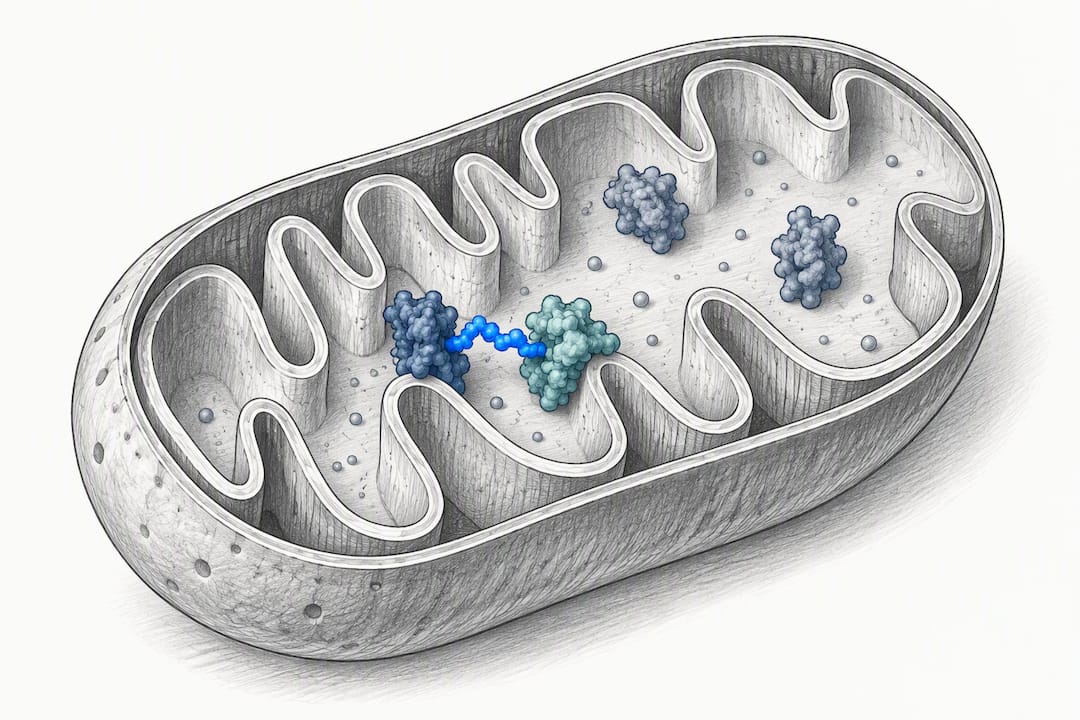
SS-31’s core mechanism starts with electrostatic and hydrophobic affinity for cardiolipin, the phospholipid that concentrates in the inner mitochondrial membrane and organizes the protein complexes of the electron transport chain. Because cardiolipin is nearly absent from the plasma membrane and other organelle membranes, SS-31 accumulates selectively at the inner mitochondrial membrane rather than distributing broadly through the cell. That selectivity is the peptide’s defining pharmacological feature: it is not a general antioxidant scavenging free radicals wherever it finds them, but a membrane-targeted molecule that stabilizes the lipid scaffold holding respiratory complexes in place.
Once bound, SS-31 appears to preserve cristae architecture, the folded inner membrane structures where oxidative phosphorylation happens. Stabilizing cristae has downstream consequences researchers care about:
- Electron transport chain coupling improves when cardiolipin-protein interactions stay intact, reducing electron leakage.
- Reactive oxygen species output drops as electron flow becomes less prone to premature escape from the chain.
- ATP production rises in tissues where mitochondrial coupling was previously impaired.
- Cristae morphology remains more organized under stress conditions that would otherwise cause membrane disruption.
The mitochondrial protein interaction landscape of SS-31 helped clarify this by identifying which respiratory components sit close enough to the peptide to be functionally relevant, rather than relying on membrane-binding assays alone.
SS-31 shows binding affinity for cardiolipin-containing membranes at levels consistent with meaningful accumulation in the inner mitochondrial membrane rather than nonspecific tissue distribution.
None of this proves organism-level efficacy on its own. Membrane biophysics explains a plausible mechanism, not a guaranteed clinical outcome. A peptide can stabilize cristae in isolated mitochondria and still fail to move a functional endpoint in a phase 3 trial, because tissue delivery, dosing duration, and disease-specific mitochondrial burden all sit between the biochemistry and the patient.
Proteomic mapping of SS-31 interactors and functional implications
Cross-linking mass spectrometry (XL-MS) gave researchers a more direct answer to a basic question: which proteins does SS-31 actually touch inside the mitochondrion. The Chavez et al. proteomics study used chemical cross-linkers to capture transient SS-31 to protein contacts in isolated mitochondria, then identified the cross-linked partners by mass spectrometry. The approach identified 12 mitochondrial proteins as SS-31 interactors, clustering into two functional groups: components of ATP production machinery and enzymes in 2-oxoglutarate metabolism.
Key findings researchers should track:
- OXPHOS components appeared among the interactors, consistent with SS-31’s proposed role in preserving respiratory complex organization.
- ADT1/ANT (adenine nucleotide translocator) surfaced as a notable partner, with docking and functional assays suggesting SS-31 reduces proton leak through this transporter.
- 2-oxoglutarate metabolism enzymes were unexpected hits, pointing to a possible link between SS-31 and Krebs cycle flux that had not been well characterized before this dataset.
- Supercomplex preservation is the working hypothesis connecting these interactions: if SS-31 stabilizes the lipid environment around OXPHOS assemblies, respiratory supercomplexes may resist the disassembly that typically accompanies mitochondrial stress.
The mechanistic read is that SS-31 does not inhibit or activate any single enzyme directly. It appears to work by occupying a structural niche near cardiolipin-dependent complexes, which is consistent with reduced proton leak at the ANT/ADT1 pocket rather than classical enzyme inhibition.
The caveats matter as much as the findings. Cross-linkers have a limited reach, typically a few angstroms, so an identified interaction confirms physical proximity, not necessarily a functional consequence. The study was conducted in isolated mitochondria, a reductionist system that strips away cytosolic signaling and tissue-level context. Reproducibility across biological replicates was reported for the core interactor set, but isolated-mitochondria proteomics is still one step removed from the intact-tissue behavior that determines clinical response.
Trial data and human studies: successes, failures, and the genotype question
The clinical record for SS-31 is genuinely mixed, and that mix is the reason genotype-specific analysis has become central to how researchers now interpret the peptide’s trajectory. The clearest win is regulatory: elamipretide, marketed as FORZINITY, received FDA accelerated approval for Barth syndrome, based on improvement in knee extensor strength, an intermediate endpoint rather than a hard clinical outcome. The approved dosing is 40 mg subcutaneous once daily for patients weighing 30 kg or more, with the label also detailing pharmacokinetic behavior and specific guidance for patients with renal impairment. Accelerated approval based on a surrogate marker means the drug gets to patients sooner while confirmatory trials continue to establish direct clinical benefit.
Outside Barth syndrome, the picture gets more complicated:
- MMPOWER-3, a phase 3 trial in primary mitochondrial myopathy, did not meet its primary or secondary endpoints in the overall study population, according to the published MMPOWER-3 report. Neither the six-minute walk test nor fatigue measures showed a statistically significant difference from placebo across all participants.
- Post hoc subgroup analysis told a different story for patients with nuclear DNA related mitochondrial disease (nDNA), who showed a statistically significant improvement on the six-minute walk test compared with placebo. The mitochondrial DNA (mtDNA) subgroup showed no comparable signal.
- NuPower, registered as NCT05162768, took that subgroup signal seriously by design: it is a phase 3, randomized, double-blind trial testing daily subcutaneous elamipretide specifically in patients with primary mitochondrial disease caused by nuclear DNA mutations, with enrollment completed in 2024.
- Cardiac and ophthalmology trials of elamipretide in heart failure and age-related macular degeneration produced mixed results, and the pattern across this broader trial record points to dosing, treatment duration, and endpoint selection as recurring variables that may have masked real effects in genetically heterogeneous populations.
The MMPOWER-3 nDNA subgroup showed an improvement on the six-minute walk test over placebo, a finding that reframed how the field reads the trial’s otherwise negative overall result and directly motivated NuPower’s genotype-focused design.
Safety across this trial record has been relatively consistent. The most commonly reported adverse events are injection-site reactions, expected for a daily subcutaneous peptide. The FORZINITY label also carries specific pharmacokinetic notes for patients with renal impairment, since altered clearance in that population changes systemic exposure without necessarily requiring a different labeled dose. Researchers designing new protocols should treat renal function as a variable worth tracking even when it is not an exclusion criterion.
Practical dosing distinctions, formulation, and safety notes
The clinical and research contexts use SS-31 in materially different forms, and conflating them is a common error. FORZINITY’s prescribing information specifies a 40 mg subcutaneous daily dose delivered from a defined pharmaceutical formulation with established stability data, manufacturing controls, and FDA oversight. Research-grade SS-31 is a different product category entirely.
- Research-grade material typically ships as a lyophilized (freeze-dried) vial that requires reconstitution before use.
- Reconstitution is generally done with bacteriostatic water, following the vial’s labeled fill weight against its Certificate of Analysis.
- Stability after reconstitution depends on storage conditions and the documented window provided by the supplier, not on the FORZINITY label’s stability data, which applies only to the approved formulation.
- Literature-reported research doses vary by study design and species, and exposure-response relationships, not just nominal dose, appear to drive the subgroup differences seen in human trials.
Pro Tip: Match your reconstitution and storage protocol to the documentation on your specific lot’s Certificate of Analysis rather than a generic figure, since fill weight and stability windows can differ between suppliers and batches.
Monitoring for injection-site reactions and accounting for renal function in dosing decisions are reasonable practices to carry over from the clinical literature, even in a research setting where subjects are not patients.
Where SS-31 research needs to go next
The MMPOWER-3 subgroup signal is the clearest signpost for the field: genotype stratification, not just disease category, may be the variable that determines whether SS-31 shows benefit. A handful of priorities stand out for researchers planning the next round of studies.
- Design trials with prespecified nDNA versus mtDNA arms rather than treating primary mitochondrial disease as a single population, following the logic that produced NuPower’s design.
- Develop better bioenergetic biomarkers, including muscle ATP production rate (ATPmax) and cardiolipin-associated markers, so trials can detect mechanistic engagement independent of functional endpoints that take months to shift.
- Extend preclinical dosing duration and diversify tissue-specific endpoints, since most mechanistic data come from acute or short-term exposure models that may not reflect chronic dosing effects.
- Test combination strategies pairing SS-31 with anti-inflammatory or metabolic modulator compounds, given that mitochondrial dysfunction rarely occurs in isolation from inflammatory signaling.
- Plan confirmatory trials that satisfy accelerated approval requirements, since FORZINITY’s Barth syndrome approval rests on an intermediate endpoint and regulatory bodies will expect direct clinical benefit data over time.
Sourcing standards and lab practices for SS-31 research
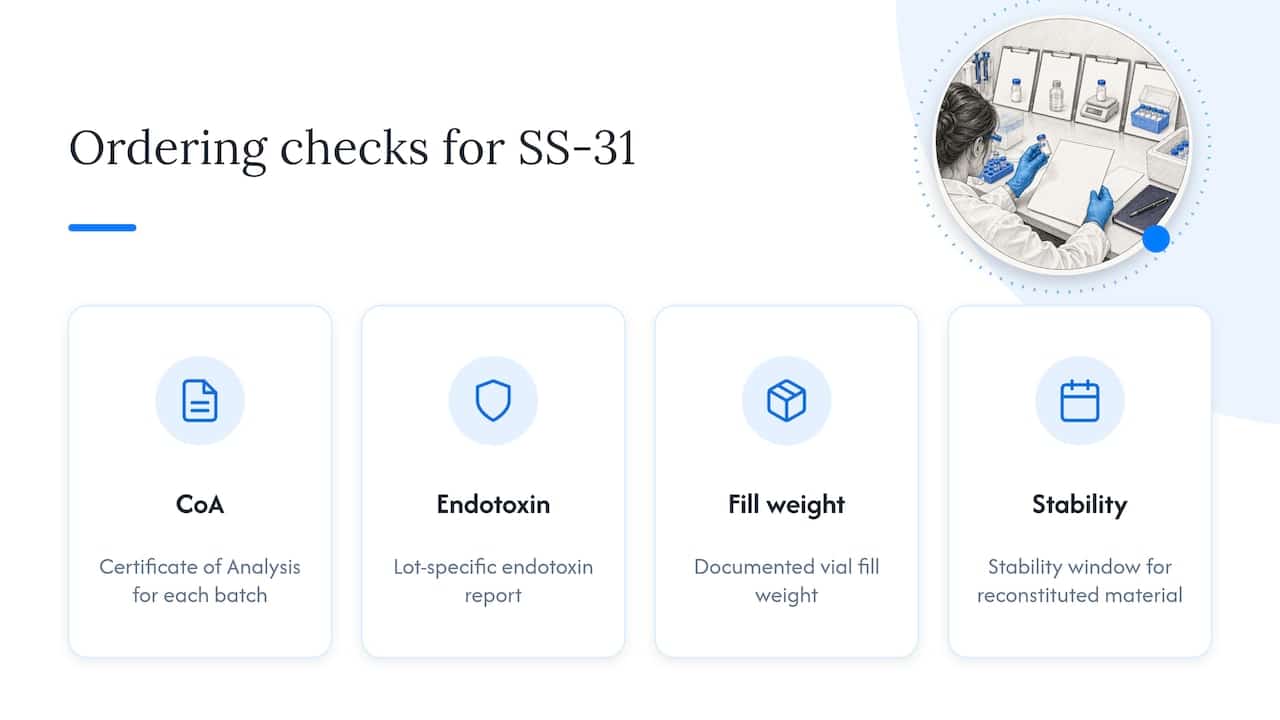
Reproducible SS-31 research depends on documentation that most literature does not spell out explicitly. Before using any lot, researchers should confirm:
- A Certificate of Analysis showing purity, identity confirmation, and lot-specific test data.
- An endotoxin report for the specific batch, not a generic product-line assurance.
- Vial fill weight matching the CoA, since discrepancies change effective concentration after reconstitution.
- A clearly stated stability window for reconstituted material stored under defined conditions.
Research-grade SS-31 and FORZINITY are not interchangeable products. FORZINITY is a regulated pharmaceutical formulation approved for a specific clinical indication; research-grade SS-31 is intended strictly for laboratory research use and does not carry the same manufacturing or regulatory backing.
A pragmatic read on where SS-31 stands
SS-31 is mechanistically compelling and clinically selective. The data justify real interest, not blanket optimism: mitochondrial disease is genetically heterogeneous, and treating it as one population in trial design likely buried real effects inside the MMPOWER-3 result. Researchers gain more by standardizing outcome measures, stratifying by genotype from the outset, and preregistering protocols openly than by waiting for a single trial to settle the question.
— Data Peptides
Sourcing research-grade SS-31 with documented quality control
FORZINITY is the approved therapeutic formulation for Barth syndrome; it is not what researchers order for laboratory work. Research-grade SS-31 is a separate, lyophilized research material, and the documentation gap between suppliers is often where quality actually breaks down. Before ordering, ask any vendor for a Certificate of Analysis, an endotoxin report specific to the lot, the vial’s fill weight, and the stability window for reconstituted material.
Data Peptides lists SS-31 product and technical information alongside Certificate of Analysis documentation for each batch sold, along with third-party purity testing and fast, discreet shipping intended for laboratory research use only. Researchers building broader mitochondrial or metabolic protocols can also review the shop’s full peptide catalog for related research materials.
This article is general information, not a substitute for advice from a qualified doctor. Consult a qualified healthcare professional about your own circumstances before acting on anything here.
Sources
- Mitochondrial protein interaction landscape of SS-31 (Chavez et al., PNAS 2020)
- FORZINITY (elamipretide) prescribing information — FDA label
- Efficacy and Safety of Elamipretide in Individuals With (MMPOWER-3 report)
- Study to Evaluate Efficacy and Safety of Elamipretide in Subjects With Primary Mitochondrial Disease From Nuclear DNA Mutations (nPMD)
FAQ
What peptides pair well with SS-31 in mitochondrial research?
There is no established, validated combination protocol for SS-31 in the peer-reviewed literature. Researchers investigating mitochondrial and metabolic pathways sometimes look at complementary compounds within broader peptide categories for recovery, but any stacking decision should be based on the specific research question and documented mechanism rather than anecdotal practice.
Is SS-31 peptide safe for research use?
In clinical trials, the most commonly reported adverse events were injection-site reactions, and the FDA prescribing information for FORZINITY includes specific pharmacokinetic guidance for patients with renal impairment. Safety data apply to the approved clinical formulation and dosing regimen studied in trials, not to research-grade material used outside that context, so any use should follow institutional research protocols and biosafety practices.
Can SS-31 reverse aging?
No clinical trial data support a claim that SS-31 reverses aging. Preclinical studies report reduced oxidative stress and improved mitochondrial function across models including neuroinflammation and liver ischemia-reperfusion injury, but these are mechanistic findings in cell and animal systems, not evidence of an anti-aging effect in humans.
Where can researchers buy SS-31 peptide?
Research-grade SS-31 is available through suppliers that provide third-party Certificates of Analysis and endotoxin testing for each lot, such as Data Peptides, which lists CoA documentation alongside its product listings. Always confirm the material is labeled for research use only and review the batch-specific documentation before use.