
In this article, “peptides banned in sports” refers to research-grade peptides sold for laboratory use only, not to anti-doping prohibited lists. Before ordering any lot, verify the Certificate of Analysis, confirm third-party testing, and check that marketing makes no therapeutic or dosing claims. The sections below explain exactly how to run those checks.
TL;DR:
- Peptide vendors must provide lot-specific Certificates of Analysis that include identity, purity, endotoxin levels, and storage data to ensure research compliance.
- Marketers should avoid dosing instructions, health claims, or prescription-like packaging, as these contradict research-use labeling and may trigger FDA enforcement.
- Independent third-party verification of peptide lot data is essential because in-house results alone cannot confirm purity, identity, or absence of contaminants.
- High endotoxin levels can skew experimental results and require specific testing methods like LAL assays for each lot to ensure safety and data integrity.
- Data Peptides offers certified, third-party tested research-grade peptides with comprehensive documentation, supporting trustworthy and reproducible laboratory research.
Table of Contents
- Why this definition matters for research procurement
- U.S. regulatory and compliance risks researchers must check
- Quality checklist: documents and analytics to require for every lot
- Step-by-step vendor verification and in-house intake workflow
- Lab handling practices that protect data integrity
- Why rigorous sourcing is non-negotiable for credible peptide research
- Where Data Peptides fits into this checklist
- Sources
- FAQ
Why this definition matters for research procurement
Researchers searching this phrase are usually trying to sort out labeling confusion, not anti-doping rules. Athletes and compliance officers need a prohibited substances list. Laboratory buyers need something different: proof that a peptide is what the label says it is, made to a documented standard, and sold without illegal therapeutic claims.
That distinction changes what you look for when comparing vendors. Marketplace listings often carry “RUO” or “not for human consumption” tags, but a tag alone does not guarantee compliant marketing: some listings pair that language with dosing instructions or health claims that contradict the research-use label.
A few sources are worth tracking before you buy or publish:
- FDA warning letters that document enforcement actions against mislabeled peptide products.
- USP documentary standards for peptide identity, purity, and reference materials.
- Peer-reviewed reviews on peptide bioavailability and study design that inform what a COA should report.
U.S. regulatory and compliance risks researchers must check
The FDA has taken enforcement action against sellers whose products claim research-use status while marketing includes dosing instructions or therapeutic promises. One documented case, the warning letter issued to Peak Performance Peptides, shows how a “not for human consumption” label does not shield a seller once marketing crosses into drug claims. The FDA has separately warned about unapproved GLP-1 and peptide products sold under research-purposes labeling but marketed for weight loss, noting that quality and safety are unverified for these versions.
For a lab, buying from a noncompliant vendor is not just a legal exposure question, it is a data quality problem. Undisclosed composition, inconsistent synthesis routes, or contaminated lots can invalidate results before an experiment even starts. Institutional review processes and procurement policies typically assume verified sourcing, and a supplier under FDA scrutiny can put both compliance and reproducibility at risk.
Watch for these red flags before you order:
- Marketing copy that includes dosing schedules, injection instructions, or specific health outcomes.
- No lot-specific Certificate of Analysis available on request.
- Refusal to name or share results from an independent testing lab.
- Pricing or packaging that mimics prescription pharmaceuticals rather than research reagents.
- No documented storage or stability data accompanying the product.
Our internal guide on regulatory distinctions for research materials covers this territory in more depth.
Quality checklist: documents and analytics to require for every lot
A usable Certificate of Analysis is lot-specific, not a generic template reused across batches. At minimum, require:
- Lot number tied to the specific vial or batch you received.
- Assay and purity data from HPLC or LC-MS, with the percentage and method stated.
- Identity confirmation through mass spectrometry or an equivalent orthogonal method.
- Water content, residual solvents, counter-ion identification, and impurity profiling.
- Assigned potency where applicable, particularly for peptides with variable bioactivity.
Endotoxin data deserves its own line item. Endotoxin testing is a safety and data-quality parameter, not an optional extra: elevated endotoxin levels can introduce inflammatory confounding in both cell culture and animal work. Ask for the specific endotoxin value and the assay method used, commonly a Limulus Amebocyte Lysate (LAL) test, rather than accepting a pass or fail summary.
Third-party verification matters because in-house data alone cannot rule out conflicts of interest. An independent lab should confirm identity, purity, and related impurities separately from the manufacturer’s own results. If only in-house data exist, treat the lot as unverified until a third party checks it.
USP peptide documentary standards provide reference materials and validated methods that labs can use to benchmark identity and purity testing, and they are worth citing when you document your own acceptance criteria. For collagen peptides specifically, a 2024 integrative review notes that molecular weight (2,000 to 3,500 daltons) affects bioavailability, so a COA or datasheet should report molecular weight distribution alongside purity.
Storage and stability data close the loop: recommended temperature, expected shelf life, and any accelerated degradation testing should appear on the COA or an accompanying sheet. Our Certificate of Analysis page walks through what this documentation looks like in practice.
Pro Tip: Keep a running spreadsheet of COA data points per lot so you can flag drift in purity or endotoxin values across shipments from the same vendor.
Step-by-step vendor verification and in-house intake workflow
Turning the checklist into a routine keeps quality consistent across orders and staff members.
- Pre-purchase: Request the COA and third-party lab contact before paying, and confirm the vendor’s marketing avoids dosing or therapeutic language.
- Method check: Compare the vendor’s analytical methods against USP-aligned approaches where a relevant standard exists.
- On receipt: Match the lot number on the shipment to the COA, inspect packaging for signs of temperature excursion, and log the delivery date and condition.
- Spot verification: Where feasible, run an internal identity or purity spot check rather than relying solely on vendor documentation.
- Archiving: Store the COA alongside your digital inventory record, tag the lot number in lab notebooks, and link every experiment’s methods section to the specific lot used.
- Escalation: If a lot fails identity confirmation, shows unexpected endotoxin values, or the COA cannot be reconciled with the shipment, quarantine the material, notify institutional compliance, and pause any experiments already using that lot.
This workflow supports reproducibility later: when a result needs to be checked or repeated, tracing it back to a specific lot and COA saves time that a vague “peptide from Vendor X” note cannot. Our ordering guide for researchers covers procurement logistics that pair with this intake process.
Lab handling practices that protect data integrity
Storage conditions affect peptide stability well before an experiment begins. Lyophilized peptides generally hold up better at lower temperatures than reconstituted solutions, and minimizing freeze-thaw cycles through aliquoting reduces degradation risk between uses.
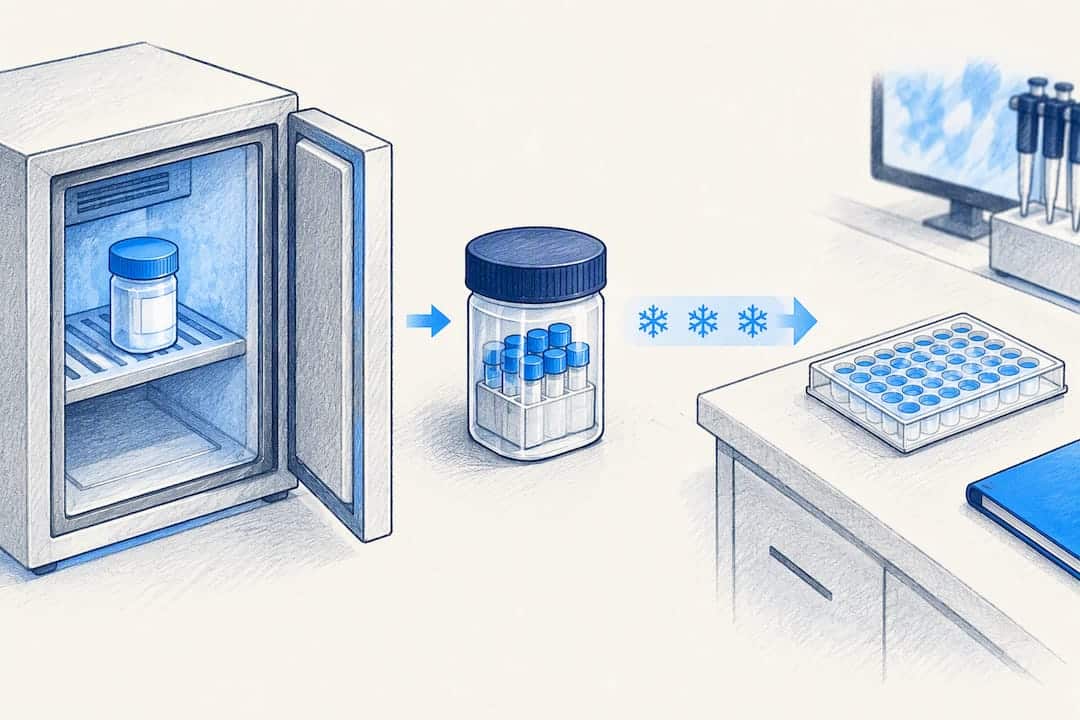
Endotoxin control belongs in routine screening rather than a one-time check at intake. Acceptable thresholds differ between cell culture and in vivo work, and mitigation often means sourcing endotoxin-tested water, using dedicated glassware, and rescreening lots that have been open for extended periods.
When writing up methods, include:
- Lot number and a citation of the COA used for that lot.
- Storage and handling conditions from receipt through use.
- Analytical confirmation method and result, not just “peptide purity confirmed.”
Pro Tip: Run a blank control using only your reconstitution buffer and document the water source, since trace contaminants in buffer or water can masquerade as peptide-related effects.
Why rigorous sourcing is non-negotiable for credible peptide research
Reproducibility depends on knowing exactly what was in the vial, not assuming it. A lot with an unverified COA or missing endotoxin data introduces a variable no statistical method can correct for after the fact. Institutional oversight bodies increasingly expect documented sourcing as part of basic research hygiene, not an afterthought added when a reviewer asks.
Third-party testing, lot-specific COAs, and endotoxin reporting exist because self-reported data alone cannot substitute for independent verification. Treating sourcing as a compliance checkbox misses the point: it is a data quality control, and skipping it quietly weakens every result built on top of it.
— Data Peptides
Where Data Peptides fits into this checklist
Data Peptides provides third-party tested, lab-grade peptides with comprehensive Certificates of Analysis, including endotoxin data for every lot, positioned strictly for research use. That covers several items on the checklist above: lot-specific documentation, independent verification, and clear research-use labeling without therapeutic claims. Orders ship fast and discreetly from a US facility, and a support team is available around the clock for questions about documentation or sourcing.
For readers who want to see this in practice, our product catalog lists current research-grade peptides across weight loss, muscle growth, recovery, anti-aging, and libido research categories, each with lot-level documentation available for review before you buy.
Sources
- Warning Letters — Peak Performance Peptides (example FDA warning letter)
- Peptide-related USP documentary standards and reference standards
- Endotoxin testing and relevance for research (PMC)
FAQ
What does “research use only” mean for a peptide product?
It means the product is sold strictly for laboratory research and not approved or labeled for human or animal consumption. Legitimate research-use labeling excludes dosing instructions and therapeutic claims, and the FDA has taken enforcement action against sellers whose marketing contradicts that status.
How can I verify a peptide vendor’s Certificate of Analysis is legitimate?
Check that the COA is tied to the specific lot number you received, includes identity confirmation and purity data from HPLC or LC-MS, and lists endotoxin results with the assay method used. Cross-reference the vendor’s claim of third-party testing by contacting the named independent lab directly when possible.
Why does endotoxin testing matter for peptide research?
High endotoxin levels can introduce inflammatory effects that confound results in both cell culture and animal studies, according to research on endotoxin testing. Labs should request the specific endotoxin value and testing method for every lot rather than accepting a general pass or fail statement.
What role do USP standards play in peptide quality verification?
USP publishes documentary standards and reference materials that labs use to validate peptide identity, purity, and analytical methods. Aligning acceptance testing with these standards gives researchers a consistent benchmark across different vendors and lots.
Does Data Peptides provide documentation for research compliance?
Data Peptides supplies Certificates of Analysis with purity, identity, and endotoxin data for each lot sold through its product catalog, positioned for research use only. Researchers can review lot-specific documentation before purchase to confirm it meets their institution’s acceptance criteria.