

Lyophilized peptide powder stored at −20°C stays chemically stable for multiple years, and −80°C storage extends stability further for archival stocks. Reconstituted solutions are a different story: refrigerate at 2 to 8°C and plan to use the vial within about 28 days if you mixed it with bacteriostatic water. Aliquot and freeze what you won’t use immediately, avoid repeated freeze-thaw cycles, and keep oxidation-sensitive sequences away from air and light.
TL;DR:
- Lyophilized peptide powder can be stored at −80°C for multiple years, while −20°C storage typically preserves peptides for two to five years.
- Reconstituted solutions stored at 2 to 8°C generally remain stable for about 28 days, with longer shelf lives possible through freezing aliquots.
- Peptides with oxidation-sensitive residues like cysteine, methionine, or tryptophan degrade faster in solution and require careful handling to prevent oxidative damage.
- Using frost-free freezers for long-term peptide storage can cause degradation due to temperature cycling, making manual-defrost freezers a better choice.
- The 28-day limit for reconstituted solutions relates to sterility, not chemical stability, and aliquoting with inert gas or freezing extends usable life.
Table of Contents
- Peptide Shelf Life at a Glance
- Why Does Powder Outlast Solution by Years?
- What Temperature Should You Store Peptides At?
- How Should You Reconstitute Peptides for Maximum Stability?
- How Do You Aliquot and Handle Peptides Without Losing Potency?
- How Long Do Peptide Shipments Stay Stable in Transit?
- Lab Checklist: Protecting Peptide Shelf Life Start to Finish
- Where to Find Reliable Storage and Testing Guidance
- Our Take: Stop Treating the 28-Day Rule as Chemistry
- Sources
- FAQ
Peptide Shelf Life at a Glance
The number that matters most depends on whether your peptide is sitting as dry powder or dissolved in solution. Powder buys you years. Solution buys you weeks, sometimes less.
| Storage State | Temperature | Typical Shelf Life | Notes |
|---|---|---|---|
| Lyophilized powder | −80°C | Multi-year, archival | Best for master stocks, minimal handling |
| Lyophilized powder | −20°C | 2–5 years | Standard lab storage, keep sealed and dark |
| Lyophilized powder | Room temp | Days to weeks | Short excursions tolerated; not for storage |
| Reconstituted (BAC water) | 2–8°C | ~28–30 days | Sterility-limited, not purely chemical |
| Reconstituted, aliquoted | −20°C frozen | Weeks to months | Extends usable window past the 28-day rule |
Peptides containing cysteine, methionine, or tryptophan degrade faster from oxidation regardless of temperature, and acidic residues like aspartate or glutamate can pull moisture from the air if left unsealed. The sections below cover both exceptions in detail.
Why Does Powder Outlast Solution by Years?
Water is the enemy of peptide stability, and lyophilization removes almost all of it. Dissolved peptides sit in an environment where amide bonds can hydrolyze, side chains can deamidate, and molecules have enough freedom to collide, aggregate, and fold into unwanted shapes. Dry powder locks the molecule in place. Without water acting as a reaction medium, most of those pathways slow to a crawl.
Temperature compounds the problem in solution far more than in powder. A rough rule of thumb in peptide chemistry: every 10°C increase in storage temperature roughly doubles the rate of chemical degradation. That means a vial left at room temperature for a week can rack up more chemical damage than the same vial spends months accumulating in a freezer.
The specific failure modes vary by sequence. Hydrolysis breaks peptide bonds outright. Deamidation converts glutamine and asparagine residues into different amino acids, shifting the peptide’s charge and activity. Oxidation targets cysteine, methionine, and tryptophan side chains, and it happens fastest when the peptide is dissolved and exposed to dissolved oxygen. GenScript’s storage guidelines recommend handling these residues under anaerobic conditions specifically because oxidation is one of the few degradation pathways that dry storage doesn’t fully solve.
What Temperature Should You Store Peptides At?
Your freezer choice depends on how long you need the material to last and how often you’ll touch it.
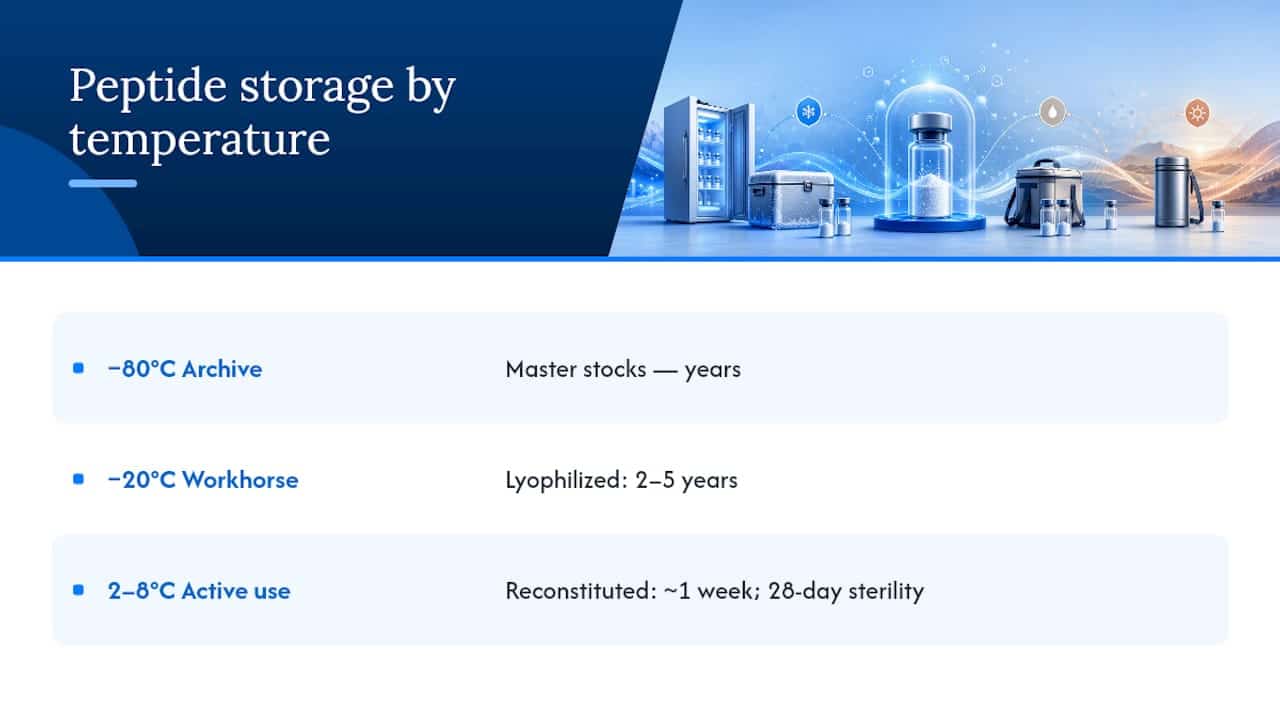
−80°C is the gold standard for master stocks and anything you’re archiving rather than actively using. This is the setpoint labs reach for when a peptide needs to outlast a multi-year study, and published stability data on lyophilized peptide vaccines backs up years of storage at this temperature without meaningful loss.
−20°C is the workhorse setting for most labs running active projects. Sealed, dry, and kept out of direct light, lyophilized peptides commonly hold their potency for two to five years at this temperature. GenScript and NIBSC both converge on −20°C as the standard recommendation for long-term lyophilized storage.
2 to 8°C refrigeration is for reconstituted vials you’re actively pulling from, not long-term storage. Sigma-Aldrich’s technical guidance notes many peptide solutions hold up for roughly a week at 4°C before instability becomes a real concern, though the practical in-use window often stretches closer to 28 days when bacteriostatic water’s sterility limit is the binding constraint rather than chemistry. Store vials toward the back of the refrigerator, never in the door, where temperature swings every time someone opens it.
One equipment detail trips up more labs than it should: frost-free freezers cycle through periodic warming to prevent ice buildup, and that cycling is exactly what peptides can’t tolerate over time. NIBSC explicitly warns against frost-free units for long-term peptide storage. A manual-defrost or dedicated ultra-low freezer holds a stable setpoint without the swings.
How Should You Reconstitute Peptides for Maximum Stability?
Your choice of diluent determines your clock more than almost anything else you do after reconstitution. Bacteriostatic water contains a preservative (typically benzyl alcohol) that inhibits microbial growth, and that preservative’s effectiveness declines every time the vial gets punctured. That’s the real reason behind the widely cited 28-day rule: it’s a sterility limit tied to the diluent’s labeling, not necessarily a sign the peptide molecule itself has broken down chemically by day 29.
A few practical points to work from during reconstitution:
- Bacteriostatic water is appropriate for multi-use vials you’ll access repeatedly over days or weeks; sterile water without a preservative is fine only if you’re using the entire volume in one session.
- Aim for a pH near neutral during dissolution unless your peptide’s data sheet specifies otherwise. Highly acidic or basic peptides may need a small amount of dilute acetic acid or ammonium hydroxide to fully dissolve.
- Hydrophobic peptides sometimes need a small volume of DMSO or DMF to get into solution, but don’t store the peptide long-term in either solvent. Use them to dissolve, then dilute into your working buffer.
- If you need more than 28 days of usable material, aliquot the freshly reconstituted solution into single-use cryovials and freeze them immediately rather than trying to stretch one refrigerated vial.
The Data Peptides reconstitution guide walks through solvent selection and volume calculations in more detail if you’re setting up a new SOP.
How Do You Aliquot and Handle Peptides Without Losing Potency?
Good aliquoting technique is the single habit that separates labs that waste product from labs that don’t.
- Calculate your actual need before reconstituting. Reconstitute only the volume you’ll use across your planned experiments; leftover reconstituted solution is where most avoidable loss happens.
- Split into single-use cryovials immediately after mixing. Minimize headspace in each vial, label with the solvent used and the reconstitution date, and freeze anything you’re not using within the day.
- Purge or degas for oxidation-prone sequences. Peptides containing cysteine, methionine, or tryptophan benefit from an inert-gas purge (argon or nitrogen) over the solution headspace, or degassing the buffer under reduced pressure before use, which measurably extends in-solution stability.
- Treat freeze-thaw cycles as a budget, not a convenience. Most peptides tolerate one freeze-thaw cycle with modest loss, but repeated cycling causes cumulative damage that can run anywhere from a few percent to well over ten percent loss per cycle depending on the sequence. If a cycle is unavoidable, log it.
Pro Tip: Keep a small desiccator pack in your peptide storage box, not just your shipping box. Every time you open a lyophilized vial, moisture from the room gets a chance to condense inside. A silica packet in the storage container costs almost nothing and protects every vial in there, not just the one you’re using today.
How Long Do Peptide Shipments Stay Stable in Transit?
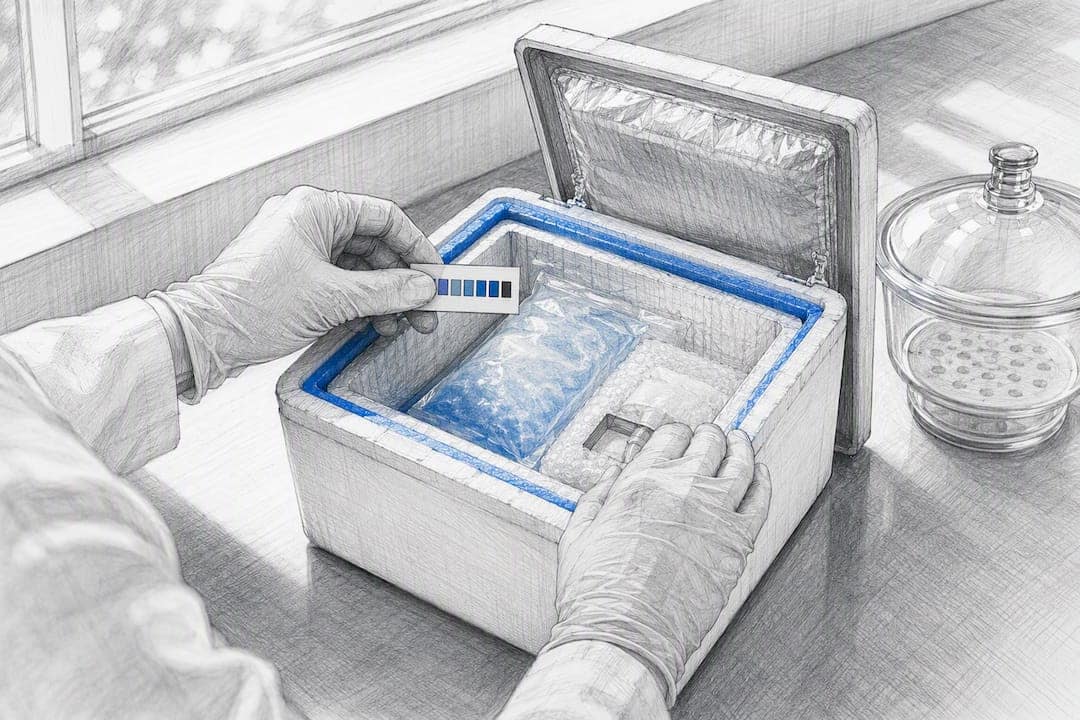
Cold-chain packaging is built around the state of the product, and it’s worth checking what you’re actually receiving. Gel packs typically maintain 2 to 8°C conditions for solutions or short-duration shipments, while dry ice maintains −20°C to −80°C conditions for longer or more temperature-sensitive lyophilized shipments.
When a shipment arrives, check the temperature indicator strip if one’s included, confirm the lot number against the Certificate of Analysis, and get the product into proper storage immediately rather than letting it sit on a bench. If a lyophilized vial ran warm during transit, let it equilibrate to room temperature inside a desiccator before opening; opening a cold vial in humid room air invites condensation directly onto the powder.
Dry lyophilized peptide tolerates a short room-temperature excursion far better than a reconstituted solution would, which is one more reason to keep peptides as powder until you’re ready to use them.
Lab Checklist: Protecting Peptide Shelf Life Start to Finish
Copy this into your SOP and adjust for your specific inventory system.
- On receipt: Check the COA, confirm the lot number, note the temperature indicator, and store immediately in the correct freezer or refrigerator.
- In storage: Label every vial with product, lot, and date; log the freezer location; keep desiccant with lyophilized stocks.
- At reconstitution: Record the date, diluent used, and your initials directly on the vial or in your lab notebook.
- In use: Discard reconstituted vials once they pass the sterility window for your diluent, typically 28 days for bacteriostatic water.
- Recordkeeping: Track product name, lot number, date received, date reconstituted, and any aliquot IDs in one central log.
Where to Find Reliable Storage and Testing Guidance
Every batch shipped carries a third-party Certificate of Analysis confirming purity, so you’re not guessing about what’s in the vial before you even start your stability clock. The peptide storage temperature guide and laboratory standards resource go deeper into setpoints and SOP structure than a single article can cover, and if a specific sequence has unusual stability concerns, the technical support team is available around the clock to talk through it. Sequence-specific quirks, like an unusually oxidation-prone cysteine residue, are exactly the kind of thing worth a quick conversation before you finalize a storage plan.
Our Take: Stop Treating the 28-Day Rule as Chemistry
The biggest misconception in peptide storage is treating the 28-day reconstituted shelf life as if it reflects the peptide falling apart. It mostly doesn’t. That number comes from bacteriostatic water’s preservative losing effectiveness after repeated puncture, a sterility concern, not a chemistry one. Conflating the two leads labs to either panic and discard usable material early, or worse, assume a solution is fine past 28 days because “the peptide itself is probably still good.”
The conventional advice generally gets the powder-versus-solution distinction right, but it under-communicates just how much freezer choice matters. A frost-free unit sitting in a lab because it was the one available in the equipment closet will quietly erode a −20°C archive over the same multi-year window where a manual-defrost freezer would have held steady. That’s an infrastructure decision hiding inside what looks like a storage-temperature question.
If we had to rank priorities for a lab building its first SOP: get the freezer type right before agonizing over exact temperature setpoints, aliquot aggressively rather than reconstituting large batches, and treat oxidation-sensitive sequences as a separate handling category rather than an afterthought. Get those three right and the shelf-life numbers in the tables above become realistic rather than aspirational.
— Data Peptides
Sources
- Peptide Storage and Handling Guidelines – GenScript
- Peptide storage – NIBSC
- Handling and Storage Guidelines for Peptides and Proteins – Sigma-Aldrich
FAQ
How Long Do Peptides Last as Lyophilized Powder?
Lyophilized peptide powder stored at −20°C typically remains stable for two to five years, while −80°C storage extends that window further for archival stocks.
How Long Does Reconstituted Peptide Solution Last?
Reconstituted peptides mixed with bacteriostatic water and refrigerated at 2 to 8°C typically stay usable for around 28 to 30 days, a limit driven mainly by diluent sterility rather than the peptide breaking down chemically.
Can I Freeze a Reconstituted Peptide to Extend Its Shelf Life?
Yes. Aliquoting reconstituted solution into single-use cryovials and freezing them immediately extends usable life well past the 28-day refrigerated window, though repeated freeze-thaw cycling on any single vial still causes cumulative loss.
Why Are Frost-Free Freezers Bad for Peptide Storage?
Frost-free freezers cycle through periodic warming to prevent ice buildup, and that temperature cycling degrades peptides faster than storage at a stable setpoint would.
Which Peptides Are Most Prone to Oxidation During Storage?
Peptides containing cysteine, methionine, or tryptophan are the most oxidation-prone and benefit from anaerobic handling, such as inert-gas purging or degassed buffers, to preserve potency in solution.