

Thymosin alpha 1 is an immunomodulatory 28-amino-acid peptide with consistent mechanistic evidence for enhancing dendritic cell and T-cell responses, but clinical benefit is indication-dependent. The sepsis, pancreatitis, and hepatitis literature shows mixed trial quality, and larger, well-controlled, stratified trials are still needed before firm conclusions hold.
TL;DR:
- For pancreatitis, five trials involving 706 patients found fewer extrapancreatic infections (RR 0.56) and improved immune markers, warranting confirmation in a larger multicenter study.
- Hepatitis studies used 1.6 mg twice weekly for months, while some sepsis protocols used 1.6 mg twice daily; schedules lack direct comparison.
- In the United States, the FDA has not approved thymalfasin, and current 503A and 503B lists omit it; confirm sourcing rules before protocol submission.
- Require a certificate tied to each lot with identity, purity, and endotoxin results, because contamination can distort immune assays during laboratory studies.
Table of Contents
- What Thymosin Alpha 1 Is and How It’s Named in the Literature
- Proposed Mechanisms Behind the Clinical Rationale
- Clinical Evidence by Indication: Where the Data Stand
- Dosing and Administration Reported in Trials
- Safety Findings and Regulatory Context for Researchers
- Operational Guidance for Designing and Sourcing TA1 Studies
- Biochemical Synthesis and Stability Considerations for Laboratory Use
- Standardized Protocols and Assay Methods for Studying TA1 Effects
- Reading a Certificate of Analysis for Thymosin Alpha 1
- Storage, Handling, and Preparation Practices That Preserve Activity
- Common Contaminants in TA1 Preparations and Their Research Impact
- Where Thymosin Alpha 1 Research Should Go Next
- How We Support Rigorous TA1 Research
- FAQ
- Sources
What Thymosin Alpha 1 Is and How It’s Named in the Literature
Thymosin alpha 1 (TA1, Tα1) is a 28-amino-acid peptide derived from the thymosin alpha precursor, with N-terminal acetylation that confers resistance to rapid proteolytic degradation. Its International Nonproprietary Name is thymalfasin, and the synthetic version is marketed under the brand name ZADAXIN in a number of countries outside the United States. Investigators searching the literature will encounter all three labels interchangeably, sometimes within the same paper, so search strategies should capture “thymosin alpha 1,” “Tα1,” and “thymalfasin” together.
Clinical studies typically report the peptide administered as a subcutaneous injection, reconstituted from lyophilized powder shortly before use. This formulation and route appear consistently across the hepatitis, sepsis, and pancreatitis trial literature, which matters for anyone designing a comparable protocol or trying to reconcile dosing across studies, a topic covered in more detail in our research applications and mechanisms overview.
Proposed Mechanisms Behind the Clinical Rationale
The biological case for TA1 rests on a reasonably coherent set of immune effects documented across preclinical and clinical literature. A comprehensive review of the literature describes TA1 as acting through Toll-like receptor signaling, including TLR-9 engagement on antigen-presenting cells, which in turn promotes dendritic cell maturation and more effective antigen presentation.
Downstream of that activation, TA1 has been associated with increased IL-2 production and shifts in T-cell subsets, including changes in CD4+ counts, CD8+ counts, and the CD4+/CD8+ ratio. Several reports also describe effects on natural killer and NKT cell activity, alongside support for thymopoiesis, the process by which the thymus generates functional T cells.
These mechanisms map fairly directly onto the endpoints trials actually measure: lymphocyte recovery after immune insult, rates of secondary infection, and antibody response following vaccination. That mechanistic coherence is why TA1 keeps attracting trial interest across sepsis, pancreatitis, and hepatitis, even though a clean mechanistic story does not by itself guarantee a mortality or morbidity benefit in heterogeneous patient populations. Our TA1 research applications resource walks through how these pathways are typically assayed in a research setting.
Clinical Evidence by Indication: Where the Data Stand
The clinical picture varies sharply by condition, and conflating indications is a common misreading of this literature.
Sepsis. The 2025 TESTS phase 3 trial randomized over a thousand adults and found no statistically significant difference in 28-day all-cause mortality between the TA1 and placebo groups. Subgroup analyses hinted at possible benefit in older patients and those with diabetes or chronic conditions. A separate updated meta-analysis found a pooled mortality odds ratio of 0.73 (95% CI 0.59 to 0.90) favoring TA1 overall, but high-quality, multicenter subgroups did not reach significance, and trial sequential analysis suggested existing sample sizes remain inadequate to settle the question.
Severe acute pancreatitis. A 2025 meta-analysis of five RCTs covering 706 patients reported increased CD4+ percentages, improved CD4+/CD8+ ratio, fewer extrapancreatic infections (RR 0.56, P=0.0005), and better APACHE II scores with TA1.
Viral hepatitis and oncology. Older RCTs examined serologic clearance in chronic hepatitis B and C and recurrence endpoints in certain cancers, but sample sizes were often small and results mixed across trials.
COVID-19 and other infectious contexts. Retrospective and small cohort reports described faster lymphocyte recovery and suggested possible mortality signals, though study design limitations prevent causal conclusions.
- Sepsis: pooled signal positive, but the largest phase 3 trial was null; prioritize subgroup-stratified confirmatory trials.
- Severe acute pancreatitis: the most consistent positive immune and infection-related signal; a candidate for a larger confirmatory multicenter trial.
- Viral hepatitis and oncology: historical signal only; needs modern, adequately powered trials before drawing conclusions.
- COVID-19: hypothesis-generating data only; no trial currently supports a clinical recommendation.
Dosing and Administration Reported in Trials
Trial protocols vary by indication but cluster around a few recognizable regimens. The literature review collates schedules including 1.6 mg subcutaneously twice weekly for months in chronic hepatitis trials, 1.6 mg twice daily for short courses in some sepsis protocols, and higher short-term dosing explored in select exploratory studies. Route of administration is consistently subcutaneous injection across the trials reviewed.
Dose selection appears tied to treatment duration and disease acuity: hepatitis protocols favor lower, sustained dosing over months, while acute sepsis and pancreatitis trials favor shorter, more concentrated courses. Investigators designing new protocols should treat these as starting references rather than fixed standards, since no dose-ranging trial has directly compared schedules head-to-head within a single indication.
Safety Findings and Regulatory Context for Researchers
Across the RCT literature, TA1 has generally shown a favorable safety profile. The TESTS trial and other large studies reported no unexpected serious drug-related adverse events relative to placebo, with fever and anemia noted as common adverse events in some cohorts. The pancreatitis and hepatitis trial literature similarly describes tolerable safety profiles without signals that changed trial conduct.
Regulatory status matters for study planning. Thymalfasin is not FDA-approved in the United States, and as of the most recent available guidance, it does not appear on current 503A or 503B bulk drug substance lists. This affects how investigators source material for human research domestically, and institutional regulatory affairs offices should confirm current FDA status before protocol submission rather than relying on prior-year assumptions.
Operational Guidance for Designing and Sourcing TA1 Studies
Study design and material sourcing deserve equal attention before protocol submission.
- Select immunologic co-primary or secondary endpoints that track the proposed mechanism: CD4+/CD8+ ratio, functional T-cell assays, lymphocyte counts, infection incidence, APACHE II score, and 28-day mortality where sepsis or pancreatitis is the model.
- Prespecify subgroup analyses by age and chronic disease status, since TESTS and related meta-analyses showed effect modification along these variables.
- Require lot-specific Certificates of Analysis, endotoxin testing, and identity/purity data from any peptide supplier before material enters a laboratory protocol.
- Confirm cold-chain handling and reconstitution procedures match what the reference trials used, to keep cross-study comparison meaningful.
Pro Tip: Build stratification by age and comorbidity into the protocol from the start rather than as a post-hoc analysis; the TESTS heterogeneity data suggest this is where real signal may be hiding.
Our thymalfasin research and IRB-ready protocol resource outlines template language for US-based investigators navigating these distinctions.
Biochemical Synthesis and Stability Considerations for Laboratory Use
TA1’s 28-residue sequence with N-terminal acetylation is typically produced by solid-phase peptide synthesis, a stepwise process that builds the chain from the C-terminus to the N-terminus while anchored to a resin support. After cleavage and purification, usually by reverse-phase high-performance liquid chromatography, the peptide is lyophilized into a stable powder form for storage and shipping.
Stability in solution is a known constraint. Once reconstituted, TA1 is subject to degradation from hydrolysis, oxidation, and microbial contamination if not handled carefully, and its effective working life in liquid form is considerably shorter than its shelf life as lyophilized powder. Researchers working with TA1 in a laboratory setting should treat reconstitution as the start of a countdown rather than a one-time preparation step.
Temperature excursions during shipping and storage are a frequent source of batch-to-biobatch variability in published research, since repeated freeze-thaw cycles and prolonged exposure to ambient heat can accelerate peptide breakdown before an assay even begins. Lyophilized TA1 is generally more stable than the reconstituted form and should be kept frozen or refrigerated per supplier instructions until use. Because synthesis methods and purification protocols differ across manufacturers, two lots labeled identically can behave differently in an assay if one carries more residual solvent, salt content, or incomplete acetylation than the other. This is one reason lot-to-lot documentation matters as much as the initial purity figure on a label.
Standardized Protocols and Assay Methods for Studying TA1 Effects
Laboratory investigation of TA1’s immunologic effects typically draws on a consistent set of assay approaches. Flow cytometry is the standard method for quantifying CD4+ and CD8+ T-cell populations and their ratio, the endpoint most frequently reported across the sepsis and pancreatitis trial literature. Functional T-cell assays, including cytokine release assays measuring IL-2 production, add a layer of mechanistic confirmation beyond simple cell counts.
Dendritic cell maturation studies often rely on surface marker expression panels assessed by flow cytometry, paired with antigen presentation assays to confirm that TLR-mediated activation translates into functional immune competence rather than marker upregulation alone. Toll-like receptor pathway activity, particularly TLR-9 signaling, is commonly assessed through downstream transcription factor activation or cytokine profiling in treated versus untreated cell cultures.
For in vitro work, researchers typically establish dose-response curves across a range of TA1 concentrations before moving to fixed-dose comparisons, since the literature reports variable potency depending on cell type and culture conditions. Reagent quality matters here: cytokine assay controls and recombinant protein standards, such as those available through Mayflower Bioscience, help ensure that observed effects reflect TA1 activity rather than assay variability. Protocols should also specify incubation times and cell density, since both variables have been shown to shift TA1’s measured effect size in published in vitro work, making cross-study comparison difficult without standardized conditions.
Reading a Certificate of Analysis for Thymosin Alpha 1
A Certificate of Analysis for TA1 should report several specific data points, and knowing what each means prevents misreading a document that looks rigorous but omits key information. Purity percentage, usually expressed by HPLC analysis, indicates how much of the sample is the intended peptide versus synthesis byproducts or degradation products. A purity figure alone does not confirm identity: mass spectrometry data confirming the correct molecular weight is the companion data point that verifies the peptide sequence matches thymosin alpha 1 rather than a structurally similar fragment.
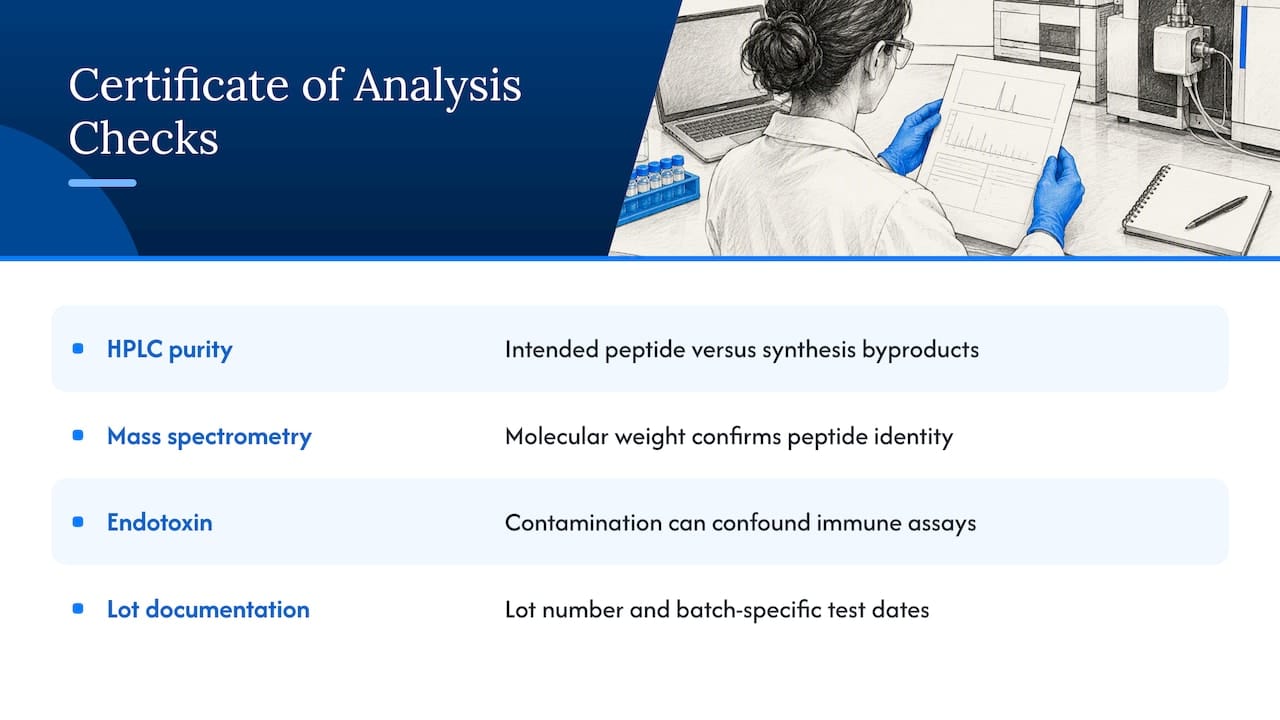
Endotoxin testing results matter particularly for TA1 given its immunomodulatory research applications, since endotoxin contamination can independently activate immune pathways and confound any experiment measuring cytokine release or T-cell activation. A Certificate of Analysis without endotoxin data leaves that confound unaddressed.
Lot number and batch-specific testing dates distinguish a genuine Certificate of Analysis from a generic specification sheet that describes what the product should contain rather than what a specific batch actually contained. Researchers should request lot-matched documentation for every shipment, not a single reference certificate reused across multiple orders. Batch-specific Certificates of Analysis with identity, purity, and endotoxin data for every lot are recommended standards any peptide intended for immunologic research should meet before it enters a protocol.
Storage, Handling, and Preparation Practices That Preserve Activity
Lyophilized TA1 should be stored frozen, typically at negative 20 degrees Celsius or below, until reconstitution, and protected from light and humidity during that storage period. Once reconstituted with sterile water or an appropriate diluent, the solution should be kept refrigerated and used within the timeframe specified by the supplier, since peptide bonds degrade faster in solution than in powder form.
Repeated freeze-thaw cycles degrade peptide integrity measurably, so researchers working through multiple experiments from a single reconstituted vial should aliquot the solution into single-use portions immediately after reconstitution rather than refreezing and thawing a shared stock. Using sterile technique during reconstitution, including filtered diluent and clean syringes, reduces the risk of introducing microbial contamination that compounds degradation over the peptide’s working life.
Preparation technique also affects reproducibility across a research team. Gentle swirling rather than vigorous shaking during reconstitution helps avoid mechanical denaturation of the peptide structure, and allowing the lyophilized powder to reach room temperature before adding diluent reduces condensation-related contamination risk. Documenting reconstitution date, diluent volume, and storage conditions for each vial gives a lab the ability to trace an unexpected assay result back to a handling variable rather than assuming the peptide itself was ineffective.
Common Contaminants in TA1 Preparations and Their Research Impact
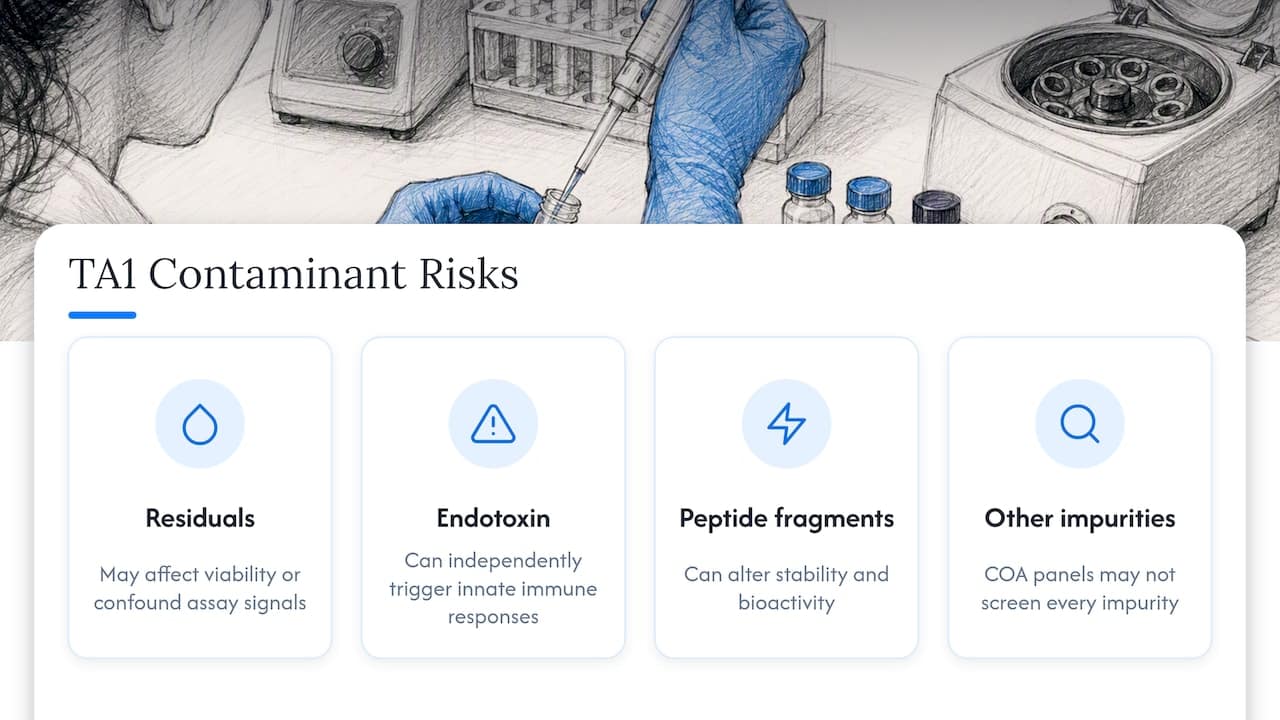
Peptide preparations, including TA1, can carry several categories of contaminants that affect research outcomes without necessarily showing up on a basic visual inspection. Residual solvents and coupling reagents from solid-phase synthesis can remain in trace amounts if purification is incomplete, potentially interfering with cell culture viability or introducing confounding signals in sensitive assays.
Endotoxin contamination deserves particular attention for an immunomodulatory peptide like TA1, since even low levels can independently trigger the innate immune responses that a TA1 experiment is trying to measure, making it difficult to distinguish peptide-driven activation from contamination-driven activation. This is precisely the kind of confound a lot-specific endotoxin test is designed to rule out.
Truncated or incompletely acetylated peptide fragments represent another common impurity category. Because TA1’s N-terminal acetylation is relevant to its resistance to degradation, a batch with a meaningful fraction of non-acetylated or truncated peptide may behave differently in stability and bioactivity testing than the intended full-length, acetylated molecule, even if overall mass-based purity looks acceptable. Mass spectrometry confirmation helps catch this issue, while a purity percentage based solely on HPLC peak area may not.
Heavy metals and residual host cell proteins are less common in synthetic peptide production than in biologically derived products, but researchers sourcing material from unfamiliar suppliers should still confirm what contaminant classes a given Certificate of Analysis actually screens for, since no single test panel covers every possible impurity.
Where Thymosin Alpha 1 Research Should Go Next
The field’s biggest gap is not mechanism, it is power. Sepsis and pancreatitis trials keep producing promising subgroup signals that never survive a well-powered, multicenter, placebo-controlled test, which argues for biomarker-stratified or adaptive designs built around the heterogeneity TESTS already revealed, rather than another broad, unstratified trial. Shared protocols and open data would let smaller studies contribute to a cumulative answer instead of each adding another inconclusive single-center result.
— Data Peptides
How We Support Rigorous TA1 Research
Reliable TA1 research depends on knowing exactly what is in the vial, and that is the problem our sourcing process at Data Peptides is built to solve. Every lot we sell ships with a batch-specific Certificate of Analysis covering identity, purity, and endotoxin data, so investigators are not left reconciling a generic spec sheet against their own experimental results. Combined with reliable shipping and support, researchers can move from procurement to bench work without sourcing delays that stall protocol timelines.
For laboratory-use peptides backed by that documentation, visit our shop to review current lots and specifications.
This article is general information, not a substitute for advice from a qualified doctor. Consult a qualified healthcare professional about your own circumstances before acting on anything here.
FAQ
Does thymosin alpha 1 actually work?
Evidence varies by indication: a 2025 meta-analysis found meaningful immune and infection benefits in severe acute pancreatitis, while the largest sepsis trial, TESTS, found no significant mortality benefit overall. The honest summary is that mechanistic evidence is strong but clinical benefit is not yet established across the board.
How long should I take thymosin alpha 1?
Treatment duration in published research depends on the indication being studied, ranging from short courses of days in acute sepsis and pancreatitis protocols to months of twice-weekly dosing in chronic hepatitis trials, according to the literature review. There is no single standardized duration across the research literature, and any protocol should be matched to the specific condition and endpoint under study.
How long does it take to see results from thymosin alpha 1?
Immunologic markers like CD4+/CD8+ ratio changes have been reported within the treatment windows used in the pancreatitis meta-analysis, which involved short-term dosing during acute illness. Clinical endpoints such as infection rates or mortality take longer to assess and are measured at fixed trial timepoints like 28 days rather than as a continuous response curve.
Is thymosin alpha 1 the same as TB500?
No, thymosin alpha 1 and TB-500 are different peptides with different structures and different research applications. TA1 is an immunomodulatory peptide studied primarily for infection, sepsis, and inflammatory conditions, while TB-500 is a distinct peptide fragment studied in different research contexts and should not be substituted for TA1 in a protocol referencing TA1 trial data.
Sources
- Thymosin alpha 1 alleviates inflammation and prevents infection in patients with severe acute pancreatitis through immune regulation: a systematic review and meta-analysis
- Thymosin alpha 1: A comprehensive review of the literature
- The efficacy and safety of thymosin α1 for sepsis (TESTS) — updated analyses