

Albumin-binding peptides are short sequences or fatty-acid-modified tags that attach a drug or peptide to serum albumin, the most abundant protein in blood, so that the cargo is cleared more slowly. The idea is simple, and the published data are striking: in one rat study a small tag extended a peptide’s half-life 25-fold. For researchers, the practical lesson is that results depend on the exact structure and purity of the material, which is why documentation matters as much as the concept. Our research catalog at Data Peptides is sold for laboratory research use only, with a Certificate of Analysis for every lot.
TL;DR
- Albumin-binding peptides tether a peptide to albumin non-covalently, which slows kidney filtration and lets the molecule detach at its target.
- Published examples include a 25-fold half-life gain in rats and a multi-day half-life for a tagged Exendin-4 analogue in monkey plasma.
- Affinity depends on design: fatty acid chain length, acylation site and peptide contacts all change binding strength.
- Reproducible research needs verified identity and purity, so check the batch Certificate of Analysis before any experiment.
- Everything we sell is for laboratory research use only, not for human or animal consumption.
Table of Contents
- What albumin-binding peptides are
- Why binding extends half-life
- What the data show
- How design changes binding strength
- Where the approach is studied
- What this means for a research bench
- Our catalog for research
- Our perspective
- FAQ
- Sources
What albumin-binding peptides are
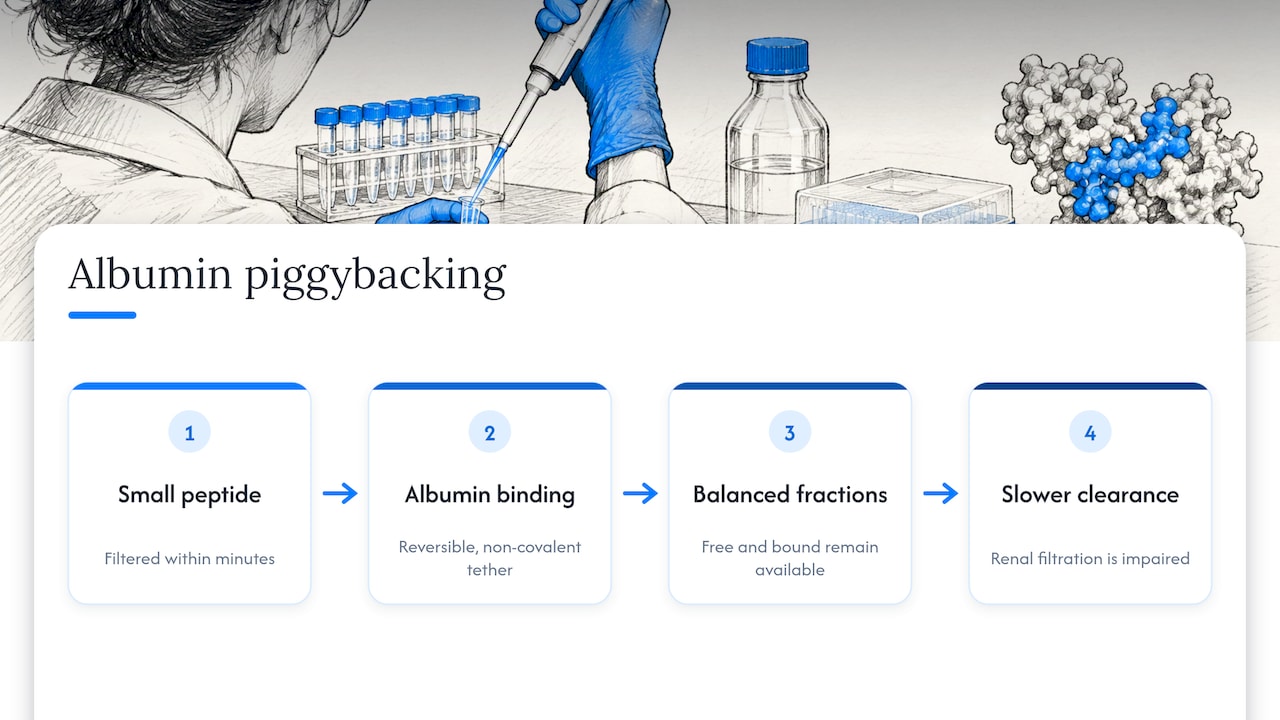
Small peptides are cleared fast. They are filtered by the kidneys and chewed up by proteases, often within minutes. Albumin is a ~66 kDa blood protein that circulates for a long time, so a peptide that rides on it is cleared more slowly.
An albumin-binding peptide is a ligand that does this without a permanent chemical bond. According to a review of non-covalent albumin-binding ligands, the ligand tethers a peptide or small protein to albumin after injection and impairs renal filtration, and reversible binding balances the free and bound fractions available at the target. This is often called a piggyback strategy. A 2023 review describes appending an albumin-binding moiety as one of the most promising carrier strategies, with natural and library-derived binders that differ in size, affinity and binding site.
Why binding extends half-life
Three effects work together:
- Size. The complex is much larger than the free peptide, so it escapes filtration.
- Shielding. A chemical strategies review explains that bound molecules are protected from proteolysis and gradually released.
- Recycling. Albumin’s interaction with the recycling receptor FcRn slows clearance further. The same review notes that albumin-binding drugs can in principle approach albumin’s own 19-day half-life.
The binding has to stay reversible. A peptide locked permanently to albumin could not reach its target, so designers aim for an affinity that holds the cargo in circulation yet lets it go.
What the data show
| Study | Design | Reported result |
|---|---|---|
| Zorzi et al., Nature Communications, 2017 | Acylated heptapeptide (EYEKpalmEYE) on a bicyclic peptide, Kd 39 ± 3 nM for human albumin | Rat half-life rose 25-fold, from 18 minutes to 7.4 hours |
| Xu et al., 2022 | Exendin-4 analogues with fatty acid tags | Half-life rose from about 14 hours to 3.1 to 4.9 days in albumin-containing monkey plasma |
| Gong et al., 2024 | Peptides screened from a one-bead one-compound library, coupled to triptorelin | Mouse circulation half-life 263.50 h versus 179.07 h for triptorelin alone |
| Yousefpour et al., 2019 | Albumin-binding domain linked to doxorubicin | Plasma half-life 29.4 ± 0.8 h in mice, with about 120-fold greater relative tumor accumulation at 72 h than free drug |
These are animal and in vitro results. They illustrate the mechanism, not a finished outcome for any product.
How design changes binding strength
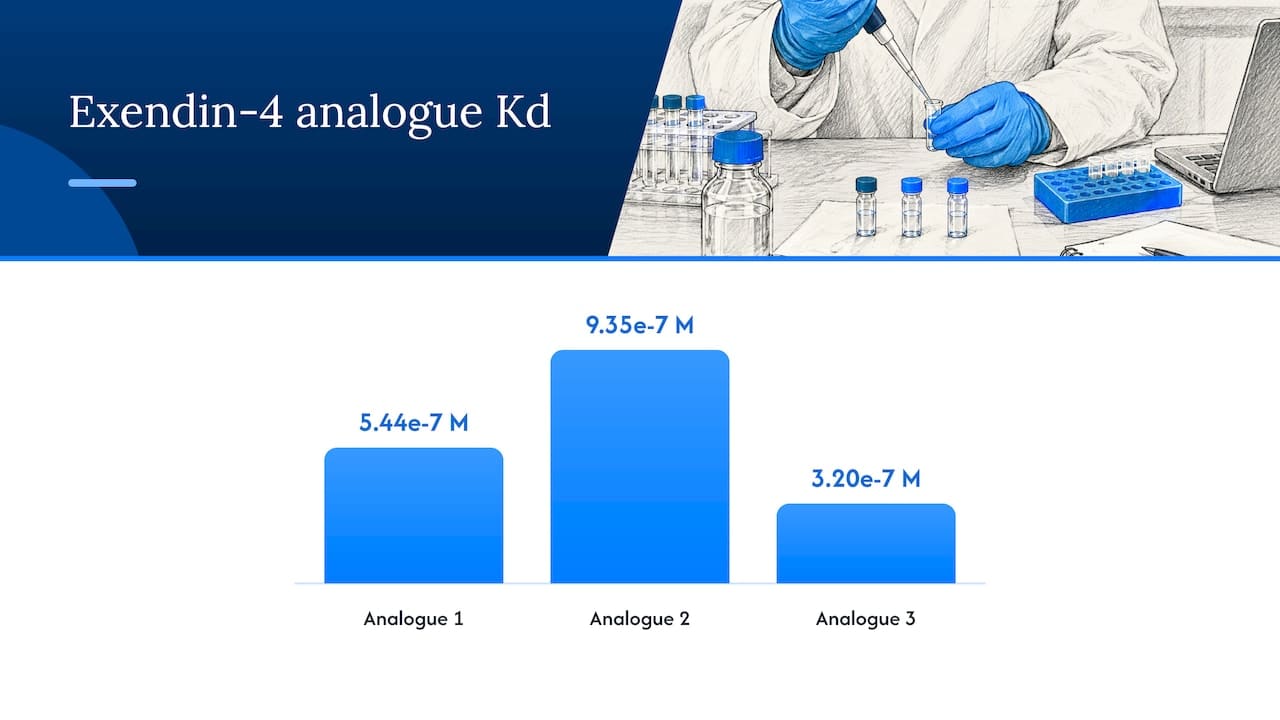
Not all binders are alike. In the Exendin-4 work, acylation site and fatty acid chain length determined affinity: the three analogues bound human serum albumin with Kd values of 5.44 × 10⁻⁷, 9.35 × 10⁻⁷ and 3.20 × 10⁻⁷ M, and the tightest binder had the longest half-life, 4.9 days.
Several design routes exist:
- Peptide–fatty acid chimeras. The Heinis group reasoned that a fatty acid anchor plus extra peptide contacts reaches low-nanomolar affinity, and that the linear tag resists degradation because its residues sit near the albumin surface.
- Library screening. Gong et al. screened for sequences with dissociation constants up to 1 × 10⁻⁸ mol/L using fluorescently labeled albumin.
- Macrocycles. A 2022 preprint reported a small perfluoroaryl macrocycle with micromolar affinity for human, rat and mouse albumin.
- Engineered domains. The SON-1010 team built a human antibody-fragment binder designed not to interfere with FcRn recycling, and added one mutation to minimize immunogenicity.
The same review literature stresses that the right ligand depends on the bioactive molecule and its application, and that biodistribution, tissue penetration and immunogenicity need evaluation case by case.
Where the approach is studied
The best-known field is metabolic medicine. Weight-loss peptide drugs approved in several countries are co-agonists of gut hormones such as GLP-1, glucagon and GIP, as a 2020 review of obesity peptides describes, and longer-acting versions are a natural target for half-life engineering. For background on how long-acting GLP-1 therapy is discussed clinically, see this piece on continuing GLP-1 receptor agonists.
Oncology is the other major area: albumin-bound doxorubicin conjugates and the SON-1010 interleukin-12 fusion, which blocked tumor growth in mouse models and is being studied in clinical trials, according to the Frontiers paper.
Albumin binding is also valued as an alternative to PEGylation, which carries long-term concerns such as hypersensitivity, antibody formation and bioaccumulation, per the lipidation review above.
What this means for a research bench
A half-life result is only as good as the material behind it. Small changes in a fatty acid chain or a residue shift affinity measurably, so a mislabeled or impure lot can ruin an experiment. Before you design a binding or pharmacokinetic assay, confirm:
- Identity. Mass spectrometry data matching the expected sequence.
- Purity. An HPLC trace tied to the specific lot number.
- Endotoxin data. Essential for any cell or in vivo work.
- Batch traceability. The COA should match the vial you hold.
At Data Peptides, every lot is third-party batch tested for purity and identity, with a Certificate of Analysis and endotoxin data, and our products are lab-grade with 99%+ purity for research use. If you are reviewing how to read these documents, our guide on what researchers should verify first and our anti-aging peptide COA checks walk through it.
Our catalog for research
We offer research peptides across weight loss, muscle growth, recovery, anti-aging, libido and ancillary supplies. Orders ship fast and discreetly from our US facility, and our support team is available 24/7. Browse the full research catalog. All products are for laboratory research use only, and are not for human or animal consumption or medical treatment.
Our perspective
Half-life engineering shows how much structure matters. A few atoms of difference in an acyl chain can move affinity and duration substantially, and that is why we treat documentation as part of the product.
We think a researcher should be able to trace every vial to a lot, a purity figure and an identity result. That is the reason we publish Certificates of Analysis and endotoxin data for every lot, and why we sell for laboratory research use only.
If your work touches peptide stability, carriers or pharmacokinetics, start from verified material and build outward. We built our catalog and 24/7 support around that approach.
Data Peptides
FAQ
What amino acids make up albumin?
Albumin is a large protein built from the standard 20 amino acids, arranged in a single chain of roughly 585 residues in humans. Its folded structure includes several pockets that carry fatty acids, hormones and drugs. Binding peptides target those pockets or neighboring surfaces.
Which hormones bind to albumin?
Albumin carries many molecules, including fatty acids, bilirubin and some hormones. The PMC review also lists peptides and proteins such as insulin, bradykinin and interferons among the molecules it binds.
Is an albumin-binding peptide the same as PEGylation?
No. PEGylation attaches a polymer to enlarge a molecule. Albumin binding uses reversible attachment to a natural blood protein. Both aim to extend half-life, but they work differently.
Are these studies evidence for use in people?
The cited results come from laboratory, animal and early clinical research on specific constructs. They do not apply to catalog research peptides, which we sell for laboratory use only.
Sources
- Non-covalent albumin-binding ligands for extending the circulating half-life of small biotherapeutics (PMC)
- Human serum albumin binders: a piggyback ride (PubMed)
- Albumin-binding tag derived Exendin-4 analogue (PubMed)
- Acylated heptapeptide binds albumin with high affinity (Nature Communications)
- Peptides screened from one-bead one-compound technique (ScienceDirect)
- Genetically encoded perfluoroaryl macrocycles (bioRxiv)
- SON-1010 albumin-binding IL-12 fusion (Frontiers in Immunology)
- Chemical strategies for half-life extension (PMC)
- Conjugate of doxorubicin to albumin-binding peptide (PMC)
- Peptides for use in obesity treatment (PMC)