

P021 is a small, CNTF-derived neurotrophic peptide that has been studied almost entirely in mice, mainly in Alzheimer’s disease models, where it improved memory-related measures and raised markers of neurogenesis. It has not been tested in humans. That single fact should frame every claim you read about it, and it is the most useful thing to know before you evaluate a source, a study or a vial.
This guide is for researchers and curious readers who keep seeing P021 described as a “brain peptide” and want to know what the peer-reviewed work says, where it stops, and what documentation to expect from any laboratory supplier of research peptides.
TL;DR
- P021 is a peptide derived from ciliary neurotrophic factor (CNTF), studied in mouse models of Alzheimer’s disease and a rare neurodevelopmental disorder.
- In female 3xTg-AD mice, long-term oral P021 reduced tau pathology and soluble amyloid-beta and rescued cognition and synaptic measures.
- A 2024 CDKL5 deficiency study found limited behavioral benefit and no in-vivo BDNF increase, so results do not carry across models automatically.
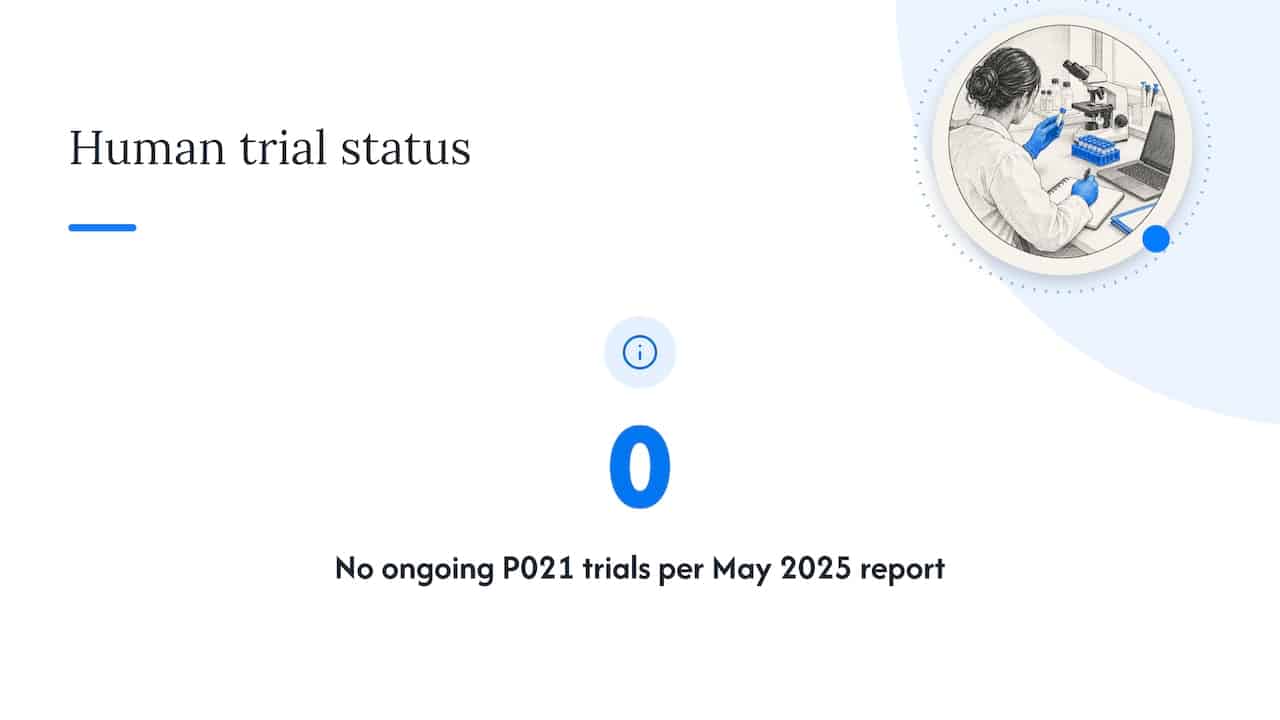
- The Alzheimer’s Drug Discovery Foundation reports no human studies and no ongoing clinical trials, so human benefit claims have no clinical basis.
- For laboratory work, lot-specific Certificates of Analysis, purity and identity data, and endotoxin results matter more than any marketing copy.
Table of Contents
- What P021 is, and what it is not
- The core mechanism: BDNF and neurotrophic signaling
- What the mouse studies actually found
- The CDKL5 result: why one model is not enough
- Human evidence: none yet
- How to read a P021 claim
- What good laboratory documentation looks like
- Planning a study around P021
- Who this evidence is, and is not, for
- Our perspective
- Laboratory-grade peptides with the paperwork attached
- FAQ
- Sources
What P021 is, and what it is not
P021 is a neurotrophic peptide. A neurotrophic factor is a molecule that supports the survival, growth and connections of nerve cells. P021 was designed from a fragment of CNTF, a protein of that family, and the Alzheimer’s Drug Discovery Foundation (ADDF) describes it in its Cognitive Vitality report as a CNTF-derived neurotrophic peptide.
The name causes confusion in search results. “P21” and “p21” are also used for a cell-cycle regulatory protein that has nothing to do with this peptide, and “P-21” appears in many product pages as shorthand. The compound in the literature is spelled P021. When you read a paper or a listing, check that it names P021 and cites the CNTF connection. If it does not, you may be reading about something else.
It also helps to separate P021 from other peptides people group together under “brain” or “cognitive” headings. Different peptides have different origins, mechanisms and levels of evidence. Our brain peptide research overview places several of them side by side, and the Humanin research page covers a different mitochondria-related peptide with its own literature.
The core mechanism: BDNF and neurotrophic signaling
The central idea behind P021 is that it nudges the brain’s own growth-factor machinery. A 2021 peer-reviewed study by Wei and colleagues reported that P021 treatment started at birth in 3xTg-AD mice increased BDNF (brain-derived neurotrophic factor, a protein involved in learning and synaptic plasticity). The same work measured activation of downstream signaling, including phosphorylation of PLC, Akt, GSK-3β, MEK and ERK, which are pathways involved in cell survival and growth.
In plain terms: the proposed chain is P021, then more BDNF, then activation of survival and plasticity pathways, then healthier synapses and more new neurons in the hippocampus, a memory-related brain region. That chain is a working hypothesis supported by animal data, not an established human mechanism.
What the mouse studies actually found
Most of what is written about P021 traces back to a handful of studies in one mouse strain. The 3xTg-AD mouse carries three human genes linked to Alzheimer’s disease and develops amyloid and tau changes with age. Here is what the main papers report.
| Study | Design | Reported result |
|---|---|---|
| Kazim et al., 2014 | Female 3xTg-AD and wild-type mice, oral P021 for 12 months starting at 9 to 10 months of age | Reduced tau hyperphosphorylation and soluble Aβ; rescued cognition, neurogenesis and synaptic plasticity deficits; only a trend toward lower plaque load in hippocampal CA1 |
| Baazaoui and Iqbal, 2017 | Dietary P021 in female 3xTg-AD mice from 3 months to 21 months | Improved neurogenesis, dendritic and synaptic measures and cognitive performance |
| Wei et al., 2021 | Treatment initiated at birth in 3xTg-AD mice | Increased BDNF and activation of downstream signaling |
| Falangola et al., 2026 | Early P021 treatment in 3xTg-AD mice, diffusion MRI | Brain microstructure changes detected on imaging |
A few things stand out when you read these side by side.
Timing varies a lot. One study began treatment in middle age, another at 3 months, another at birth. Starting before pathology develops is a prevention design, while starting after is closer to a treatment design. The two answer different questions, and a headline that says “reverses” or “prevents” without naming the start age is skipping the most important variable.
The route was oral in the long-term studies. The 2014 and 2017 work gave P021 by mouth over many months, which is part of why the compound drew interest. It still tells you about mice, not about absorption or dosing in people.
Plaques barely moved. The 2014 study reported only a trend toward reduced plaque load in one hippocampal region. The stronger effects were on tau, soluble amyloid, synapses and behavior. Pages that claim P021 clears plaques overstate the paper.
Imaging is not behavior. The 2026 diffusion-MRI paper, published February 23, 2026, described microstructure changes after early treatment, but its authors note that it included no behavioral testing and that histological validation is needed. They also state that MRI changes alone do not show that the microstructure findings translate into cognitive benefit.
The CDKL5 result: why one model is not enough
The most instructive paper is one that did not give a clean win. In a 2024 study of CDKL5 deficiency disorder, a rare neurodevelopmental condition, Mottolese and colleagues tested P021. They reported restoration in vitro of neuronal proliferation, survival, maturation and GSK-3β signaling in cultured cells. In mice, though, behavioral benefit was limited, and there was no BDNF increase and no improvement in neuroanatomical defects in vivo.
This matters for anyone designing an experiment. A mechanism seen in a dish, or in one disease model, can fail to appear in another. Good research reading means holding three levels apart: cell culture, animal models, and humans. P021 has solid-looking data at the first two levels in specific settings, and nothing at the third.
Human evidence: none yet
The ADDF Cognitive Vitality report, last updated May 12, 2025, states that P021 has not been tested in humans and that its reported cognitive and neuroprotective effects are preclinical. It also says that, based on a ClinicalTrials.gov check, no clinical trials testing P021 were ongoing. The same report notes that no human safety assessment exists. Rodent studies lasting up to 18 months reportedly showed no weight loss, tumors or signs of pain associated with full-length CNTF.
That last point deserves care. It concerns animals and the parent protein, so it is not a human safety profile. For P021 specifically, there is no established human dose, no approved use and no clinical outcome data.
This is where much of the search-result copy goes beyond the science. Pages promising improved memory, anti-aging, cancer-fighting or performance effects in people are extrapolating from mouse papers. If your interest is a clinical route to peptides, the right conversation is with a licensed clinician about what is actually approved and studied, and clinics that offer peptide therapy in a medical setting work under that kind of oversight. P021 research material is for laboratory work only.
How to read a P021 claim
Use these questions on any page, video or product listing.
- Which species and model? “Studies show” usually means female 3xTg-AD mice. The 2017 authors themselves caution that this overexpression model does not reproduce the full mechanism or neuropathology of human Alzheimer’s disease, and that their study used only female mice.
- When did treatment start? Prevention at birth or 3 months is not the same as treatment of established disease.
- What was measured? Behavior, biochemistry, imaging and cell culture are different kinds of evidence. Imaging alone does not show cognitive benefit.
- Was there a null or mixed result? The CDKL5 paper is the example. A summary that mentions only positive findings is incomplete.
- Does the claim leave the lab? Any sentence that tells a person to take P021, or that predicts an effect on memory, aging, recovery or athletic performance in people, has no clinical study behind it.
Applying these filters takes about ten minutes and removes most of the noise from a search results page.
What good laboratory documentation looks like
Because the biology is still being worked out in animal and cell systems, the quality of the material matters. An experiment run on an impure or mislabeled peptide cannot be interpreted. That is true for P021 and for every other research peptide.
When you source any research peptide, look for:
- A lot-specific Certificate of Analysis (COA). It should match the batch you receive, not a generic sheet for the product.
- Purity by HPLC. High-performance liquid chromatography separates the peptide from contaminants and gives a purity percentage.
- Identity confirmation. Mass spectrometry confirms that the molecule is what the label says.
- Endotoxin data. Endotoxins are bacterial residues that can confound cell and animal work.
- Third-party testing. Independent batch testing means the numbers do not come only from the seller.
- Research-use-only labeling. Laboratory-grade material is sold for in vitro and laboratory research, not for human or animal consumption.
Our guides on what researchers should verify first for recovery peptides and on matching assay tier to procurement with four COA checks walk through the same documentation logic in more detail, and it applies to any peptide you plan to work with.
Planning a study around P021
For researchers, the existing literature suggests a few practical design points.
Define the question by model. The Alzheimer’s data come from a transgenic mouse, and the CDKL5 data from a different disease model. Choose the model that matches your question rather than assuming the effect transfers.
Include both sexes. The 2014 and 2017 studies used only female mice, and the 2017 authors flag this as a limitation. A new study that adds males fills a real gap.
Pair imaging with behavior and tissue. The 2026 imaging paper shows why: microstructure changes were seen, but behavior was not tested and histology is still needed to validate them.
Record batch numbers. Tie every result to a lot and its COA so another lab can reproduce your conditions. Reproducibility is the main weakness of any peptide literature built on small numbers of animal studies.
Report null results. The CDKL5 paper is useful precisely because it recorded what did not happen.

Who this evidence is, and is not, for
This topic matters most to laboratory researchers and students of neurobiology. Athletes, fitness enthusiasts and people interested in anti-aging often arrive at P021 through social media. For them the evidence statement is short: there are no human studies of P021 for performance, recovery, weight or aging, so no such effect can be claimed. If your interest is research on recovery, muscle or metabolic pathways, the literature around other compounds is wider, and you can start with our overviews of recovery peptides and muscle growth peptides for laboratory use.
Our perspective
We read P021 the way we read every compound: start with the paper, then the model, then the batch in front of you. The mouse work on neurotrophic signaling is interesting, and the CDKL5 result is a reminder that interesting is not the same as proven.
That is why we put documentation first. Every product we sell is third-party batch tested for purity and identity, with a Certificate of Analysis and endotoxin data for each lot. A researcher can only trust a result if the material behind it is what the label says.
Our peptides are sold strictly for laboratory research use, never for human or animal consumption or medical treatment. We ship fast and discreetly from our US facility, and our support team is available 24/7 for questions about an order or its paperwork.
Data Peptides
Laboratory-grade peptides with the paperwork attached
If your work calls for research peptides in the recovery, muscle growth, weight loss, anti-aging or libido categories, you can browse the full range in the Data Peptides shop. Each product is for laboratory research use only and comes with third-party testing and a Certificate of Analysis. For more reading on related compounds, our blog collects research overviews.
FAQ
Has P021 been tested in humans?
No. The Alzheimer’s Drug Discovery Foundation’s report, last updated May 12, 2025, states that P021 has not been tested in humans and that no clinical trials were ongoing based on its ClinicalTrials.gov check. All reported cognitive and neuroprotective effects come from animal and cell studies.
What did the P021 mouse studies show?
In female 3xTg-AD mice, long-term oral P021 reduced tau hyperphosphorylation and soluble amyloid-beta and rescued cognition, neurogenesis and synaptic plasticity deficits. It showed only a trend toward lower plaque load in one hippocampal region. Those results apply to that mouse model.
Does P021 work in every disease model?
Not as far as published work shows. A 2024 CDKL5 deficiency study found restored neuronal signaling in cultured cells but limited behavioral benefit in mice, and no in-vivo BDNF increase. Results depend on the model, the start age and the outcome measured.
Is P021 the same as p21?
No. P021 is a CNTF-derived neurotrophic peptide. The lowercase protein called p21 is a different molecule involved in cell-cycle control, and product pages that use “P-21” loosely can blur the two. Check that a source names P021 and its CNTF origin.
What should I check before using a peptide in lab work?
Confirm a lot-specific Certificate of Analysis showing purity and identity, endotoxin data and independent batch testing. Make sure the material is labeled for laboratory research use only, and record the lot number in your protocol.
Sources
- Neurotrophic treatment initiated during early postnatal development prevents the cognitive decline in 3xTg-AD mice (Wei et al., 2021)
- Effects of a CNTF-derived peptide in CDKL5 deficiency (Mottolese et al., 2024)
- Disease modifying effect of chronic oral treatment with a neurotrophic peptidergic compound in a triple transgenic mouse model of Alzheimer’s disease (Kazim et al., 2014)
- Prevention of dendritic and synaptic deficits and cognitive impairment with a neurotrophic compound (Baazaoui and Iqbal, 2017)
- Diffusion MRI measures detect brain microstructure changes after early P021 treatment in 3xTg-AD mice (Falangola et al., 2026)
- Alzheimer’s Drug Discovery Foundation, Cognitive Vitality report on P021 (updated May 12, 2025)