

Ethical peptide research rests on four things: independent review of any study involving people, honest labeling of what a compound is for, documented quality for every lot, and a clear line between laboratory work and human use. If you buy research peptides, that line is yours to hold. We sell research peptides for laboratory use only, with a Certificate of Analysis (COA, the lab report for a specific batch) and endotoxin data for every lot, because ethics in this field starts with knowing exactly what is in the vial and what it may be used for.
This guide is for researchers, and for athletes, fitness enthusiasts and people curious about recovery, anti-aging or weight management who keep running into peptides online. It explains the principles that guide biomedical research, the U.S. rules that matter, where the marketing of “research” peptides goes wrong, and how to source responsibly.
TL;DR
- Ethical research follows recognized principles: social and clinical value, scientific validity, fair subject selection, a favorable risk-benefit ratio, independent review, informed consent and respect for participants.
- Research use only is a legal and ethical commitment, not a label. The FDA has treated products as unapproved drugs when a seller’s own website showed human use, whatever the label said.
- Any study that gives a peptide to people needs institutional review board (IRB) approval and informed consent before it begins. A product page is not a protocol.
- Quality is an ethical issue. A batch-specific COA, identity and purity testing and endotoxin data protect your data and anyone downstream of it.
- Our peptides are sold for laboratory research only, with third-party batch testing and documentation for every lot.
Table of Contents
- What “ethics” means in peptide research
- The consent and review rules, in plain terms
- Where “research use only” goes wrong
- Why the evidence gap matters ethically
- Peptide drug development has its own ethical questions
- Quality is an ethical issue, not a marketing point
- A responsible-sourcing routine
- Our perspective
- Browse research peptides by category
- FAQ
- Sources
What “ethics” means in peptide research
A peptide is a short chain of amino acids. Some are approved medicines. Many others exist only as research compounds, studied in cells, tissues and animals. Ethics enters at the moment someone proposes to move a compound from one of those settings toward a person.
The NIH Clinical Center lists seven principles for ethical research: social and clinical value, scientific validity, fair subject selection, a favorable risk-benefit ratio, independent review, informed consent, and respect for potential and enrolled subjects. Read together, they say one thing: asking people to accept risk must be justified by a question worth answering, answered with sound methods, and overseen by someone other than the people running the study.
For a bench researcher working with cell cultures, most of these principles apply indirectly. They still shape the work in three ways:
- Validity. A study built on a mislabeled, impure or contaminated compound cannot be scientifically valid, and results that cannot be reproduced waste the effort of everyone who builds on them.
- Honesty about intent. Research compounds are meant to answer research questions. Using them as a stand-in for treatment is outside that purpose.
- Downstream responsibility. Preclinical findings are sometimes used to justify later human studies. Weak data at the start carries risk forward.
The consent and review rules, in plain terms
If your work will ever involve human participants, two layers of oversight apply. Neither is optional.
Informed consent
For FDA-regulated clinical investigations, 21 CFR Part 50 requires legally effective informed consent before a person is involved as a subject. Consent must be sought with enough opportunity to consider participation, must minimize coercion or undue influence, and must be in understandable language. It may not include wording that waives the subject’s legal rights or releases the investigator, sponsor or institution from liability for negligence.
In practice that means a signed form is not enough. The person has to understand what is being tested, what is unknown, and that they can say no.
Institutional review
An IRB is a committee that reviews research involving people before it starts and while it runs. A university handbook for investigators states that the principal investigator is the ultimate protector of participant rights and safety and may not begin human research without prior IRB review and approval. The same handbook explains that IRB criteria under 45 CFR 46.111 cover minimized risks, risks reasonable relative to anticipated benefits, equitable selection of subjects, documented consent with the right to withdraw, safety monitoring, privacy protections and extra safeguards for vulnerable groups.
The FDA and the Office for Human Research Protections also expect IRBs to follow written procedures for initial and continuing review, to ensure changes are not started without approval except to remove an immediate hazard, and to report unanticipated problems and serious noncompliance, as set out in joint FDA/OHRP guidance on IRB written procedures.
When an IND is needed
An Investigational New Drug (IND) application is the FDA filing that lets a drug be studied in people. FDA guidance explains that certain basic research, such as studies with radiolabeled endogenous peptides that seek information about metabolism or physiology at doses known not to cause a clinically detectable pharmacologic effect, may not need one. But if the hypothesis concerns diagnosing, treating or preventing disease, an IND is required under 21 CFR Part 312. Your IRB and institution can tell you which side of that line a protocol falls on.
Where “research use only” goes wrong
The phrase “for research use only” is a fair description of a product when the seller and buyer both treat it that way. It becomes a problem when it is a disclaimer stapled to something else.
The FDA’s December 10, 2024 warning letter to Xcel Research LLC is the clearest public example. The agency found that evidence on the company’s website established that its products were intended as drugs for human use, even though they carried “for research use only” and “not intended for human use” labels. That made them unapproved new drugs introduced into interstate commerce under the FD&C Act.
The lesson for researchers is practical:
- Intent is judged by the whole picture. Website claims, dosing talk and testimonials count, not just the label.
- A responsible seller keeps its pages and support aligned with laboratory use. That includes what customer service will and will not discuss.
- A responsible buyer does the same. Your purchase records, protocols and lab notebooks should describe in vitro or animal research that your institution has approved where required.
That is the position we take. Our products are sold for laboratory research only, and our customers are researchers, research organizations, fitness professionals and hobbyists buying for laboratory applications. They are not for human or animal consumption or for medical treatment. For the legal background, see our guide to whether peptides are legal for research in the U.S.
Why the evidence gap matters ethically
People who see peptides promoted for recovery, anti-aging or weight loss often ask why researchers do not simply “try” them. The answer is the ethics of evidence.
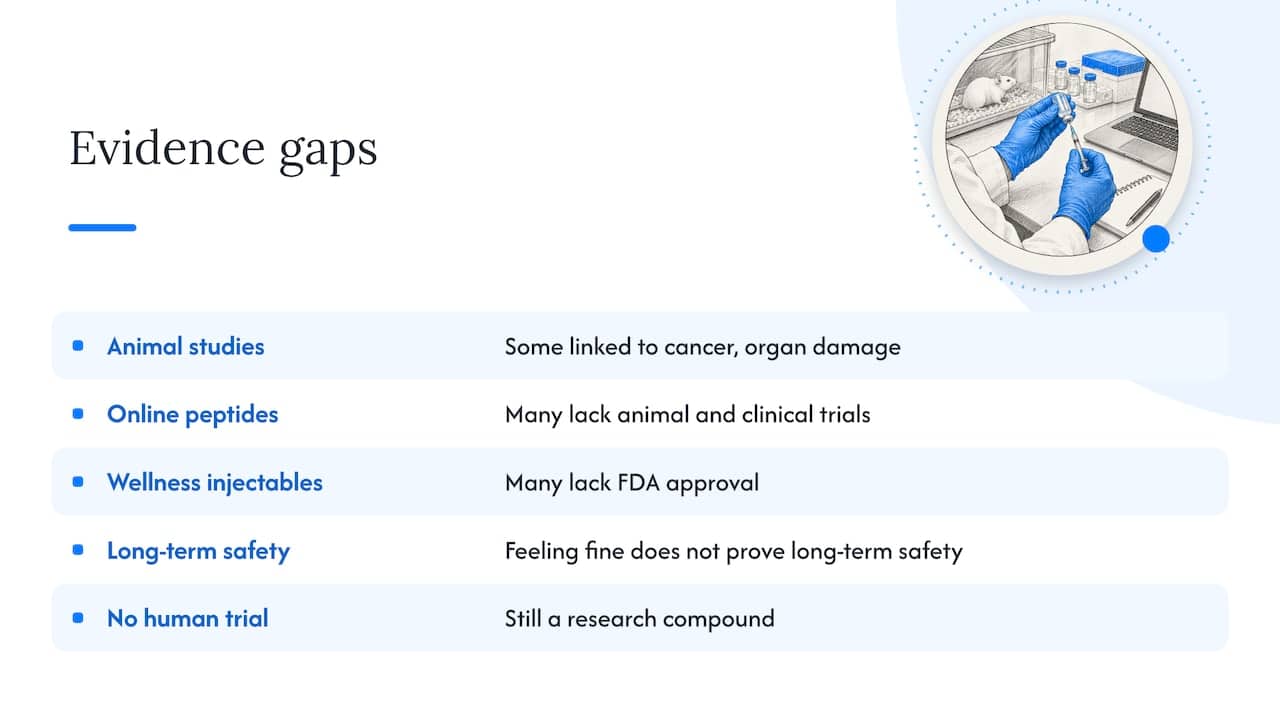
A Stanford Medicine pathologist has warned that in animal studies, some peptides used over weeks or months led to cancer, organ damage or neurotoxicity, and that many research-grade peptides sold online have not gone through the animal testing and clinical trials needed to establish safe and effective human dosing. She also notes that feeling fine after taking a peptide does not show it is safe over the long term.
The American Medical Association’s September 2026 summary says the same from the clinical side: many newer injectable peptides promoted for wellness are not FDA approved and have limited evidence on dosing and long-term risk, and physicians advise talking to a doctor before using any injectable peptide. If you are an athlete, a fitness enthusiast or someone interested in anti-aging, that doctor conversation is the right route for personal health decisions. Laboratory peptides are for the bench, where the work builds the evidence that others will one day rely on.
If pain or recovery is what brought you here, non-drug approaches have their own literature, such as this overview of PEMF for pain research.
For people who are not running research, this is the useful takeaway: the absence of a human trial is the reason a compound is still a research compound.
Peptide drug development has its own ethical questions
Ethics is not only about restriction. A peer-reviewed article in the Journal of Chemical and Pharmaceutical Research argues that ethical peptide drug development requires thorough risk-benefit analysis. Peptide drugs are often specific and may cause fewer side effects than small-molecule drugs, but unexpected immune responses and stability problems are real risks. The same article argues that distribution should address access and affordability, so that high development costs do not price valuable therapies out of reach.
These questions are what makes preclinical work valuable. Well-characterized compounds, honest reporting and reproducible assays are how a candidate peptide earns the right to be studied in people.
Quality is an ethical issue, not a marketing point
A contaminated or mislabeled peptide harms research in a quiet way: a failed replication, an unexplained cell response, a retracted figure. Sourcing discipline is part of research integrity.
What to check before a lot enters your assay
| Check | What it tells you | What to look for |
|---|---|---|
| Batch-specific COA | Purity and identity of the lot in your hands | Lot number on the report that matches the vial |
| Identity testing | The compound is what the label says | Mass spectrometry or comparable data, not a generic statement |
| Purity | How much of the material is the target peptide | A stated percentage tied to the lot |
| Endotoxin data | Bacterial contamination that can skew cell-based work | A reported value for the lot |
| Third-party testing | Results that are not self-reported | An independent lab named on the report |
| Intended-use language | Whether the seller treats the product as research material | Consistent research-only wording everywhere |
Our own approach follows this list. Every product is third-party batch tested for purity and identity, and we provide a COA and endotoxin data for every lot. We state 99%+ purity for our research peptides, and orders ship quickly and discreetly from our U.S. facility with 24/7 support for all purchases.
Fake documentation is its own ethical problem. Our guides on peptide scams and fake COAs and on three safety checks before a lot enters your assay walk through the red flags in detail. If your work touches competitive sport, our checklist for peptides banned in sports covers the data-integrity side.
A responsible-sourcing routine
- Define the research question and setting. Write down whether the work is in vitro, in animals or involves people. Anything involving people goes to your IRB first.
- Confirm institutional approvals. Animal work needs its own committee approval at most institutions. Ask your compliance office, not a vendor.
- Buy from a seller whose documentation matches the lot. Compare the lot number on the COA with your vial and file the report with your records.
- Keep research-only language consistent. Your purchase orders, protocols and storage labels should all describe laboratory use.
- Record handling and storage. Reproducibility depends on how a lot was stored and when it was reconstituted.
- Report honestly. Name the compound, source, lot and purity in your methods so others can replicate your work.
For a broader view of how to buy, our guide to buying research peptides online goes through each step.
Our perspective
We built Data Peptides around a simple view: the most ethical thing a supplier can do is make the research better and keep it in the laboratory.
That means documentation you can check. Every lot is third-party batch tested for purity and identity, and every lot ships with a Certificate of Analysis and endotoxin data. A researcher should never have to wonder whether a result came from the compound or from an impurity.
It also means being clear about use. Our peptides are for laboratory research only. We do not sell for human or animal consumption or for medical treatment, and we want our customers’ records to say the same.
Peptide research for recovery, muscle, metabolism and aging is moving quickly, and the people doing it deserve a supplier that is fast, discreet and reachable at any hour. Our support team is available 24/7 for every purchase.
Data Peptides
Browse research peptides by category
If you are ready to source material for an approved laboratory project, our research peptide shop covers weight loss, muscle growth, recovery, anti-aging, libido and ancillary research supplies. Each product is sold for laboratory research only, with lot documentation.
FAQ
What are the main ethical principles in biomedical research?
The NIH Clinical Center lists seven: social and clinical value, scientific validity, fair subject selection, a favorable risk-benefit ratio, independent review, informed consent, and respect for participants. They apply most directly to studies with people, and they guide how preclinical work should be designed and reported.
Do I need IRB approval to use research peptides?
You need IRB review and approval before starting any research that involves human participants. Work done only in cell cultures or other laboratory systems follows your institution’s own rules, and animal work typically needs its own committee approval. Your institution’s compliance or research office can tell you which applies.
Why does “for research use only” matter so much?
Because the FDA looks at what a product is intended for, not just what its label says. In a December 2024 warning letter, the agency found that a seller’s website claims made its research-labeled products unapproved drugs. Consistent research-only wording, from product page to support, is part of selling and buying responsibly.
Are research peptides tested for human safety?
No. Research compounds are sold for laboratory use because they have not completed the animal testing and clinical trials needed to set safe human dosing, according to Stanford Medicine. Anyone considering a peptide for personal health should speak with a physician.
How can I tell whether a peptide supplier is documenting quality properly?
Look for a COA tied to the specific lot number, independent third-party testing, identity and purity data, and endotoxin results. Our reports follow that pattern for every lot.
Sources
- Guiding Principles for Ethical Research, NIH
- 21 CFR Part 50, Protection of Human Subjects, eCFR
- Investigator’s Handbook for the Protection of Human Research Subjects, Vanderbilt University Medical Center
- IRB Written Procedures, FDA and OHRP
- Investigational New Drug Applications: Determining Whether Human Research Studies Can Be Conducted Without an IND, FDA
- Xcel Research LLC warning letter, FDA, December 10, 2024
- Peptides talk is everywhere: But what does the science say?, Stanford Medicine
- What doctors want patients to know about injectable peptides, American Medical Association
- Ethical and Regulatory Considerations in Peptide Drug Development, Journal of Chemical and Pharmaceutical Research