
Peptide scams fall into two groups: sellers who take your money and send nothing (or something other than what you ordered), and marketers who sell hope with claims no regulator has verified. You can screen out most of both by checking four things: who the seller is, whether the lab documentation is real and tied to your lot, whether the claims sound like medicine, and how the seller wants to be paid. This guide walks through each, then covers what to do if you have already paid.
We sell research peptides, so we have a stake here, and we say so plainly. Our view is that the category deserves more scrutiny, not less.
TL;DR
- Many peptides promoted online have had little or no rigorous clinical testing and are not FDA-approved for human use, so “it works” claims are the first red flag (Harvard T.H. Chan School of Public Health).
- A “research use only” label does not make a product safe or approved for people (Consumer Medication Safety).
- A real certificate of analysis names a batch, a lab and a method, and the lot number matches the vial you receive. A generic PDF is not proof.
- If you paid and something is wrong, document everything, contact your card issuer, report to the FTC at ReportFraud.ftc.gov, and report any adverse reaction to FDA MedWatch.
Table of Contents
- What counts as a peptide scam
- Do peptides actually work? What the evidence says
- Red flags on a peptide website or seller
- What “research use only” does and does not mean
- Health risks of unapproved or mislabeled products
- How to verify a seller and a certificate of analysis
- Our perspective
- If you are buying for laboratory work
- What to do if you think you were scammed
- FAQ
- Sources
What counts as a peptide scam
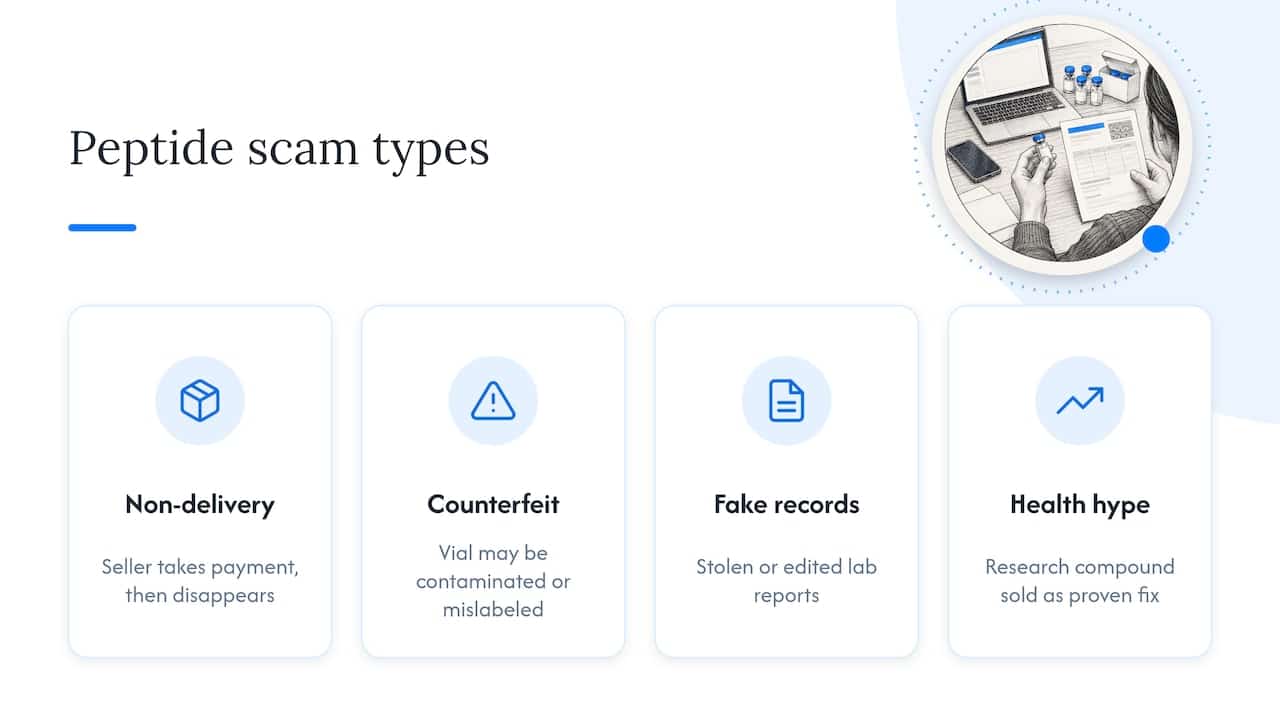
The word covers several different problems, and it helps to separate them.
Exit scams and non-delivery. A polished storefront, a social account or a messaging group takes payment and disappears. Some sellers send fake tracking numbers to buy time.
Counterfeit or mislabeled product. The vial arrives, but the contents are underdosed, contaminated or something else entirely. Health Canada’s testing of seized unauthorized peptides found products that contained no peptides at all, were not sterile, or were mismarked. Harvard’s public health school adds that products labeled as a given peptide may carry bacteria, heavy metals, solvents or other toxins.
Fabricated documentation. Stolen or edited lab reports, certificates with no lot number, and testimonials from people who do not exist.
Hype-driven health fraud. Influencers and sellers who present a research compound as a proven fix for weight, aging or injuries. Harvard’s S. Bryn Austin notes that anyone promoting peptides on social media is doing it to make money, and that some videos may be AI-fabricated and not show a real person (Harvard).
The last category is where many buyers get hurt, because it can involve a real shipment of a real vial and still be a scam in the sense that matters: the promise was never supported.
Do peptides actually work? What the evidence says
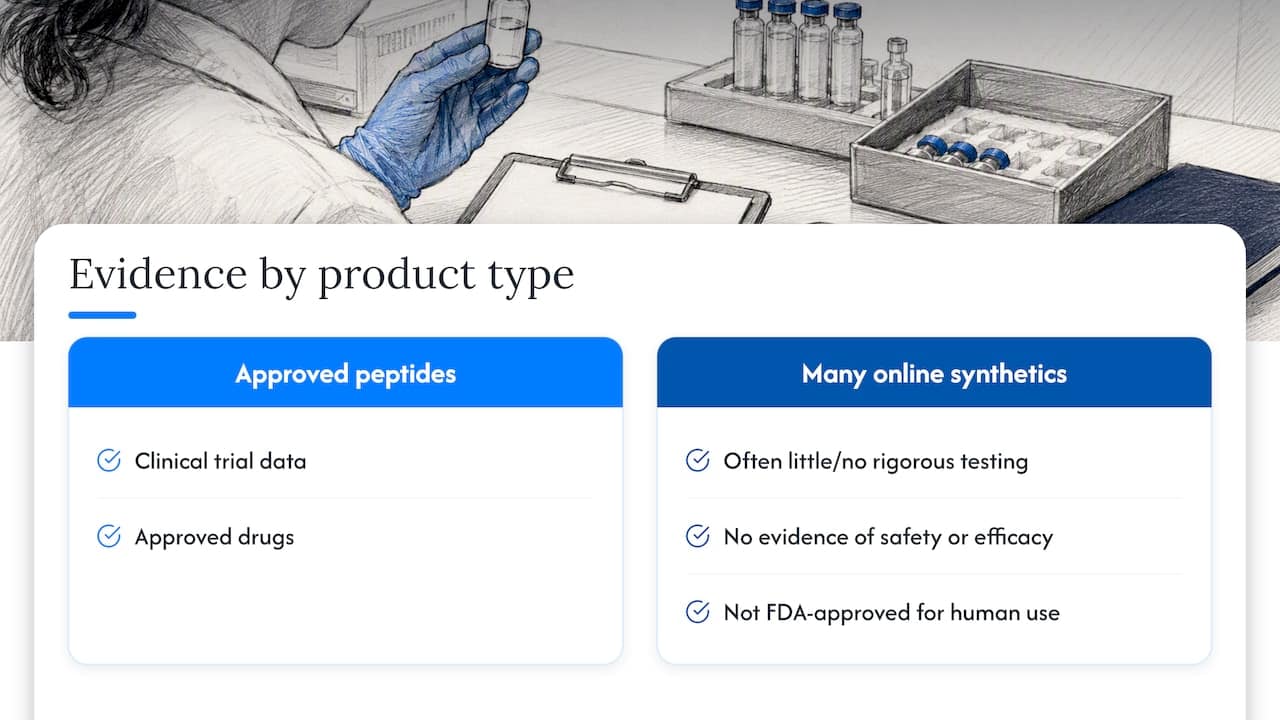
This is the question behind most searches, so it deserves a straight answer. Some peptides are approved drugs with clinical trial data behind them. Many of the synthetic peptides sold online are not. According to Harvard’s public health school, many of those have gone through little to no rigorous clinical testing, and there is no evidence that they work or are safe to consume or inject (Harvard). The same source says that, as of October 2026, peptides sold on the gray market or by research-chemical suppliers often lack that testing and have not been approved by the FDA for human use.
That is why anyone telling you a compound will melt fat, rebuild a tendon and reverse aging is making a claim they cannot back up. A seller who guarantees outcomes for your body is a seller to walk away from.
Red flags on a peptide website or seller
No single sign proves a scam, but several together should stop you.
Claims that sound like medicine
The FDA lists the classic health-fraud tells: one product that cures a wide range of conditions, “miracle” results, anonymous testimonials and conspiracy-flavored marketing (FDA). The agency also warns that “all natural” is used to imply safety, even though many toxic substances come from natural sources. If a product page promises results, dosing protocols for people or before-and-after photos, it is selling a drug claim, not a lab reagent.
Pharmacy-style warning signs
The FDA’s guidance on buying medicine online names the warning signs of unsafe sellers: no prescription required, no U.S. and state licensing, no licensed pharmacist on staff, deep discounts, and no clear written protection for your personal and financial information (FDA). A research supplier is not a pharmacy and should not pretend to be one, but the discount and privacy points apply to any online store.
Payment and contact patterns
- Payment only by crypto, wire transfer or peer-to-peer apps, with no card option.
- Ordering through a chat app, a “wholesale rep” or a DM instead of a checkout page.
- No physical business address, no company name, no working support email or phone.
- Prices far below everyone else’s, with urgency timers.
- A brand-new domain with dozens of five-star reviews and nothing outside the site.
Dosing and injection advice
A seller who tells you how much to inject, or sells bacteriostatic water and syringes bundled with a “protocol,” is signaling human use. In a March 2026 warning letter, the FDA said that despite “Research Use Only” language, a company’s website showed its products were intended as drugs for human use, and it noted that selling bacteriostatic water for injection alongside peptides was part of that evidence. Labels do not override how a product is marketed.
What “research use only” does and does not mean
A “research use only” label tells you the seller says the material is for laboratory work. It does not tell you the product is approved, sterile, or safe in a person. Consumer Medication Safety puts it directly: the label does not make a product safe or mean a doctor has approved it for you (Consumer Medication Safety).
For a legitimate laboratory buyer the label is a boundary, not a loophole. Research material is bought by labs for in vitro and bench work, and it should be handled that way. If you want the legal background, our guide on whether peptides are legal for research in the U.S. covers it. Athletes should also read our checklist on peptides banned in sports before buying anything.
Health risks of unapproved or mislabeled products
This part is not abstract. The risks Harvard’s public health school lists for unapproved peptides include injection-site and systemic infection, gastrointestinal problems, cardiac abnormalities, liver injury and death (Harvard). Health Canada adds that injecting unauthorized peptides, especially with shared needles, can expose people to blood-borne infections such as HIV and hepatitis C (Health Canada). The FDA has received reports of blindness, tumor formation and infections tied to unapproved regenerative medicine products (FDA).
If you are considering a peptide for a health goal, talk to a physician before anything else. That is especially true if you take medication, since Health Canada notes that testimonials are not the same as scientific studies and a product may affect people differently or interact with medicines (Health Canada).
How to verify a seller and a certificate of analysis
Here is a practical routine to run before you pay. It takes about twenty minutes.
- Search the FDA’s database. The FDA keeps a searchable health fraud product database for notifications about dangerous, fraudulent or contaminated products (FDA). Search the product and company name.
- Search the name with “scam,” “complaint” and “review.” The FTC suggests this simple step to find unreliable vendors (FTC). Look beyond the seller’s own site and beyond forums where accounts can be bought.
- Check the business basics. A named company, a U.S. address, a phone or support channel that answers, and a checkout that accepts standard cards.
- Read the certificate of analysis like a skeptic. See the table below.
- Ask for the lot’s documentation by email before buying. A real seller can send the COA for the exact lot. A scammer will stall or send a different file.
- Start small. If you are a lab buyer, a first order for a single item tells you more about shipping, packaging and documentation than any review.
Reading a certificate of analysis
| What to check | Looks legitimate | Looks suspicious |
|---|---|---|
| Lot or batch number | Printed on the COA and on your vial label | Missing, or different from your vial |
| Testing lab | Named, with a date and contact details | Unnamed, or only a logo |
| Methods | Identity (such as mass spectrometry) and purity (such as HPLC) shown with data | A single purity number with no chromatogram |
| Endotoxin data | Reported for the lot | Absent |
| Consistency | Each lot has its own report | Same PDF reused for every product |
| Verifiability | The lab can confirm the report when contacted | Lab cannot be found, or never replies |
A stolen report is a real report for someone else’s batch, so the lot match and the ability to confirm with the lab matter more than a nice layout. Third-party testing means the lab is independent of the seller; it does not mean a lab ran every vial. That is why lot numbers are the link between paper and product. Our guide to buying research peptides online goes deeper on documentation, and our page on the best place to buy peptides lays out the criteria we use ourselves.
Our perspective
We sell lab-grade peptides for laboratory research only, so we see the scam problem from the inside. Two things stand out to us.
First, documentation is the product. For a research buyer, a vial without a lot-specific certificate is just a liquid or powder of unknown identity. We test every lot through third parties for purity and identity and provide the certificate of analysis along with endotoxin data, so buyers can check the paper against the label. A seller who will not show you that has not earned your order.
Second, honest positioning matters more than a good sales line. We do not market our products for human or animal consumption or as medical treatment, and we do not think anyone should buy research peptides expecting a health outcome. If a seller’s marketing contradicts its own “research use only” label, believe the marketing. We also think fast, discreet shipping and reachable support are basic service, not a differentiator that excuses weak testing, so we staff support around the clock for every purchase.
— Data Peptides
If you are buying for laboratory work
Researchers and lab buyers who have been burned by vague suppliers can use the checks above on us too, and we would rather you do. Our shop lists research peptides across weight loss, muscle growth, recovery, anti-aging and libido categories, plus research supplies. Each product ships for laboratory use only, with a certificate of analysis. Before you order, ask for the COA for the lot you are buying and compare it against these criteria. If you want an overview of what each research category covers, start with what peptides are used for in research.
What to do if you think you were scammed
Act fast, and keep records. These steps apply in the U.S.
- Save everything. Screenshots of the product page, order confirmation, emails, chat messages, tracking numbers, payment receipts and the COA you were sent. Sites vanish quickly.
- Contact your card issuer or payment provider. Say the goods were not delivered or not as described and ask to dispute the charge. Do this soon, because dispute windows are limited, and your issuer can tell you its deadline. If you paid by crypto or wire transfer, recovery is much harder, which is one more reason to avoid those methods.
- Report to the FTC. The FTC directs people to report scams and fraudulent health claims at ReportFraud.ftc.gov.
- Report any physical reaction. If you or someone else had side effects or became ill, get medical care first. Then report it to FDA MedWatch online or by calling 1-800-FDA-1088 (FTC). The FDA also asks that adverse effects from unapproved regenerative medicine products be reported to MedWatch (FDA).
- Protect your accounts. If you entered card details or reused a password on a suspect site, change the password and watch your statements. Ask your issuer about replacing the card.
- Do not pay “recovery” fees. People who were scammed often get contacted by a second party offering to retrieve the money for a fee. Treat that as a follow-up scam.
If you have unused product and are unsure what it is, do not inject, ingest or apply it. A physician or poison control can advise on exposure; for a medical emergency call 911.
FAQ
Is it a scam if a peptide seller says “research use only”?
Not necessarily. Legitimate labs and suppliers use that label for material meant for laboratory work. It becomes a red flag when the rest of the site markets the product for human results, dosing or injection, which the FDA has treated as evidence of intended drug use in its warning letters.
Do peptides really work?
Some peptides are approved medicines with clinical evidence. Many synthetic peptides sold online have had little to no rigorous clinical testing, according to Harvard’s public health school, and there is no evidence they work or are safe to inject or consume. Ask a physician about approved options for any health goal.
How can I tell if a certificate of analysis is fake?
Check that the lot number matches your vial, the lab is named and reachable, and identity and purity data (not just a percentage) are shown. A certificate reused across products, or one the lab cannot confirm, is a warning sign. Ask the seller to email the COA for your exact lot before you pay.
Where do I report a peptide scam in the U.S.?
Report scams and fraudulent claims to the FTC at ReportFraud.ftc.gov. Report side effects or illness to FDA MedWatch online or at 1-800-FDA-1088. Your card issuer should hear about it too, so you can start a dispute.
Sources
- Peptides are all over social media and the news. Here’s what to know (Harvard T.H. Chan School of Public Health)
- How to Buy Medicines Safely From an Online Pharmacy (FDA)
- 6 Tip-offs to Rip-offs: Don’t Fall for Health Fraud Scams (FDA)
- Common Questions about Medication Health Fraud (FDA)
- Common Health Scams (FTC)
- Peptides: Health risks (Health Canada)
- ‘Wellness’ Peptides Sold Online: What You Should Know Before Buying (Consumer Medication Safety)
- Important Patient and Consumer Information About Regenerative Medicine Therapies (FDA)
- Gram Peptides warning letter, March 31, 2026 (FDA)