
Humanin is a 24-amino-acid peptide made by mitochondria. Studies in cells and animals link it to cell protection, stress responses and metabolism. Human data is limited to observational work that measures the humanin the body makes naturally. Nobody has shown in a controlled human trial that giving humanin improves a health outcome. This guide covers what has been tested, how the mechanisms work, where the evidence stops, and what a laboratory should verify before buying any humanin material.
TL;DR
- Humanin is a mitochondrial-derived peptide discovered in 2001. It is encoded inside the mitochondrial 16S rRNA gene.
- Cell and animal studies report cytoprotective, neuroprotective and metabolic effects. Much of that work uses HNG, an engineered analog, not native humanin.
- Human studies measure natural humanin levels in blood and tissue. They show associations with aging and disease, not treatment effects.
- Claims about humanin for aging, athletic performance, recovery or weight loss in people are not backed by human trials.
- For laboratory work, identity, purity and lot documentation matter more than any marketing claim.
Table of Contents
- What humanin is and where it comes from
- How humanin is thought to work
- What humanin studies have investigated
- The aging and lifespan question
- Cell, animal and human evidence are not interchangeable
- What is not known
- Why the humanin sold online needs scrutiny
- Designing a sound humanin experiment
- Our perspective
- Sourcing research peptides for your lab
- FAQ
- Sources
What humanin is and where it comes from
Humanin is a 24-amino-acid peptide encoded by a small open reading frame in the mitochondrial 16S rRNA gene. Researchers found it in 2001 while screening for factors that protected neurons from toxicity linked to Alzheimer’s disease. That origin explains why much early work focused on the brain.
It was a surprise at the time. Mitochondrial DNA was long thought to encode only a small set of proteins for energy production. Humanin showed that mitochondria also make short signaling peptides that act inside and outside the cell. Researchers now group humanin with other mitochondrial-derived peptides.
Native humanin versus HNG
You will see two forms in the literature.
- Native humanin (HN): the peptide the body makes.
- HNG (S14G-humanin): a synthetic analog with a single amino acid swap. It is more stable and more potent in assays, which is why many preclinical studies use it.
This difference matters when you read a paper. A result from HNG does not automatically transfer to native humanin, and neither transfers automatically to a product sold under the name “humanin.” Always check which molecule a study used.
How humanin is thought to work
The mechanism literature splits into what happens inside cells and what happens at the cell surface.
Inside the cell
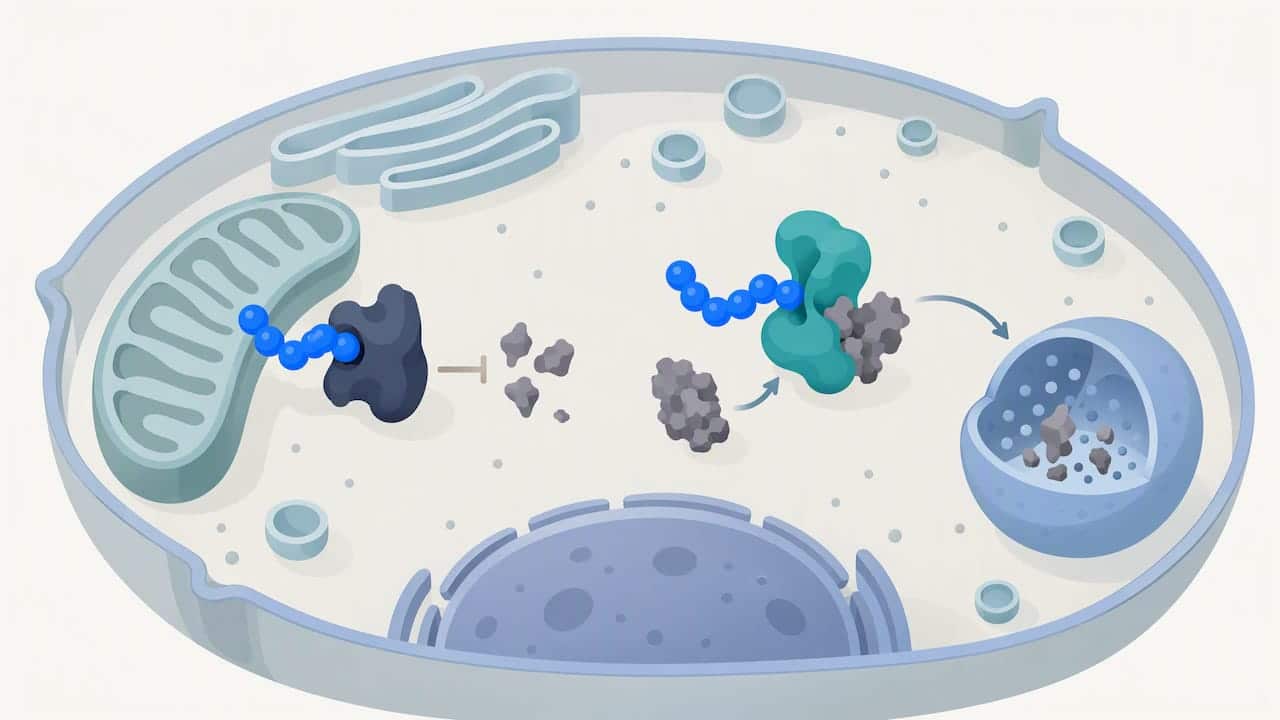
Humanin appears to bind intracellular proteins. One review describes it binding BAX to inhibit apoptosis, and activating chaperone-mediated autophagy through interactions involving HSP90. Chaperone-mediated autophagy is a selective cleanup route in which damaged proteins are delivered to lysosomes. A study found that humanin increases substrate binding and translocation into lysosomes, and that HNG protected cells from stressor-induced death through this route.
At the cell surface
Humanin also works as a secreted signal. Reviews report that, outside the cell, it binds FPRL1/2 to mediate ASK/JNK signaling, and CNTFR-α/gp130/WSX-1 receptors to induce JAK2/STAT3 signaling. These are well-known pathways for survival and inflammation, so humanin’s effects probably depend on cell type and context.
Mitochondrial function under stress
In cultured retinal pigment epithelial cells and in myocardial models, work reported that humanin restored mitochondrial bioenergetics and increased mitochondrial DNA copy number under oxidative stress. This is the most common reason labs study it in oxidative stress and mitochondrial dysfunction models.
The map is incomplete. Reviewers point out that redox signaling pathways involving humanin are not yet comprehensively mapped, so a clean, single-mechanism story would overstate what is known.
What humanin studies have investigated
Published work has examined humanin in three broad areas, according to a review of its roles in aging: neurodegenerative disease such as Alzheimer’s, metabolic disorders such as diabetes, and cardiovascular disease. The recurring themes are cytoprotection, anti-inflammatory activity and insulin sensitization. The same review describes cytoprotective, neuroprotective and metaboloprotective properties in preclinical models.
A short map of the research:
| Research area | Typical model | What was reported | Confidence for humans |
|---|---|---|---|
| Neuronal survival | Cultured neurons | Protection against toxicity linked to Alzheimer’s disease | None from trials |
| Oxidative stress | Retinal and heart cells | Restored mitochondrial function | None from trials |
| Metabolism | Mice | Better metabolic parameters, less visceral fat | None from trials |
| Lifespan | C. elegans, mice | Extension in worms, none significant in mice | None from trials |
| Circulating levels | Human cohorts | Associations with age and disease | Observational only |
The aging and lifespan question
Humanin gets the most attention in longevity circles, so the details are worth reading closely.
In the roundworm C. elegans, humanin overexpression increased lifespan, in a way that depends on signaling pathways such as daf-16/Foxo. That is a real finding in a real model organism. It is also a worm.
The mouse data is more measured. In middle-aged mice, twice-weekly HNG improved metabolic health measures and reduced visceral fat, but did not significantly extend lifespan. Better healthspan markers without a longer life is a more modest result than many summaries suggest.
In people, the same paper notes that children of centenarians had higher circulating humanin than age-matched controls. That is an interesting association. It does not show that raising humanin levels causes longer life. Other observational studies have reported lower humanin with aging or in Alzheimer’s disease, so the human picture is mixed.
Cell, animal and human evidence are not interchangeable
A useful habit when reading any peptide paper is to ask what kind of evidence it is.
The NIH explains that in-vitro studies cannot reproduce the complex interactive system of a whole animal or human. It adds that consistent results across different models are more believable, but no single model predicts exactly what will happen in another species. The US EPA states that statistically controlled human clinical studies provide the best evidence linking a stressor to an effect, and that animal studies are used when human data are unavailable and require uncertain extrapolation.
Apply that to humanin:
- Cell culture shows a mechanism is possible.
- Animal models show whether an effect survives in a whole organism, for a given dose, route and analog.
- Human observational studies show what natural humanin levels track with.
- Human interventional trials would show whether giving the peptide changes outcomes. For synthetic humanin or HNG, we have not found published trials of this kind in the literature we reviewed.
Humanin sits firmly in steps 1 to 3. Anyone who writes as though it is in step 4 is going beyond the data.
What is not known
The gaps are as important as the findings.
- No human efficacy data. Claims about aging, athletic performance, recovery or weight loss in people have no controlled human trial behind them.
- No established human dose, route or safety profile. Researchers stress that preclinical results are not human safety data.
- No FDA-approved use. We are not aware of any FDA approval of humanin as a treatment. You can confirm drug status on the FDA’s own database.
- Pharmacokinetic hurdles. Reviewers describe a short plasma half-life, difficulty reaching therapeutic concentrations in the central nervous system, and context-dependent effects, including signs of pro-tumorigenic activity in some cancer models.
- Incomplete mechanism. The signaling pathways are not fully mapped, as noted above.
The last two points deserve weight. A peptide that protects cells from death is not automatically good in every setting. Cell survival signals can matter differently in healthy tissue and in tumors, which is one reason the field is cautious.
Why the humanin sold online needs scrutiny
Humanin is easy to find in the research-chemical market. Quality is not uniform. Reviewers have noted that products sold as humanin often lack verified identity, dose, purity and sterility, and that the market lacks standardization, particularly since the primary research uses engineered analogs like HNG, not native humanin.
For a laboratory, that translates into a short checklist. Before any humanin or HNG lot enters an experiment, ask for the following.
- A lot-specific Certificate of Analysis. It should match the lot number on the vial, not be a generic document for the product.
- Identity confirmation. Mass spectrometry data showing the molecular weight expected for the exact sequence, native or S14G.
- Purity by HPLC. Look at the chromatogram, not only the percentage on the label.
- Endotoxin data. This matters a great deal for cell work, where endotoxin can mimic or mask the stress responses you are trying to measure.
- Third-party testing. An independent lab result is stronger than a supplier’s own claim.
- Clear labeling of the form. The product page should say whether it is native humanin or HNG, and your protocol should record it.
We go deeper on how to read these documents in our guide to what researchers should verify first for recovery-focused peptides and in our anti-aging peptide COA checklist.
Designing a sound humanin experiment
Good humanin work starts with a narrow question. A few practical points follow from the literature above.
- Pick the molecule on purpose. If your question is about endogenous biology, native humanin is the relevant molecule. If you need stability and potency in a model, HNG is common, but report it as HNG.
- Match the model to the mechanism. Chaperone-mediated autophagy and BAX-related apoptosis are intracellular. Receptor-driven JAK2/STAT3 and JNK signaling are extracellular. They call for different readouts.
- Include stress controls. Many reported effects appear under stress, such as oxidative stress, serum starvation or hypoxia. Effects in unstressed cells may be smaller or different.
- Plan for stability. Short half-life affects how you design timing and handling in animal work.
- Use matched vehicle and endotoxin controls. This is especially important for peptide preparations of uncertain provenance.
- State the limits. Write the species, analog and context into your conclusions, so nobody reads a cell result as a clinical one.
Our perspective
Humanin is a good example of a peptide that deserves attention and also restraint. The science is genuinely interesting, and it is why labs ask us about it. But the honest summary is short: strong mechanistic work in cells and animals, mixed observational data in people, and no human trial of administered humanin that we have found.
That shapes how we handle every research peptide. We sell for laboratory research use only. We are not a source of medical advice, and we do not market any peptide as a treatment for people. What we can do is make the material side of your work less uncertain: batch-level third-party testing for purity and identity, Certificates of Analysis, and endotoxin data for each lot, so your results reflect your experiment and not an unknown reagent.
If a supplier cannot show you lot-specific documentation, treat that as the answer. Our humanin overview is on our humanin peptide research page, and the wider context is in our guide to what peptides are used for in research.
— Data Peptides
Sourcing research peptides for your lab
If your work involves peptides in oxidative stress, metabolic or aging models, you can browse our research peptide catalog, including the anti-aging category. Every product is for laboratory research use only, ships discreetly and quickly from our US facility, and comes with a Certificate of Analysis. Our support team is available 24/7 if you need documentation for a specific lot.
FAQ
Is humanin approved by the FDA?
We are not aware of any FDA approval of humanin for therapeutic use, and no validated human dose or safety profile has been established. It is a research compound. You can check current drug approvals directly in the FDA’s databases.
Does humanin extend lifespan?
In C. elegans, overexpressing humanin increased lifespan through specific signaling pathways. In middle-aged mice, HNG improved metabolic measures and cut visceral fat but did not significantly extend lifespan. There is no human evidence that humanin extends life.
What is the difference between humanin and HNG?
Humanin is the 24-amino-acid peptide the body makes. HNG, or S14G-humanin, is a synthetic analog that is more stable and more potent in assays, and it is used in many preclinical studies. Results for HNG should not be assumed to apply to native humanin.
Has humanin been tested in human trials?
Human work we found is observational. It measures natural humanin in blood and tissue and relates levels to age or disease. We found no published trial that administered synthetic humanin or HNG to people to test an outcome, so claims about performance, recovery or weight loss are unsupported.
What should I check before buying humanin for lab use?
Ask for a lot-specific Certificate of Analysis with mass spectrometry for identity, an HPLC purity trace, endotoxin data and independent third-party testing. Confirm whether the product is native humanin or HNG, and record that in your methods.
Sources
- Peptides derived from small mitochondrial open reading frames
- Humanin is an endogenous activator of chaperone-mediated autophagy
- The Mitochondrial-Derived Peptide Humanin Protects RPE Cells
- Humanin and Its Pathophysiological Roles in Aging
- The Molecular Structure and Role of Humanin in Neural and Non-Neural Tissues
- The mitochondrial derived peptide humanin is a regulator of lifespan and healthspan
- Protective Mechanism of Humanin Against Oxidative Stress
- Conducting a Human Health Risk Assessment, US EPA
- Animal Research fact sheet, NIH