

Dihexa is a small synthetic peptide derived from angiotensin IV. Preclinical studies in rodents have tested it for memory and synaptic effects. It has no approved human use and no completed human trials that we can point to. Its best-known mechanism paper has also been retracted. If you are reading about Dihexa for laboratory work, you need the animal data, the regulatory picture and a plan for verifying material, in that order. This article covers all three.
TL;DR
- Dihexa is an angiotensin IV analog studied in rodent and cell models of cognitive impairment. The evidence is preclinical only.
- The 2014 paper that proposed the HGF/c-Met mechanism carries a retraction notice, so treat that mechanism as unsettled.
- The FDA says it lacks human exposure data on Dihexa acetate, and the compound is on the WADA Prohibited List.
- Because no standardized manufacturing process exists, lot-level documentation (identity, purity, endotoxin) matters more than the label.
Table of Contents
- What Dihexa is
- What the preclinical studies report
- The retraction problem
- Has Dihexa been tested on humans?
- Regulatory status in the United States (as of October 2026)
- How long until you see results?
- Perspective: why documentation comes before the compound
- How to vet a lot of any research peptide
- Designing a defensible experiment
- Where our catalog fits
- FAQ
- Sources
What Dihexa is
Dihexa (also written as N-hexanoic-Tyr-Ile-(6)-aminohexanoic amide) belongs to a family of molecules built from angiotensin IV, a fragment of the renin-angiotensin system peptides. Native angiotensin IV is broken down quickly and has trouble reaching the brain. Dihexa was engineered as a more stable analog. A 2018 review of angiotensin IV and angiotensin-(1-7) is the type of paper that discusses why such analogs were favored for future testing: hydrophobicity, metabolic stability and blood-brain-barrier penetration.
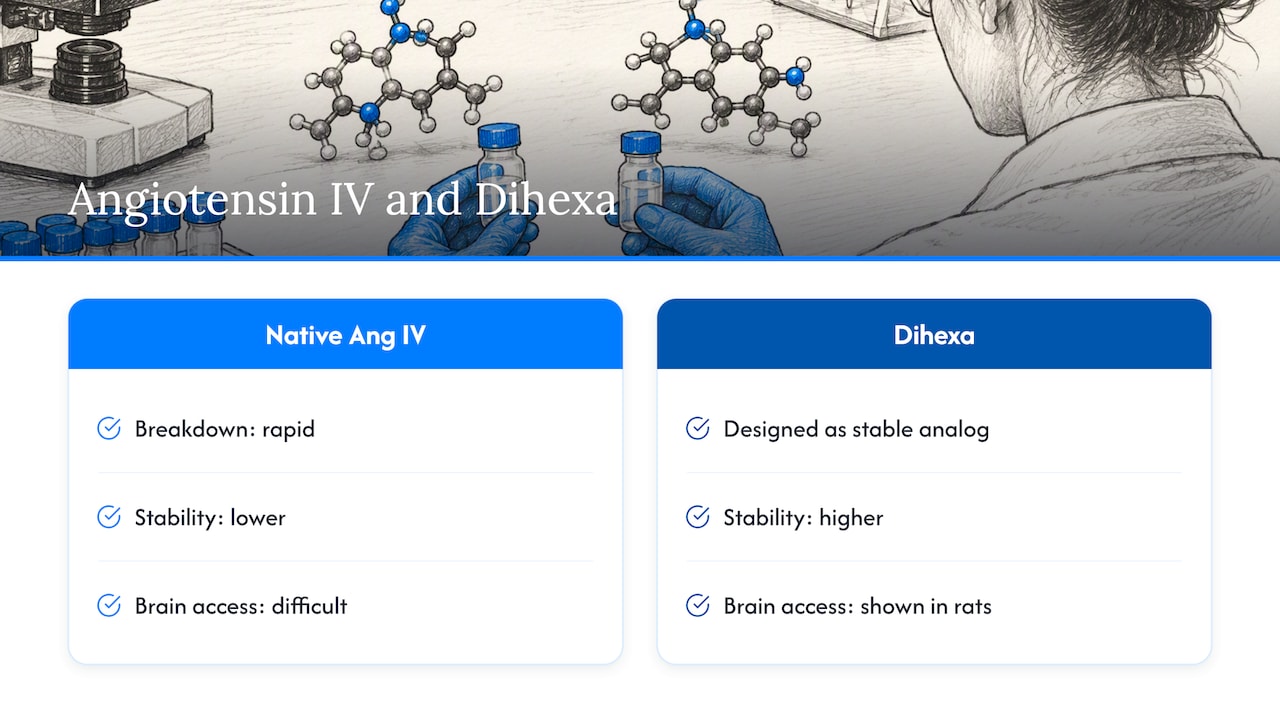
That design story is the reason the compound draws attention in cognition research. It is also all the story amounts to at present. A compound that is stable and reaches the brain in a rat tells you very little about whether it is safe or useful in a person.
What the preclinical studies report
The most useful way to read the literature is by model, not by headline.
Rodent memory models
In rodent models of cognitive impairment, Dihexa has been associated with shorter escape latency in the Morris water maze, a standard test of spatial learning. Reported doses in these studies include 1.44 mg/kg and 2.88 mg/kg. These are animal measurements of spatial learning. They are not validated evidence of human cognitive improvement, and mg/kg figures from a rat cannot be carried over to a person.
The APP/PS1 mouse study
A 2021 paper in an Alzheimer’s-type transgenic line, AngIV-analog Dihexa in the APP/PS1 mouse, reported that the compound rescued cognitive impairment and memory through the PI3K/AKT signaling pathway. The authors tied it to the central nervous system renin-angiotensin system. It is one lab’s finding in one mouse model. Independent replication is what turns a finding like this into a fact.
Safety gaps
An evidence summary from the Alzheimer’s Drug Discovery Foundation notes that Dihexa improves cognition and increases synapses in rat models but that no studies have evaluated long-term safety, including possible tumorigenic and metastatic effects. That last point follows from the proposed mechanism: growth-factor signaling is also relevant to cancer biology. The concern is theoretical, and it is also unanswered.
The retraction problem
Most write-ups of Dihexa repeat the same mechanism: the compound enhances hepatocyte growth factor (HGF) signaling through its receptor c-Met, which in turn drives new synaptic connections. The foundational paper for that claim, on procognitive and synaptogenic effects of angiotensin IV-derived peptides, is marked on PubMed Central as retracted, with the notice published in the Journal of Pharmacology and Experimental Therapeutics in April 2025.
For a researcher, this has a practical meaning:
- Do not cite the HGF/c-Met mechanism as established. Cite it as proposed, and note the retraction.
- Check any secondary article, product page or review that leans on that paper. Many do, and few mention the retraction.
- Prefer independent work, such as the PI3K/AKT study above, and look for whether it has been replicated.
A page that says Dihexa is proven to rebuild synapses is describing a hypothesis as a result.
Has Dihexa been tested on humans?
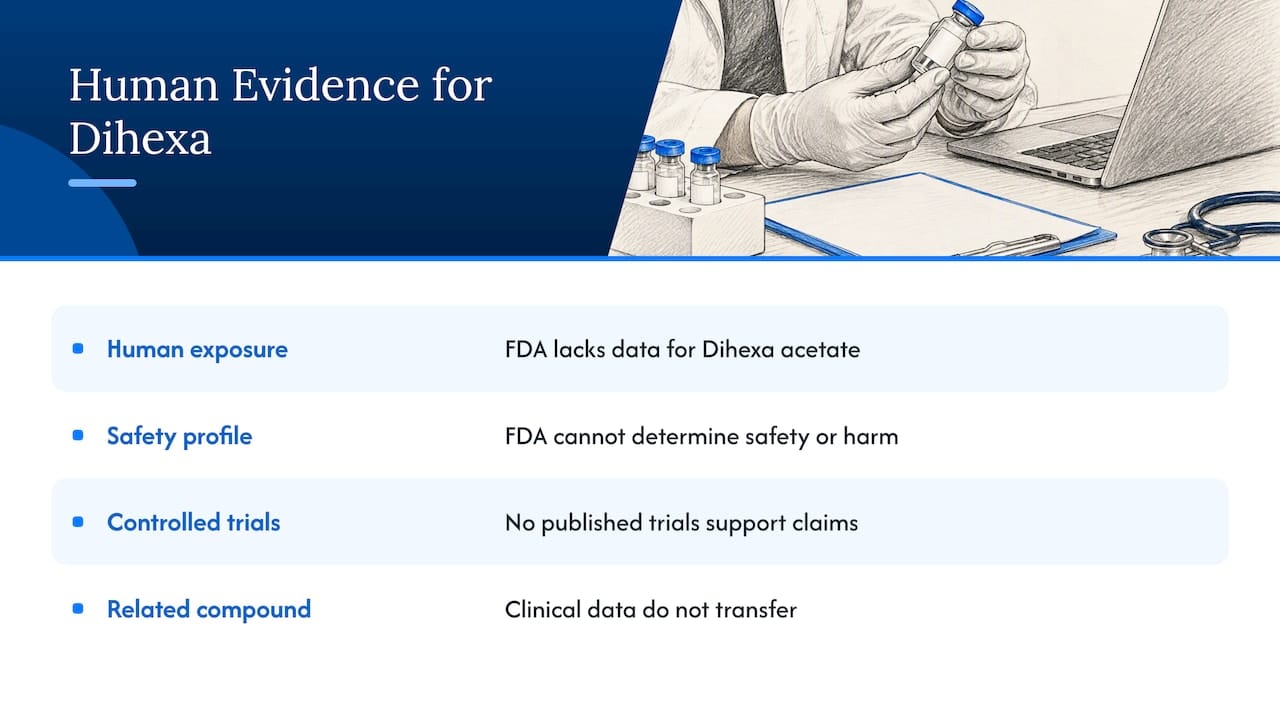
Not in any way that gives usable efficacy or safety data. The FDA has stated that it lacks human exposure data for Dihexa acetate and cannot determine its safety profile or potential for harm if administered to humans. The same FDA page is the source for the regulatory status described below.
Some pages claim early clinical observations. Those claims are not backed by published controlled trials, and a related compound’s clinical program does not transfer to Dihexa itself. Read any such claim for a citation to a registered, peer-reviewed human study. If there is none, discount it.
Regulatory status in the United States (as of October 2026)
FDA
Dihexa acetate was previously listed in the FDA’s Category 2, the list of bulk drug substances that may present significant safety risks for compounding. As of October 2026 the agency is reviewing it for the 503A bulks list. The FDA has said it will host a Pharmacy Compounding Advisory Committee meeting before the end of February 2027. That meeting could clarify the compound’s standing. It does not change what is true today: Dihexa is not approved for any human use.
This limbo also has a material consequence. With no authorized, standardized manufacturing process, nobody can assume impurity profiles or batch-to-batch consistency. That is the case for demanding documentation on every lot.
Anti-doping
If you work with athletes or sport-science programs, note that the 2026 WADA Prohibited List covers non-approved pharmacological substances under S0, which applies to anything without governmental approval for human therapeutic use. As an HGF-modulating substance, Dihexa also falls under S2.3, growth factors and growth factor modulators, banned at all times, in and out of competition. For competitive athletes there is no gray area here.
Is Dihexa legal to buy?
The answer depends on what it is sold for and who is buying. Research chemicals can be sold for laboratory use, but that does not make them approved drugs, and it does not authorize human or animal use. Our overview, Are peptides legal for research in the U.S.?, walks through the research-use framework in more detail. If you have a legal question about a specific purchase, ask a qualified attorney.
How long until you see results?
This is a common question, and it has no valid answer for humans. The studies above measured outcomes in animals over timeframes set by the study design, and nothing translates into a human schedule. Anyone quoting weeks or months to results is guessing. For laboratory work, the better question is which endpoint you are measuring, in which model, and over what duration. Define that before the material arrives.
Perspective: why documentation comes before the compound
We sell research peptides, so we get asked about compounds like Dihexa. Here is how we think about it.
The interesting science here is real, but small. A few rodent studies, one key paper retracted, no human trials, no authorized manufacturing process. That is a profile where the quality of the material becomes a variable in your experiment. If a lot has unknown impurities or the wrong peptide content, your results say nothing about the compound you think you are studying.
So our position is simple. Every lot should come with third-party batch testing for purity and identity, a Certificate of Analysis you can read, and endotoxin data. Our products are sold for laboratory research only, and we say so plainly, because our customers are researchers and research organizations, not people seeking something to consume or a medical treatment. We would rather lose a sale to someone looking for a shortcut than blur that line.
We also think researchers should be skeptical of marketing language. Words like clinically proven, brain repair or cognitive reset should never stand in for a citation. Read the paper, check whether it has been retracted, and check the lot.
— Data Peptides
How to vet a lot of any research peptide
These checks apply to Dihexa and to any compound with a thin evidence base.
| Check | What to look for | Red flag |
|---|---|---|
| Certificate of Analysis | Lot number matching the vial, test date, named method | Generic COA with no lot number |
| Purity | HPLC chromatogram, not only a percentage | A purity figure with no trace |
| Identity | Mass spectrometry result matching the expected molecular weight | No identity test |
| Endotoxin | A reported value for the lot | Silence on endotoxin |
| Testing party | Independent third-party lab | Testing done only by the seller |
| Handling | Storage and reconstitution guidance for lab use | Dosing advice for people |
That last row matters. A supplier that tells you how much to take, rather than how to store and handle the material in the lab, is selling a drug claim, not a research reagent.
For a longer treatment of this process in cognition-related compounds, see our guide on verifying research-grade lots of nootropic peptides. If your interest is broader, brain peptide research covers the mechanisms and models researchers commonly use, and our peptides for brain fog procurement guide explains what to verify before ordering.
Designing a defensible experiment
If you do plan laboratory work on a compound with this record, a few habits keep it defensible:
- Pre-register your endpoint. Pick one primary outcome, such as water maze escape latency, before you start.
- Use controls that match the vehicle. Cognitive tests in rodents are sensitive to handling and stress.
- Report the lot. Put the lot number and COA in your methods so others can compare.
- Cite the retraction. If you mention the HGF/c-Met hypothesis, say it comes from a retracted paper.
- Keep claims in scope. A water maze result supports a statement about that model, not about human memory.
Where our catalog fits
Our shop carries lab-grade research peptides across weight loss, muscle growth, recovery, anti-aging, libido and ancillary categories. Each is third-party tested with a Certificate of Analysis. Orders ship discreetly from our US facility, and support is available 24/7 if you have a question about documentation. Everything we sell is for laboratory research use only. If you want a wider view of how researchers use these compounds, start with peptides used for research applications.
FAQ
Has Dihexa been tested on humans?
There are no published controlled human trials establishing safety or efficacy. The FDA has said it lacks human exposure data on Dihexa acetate. Claims of human benefit online generally trace back to animal studies or anecdote.
What does Dihexa do to the brain?
In rodent and cell studies, it has been associated with increased synaptic markers and better performance on memory tasks such as the Morris water maze. The proposed HGF/c-Met mechanism rests on a retracted paper, so the mechanism is unsettled. None of this shows what it does in a human brain.
Is Dihexa legal to buy?
It is not an FDA-approved drug, and it is under FDA review for the compounding bulks list. Material sold as a research chemical is for laboratory use only, not for human or animal consumption. Competitive athletes should also know it is prohibited by WADA at all times.
How long does it take to see results from Dihexa?
No one can say for humans, because there is no validated human dose, route or timeline. Animal studies used timeframes defined by each experiment’s design. In the lab, set your measurement window around your endpoint and model.
Sources
- FDA: Certain bulk drug substances for use in compounding that may present significant safety risks
- FDA: Meeting of the Pharmacy Compounding Advisory Committee
- WADA 2026 Prohibited List
- AngIV-Analog Dihexa Rescues Cognitive Impairment and Recovers Memory in the APP/PS1 Mouse (PMC)
- The Procognitive and Synaptogenic Effects of Angiotensin IV-Derived Peptides (PMC, retracted)
- Dihexa evidence summary, Alzheimer’s Drug Discovery Foundation
- PubMed Central